3 envolvidos foram sentenciados no Complexo do Salgueiro

A hierarquia maior do tr�fico dentro do Complexo do Salgueiro (CV) em S�o Gon�alo, realizou mais uma limpa no seu plantel criminoso.

Segundo informa��es, houve uma reuni�o dentro das comunidades do Salgueiro (CV), e o teor foi para levar alguns membros para o tribunal do tr�fico.

Chegaram a conclus�o que 3 membros do Comando Vermelho deveriam ser executados, e  a ordem foi cumprida.

Criminoso dos vulgos Biscol�, Piranha e um terceiro n�o identificado, foram mortos ap�s a reuni�o.

Inclusive, eram amigos dos 3N (morto), quando  o mesmo era do Comando Vermelho e tinha o cargo de frente no Salgueiro.

Determine if your methionine oxidation is from biology or an artifact!

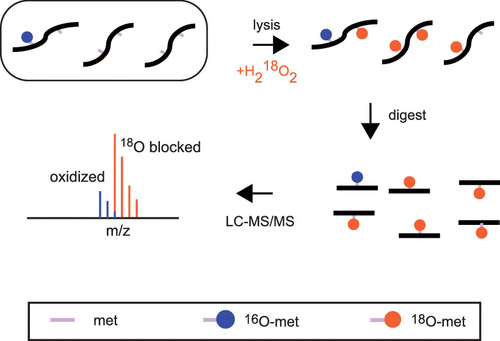
Okay — so, despite all appearances, methionine oxidation (Met-Ox)is actually a really important thing. Before I get distracted, you should check out this really smart way of studying whether it is a biological Met-Ox or a sample prep Met-Ox artifact here.

This is an aside, but — holy cow — the first 11 papers I tried to find to prove this from home were all locked behind paywalls. I had to go back to this 1997 PNAS paper for something that was open access.

Are you a US citizen and do you think that if your tax dollars funded some research then those results should have to be openly accessible to you? If so, check out this thing some guy set up….

Here is a direct access link to this petition.

With that out of the way — back to Met-Ox. For real — this is important. It can be used as a metric for ROS scavenging and for a long time has been thought to be impaired in a lot of diseases and may even be a generic metric of aging.  It just turns out that we don’t have a great way of determining what is real Met-Ox and what is an artifact of the myriad ways our field extracts and digests proteins. And now we do! If it looks like Met-Ox might be playing a key role in your biology you can get some heavy labeled hydrogen peroxide and — ouch — it is surprisingly expensive, at least at the first suggestion Google had for purchasing it and find out for sure!

CV da Penha manda aviso para os moradores que for alugar casa

Ap�s a opera��o de ontem no Complexo da Penha (CV) na zona norte do Rio de Janeiro,  o chefe do tr�fico ordenou que um dos seus soldados mandasse um recado para os moradores.

O principal chefe do Comando Vermelho na Penha, conhecido como Pedro Bala ou Urso, continua escaldado com os moradores da comunidade.

Ordenou que caso os moradores for disponibilizar seu im�vel para aluguel, comunicar imediatamente a “boca de fumo”, informando quem ser� o novo morador.

Obviamente escaldado que o TCP arme alguma aracupa ou ponto de vigia para mapear e monitorar o tr�fico dentro do Complexo da Penha.

Entretanto, essa � uma t�tica bem conhecida da policia, para colocar a intelig�ncia para agir dentro da comunidade.

CV invadiu o Jorge Turco pela 20121029103 vez

No final da noite desta quarta-feira o Comando Vermelho tentou retomar o controle do Morro do Jorge Turco em Coelho Neto, na zona norte do Rio de Janeiro.

O Jorge Turco estava sendo controlado pelo Terceiro Comando Puro, mas parece que a “Tropa do Marreta” esta empenhada pra retomar o morro, porque est�o sem territ�rio na Pra�a Seca.

At� o momento nada mudou.

Bope apreende 2 fuzis e prende 3 no Caju

Nesta quarta-feira os policiais do BOPE realizaram uma opera��o no Complexo do Caju (TCP) na zona portu�ria, zona norte do Rio de Janeiro.

Conseguiram prender 3 envolvidos com o tr�fico do Terceiro Comando Puro dentro da comunidade.

Apreenderam 2 fuzis, 1 pistola e carregador.

O material foi encaminhado para  19 � DP.

BioPlex Update Preprint — 5,500 New Protein Interactomes — in a new cell line!

Ummm….so on a scale of 1 to BioPlex — how big is your big proteomics data?  Holy cow. You know, sometimes when you don’t hear about these huge proteomics undertakings its easy to think “maybe they thought the first 10,000 human proteome interactomes was enough…”

NOPE. BioPlex is alive and well and providing human protein protein interaction data at a pace that doesn’t quite seem possible.

Proof? Check out this new preprint!

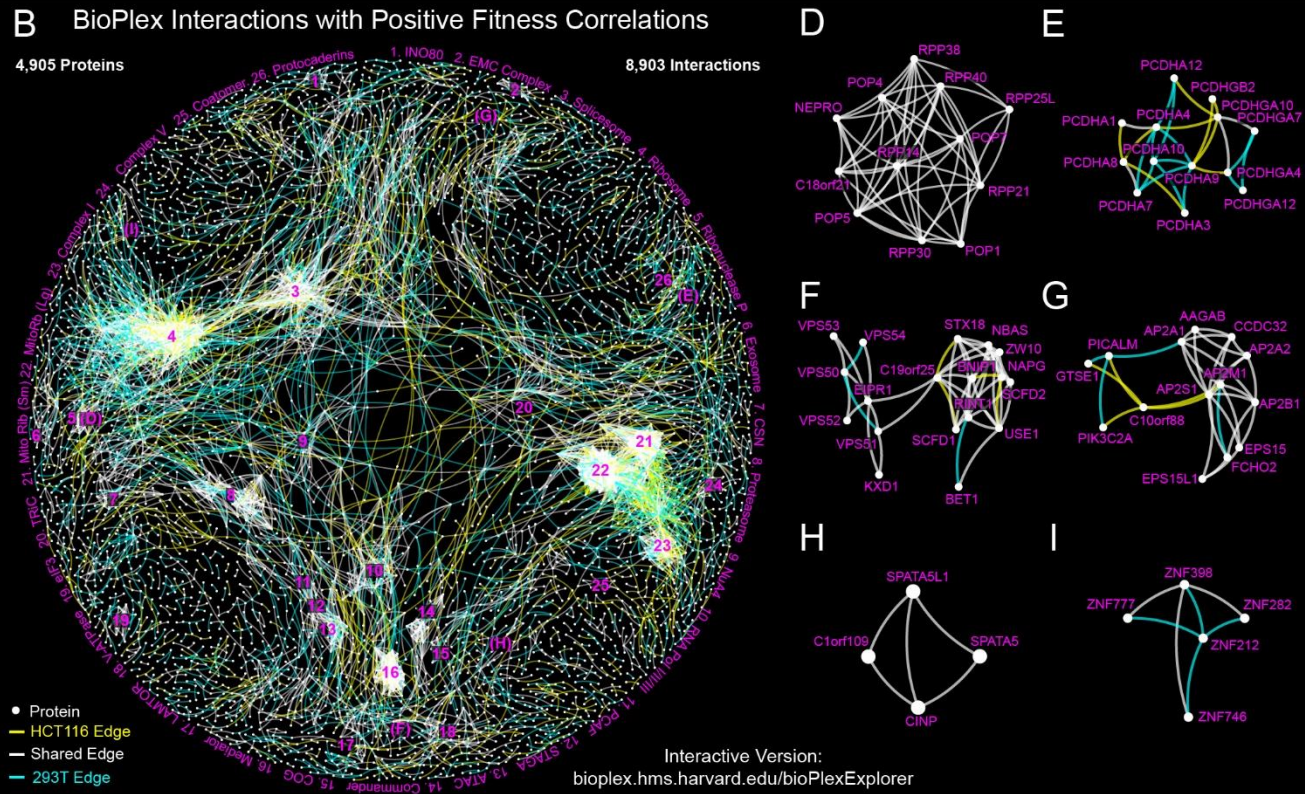
Not familiar with BioPlex?  It is a bulldozer type approach to human protein interactions. Instead of doing something complicated and elegant — why not just synthesize every open reading frame in humans and do an expert level immunoprecipitation — mass spectrometry experiment on them. Yeah — every one! BioPlex 3.0 showed about half the theoretical human proteome. For real.

It is a project so big and ambitious that is is easy to forget about. How do you take this another step forward? Well — you throw in some different cell types. And instead of looking at a few interactomes, you look at a few THOUSAND interactomes.

What on earth do you do with all that data? Besides make the most intimidating plots of all time (which you can do online at the BioPlex Explorer, here), well — this might be the biggest of the big data for proteomics right now. Did you need an excuse to buy that TensorFlow laptop and take that online course that keeps popping up on that sidebar you can’t seem to block anymore on Reddit? To really explore this — we’re going to need those artificial learning machine things — OR

— the BioPlex explorer is suprisingly powerful and intuitive!

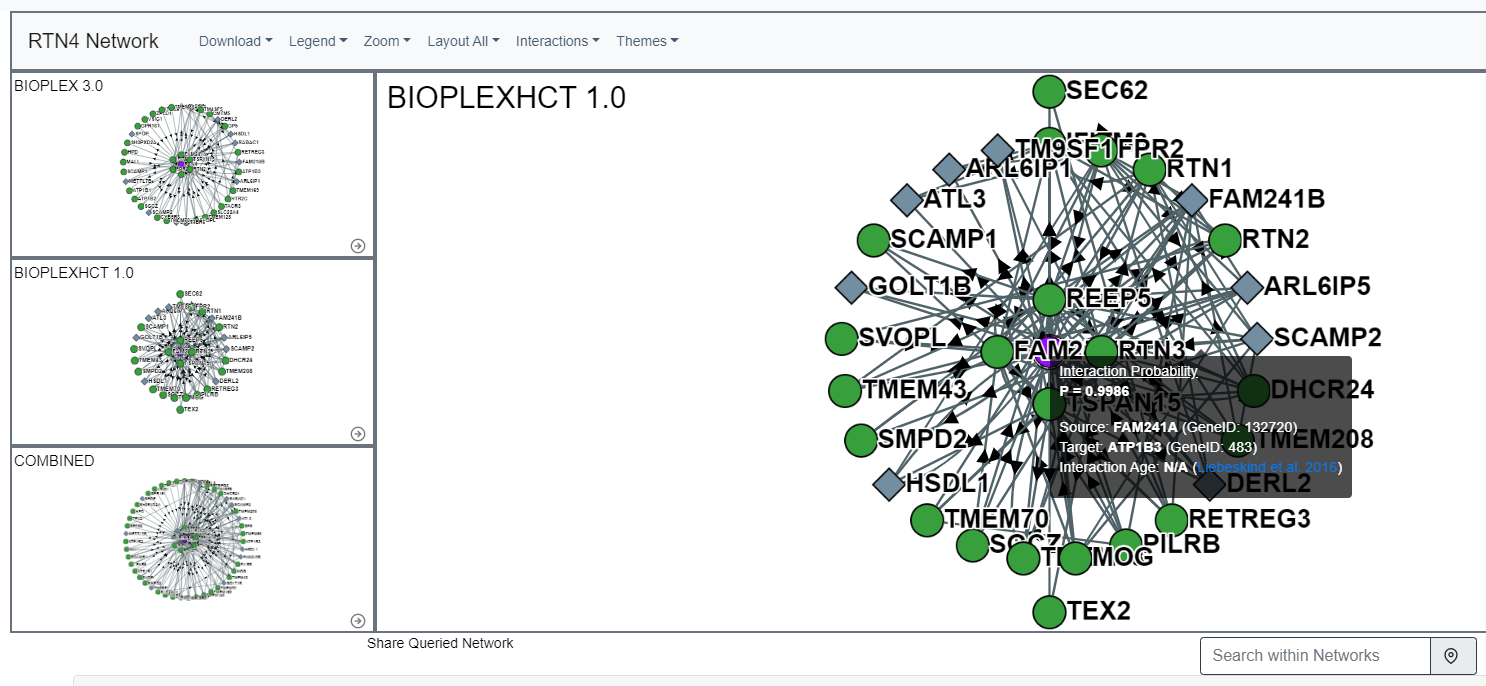
Check this out — I’ve got a protein that is strongly dysregulated in a bunch of samples by both transcript and by proteome. It seems important, but it’s been confusing. I’ll just put that into the BioPlex explorer — BOOM –visualizations of protein-protien interactions!

Okay — so no surprise to me — this thing has a done of direct interacting partners. One thing that is cool and new here is how different this family of interactors is between the BioPlex 3.0 and the new HCT interactome.

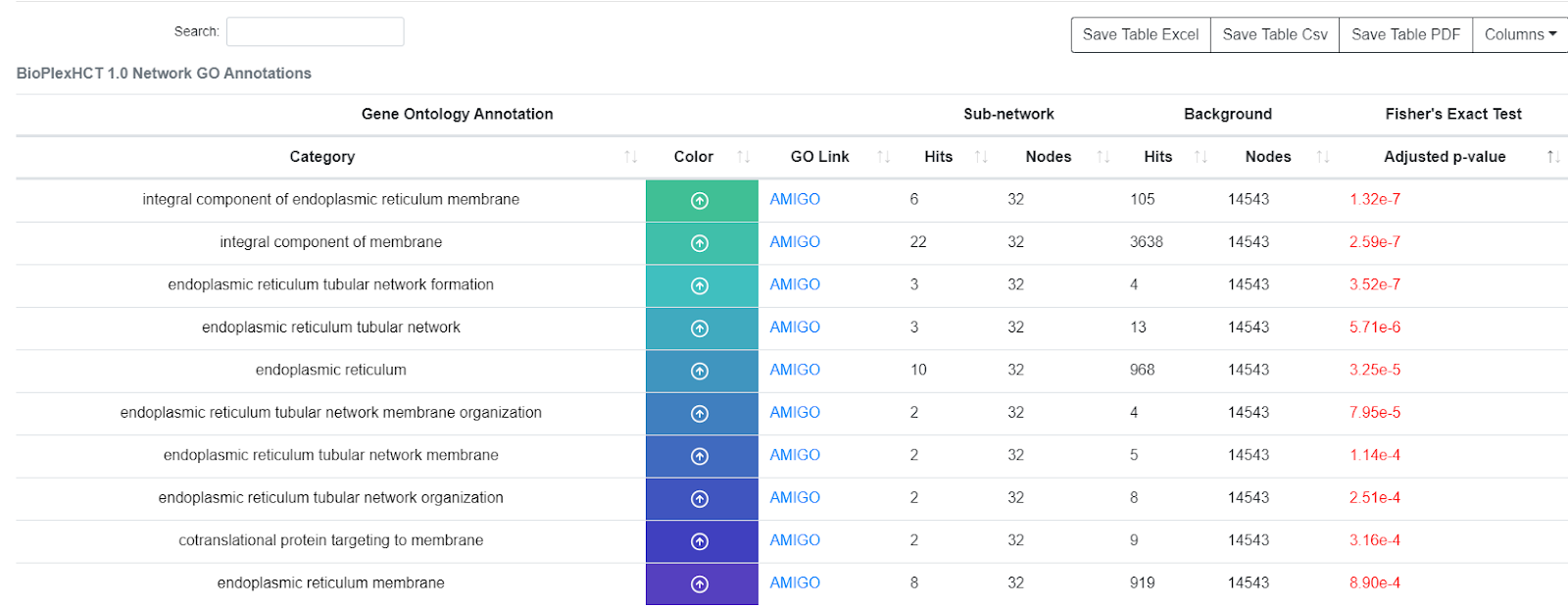
If I didn’t know what this protein did BioPlex provides that information and the data is all directly exportable in several formats — and links directly to AMIGO (which was undergoing maintenance stupid early in the morning when I was writing this)

Around these very practical resources the preprint paper makes some very impressive solutions regarding the human interactome — and — let’s just say that the interactome doesn’t shift on a small scale. The interactome appears to shift on a completely global scale. Which…has some definite ramifications, right?

How many times do you get an IP-MS (AE-MS) that is a pulldown from cell line A and cell line B? Hopefully the main characteristic of that cell line, for example, say homozygous KRAS weirdo terminus in B vs wild type in A? Hopefully that main protein is driving the change in your protein-protein interactions for your bait. But….if you’ve globally shifted the entire interactome? How does that change your results and confound your downstream interpretation? Way too big picture for me, but something that we need to keep in the back of our minds. Biology is complicated…

TL/DR: BioPlex is growing and is a shining example of what proteomics can be. Send this paper to every biologist you know. My guess is that it’s going to be in a big journal pretty soon.

TCP invade comunidade do Dick em S�o Jo�o de Meriti

Na madrugada desta quarta-feira os traficantes do Terceiro Comando Puro iniciou mais um plano de expans�o na Baixada Fluminense.

O alvo dessa vez foi a comunidade conhecido como Dick do Vilar em S�o Jo�o de Meriti, dominada pelo Comando Vermelho.

Era um morro bem armado do CV em S�o Jo�o de Meriti, mas at� a publica��o, os Terceiros conseguiram expulsar os rivais e permaneceram dentro da comunidade.

Os invasores s�o oriundos do Barro Vermelho (TCP) no Gramacho em Duque de Caxias, promovidos pelos traficantes liderados pelo bandido conhecido como Trem.

Agora � aguardar se o CV vai retomar a comunidade, porque pr�ximo existe o conjunto de comunidade controlados pelo Bonde da Parma.

CyTOF data on single cells for 281 cancer patients with long term clinical data!

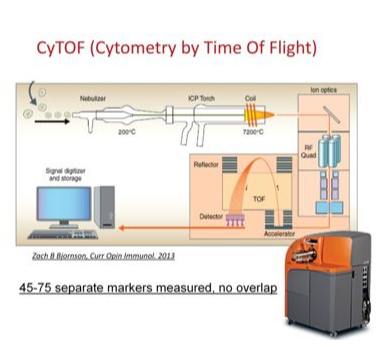
Somewhere around you, possibly within walking distance, depending on the relative funding level and decision making skills of your administrators is probably a big grey and orange box like the thing above. I’d be comfortable betting you $1.14 that it probably isn’t doing anything right this second. This box is called a CyTOF and — I swear — it has all sorts of promise, but it’s a bit of technology that is seeking a real application. And I’m going to jump on every paper I see that suggests we may have finally found it.

Imagine that you’re doing flow cytometry. You’ve tagged your cells with a couple of proteins and these proteins have a dye on them. The instrument measures the intensity of these dyes as the cells are sorted and you basically get single cell data on the intensity of these two proteins in each single cell. Now upgrade that idea and replace the dyes with protein tags that you can see with a mass spec. The cells get sorted, go through, get ionized, and a mass spec measures the tags for each cell! Great idea, right?

{Deleted a lot of me making fun of how ridiculously underpowered the TOF on the back end of the CyTOF prior to hitting the publish button. However, because this technology has so much promise, it’s a little soul crushing they didn’t partner with someone — anyone– to make a better detector. There are mass spec you can carry around that are higher resolution.}

Okay — but you are still looking at a bunch of proteins across a bunch of cells. With the right experimental design maybe you can get past the limitations on the back end — and for real — maybe this is it!!

This group uses 35 protein tags — which is a lot for a flow instrument — and they use a smart experimental design and a really large cohort — and they end up getting over 700 sample across and collect data on the 35 proteins across the SINGLE CELLS from these patients. Right?!?!? Yeah — it’s only 35 markers — but this is a ton of smart and then they can correlate their findings at the single cell level with clincal data and — get this — they have long term recovery data for 280 of these patients!

This is how you utilize a CyTOF. The problem is going to be access to data that is this powerful for every institution that has invested in these things — but — it’s a start and this is an awesome study.

Announcing the First Ever News In Proteomics MineAthon (Challenge)!

I have been working on yet another crazy idea off and on for a month or two and it’s now almost (like 18%) fully organized.

I’ll stand by these words all day. Proteomics hardware is about mature. Yeah, we’ll get some cooler stuff down the road, but until we figure out how to fix our informatics problem — who cares if you get 3% more peptide IDs or 10% more spectra? Most of the tools people are using are only converting a tiny percentage of spectra into biological findings. There is much more to be gained with smarter data processing than even applying phase constraint over a wider mass range. In the most popular data processing pipelines people aren’t even looking for PTMs, because it’s still really hard to do it.

SO….Let’s see where we are right now!

Do you think your data processing pipeline is the best for finding important biological changes and PTMs? Want to prove it, participate in some cool human research, be on a cool paper, a wold-wide webcast talk and maybe even get a trophy and definitely get the chance to talk some smack to your peers?  Yes?

Time to sign up for the — 

FIRST ANNUAL (News In) PROTOEMICS (Research?) DATA MINEATHON!! 

(EDIT: I was just told an “athon” means you do it now. This is a “challenge” since we do it over an extended time period)

(…echo…echo…echo…) 


How’s it work? 

You register by sending an email to lcmsmethods@gmail.com on or before we start mining data! Let’s put a deadline of February 13th 2020 to start. I’ll make a list with your name and contact info on it and definitely will not lose that list. This is important to me.

On February 13th you and anyone else who has signed up (honestly, maybe just you) will be provided the link to download a relatively large label free human proteomics data set (the one I like is 66 Q Exactive single shot files, but we’re looking for the most important and under mined set of data we can find and I can’t swear it’ll be that one. I want to use something realistic for today’s human studies by using a real and awesome human study.

You have until March 31st to turn in your results (I like long deadlines. I figure most of you people have jobs and classes and stuff and probably like decently long deadlines as well).

The goal will be to find the most important differences between patient and control samples with a specific focus on those pesky PTMs!

Why would you do this? 

No reason, to be honest. I’m just too lazy to do it myself and I’m crowdsourcing so I don’t have to.  Wait! That’s not right! There are reasons!

1) Bragging rights. There will be a real winner to this contest, as well as some top candidates based on some of these criteria by our not-yet-chosen judges:
A) Most PTMs
B) Best evidence of said PTMs
C) Best presentation of said PTMs
D) Most useful PTMs
E) Metrics for the quantitative changes of said PTMs.

Remember when we got dumb trophies for everything? “You ran around the playground without falling down more than twice? Have a trophy!”   Then you never ever get a trophy ever again? That’s dumb.  I think we should get an awesome trophy for this. I’ll find a trophy store. Not even joking.

2) FAME!! Are you familiar with GenomeWeb? It’s a big deal for people that do science business stuff.  The top candidates, chosen by our impartial and-not-yet-selected judges, will be allowed (if they’re interested) to present their analysis and their results via a live streamed webinar on GenomeWeb. I’ve talked to them and they didn’t say no.  I don’t think anyone actually said yes, but they were totally cool about it and they’re altogether great people.

3) A paper!  Yo, we’re going to try and find the most important and under-mined set of files that we can. Then we’re going to mine the crap out of it and try to show what today’s proteomics can really do! And we’re going to showcase the ever loving shit out of the fact that it’s 2020 and proteomics isn’t just hardware.

I think I’m going to even put this in for at least a poster or a talk or two somewhere so I can talk about how amazing you and your solution are. Somehow I gave like 10 invited talks last year. I hope I’m not dumb enough to do that many this year, but I’ll totally get you and your results and solution as much exposure as I can (which I can’t swear will help you in any way. I think I get invited to talk places just so people can find out if I’m as strange in person as I appear in writing and, if you are short a qualified proteomics speaker, you can always try me, I clearly love talking about this stuff)

Who is eligible? 

Everyone! We don’t care if you wrote your own pipeline or if you’ve just kluged (is that a word?) together a bunch of different tools into something semi-feasible that totally works for you although you’ve never been able to explain it to anyone else well enough that they could do it (although…to be honest…that might not be ideal, but I’ll work with it!) I don’t care what timezone you are in (we’ll just adjust the webinar accordingly and I’ll ship the trophy wherever. Although if you are somewhere really cool I seriously might come deliver it myself. Again, this is important to me.

Disclaimers:

There aren’t any. A lot of my favorite people I’ve ever met have been responsible for the software that I use every day. I clearly have my biases and my favorite tools, but that’s why I’m going to get some impartial judges. I’d like to just be the hype man.

If no one enters? 

That’s okay, too! I really wanted to write something in this box today and I’m going to run the same dataset through every tool I have on my PCs and I’ll announce a winning software and I’ll be very glad that I put the deadlines so far in the future! Your solution just won’t have a chance if I don’t know how to use it. Probably your solution isn’t very good anyway. Poop head.

Mais de 10 bandidos de Maca� pularam para o S�o Carlos

Segundo informa��es, mais traficantes da fac��o Amigos dos Amigos (ADA) pularam de Maca� em dire��o ao Complexo do S�o Carlos (TCP) no Est�cio, regi�o central do Rio de Janeiro.

Neste final de semana esses traficantes j� foram vistos no Morro do S�o Carlos.

Pularam porque um bandido considerado no S�o Carlos ganhou a liberdade, e estaria disposto a recuperar todo territ�rio de Maca�, perdido ap�s um golpe do Feio, Baixinho e Monstro.

Os planos parecem ser audaciosos, porque chamou aten��o dos chef�es do Complexo do S�o Carlos, que est�o dispostos a investir.

At� a lideran�a do Morro do 18 em �gua Santa, estaria envolvida na negocia��o.

Entretanto, desde a separa��o da �ltima uni�o TCP e ADA, ocasionando no “Pula pula” de v�rios chef�es do ADA, a ala de Maca� se manteve na fac��o e fortemente armados.

Se uniram com o territ�rio da Vila Vint�m (ADA) em Padre Miguel, e est�o fortes na terra do petr�leo.

Vamos aguardar.

Design a site like this with WordPress.com
Get started