No, a Seller Doesn’t Have to Accept Cash

If private sellers wish to do so, they can require that payment be made in the form of credit cards or checks. They are not required to accept cash. The Federal Reserve crisply explains the law in this FAQ (last updated June 17, 2011):

Is it legal for a business in the United States to refuse cash as a form of payment?

Section 31 U.S.C. 5103, entitled “Legal tender,” states: “United States coins and currency [including Federal reserve notes and circulating notes of Federal reserve banks and national banks] are legal tender for all debts, public charges, taxes, and dues.”

This statute means that all United States money as identified above is a valid and legal offer of payment for debts when tendered to a creditor. There is, however, no Federal statute mandating that a private business, a person, or an organization must accept currency or coins as payment for goods or services. Private businesses are free to develop their own policies on whether to accept cash unless there is a state law which says otherwise.

The US Department of the Treasury has a very similar statement at its website.

There are, of course, a rising number of examples of sellers who do not accept cash: certain stores, parking garages, flight attendants on most airlines, and others. Other sellers may refuse to accept certain types of currency, like buses that won’t take pennies for the fare, or stores that won’t accept bills larger than a certain denomination.

My understanding is that no state enforces laws with actual teeth that require firms to take cash. (Massachusetts seems to have an unenforced law without penalties that retailers must accept cash.) It’s not obvious that states should enact such laws, either. But as the use of cash fades in many contexts, it’s worth remembering that not everyone has credit cards. For example, about one-quarter of all US families in the bottom 20% of the income distribution are “unbanked,” and for those without a bank account, having access to plastic-based spending power can be difficult or costly or both.

When Invoking Poverty and Necessity is a Ruse

Consider a policy of giving every American $1,000. The argument made in support of the policy is that poor people need money to buy necessities. If you point out that helping poor people does not require writing a check to everyone, the response is to accuse you of being someone who opposes helping poor people.

The logical fallacy in this syllogism is obvious.

Premise A: A policy helps poor people.
Premise B: You oppose the policy.
Conclusion: You oppose helping poor people. 

Of course, it may be that what is actually opposed is not support for those in need, but the broader policy which promises benefits for everyone, and thus imposes much higher cost. One might also support an alternative way of helping the poor, which involves different incentives. In this sense, there are number of cases where invoking “the poor” or “basic necessities” is a ruse, designed to provide a smokescreen for policies that mainly seek to benefits the middle and upper class. Once you are alerted to the dynamic, examples are numerous.

A standard example arises when some items are exempted from state sales taxes. Here in my home state of Minnesota, a number of items are exempt from state sales tax: food,  clothing home heating fuels, prescription drugs, certain medical devices, and caskets and funeral urns. The usual reason given for these exemptions is that these are “basic” items. The list of basic necessities is disputable: for example, only three other states exempt clothing from sales tax. But more broadly, the poverty rate in Minnesota is below 10%. If the goal is to help the bottom 10-20% of the income distribution in affording “basic” items,, it is not sensible to exempt 100% of the population from sales tax on these items. It would be straightforward to collect the sales tax from everyone, and then rebate the money to the poor in some way. Or the poor could be issued a “no sales tax” ID card that would be given to cashiers when buying certain goods.

Another example on my personal list involves congestion tolls charged for travelling in certain lanes during peak commuting times. The Washington Post recently reported that just-established congestion toll lanes in northern Virginia were charging $34.50 on a certain day to travel 10 miles during the worst of the morning commute. The story quotes the concern that such tolls are “going to introduce a real hardship for people on low wages or working in the nonprofit or public sector,” along with arguments that congestion tolls needed to be capped. But of course, a price cap to make congestion fees “affordable” won’t actually get rid of the congestion–and then no one will want to pay the fee, either. If the goal is to reduce transportation costs for people with low incomes, spending the congestion fees on subsidizing the mass transit that they use is going to likely to be a choice that helps more people in a more cost-effective manner.

Another example involves a recent proposal from the US Department of the Interior to raise the price of enter to 17 of the most popular national parks during their peak seasons.  This fee increase doesn’t seem especially well thought-out: for example, the price for entry into these 17 parks during peak season would rise to $70 for a week of access, while the proposed fee for an annual pass to these same parks would be almost the same at $75, But those who go to national parks typically have above-average incomes, and what they spend on transportation, lodging, food, and gear is typically a lot more than the cost of entering the park. If the goal is to make national parks available and affordable to those with lower income levels, it would be fairly straightforward to set up a system where low-income people could receive vouchers. It would also be useful to provide additional low-cost mass transit and housing within the national parks. But low park entrance fees for everyone is not a cost-effective way of helping those with low incomes enjoy the parks.

Government programs that start out being aimed at the poor often find themselves expanding so that much of the assistance goes to other groups. A classic example is Community Development Block Grants, through which the federal government was going to provide funds to low-income communities. But unsurprisingly, the rules for allocating these funds include more than average income levels in a community, and a lot of the funds end up flowing to destinations and purposes that don’t seem to fit the broader intention of the program. Steven Malanga makes the case for “Let�s Kill the CDBG” in the Autumn 2017 issue of City Journal. He writes:

“These days, the CDBG hands out money for projects that have little to do with its poverty-combating mission. With an average annual family income of $67,000, well above the poverty line, Manchester, New Hampshire, is no one�s idea of a depressed community; but the city is spending $200,000 in block-grant money to fill an unused pool and convert it into a �splash pad.� Elgin, in suburban Illinois�with a poverty rate of just 8 percent�is sprucing up its parks with $740,000 in CDBG funds. Fast-growing Berkeley County in South Carolina is building a library and recreation complex, including a swimming pool and tennis courts, partly with block-grant money. In 2016, Monmouth County, New Jersey�average household income: $115,000�spent more than $110,000 in CDBG funds on enhancements to a publicly owned entertainment venue, the Count Basie Theater.”

An April 2017 report from the Urban Institute hits similar notes in its review of the literature: “For example, wealthy suburbs may have older housing stock and low population growth but are not especially needy. … Studies have found that the formulae�s abilities to match funding to need have diminished over time.”

Examples of programs that claim to be supporting the poor, while actually designed to confer equal or greater benefits on the non-poor, can easily be multiplied. For example, I’ve heard attempts to justify universal pre-K education because it might be helpful for low-income families. But subsidizing pre-K education for low-income families doesn’t require subsidizing it for all. At the other end of the education spectrum, I’ve heard attempts to justify free college education for all because some people can’t afford the costs–but it’s not necessary to make it free for everyone in order to help a subset of the population. I’ve heard the tax deduction for mortgage interest defended as a way of encouraging homeownership, but  even leaving aside the issue that most homebuyers by definition are not poor, giving a boost to first-time homebuyers can be done in a lot of ways that don’t involve allowing deductibility of mortgage interest for all. The minimum wage is often defended as a way of helping the poor, but about half of those receiving the minimum wage are not actually below the poverty line. Rather than advocating a plan that seeks to boost the incomes of high school workers from middle-class families, there are a variety of other ways of subsidizing wages for low-income workers.

 And of course, there are a number of international examples of this phenomenon as well, most prominently the many low-income countries that hold down prices or offer broad subsidies for basic necessities like fuel and food.

Many countries have had policies of keeping food prices low to  help the poor, but found that most of the benefits went to the nonpoor.  A 2014 story in the Economist noted: “In Burkina Faso, Egypt and the Philippines less than 20% of spending on food subsidies goes to poor households. In the Middle East and North Africa only 35% of subsidies reach the poorest 40%, the IMF reckons.” Similar patterns often emerge for fuel subsidies, which can cost about $1 trillion annually in developing countries. Again, helping the poor could be done through cash transfers, or some form of direct distribution, or through vouchers–pretty much any approach targeted more specifically at the poor will be more affect than universal (or nearly so) lower prices or subsidies.

I’m often in favor of programs that transfer resources to the poor–and only to the poor. But it’s worth being wary of the political dynamic which uses the poor as as stalking horse for policies and programs with rather different effects.

NIcholas Stern Interviews Tony Atkinson: Poverty, Inequality, and the Economics Profession

All economists are at least somewhat familiar with the work of Tony Atkinson, who died a year ago on January 1, 2017. The Annual Review of Economics offers a tribute in “Tony Atkinson on Poverty, Inequality, and Public Policy: The Work and Life of a Great Economist,” by Anthony Barnes Atkinson and Nicholas Stern (2017, pp. 1-20).  More specifically, Lord Stern interviews Sir Tony. Here are some snippets, among many of the lively exchanges that caught my eye. 

The Value of Measuring and Publicizing Poverty

Atkinson: [I]t�s one principle I work on: I won�t do something unless I actually see, firstly, that it�s something where I actually want to know the answer because I think it�s intellectually interesting but, secondly, that there is some potential way in which it�s feeding into what actually happens.

The European Social Indicators is a good example of that, because it came about because the European Union was, under Jacques Delors, becoming quite concerned about social dimensions and the fact that there was significant poverty in the European Union, which Delors did quite a lot to identify. There was movement, as it were, at the beginning of the 2000s to give it some more priority. And it turned out by coincidence or by chance that the Belgians had the presidency, and the Belgian Minister of Social Affairs was one of my former students. … Well, economists might well say, �Oh, it�s cheap talk.� We know that there are 125 million people in the European Union living in poverty, according to standard measures. But actually, it changed the climate of discussion because each country is peer-reviewed every year as to what their performance is according to indicators, and it is more than mildly embarrassing when, as in Germany at the moment, poverty is going up quite rapidly.

Restoring Official Measurements of Inequality in the United Kingdom, and Elsewhere

Atkinson: [C]learly, since about the early 1990s, I�ve been trying to get the government and other bodies to restore income distribution to being something that they actually publish data on. You have to remember, in this country�the UK�we dropped the income distribution statistics somewhere in the 1980s. After that, there were none.

Stern: We had a Royal Commission on the Distribution of Income and Wealth�

Atkinson: �which I was a member of, indeed. And we were sacked.

Stern: By Margaret Thatcher?

Atkinson: Yes, indeed. And after that, the income distribution statistics were stopped. The OECD [Organisation for Economic Co-operation and Development], for example, after putting their toe in the water in the 1970s, didn�t return to the subject for another 20 years. So the report that I did with Tim Smeeding and Lee Rainwater in 1995 for OECD (Atkinson et al. 1995) was the first time they�d had a publication on income distribution for 20 years.

On the importance of looking at deviations from pure general equilibrium thinking

Atkinson: I can remember the lecture given by Jacques Dreze, which you may have been at, which was called �the firm in general equilibrium theory.� He said, �How do you get the firm into general equilibrium theory? Well, you blow up a paper bag, and then you puncture it. … And so, you�ve let all the air out. The firm has no real existence.�

The Importance of Knowing How Economic Data is Generated

Atkinson: I think the other thing is that our understanding of data on the more macro side is much inferior to what it was. In the early days of national accounts, they were constructed by people who did macroeconomics, as well, people like Richard Stone, Paul Samuelson, James Meade, and so on.

Stern: The best of the best.

Atkinson: Exactly. They were doing work on constructing national accounts, so they knew perfectly well what they were using. Keynes, for example, knew how his younger colleagues were making up those numbers. I fear that, today, that�s one of the areas where people just don�t understand what they�re using, and the origin of the numbers should not just be a footnote point. … And I came across this when I wrote a review of how government output is measured, because the United States�still, as I understand it�measures government output according to the input. Some US economists say this is a general policy, but it is not; the European Union, and the UK as part of it, has been using an output-based measure for quite a long time. When we looked at this issue, we discovered that about half the difference in the recorded growth rates between the UK and the US was due to this difference in method.

On the problems of narrowness and publication pressure for young economists

Stern: Are we really helping create the all-around economist in a way that, perhaps, came more naturally earlier? 

Atkinson: One has to recognize there was this question, again, about change over time. When you and I were students, we could actually read the major journals�there were probably, at most, a dozen�and one could at least cast one�s eye down and see what was going on. They were all a lot less fat than they are today, too. So, I think one has to recognize the subject is partly the victim of its success. The profession is so much bigger, and there�s so much more research going on. But I think this has come at a cost. We have become too specialized, and people define themselves as being specialized economists, whereas I just think of myself as an economist. 

Now, if you meet people, they�ll say, �I�m a labor economist,� or, �I�m an IO [industrial organization] economist,� as if they belong to that tribe. I think that�s fine, but of course you then get seminars taking place on labor economics, which actually would�ve benefited enormously from the seminar on industrial organization that happened at the same time. And people just don�t talk to each other, and I think that�s a loss; at least all my cohorts had an appreciation of what was going on elsewhere. 

Stern: Is there something we could do? 

Atkinson: Well, I think it�s partly a question of training; that is, one needs to have more courses teaching people the appreciation of something rather than the identification of a thesis topic. But also I think the loss, in many places, of the general seminar is an example of an issue with the academic departments; when I was there, Harvard, to its credit, did have three general seminars a term, which were well attended. Probably 60 or 70 people, at least, would come to them. And the talks were, on the whole, at very appropriate levels. Of course, there are various forms of diffusion through media; they all serve this function. But I think it�s perhaps more an issue of persuading younger economists that this is something they ought to take more seriously than they do. …
Whenever I talk to a would-be graduate student, I say, �What is it you want to know?� I�m sure you do the same. Not having an answer to that question is a weakness, and, in some way, it�s partly due to the professionalization. People are doing economics as a profession rather than because they�re really interested in the answers. …

Well, I think the position of young economists is actually very difficult at the moment, at least as far as the academic sphere is concerned, because we�ve now moved to a pretty unforgiving judgement based on journal publication. This means they�re under great pressure, which is often very hard for them to satisfy in the sense that everyone is trying to publish in top journals. I think this pressure affects the choice of subject matter and the style of economics. It�s much easier to publish, I suspect, theoretical than applied economics in major journals; it is certainly easier to publish theory than applied economics concerned with countries other than the US. I think that young economists are being pressured into a very difficult situation where their academic careers are related to things that are often quite opposed to what they want to do. If you ask them what the question is that they want an answer to, many of them have a very good response: They�re doing economics because there is something they really want to find out, they�re really concerned about some particular issue, or they�ve read something that really inspired them and that they want to follow up. I often find it very difficult to advise them. My instinct is to say, �Follow your instincts,� but, on the other hand, they may never get jobs.

Gender Mix in AP Economics

About 30% of undergraduate economics degrees given to US citizens and permanent residents go to women. Perhaps unsurprising, about 30% of the PhD degrees given to  US citizens and permanent residents go to women, too. A sizable literature has tried to spell out possible reasons for these patterns. Here, I will point out that the underrepresentation of females in economic starts before college, and can be seen in the number of students taking the AP economics examinations in  micro and macro.

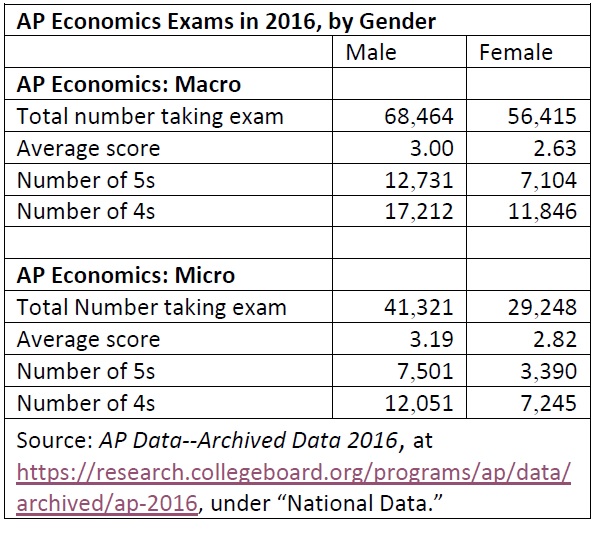
The data below is from the AP Data–Archived Data 2016 (scroll down to the National and State Summary Reports, and then look just at the National Data for the US).

More male students take the AP economics exams than females, although overall, females take more AP exams than men. The scores of males are higher, and the number of males with a score of 4 or 5 on the exams is higher, too. I have no wish to overinterpret these numbers, but a couple of quick thoughts seem fair.

1) These differences suggest that among those high school students thinking about college, and thus taking AP exams, a greater number of males have an interest in economics than females. Moreover, a greater number of men have received positive feedback for that interest in economics–in terms of a high score.

2) To the extent that many students who arrive in college have at least a fuzzy idea of the areas in which they might wish to concentrate already in place, colleges that want to move toward more gender balance in their undergraduate economic enrollments will need to overcome some patterns that have already been set in high school. If the pipeline of women who major in economics isn’t expanded substantially, it will be difficult for the number of women who earn PhD degrees in economics to expand substantially.

"If You’re Not Paying for It, You’re the Product"

This blog is free in monetary terms. I don’t pay a fee to an internet company; readers don’t pay a fee to me.  The costs are mainly in terms of time: that is I spend time writing the blogs, and readers spend time looking them over. But while it’s comforting and even partially true to think that this blog is a public service provided for my own devious reasons, the software is provided and the hosting is done by Google. Thus, I’m working without a monetary return to draw your attention to Google, and you are providing your attention to Google.

All of which serves as a reminder of a saying that I’ve seen repeated a number of times in various forms during last few years: “If you’re not paying for it, you’re the product.”  Fortunately, I didn’t have to track down the origins of this quotation. because the Quote Investigator website already did it last summer.

The renaissance of this sentiment seems to trade back to a comment from the Metafilter website back in 2010:

If you are not paying for it, you’re not the customer; you’re the product being sold.posted by blue_beetle at 1:41 PM on August 26, 2010.

The comment was then picked up and amplified by other writers. Turns out that the “blue_beetle” actually goes by the name of Andrew Lewis.

But the first clear enunciation of the aphorism that the audience of mass media is the product, not the customer, seems to date back to a 7-minute 1973 movie by Richard Serra and Carlota Fay Schoolman called “Television Delivers People” (and watchable with the magic of YouTube).  The movie is almost entirely a slow scroll of text, one sentence at a time, with spaces between the sentences (to allow time for your deeper contemplation) and muzak playing in the background. It’s the kind of movie you would watch in modern art museum.  The scroll starts like this:

“The product of Television, Commercial Television, is the Audience. 

Television delivers people to an advertiser. 

There is no such thing as mass media in the United States except for television. 

Mass media means that a medium can deliver masses of people. 

Commercial television delivers 20 million people a minute. 

In commercial broadcasting the viewer pays for the privilege of having himself sold. 

It is the consumer who is consumed. 

You are the product of t.v.

You are delivered to the advertiser, who is the customer. 

He consumes you. 

The viewer is not responsible for programming——

You are the end product. 

You are the end product delivered en masse to the advertiser. 

You are the product of t.v.”

The text goes on to mention the NEW MEDIA STATE (in capital letters, natch) run by corporations to indoctrinate us all in materialism. Setting aside the giggle-worthy levels of portentiousness and pretentiousness, here are a few thoughts: 
In thinking about the social effects of internet and social media, it’s worth remembering that many of the same issues were raised with some force about television. American households have a television turned on about eight hours per day, and time use surveys suggest that Americans spend more than half of their five hours of “leisure time” in a given day watching television. There does seem to be a shift away from watching television screens to watching other screens. But the ability of screens to draw our attention is not new.

In economic terms, the value of broadcast television (and radio) was determined by the revenue collected–which for a long time was mostly advertising revenue. Similarly, when economists today try to put an economic value on the “free” services from Google and others, they use advertising (and other revenues)_to estimate how the attention of the audience is valued in the market.

Analogies between different technologies aren’t likely to be perfect, or course, and the analogy between television and the internet is no exception.  Internet screens offer some greater possibilities for audience participation: as game-players, content providers (written, musical, video), commenters, shoppers, and so on.  But they share the characteristic that content comes and goes, but the platform through which the content is provided lives on. And they share the characteristic while much of the attention given to screens is provided in a household context, there is an ongoing social pressure to be part of the in-group that saw the video clip, the picture, the tweet, the Instagram or Facebook update, the article, the game.

In the old-time days of broadcast television this pressure may have been a little less, because if you missed a certain TV show, you wouldn’t be able to see it again until summer re-runs. But social media is asychronous, so even if you don’t see something when it first appears, you can check it out an hour or a day or a week later. Content on old-time broadcast television was like catching a bus that came by now and then; modern internet media is a treadmill where every time you step off, you can step right back on again.

The most fundamental and unbending of all economic tradeoffs is that none of us gets more than 24 hours in a day. For all of us, it is worth considering which roles we actually play for hours each day–whether looking at screens or otherwise.

Nigerian Man Sentenced to 60 Months for ID Theft Fraud

United States Attorney Paula D. Silsby announced today that Olumide Adeola Pidan, 30, a native of Nigeria, was sentenced to a total of 60 months in prison for convictions on one count of bank fraud and two counts of aggravated identity theft. United States District Judge George Z. Singal imposed the sentence following Pidan’s guilty plea on November 20, 2009 to one count of bank fraud and two counts of aggravated identity theft. Those convictions were based upon a scheme in which Pidan hijacked the identities and bank accounts of victims, inflated those accounts with credit, and transferred money out of the victim accounts into his own bank accounts where he spent the money on himself and his friends.

Court documents reveal that Pidan moved to Maine in January of 2007 in order to pursue a medical degree. He opened bank accounts at a local bank branch office in Windham and deposited little, if any, of his own money into those accounts. Pidan opened other checking and credit accounts in the names of two real people, using their true dates of birth and Social Security numbers. Pidan opened a UPS box in Spearfish, South Dakota, and used that box as the mailing address for the accounts. Pidan then inflated the values of the victims’ accounts by making a series of bogus payments into their accounts from other fraudulent accounts. He then transferred money from his victims’ credit accounts into their checking accounts. From the checking accounts, Pidan was then able to transfer money in to his own bank accounts. In this way, between about February and about April of 2007, Pidan transferred a total of about $85,000 from the victims’ accounts into his own accounts.
Court documents further reflect that Pidan admitted opening between 80 and 100 bank accounts in other people’s identities at various other banks. He opened mailboxes in places including Fargo, North Dakota and Rapid City, South Dakota to be used as mailing addresses in connection with the scheme.

Repeat Offender Permanently Banned from Telemarketing, Selling Business Programs

A scammer, who boasted that consumers could earn a six-figure income if they purchased and used his $10,000 “asset protection service” business program, is banned for life from telemarketing and from selling any type of business program in the future.

A screenshot of a training video shows “Rick N.,” who The Enquirer has learned is Richard Neiswonger. Neiswonger has served time in federal prison on a fraud conviction and is currently awaiting sentencing for another conviction.

The Federal Trade Commission previously charged that the scam artist falsely claimed consumers would make a substantial income, and that he failed to disclose that his company’s “references” were paid to give favorable reviews. An FTC order entered in 1997 barred those deceptive practices, but the scammer has violated the order by using the same deceptive business practices in his most recent scheme. In addition, he failed to disclose significant facts to consumers, especially his time spent in federal prison for money laundering and wire fraud – a violation of the FTC order.

Richard C. Neiswonger, based in Las Vegas, Nevada, his business partner, William S. Reed, and their firm, Asset Protection Group, Inc., told consumers with no sales experience that by purchasing their “APG Program” they would become well-paid business consultants selling APG’s “asset protection” services. For $9,800, consumers received training materials, a one-day training session, and a business affiliation with APG, which defendants claimed would provide consumers with carefully-screened “qualified prospective clients.” Consumers were supposed to make money by selling APG’s asset protection services to clients who wanted financial privacy and wanted to make their assets less obvious to potential litigants or creditors. These services involved guidance on forming Nevada corporations and creating offshore corporations. The defendants promised consumers that they would readily make a six-figure income; the company even provided references that consumers could call who would back up their claims.

In fact, consumers paid thousands of dollars for cold call lists, rather than pre-screened clients. Not only were they unable to achieve six-figure incomes, according to the receiver appointed to oversee the business, approximately 94 percent of the consultants failed to earn back their initial purchase fee for the program. Only one person ever earned a six-figure income, while hundreds of consumers lost money. The company’s references were, in fact, paid to deliver positive reviews of their experience. In addition, the 1997 order required that Neiswonger provide written proof to the FTC of a $100,000 performance bond to the Commission before marketing any program, which he failed to do while continuing to market his business opportunity program.

The judge entered a second permanent injunction against Neiswonger, which permanently bans him from advertising, marketing, promoting, offering for sale, selling, or otherwise inducing participation in any program and bans him from telemarketing.

Design a site like this with WordPress.com
Get started