The National Security Argument for Steel and Aluminum Tariffs

The reason behind the tariffs that President Trump has announced for steel and aluminum is an unusual one. The legal justification for the tariffs is based Section 232 of the Trade Expansion Act of 1962, which gives the President the power to impose tariffs if “national security” is at stake.

As Chad Bown of the Peterson Institute for International Economics has pointed out, this specific justification for import tariffs has led to a total of 28 investigations in the 56 years since the law was enacted. The most recent investigation as to whether national security should lead to import tariffs was in 17 years ago in 2001; the most recent time in which national security actually led to imports being limited was 32 years ago, when President Reagan used this argument to limit imports of certain machine tools.

However, the argument that it might sometimes be necessary to limit imports because of national security has a venerable history. Adam Smith, the intellectual godfather of free trade arguments, listed national defense as an exception in  Book IV of the The Wealth of Nations.. Smith wrote:

“There seem, however, to be two cases in which it will generally be advantageous to lay some burden upon foreign for the encouragement of domestic industry. The first is, when some particular sort of industry is necessary for the defence of the country. The defence of Great Britain, for example, depends very much upon the number of its sailors and shipping. The act of navigation, therefore, very properly endeavours to give the sailors and shipping of Great Britain the monopoly of the trade of their own country in some cases by absolute prohibitions and in others by heavy burdens upon the shipping of foreign countries.”

By all means, the national security argument deserves serious consideration. And seriously, are the steel and aluminum tariffs actually about national security in the sense of military strength? Or is it “national security” in a more generic and rhetorical sense, really meaning that if it’s good for steel industry profits, then it’s good for “national security.”

(Side note: Of course, this second argument is essentially similar to the line attributed long-ago to to Charles Wilson, a former head of General Motors who was nominated to be Secretary of Defense in 1953. Wilson was widely mocked for saying, “What’s good for General Motors is good for the country.” That’s not actually what he said, as I explain in “What’s Good for General Motors …” (October 23, 2012). But the sentiment that if corporate profits for favored industries are vital to national security was certainly common enough, then and now.)

The US Department of Commerce has put forward the “national security” justification for the steel and aluminum tariffs in two January 2018 reports: “The Effect of Imports of Steel on the National Security” (January 11, 2018) and “The Effect of Imports of Aluminum on the National Security” (January 17, 2018).

As the reports point out, Section 232 allows for a broad definition of “national security.” It quotes from a report back in 2001, the last time the national security justification for tariffs was considered (although not ultimately used), to note that�in addition to the satisfaction of national defense requirements, the term �national security� can be interpreted more broadly to include the general security and welfare of certain industries, beyond those necessary to satisfy national defense requirements that are critical to the minimum operations of the economy and government.� These reports have a lot of detail on levels of steel and aluminum imports and the difficulties of US steel and aluminum companies. But the details about just how national security is being affected are harder to find and to pin down. Here, I’ll first give some details on the steel industry from the US Department of Commerce report, and then turn to the aluminum industry report.

Background on the US Steel Industry

The report sums up its case in this sentence: “It is these three factors � displacement of domestic steel by excessive imports and the consequent adverse impact on the economic welfare of the domestic steel industry, along with global excess capacity in steel � that the Secretary has concluded create a persistent threat of further plant closures that could leave the United States unable in a national emergency to produce sufficient steel to meet national defense and critical industry needs.”

How much steel is actually used by the US Department of Defense? The answer is 3% of domestic US production. The report says: “The U.S. Department of Defense (DoD) has a large and ongoing need for a range of steel products that are used in fabricating weapons and related systems for the nation�s defense. DoD requirements � which currently require about three percent of U.S. steel production � are met by steel companies that also support the requirements for critical infrastructure and commercial industries.”

What about the “critical industries” more broadly? The answer is about half of domestic production. The report says: ‘”[T]here are 16 designated critical infrastructure sectors in the United States, many of which use high volumes of steel (see Appendix I). The 16 sectors include chemical production, communications, dams, energy, food production, nuclear reactors, transportation systems, water, and waste water systems. … The updated analysis in Appendix I shows that 49.1 percent of domestic steel consumption in 2007 was used in critical industries.”

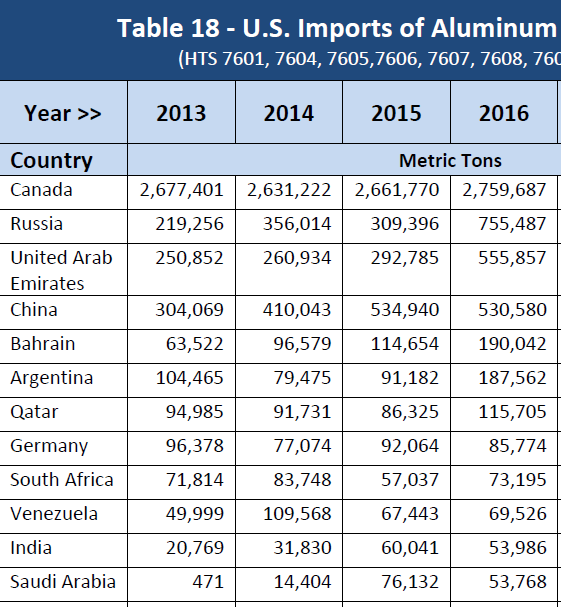
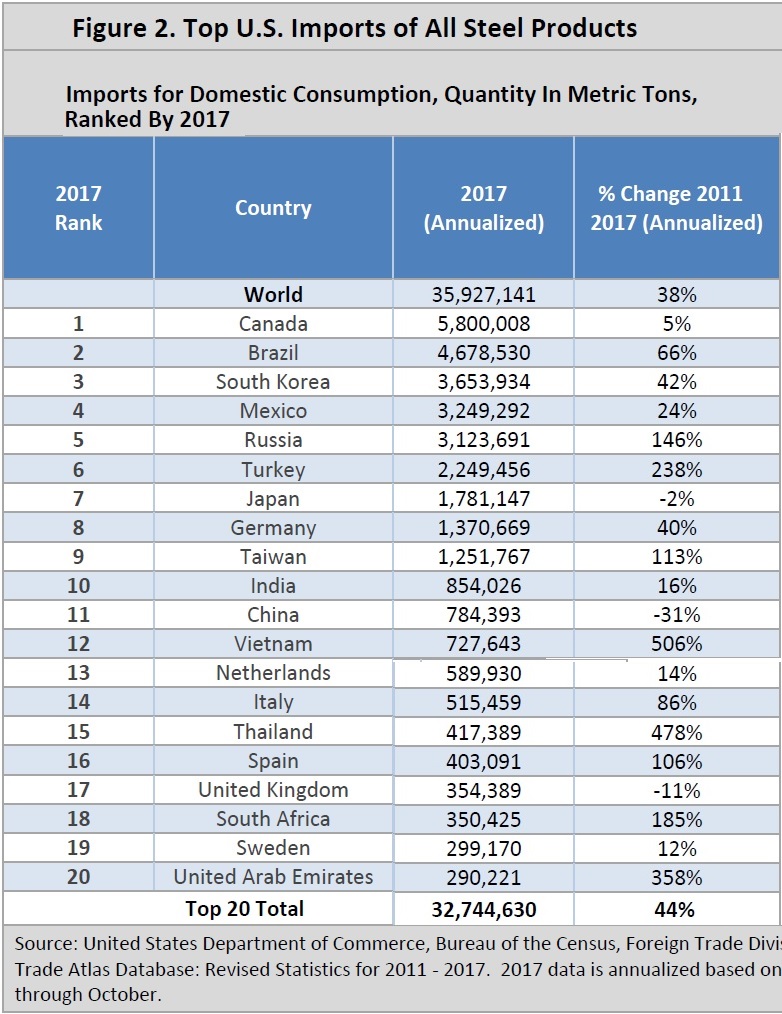
The report has a LOT to say about steel production in China. But when you look at US imports of steel, this table taken from the report shows that Canada is at the top and China is 11th. US steel imports from 2011 to 2017 are up considerably overall, especially from Brazil, South Korea, Mexico, Russia, Turkey, Germany, and Taiwan. But over that time, US steel imports from China are down by about one-third.

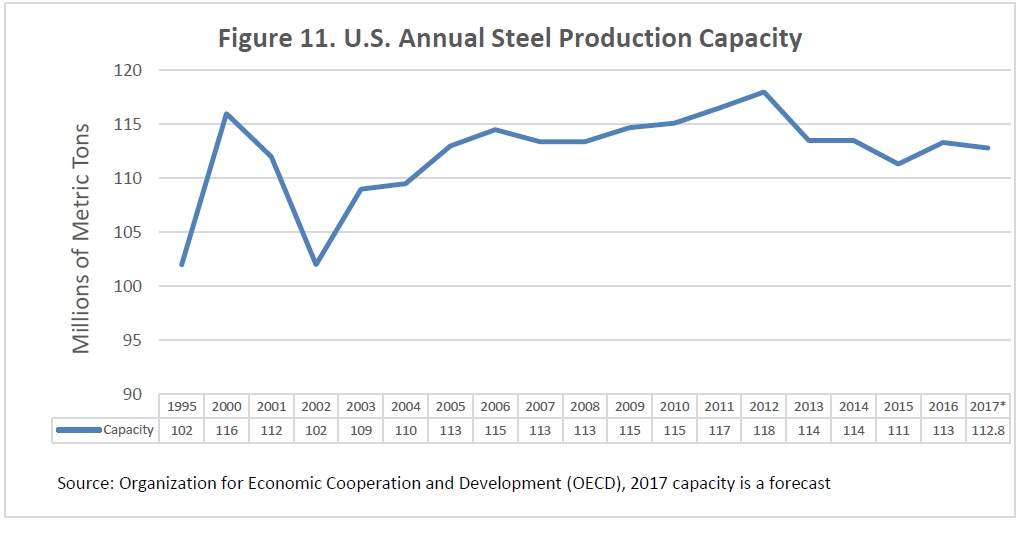
How much is US production capacity dropping off? Here’s the figure from the report. There’s a rise before the Great Recession and a fall after, but current steel capacity is about the same as it was in the early 2000s.  
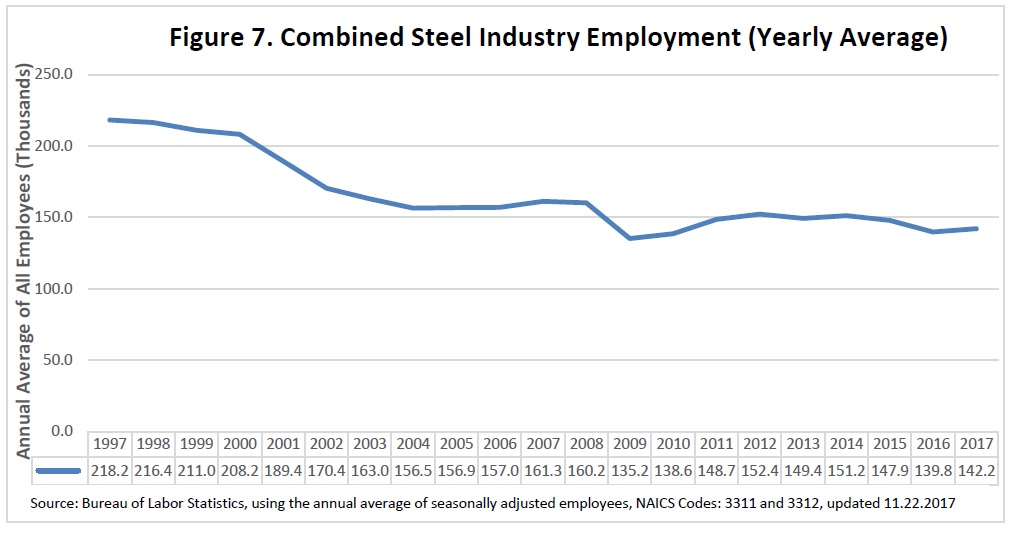
Logically speaking, the number of jobs in the US steel industry shouldn’t be part of the national security argument. After all, steel like pretty much every other industry is continually making more use of automation and robots. But here’s what the report shows about steel industry jobs: a big drop from about 2000-2003, but not much change since then. 
For me, it’s hard to look at these kinds of figures and see a national security crisis in the making in the military strength category. The report even notes that while steel prices are low all around the world, “Notwithstanding these effects, prices for steel in the U.S. remained substantially higher than in any other area. However, relative to prices between 2010 and 2013, prices are still relatively depressed.”
The report does give a few examples of specific types of steel products that are important for defense production and where there are few domestic suppliers. The report notes:

“This is not a hypothetical situation. The Department of Defense already finds itself without domestic suppliers for some particular types of steel used in defense products, including tire rod steel used in military vehicles and trucks. … In the case of critical infrastructure, the United States is down to only one remaining producer of electrical steel in the United States (AK Steel � which is highly leveraged). Electrical steel is necessary for power distribution transformers for all types of energy � including solar, nuclear, wind, coal, and natural gas � across the country. If domestic electrical steel production, as well as transformer and generator production, is not maintained in the U.S., the U.S. will become entirely dependent on foreign producers to supply these critical materials and products.”

The report also notes that steel producers have reduced their capability to ramp up production in a national emergency:

“[D]omestic steel producers have a shrinking ability to meet national security production requirements in a national emergency. The U.S. Department of Commerce, Census Bureau regularly surveys plant capacity, and has found that steel producers are quickly shedding production capacity that could be used in a national emergency. The Census Bureau defines national emergency production as the �greatest level of production an establishment can expect to sustain for one year or more under national emergency conditions.� From 2011 to 2017, steel producers increased the utilization of the surge capacity they would have during a national emergency from 54.2 percent to 68.2 percent …  As steel producers use more of this emergency capacity, there is an increasingly limited ability to ramp up steel production to meet national security needs during a national emergency.”

As the report notes, ramping up steel production in the patterns that occurred during the Vietnam War or World War II would take time and effort. Of course, the notion that the US steel industry should be continually prepared to ramp up at high speed for the equivalent of World War II is a questionable one. Let’s pause there for a moment, and turn to the aluminum report.

Background on the US Aluminum Industry

As the aluminium report explains: “Aluminum originates from bauxite, an ore typically found in the topsoil of various tropical and subtropical regions; the United States is not a significant source of bauxite as it cannot be economically extracted here. Once mined, aluminum within the bauxite ore is chemically extracted in a refinery into alumina, an aluminum oxide compound. In a second step, the alumina is smelted to produce pure aluminum metal.”

One of the ironies here is that the US is worried about the national security importance of an industry that depends entirely on imported raw materials. However, as the report notes: “The U.S. Government does not maintain any strategic stockpile of bauxite, alumina, aluminum ingots, billets or any semi-finished aluminum products such aluminum plate.”

How much aluminum is used by the US Department of Defense? The report blacks out this information. It reads: “The U.S. Department of Defense (DoD) and its contractors use a small percentage of U.S. aluminum production. The DoD �Top Down� estimate of average annual demand for aluminum during peacetime is XXXXX, or XXXXX percent of total U.S. demand.” However, later in the discussion in the specific category of high-purity aluminum, the report reads: “The U.S. manufacturers of products based on aluminum require 250,000 metric tons of high-purity aluminum a year. Approximately 90 percent of this is for commercial aerospace and other applications. Ten percent is used to support the manufacture of defense-related products.”

As with steel, the main source of US aluminum imports is Canada. In fact, this outcome is the result of long-standing polices. The report notes: 

“The U.S. in 2016 relied on imports for 89 percent of its primary aluminum requirements, up from 64 percent in 2012. Canada, which is highly integrated with the U.S. defense industrial base and considered a reliable supplier, is the leading source of imports. With Canadian smelters operating at near full capacity and with the vast majority of their production already going to customers in the United States, there is limited ability for Canada to replace other suppliers. … 

“The U.S. and Canadian defense industrial bases are integrated. This cooperative relationship has existed since 1956 and is codified in a number of bilateral defense agreements. For example in 1987, DoD (all Services), the Defense Logistics Agency (DLA), the Office of the Secretary of Defense (OSD), and the Canadian Department of National Defence (DND) joined together to form a North American Technology and Industrial Base Organization (NATIBO). NATIBO is chartered to promote a cost effective, healthy technology and industrial base that is responsive to the national and economic security needs of the United States and Canada.” 

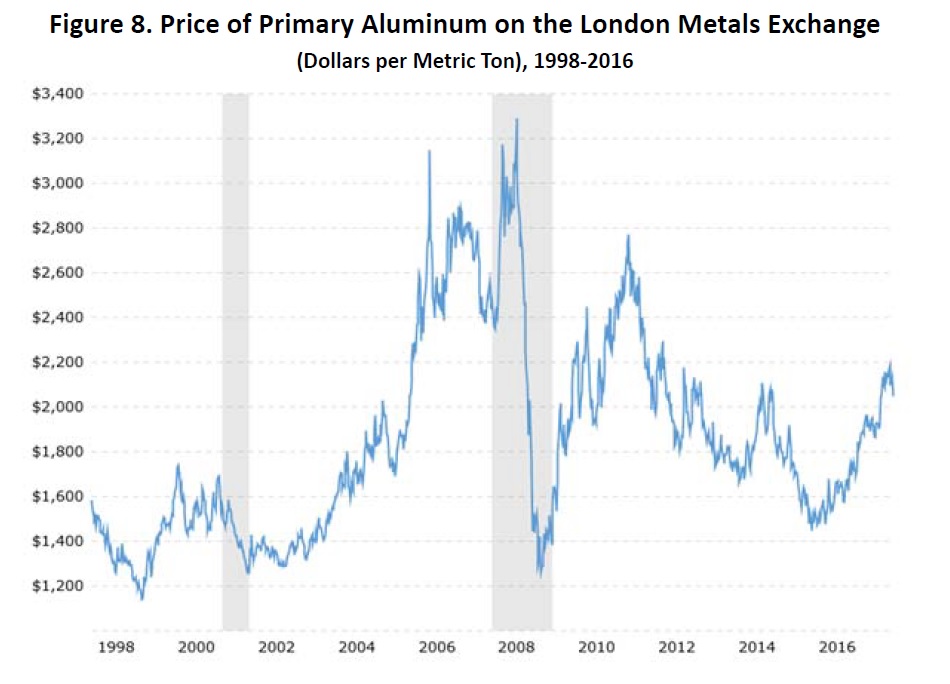
How low is the price of aluminum? Here’s a graph from the report showing aluminum prices since 1998. Prices peaked during the commodity boom in the lead-up to the Great Recession, then crashed, but presently are above where they were in the late 1990s and early 2000s. In other words, it’s hard to make the case that prices have fallen below their usual historical range, rather than being pretty much in the middle of that range. 
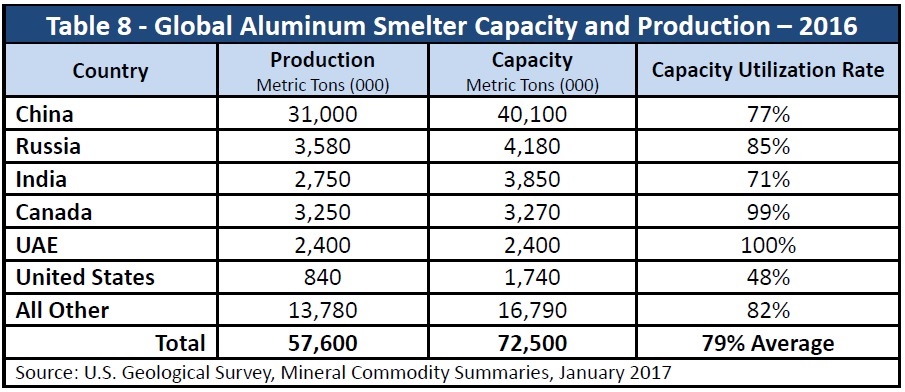
Where is the world’s aluminum produced? The report says: “Because aluminum production is highly energy intensive, the world�s leading producers are generally the countries with the lowest energy costs (including Canada, Russia, the United Arab Emirates (UAE), and Bahrain). The exception is China, where electricity costs are actually higher than those of the United States ($614 per metric ton of aluminum produced in China versus $532 per metric ton in the United States); China� overall production costs were equal to that of U.S. producers.” 
What jumps out at me from the previous table is the US capacity utilization rate in aluminum production is so very low. 
The report does note two particular issues that seem to me potentially relevant to national security in the military sense. One is the particular area of “high-purity aluminum:

“The U.S. currently has five [aluminum] smelters remaining, only two smelters that are operating at full capacity. Only one of these five smelters produces high-purity aluminum required for critical infrastructure and defense aerospace applications, including types of high performance armor plate and aircraft-grade aluminum products used in upgrading F-18, F-35, and C-17 aircraft. Should this one U.S. smelter close, the U.S. would be left without an adequate domestic supplier for key national security needs. The only other high-volume producers of high-purity aluminum are located in the UAE and China (internal use only).”

A somewhat related issue is that many of the high-tech uses of aluminum involve research into new alloys and their properties. But aluminum industry R&D seems to have died off:

“At this time most aluminum companies cannot afford to fund research. The importance of research in this industry is clear, however. More than 90 percent of all alloys currently used in the aerospace industry were developed through Alcoa�s research. … Of the three remaining companies with U.S. smelting operations in 2016, Alcoa is the only company to report spending on Research and Development over the past five years in its financial statements; Century Aluminum and Noranda reported zero spending on R&D since 2012.”

Some Thoughts about the National Security Argument for Protection

Imagine for a moment that you were firmly convinced that the US faced a national security problem with steel and aluminum–and I mean in the specific sense of being related to military and critical industry needs, not in the generic sense of just thinking some industries should have bigger profits. What would you propose? Here are some ideas: 

  • Focus on the specific areas where the dependence on imports of steel and aluminum is most concerning, like the areas of steel tire rods, electrical steel, and high-purity aluminum mentioned in the reports. 
  • Undertake a crash R&D program to find ways of substituting for steel and aluminum in various applications, and also to reuse and recycle existing steel and aluminum where possi le 
  • Stockpile bauxite and other raw materials, so as not to be vulnerable to import disruptions. 
  • Take all the subsidies that are proposed or enacted for favored noncarbon energy sources like solar and wind, and adapt them to apply to steel and aluminum: maybe tax cuts for these industries; or government guarantees that these companies could borrow large sums at subsidized or zero interest rates; or the  Department of Defense and other government purchasers would buy purchase steel and aluminum from US producers at above-market prices; or government could pay steel companies to keep unused excess capacity that could be ramped  up quickly. 
  • Make  contingency plans that would redirect steel and aluminum from noncritical uses to national security uses, if needed. 
  • Avoid undercutting Canada, which is both a key US ally and the largest outside supplier of steel and aluminum.
Just to be clear, I’m not advocating everything on this list of ideas. I’m saying that someone who is seriously concerned that the domestic production of steel and aluminum raises national security concerns should be considering all of these ideas, and advocating for at least some of them.

If the response to national security concerns over steel and aluminum is just “slap on tariffs, help domestic industry earn higher profits, and just kinda sorta hope that domestic industry uses those profits to build up capacity and specialized products and R&D”–well, that response doesn’t actually seem like a serious concern over national security to me.  If the national security concerns are legitimate, seems like a remarkably sloppy and unserious way to address them.  

Speaking of being serious, one frustration for any economist reading these reports is that at no point do they acknowledge that imports tariffs or quotas have any costs to consumers and other industrial users of these products. After all, the key mechanism by which import restrictions benefit domestic firms is by allowing them to charge higher prices to buyers.  
I care a considerable amount about national security. But waving the words “national security” should not exempt anyone from an actual consideration of actual costs, benefits, and alternative strategies. 
There is zero question in the mind of any economist that import tariffs will offer short-run benefits to  the domestic steel and aluminum industries. Whether it benefits the country overall–either in the military or the economic sense of “national security”– is considerably more dubious. The inevitable trade retaliation from other countries will only worsen these tradeoffs.

Finally, one sometimes hears the argument that these steel and aluminum tariffs are just an opening bid in the renegotiation of trade agreements. In this telling, the steel and aluminum tariffs could be bartered away for concessions in other parts of trade agreements. Maybe this is true. But if the tariffs are now bargained away or discarded so, I would conclude that the national security justification for their existence was not made sincerely in the first place.

Economics of Tourism: The Future of Direct Contact with Other Countries

Tourism intrigues me in economic terms, because it’s a larger industry than many people realize. It’s also treated as an export industry, in the sense that if a German tourist comes to the US, the spending is essentially in economic terms an export of “services” produce in the US and consumed by a non-American–even though the actual consumption happened within the geographical US. At a broader human level, tourism interests me because face-to-face direct interactions with people from other places, whether as host or as visitor, can shape how people from around the world view each other.

Thus, I read with interest the OECD Tourism Trends and Policies 2018 report, and in particular the discussion of “Megatrends Shaping the Future of Tourism.”  Here are some snippets (citations omitted):

“Global tourism has experienced steady growth for over six decades, culminating in an estimated 1.2 billion arrivals in 2016; a figure which is forecast to rise to 1.8 billion by 2030, with international tourist arrivals in emerging economy destinations projected to grow at double the rate of that in advanced tourism economies. Global expenditures on travel more than doubled between 2000 and 2016, rising from USD 495 billion to USD 1.2 trillion and accounting for 7% of global exports in goods and services. In OECD countries, tourism accounts for, on average, 4.2% of GDP, 6.9% of employment, and 21.7% of service exports.” 

What are some of the megatrends that will affect patterns of international tourism moving forward?
There is an expansion of the global middle class: “”At the end of 2016, there were approximately 3.2 billion people considered to be in the global middle classes around the world. Annually, about 150 million people are joining this demographic group, with the majority of these (an estimated 88%), residing in Asia … ” The share of elderly in global population is rising: “The United Nations (UN) has projected that by 2050, nearly all regions of the world will have almost a quarter of their population aged 60 and older …”

Taken together, these patterns suggest much larger tourist flows from Asia to the rest of the world. They also suggest a possible emphasis on tourism involving the elderly. In some cases, this may take the form of a rise in multigenerational tourism. In others, it may just mean an emphasis on “accessible” tourism, which has an emphasis on having transportation connections and eventual destinations that work well for the elderly.

Another pattern involves medical tourism:

“Another niche segment that is likely to experience significant growth in the coming years is that of medical tourism. As the cost of medical insurance and procedures, whether for health or cosmetic purposes, continue to increase in developed economies, emerging economies will become attractive options. As the quality of medical practitioners and infrastructure improves and the costs remain low, relative to those in source markets, tourists will be more likely to consider travelling abroad for wellness purposes and/or to combine a medical procedure with a short break …”

And yet another involves the evolving travel patterns of “Millenials”:

Millenials currently account for about 20% of international travel, spending an estimated USD 203 billion around the world. By 2040, they will range in age from 45-60 … Data indicates that Millenials take more trips annually  than other generations–at four or more per year. However, trips tend to be shorter in duration compared to other demographic groups. Furthermore, they are more likely to pick travel experiences that they consider to be “authentic”–preferring to head off the beaten track and “live like a local” …

A variety of other evolutions are likely to matter, as well. Internet connectedness is changing how people can plan and shop for vacations–but also making it more important to have methods for evaluating whether what you see on the web is trustworthy. There are even some predictions that the rise of virtual reality tourism will at some point tend to reduce the actual need to travel. Maybe that tradeoff will happen someday. But my guess is that for the short- and middle-term, virtual reality may turn out to be one of the most effective tools for making  people want to take a trip.

For some additional commentary on the tourism industry in the US and at the global level, see:

Dosanjh & Ors v R

  1. On 14 June 2012 the three appellants were convicted in the Crown Court at Southwark of a major Value Added Tax (“VAT”) fraud involving a total loss to the public purse of 39 million. The mechanism of the fraud was a Missing Trader Intra Community (‘MTIC’), with carbon credits as the purportedly traded commodity. The prime organisers were said to be the appellant Sandeep Dosanjh and his second cousin Pardeep Dosanjh (who fled the jurisdiction before arrest). Gill and Chahal were variously described as “organisers under the Dosanjh family” and “lieutenants”.
  2. On 18 June 2012 the trial judge HHJ Testar sentenced each of them for the offence of conspiring to cheat the public revenue. Dosanjh received a sentence of 15 years imprisonment, Gill 11 years’ imprisonment and Chahal 9 years’ imprisonment. They were each disqualified from acting as directors for 12 years. The co-accused Dhanvinder Singh Basra, Sandeep Harry, Pritpal Singh and Kernjit Gill Dhillon were all acquitted by the jury.
  3. The prosecution case against the appellants was that they were involved in manipulation of the EU Emissions Trade Scheme. The scheme was set up pursuant to the Kyoto Protocol to help reduce ‘Green House Gases’ and it regulated trade in carbon allowances or ‘credits’. A ‘carbon credit’ or European Union Allowance (‘EUA’) was the right to emit one tonne of carbon into the atmosphere. Polluting companies were issued with a number of carbon credits to cover a particular period, but could sell surplus credits or buy more credits on the market.
  4. The appellants were involved in the running of companies that formed two artificial ‘trading chains’ through which the fraud operated. At the bottom end of each chain was a ‘missing trader’, a company that defaulted on its VAT liability. There were then two ‘buffer’ companies in each chain. At the apex of each chain was a company owned and operated by the appellant Sandeep Dosanjh, called KO Brokers Ltd.
  5. KO Brokers Ltd was incorporated in 2006 and registered for VAT in 2008 but had little legitimate business activity prior to and after the fraud. The fraudulent trading took place over a total of 69 days between January to May 2009 and the total VAT owed to the UK Treasury by the missing traders was approximately 39 million (41,039,261 Euros).
  6. The first chain involved carbon credits being acquired on a zero-rated basis from other EU traders by Mak & Co UK Ltd which sold them on to Helios Technical Services Ltd. Helios sold them onto Infiniti UK Ltd and Infiniti sold them on to KO Brokers Ltd. KO Brokers sold them onto the open market to ‘blue-chip’ companies such as BP, Shell and Gazprom at a profit.
  7. Gill was involved with both Infiniti and Mak. There was little legitimate business activity in either company before the start of the fraud. Chahal set up a replacement for Mak in case it was needed. The first trade through chain one was on 20 January 2009 and the final trade was on 8 April 2009. A total of 19,478,000 carbon credits were traded during this period. In total a sum of 240,214,116 Euros (of which 31,332,276 were VAT) was paid on invoices into this chain by KO Brokers. Mak, as a ‘missing trader’, defaulted on the VAT due in the sum of 31,244,175 Euros.
  8. The second chain involved credits being acquired on a zero-rated basis from other EU traders by Swift Enterprises Ltd that sold them on to Allianz Group Ltd. Chahal supervised the operation of Swift. Gill introduced one of his companies AGH Associates Ltd into the Swift chain, as a ‘buffer’, to be run by his wife. Chahal was a director of Allianz that sold credits on to AGH. They, in turn, sold them on to KO Brokers Ltd, which sold them onto blue-chip companies.
  9. The first trade through chain two was on 2 April 2009 and the final trade was on 6 May 2009. The trading ended at this point because AGH Associates Ltd lost their registration for VAT. A total of 5,283,000 credits were traded during this period. In total, the sum of 77,964,745 Euros (of which 10,169,315 was VAT) was paid on invoices into the chain by KO Brokers. Swift was a ‘missing trader’ and defaulted on the VAT due in the sum of 9,795,086 Euros.
  10. The proceeds were swiftly moved offshore into ‘banking platforms’, in particular, commercial banks in Hong Kong, Australia and New Zealand. These operated in a manner described as being ‘analogous to a solicitor’s client account’. All the money went into one account but there were internal ledgers used to allocate it between the ‘sub-accounts’ of the traders. This meant the true nature of the transfers was effectively disguised and difficult to detect.
  11. All three appellants were of previous good character and were each arrested on 19 August 2009. Dosanjh was 31 years of age. He gave a prepared statement in interview denying any involvement in a conspiracy to defraud and then declined to answer further questions. Of those charged, he took the lion’s share of the profits which amounted to approximately 6,600,000 (spending a million pounds in cash on one property in London and on a Rolls Royce). At a hearing on 16 October 2013 the judge made an order for 12,887,685 to be confiscated and paid within six months. The default sentence was set at 10 years imprisonment.
  12. Navdeep Gill was 33. He too declined to answer questions in interview. His personal benefit was calculated at 309,000. A bundle of 8 character letters were produced on his behalf.
  13. Ranjot Chahal was 36. He answered no comment to all questions, but gave a prepared statement denying any involvement. His benefit was calculated at 40,000 half of which was paid to HM Revenue and Customs

Grounds of Appeal against Sentence

  1. Miss Clare Montgomery QC appeared for Dosanjh and advances two grounds of appeal the first of which was common to all three appellants.

Ground 1: wrong in principle.

  1. Miss Montgomery insists that a “significant and growing discrepancy” has become apparent in penalties for common law and statutory offences. Unless this “anomaly” is properly addressed by the court, a prosecutor may simply ignore any restrictions imposed by statute and choose to charge an offence where no time limits apply or the penalty is at large. This potentially offends the principles in R v Rimmington; R v Goldstein [2006] 1 AC 459.
  2. As the law stands, there are four categories of offence, all of which may apply to the same fraudulent conduct:

i) Common law conspiracy to defraud where sentence was originally at large but which now carries a maximum of 10 years imprisonment, see s.12 of the Criminal Justice Act 1987.

ii) Common law conspiracy to cheat which was abolished by s.32(1)(a) of the Theft Act 1968 ‘except as regards offences relating to the public revenue’. Sentence remains at large.

iii) The fraudulent evasion of VAT contrary to s.72 of the Value Added Tax Act 1994, which carries a maximum sentence on indictment of seven years’ imprisonment.

iv) A statutory fraud offence, carrying a maximum sentence of ten years’ imprisonment.

  1. Here, the Appellants were convicted of conspiracy to commit the common law offence of cheating the public revenue. Had they been convicted of statutory fraud or VAT offences they would have been liable to maximum penalties of ten and seven years respectively. Miss Montgomery’s theme was that it is wrong in principle to pass a sentence on a common law conspiracy that is longer than the maximum penalty available for the equivalent statutory offence or the cognate common law charge of conspiracy to defraud.
  2. In support of this assertion, Miss Montgomery placed heavy reliance upon the decisions in Rimmington and Goldstein. The appellants Rimmington and Goldstein were each charged with the common law offence of public nuisance for sending out racially offensive material in Rimmington’s case and salt in Goldstein’s case. The House of Lords considered the ingredients of the offence of public nuisance and the extent to which it is still known to the common law in the light of statutory developments.
  3. Lord Bingham of Cornhill, in the leading speech, reviewed its history. He noted that conduct formerly chargeable as the crime of public nuisance has become the subject of express statutory provision. Where that is so, the general rule should be that conduct which might amount to an offence under both common law and statute should be charged under statute. At paragraph 30 he gave his reasons:

“Where Parliament has defined the ingredients of an offence, perhaps stipulating what shall and shall not be a defence, and has prescribed a mode of trial and a maximum penalty, it must ordinarily be proper that conduct falling within that definition should be prosecuted for the statutory offence and not for a common law offence which may or may not provide the same defences and for which the potential penalty is unlimited. It cannot in the ordinary way be a reason for resorting to the common law offence that the prosecutor is freed from mandatory time limits or restrictions on penalty. It must rather be assumed that Parliament imposed the restrictions which it did having considered and weighed up what the protection of the public reasonably demanded. I would not go to the length of holding that conduct may never be lawfully prosecuted as a generally-expressed common law crime where it falls within the terms of a specific statutory provision, but good practice and respect for the primacy of statute do in my judgment require that conduct falling within the terms of a specific statutory provision should be prosecuted under that provision unless there is good reason for doing otherwise.”

  1. Miss Montgomery accepted it does not follow that it is necessarily wrong per se for a prosecutor to charge a common law offence where a statutory offence is available. Lord Bingham’s concern related to cases where the decision to do so creates a disadvantage to the defendant, for example by avoiding a statutory time limit or a maximum penalty. However, there must be ‘good reason’ for charging the common law offence. In the context of public nuisance, Lord Bingham considered that ‘the circumstances in which, in future, there can properly be resort to the common law crime of public nuisance will be relatively rare.’ (See paragraph 31).
  2. The principles in Rimmington were recently applied in R v Dady [2013] EWHC 475 (QB) in which Coulson J considered a prosecution application to prefer a voluntary bill of indictment. The defendant was alleged to have operated a website that facilitated the illegal downloading of football matches. The draft bill contained three counts: conspiracy to defraud at common law, an offence under s.107(2A) of the Copyright, Designs and Patents Act 1988 and an offence under s.297 of the 1988 Act. Coulson J held that the second count was not properly available on the evidence. At paragraph 21 he considered the relationship between counts 1 and 3 and observed:

“I consider that s.297 catches precisely the criminal conduct which is now alleged against Mr Dady. He was providing his subscribers, for a fee, with a means to get round the encryption. For present purposes, I am prepared to accept that this amounted to a conspiracy to breach s.297. In those circumstances, it seems that his offending should have been charged as such. The matters of difficulty created by s.3 of the Criminal Law Act 1977, such as the six month time limit and the need for permission from the DPP, are procedural safeguards which were plainly regarded by Parliament as important. In my judgment, it would be wrong to allow the Crown now to ignore these safeguards, and to charge what would otherwise be a precise statutory offence under the wide common law offence of conspiracy to defraud. In addition, of course, to allow the Crown to prefer this voluntary Bill would be contrary to Lord Bingham’s guidance in R v Rimmington, because it would be depriving the defendant of the protection of being charged with an offence which was summary only.”

  1. Coulson J was also a member of the Courts Martial Appeal Court in R v Armstrong [2012] EWCA Crim 83. The appellant had been charged with four counts contrary s.69 of the Army Act 1955 (conduct to the prejudice of military discipline). The alleged conduct could also have formed the basis of substantive charges under the Criminal Law: under the Firearms Act 1968, the Misuse of Drugs Act 1971 and the Official Secrets Act 1989. At paragraphs 20 and 21, the Court noted that:

“Beyond recording the position of the Crown, it is neither necessary nor desirable that this Court should comment on the scope of comment under s.69, save to say that where conduct constitutes an offence under the ordinary criminal law, it must be charged as such save in wholly exceptional circumstances. As Mr Mably rightly submitted [for the Attorney General], there can ordinarily be no justification for using s.69 in such circumstances and it would be outside the lawful exercise of the prosecutor’s discretion; its use might well circumvent the statutory sentencing regime imposed by Parliament on the courts either to the detriment of the defendant by enabling a harsher sentence to be passed or to the detriment of the public interest in preventing the court passing a sentence within the range specified by Parliament and imposing ancillary orders.”

  1. Miss Montgomery acknowledged that there is at least one decision of the Court of Appeal in an appeal against conviction for revenue fraud which appears to contradict her argument (namely Mavji [1987] 2 All ER 758) and a whole line of sentencing decisions which undoubtedly contradict it. Nothing daunted, she argued the decision in Mavji, in so far as it conflicts with Rimmington, has been overruled and the subsequent sentencing cases were decided per incuriam (the point having been overlooked).
  2. In Mavji the Court of Appeal considered an appeal against conviction for conspiracy to cheat the revenue by way of the non-payment of VAT. Giving the judgment of the court Michael Davies J observed at page 761A-B:

“It was submitted on behalf of the appellant that it would be anomalous if the common law and statutory offences stood side by side, with no more having to be proved to establish the former than the latter, and, in the former case, without limit of penalty. We see no anomaly. In our judgment s.38(1) of the 1972 Act was a ‘catch-all’ provision directed specifically to punishing evasion of value added tax when that tax was newly introduced and has no bearing on the general principles of cheating in relation to the public revenue, particularly as there is no counterpart to s.38(1) in the statutory provisions relating to other taxes.”

  1. Similar clear statements appear in the line of sentencing decisions. We shall refer to just three. In R v Ward [2005] EWCA Crim 1926, the appellant was convicted of conspiracy to cheat, and argued that the judge ought to have had regard to the 7 year maximum for the statutory VAT offence. The Court rejected this argument at paragraph 16:

“It seems to us that the position in cases such as this, where the allegation is that many millions, not merely one million, has been lost to the country’s revenues is that it is entirely appropriate for the court to approach the matter on the basis that a conspiracy to cheat is the appropriate charge and that entitles it to conclude that a sentence in excess of the statutory maximum for the single substantive offence would be available and proper. This court made it clear in Dosanjh and repeated it in Czyzewski that that was a permissible course to take. The judge in the present case was accordingly entitled, as a matter of principle, to conclude that he was not constrained by the statutory maximum for the substantive offences. He had, however, as he did, to take it into account as assisting him in coming to a conclusion as to where he should place the appropriate sentence.”

  1. In Bright [2008] EWCA Crim 462; [2008] 2 Cr App R(S) 102 the appellant was convicted of conspiring to commit an insurance fraud on evidence which would have supported an indictment for conspiracies to trade fraudulently. The ultimate losses were likely to be 1 billion and 1000 employees lost their jobs. The court, over which the then Sir Igor Judge P presided, held that the sentencing judge was not obliged to sentence on the basis that the lower maximum sentence for conspiracy to trade fraudulently applied.
  2. In R v Randhawa [2012] EWCA Crim the Court upheld sentences of 15 and 14 years for appellants who had had an organising role in an MTIC fraud. The court noted the distinction between the sentencing regimes applicable to common law cheating and statutory fraud and observed at para 38:

“There are no sentencing guidelines applicable to this case. The guidelines for statutory offences of fraud (carrying a maximum of 10 years’ imprisonment) do not extend to offences of cheating, or conspiring to cheat, the public revenue, for which the penalty is at large. Such offences are reserved for the most serious cases, where a sentence in excess of the statutory maximum for other offences may be appropriate.”

  1. Miss Montgomery suggested that the effect of these and other similar observations (for example in the Sentencing Guidelines Council’s Definitive Guideline on Fraud) would mean that a serious case of cheating the public revenue is necessarily more serious than the most serious case of statutory fraud or conspiracy to defraud. Upholding a 15 year sentence in a case of conspiracy to cheat is tantamount to saying that an offender’s conduct is so serious that it calls for a 50% longer sentence than any conceivable case of fraud. She posed the rhetorical question: surely Kallakis (see Kallakis 2013 EWCA Crim 709) who was involved in the UK’s largest ever mortgage fraud (over 740 million advanced) required a more severe punishment than the offenders here?
  2. It is for Parliament to decide upon maximum and minimum level of sentences, and Miss Montgomery claimed there is a real possibility of courts encroaching on their territory. Where Parliament has set maximum sentences for particular conduct, it is not for the courts and the executive to decide that those sentences are not enough, and that the statutory limits should be evaded. This is precisely the objectionable course of action that Lord Bingham identified in Rimmington.

Conclusions on Ground 1

  1. We can dispose of this ground relatively swiftly. As Mr Waddington for the Crown, observed, it is contrary to a consistent line of Court of Appeal authority going back over 25 years. We see no reason to dissent from the proposition in the Sentencing Guidelines Council’s Definitive Guideline on Fraud to the effect that “the common law offence of cheating the public revenue is generally reserved for the most serious and unusual offences and where a sentence in excess of the statutory maximum would be proper”. In our judgment that statement coincides with the law and best practice. We are not surprised, therefore, that the SGC’s successor, the Sentencing Council, has adopted a similar approach in its recently published draft guideline.
  2. There is no inconsistency with the decision in Rimmington. Both approaches are based on the will of Parliament. In Rimmington the House held that where Parliament has created a statutory offence and defined its ingredients, (possibly providing for time limits on prosecutions, defences and a maximum penalty), it is not for a prosecutor to thwart Parliament’s clearly expressed intention by charging a common law offence to which none of the restrictions apply.
  3. Here, however, Parliament has created statutory offences of fraud and conspiracy to defraud to which maximum penalties apply but it has also expressly retained the common law offence of cheating the revenue. The offence was singled out from the general abolition of common law dishonesty offences by section 32(1)(a) of the Theft Act 1968. Further, despite subsequent reviews of the offences of fraud, Parliament has left not only the offence in existence but the penalty at large. This is entirely consistent with the general approach over decades to major frauds on the revenue. They have always been treated as offences of particular seriousness.
  4. Thus, we are entirely confident that as far as Parliament is concerned, the offence of conspiracy to cheat the public revenue retains its established and clearly understood role in the prosecution of revenue cases. It is used to supplement the statutory framework and is recognised as the appropriate charge for the small number of the most serious revenue frauds, where the statutory offences will not adequately reflect the criminality involved and where a sentence at large is more appropriate than one subject to statutory restrictions. These are not ‘ordinary’ cases.
  5. Lord Bingham’s assertion of what would “ordinarily” be appropriate is premised on the assumption “that Parliament imposed the restrictions which it did having considered and weighed up what the protection of the public reasonably demanded”. It is reasonably to be assumed that Parliament has deliberately left the common law offence of cheating the revenue untouched by statutory changes in this area because it recognised that it was appropriate to do so for the protection of the public, for all the reasons set out in the authorities. That was clearly Parliament’s intent at the time of the Theft Act and there is no reason to believe that their intent has changed. In any event, Lord Bingham recognised that his general approach may not apply where there was good reason for charging the common law offence. In this case, we agree with Mr Waddington, there is “good reason”.

Ground 2 Dosanjh: manifestly excessive

  1. In the event that her primary argument fails, Miss Montgomery submits that, even if the courts are, in principle, entitled to pass sentences in common law cases which are greater than the statutory maxima for comparable offences, a sentence of fifteen years is manifestly excessive on the facts of his case.
  2. Pardeep Dosanjh played a more important role in the conspiracy. A sentence of 15 years for the Appellant would imply a sentence of 17 years or more for him. A sentence of that length should be reserved for cases where an even larger sum of money is involved. Further, she argued it cannot be right that the Appellant received a sentence that was 50% longer than could be passed for any statutory fraud, however grave.
  3. The sentence also looks excessive when compared with previous decisions of this court and with the draft guideline from the Sentencing Council. For a category 2 offence (which this would be) and for an organiser (which the appellant was) the range of 8-13 years is proposed with a starting point of 10 years. The starting point is based on the fraud being worth over 30 million pounds. A sentencing range of 10 to 17 years is reserved for frauds of over 50 million. Miss Montgomery did not suggest the draft Guideline is binding but drew to our attention the fact that it is based on a thorough review of current sentencing practice. On that basis, it does provide a useful guide.
  4. The submissions of both Gill and Chahal repeat and depend to some extent on the success of Miss Montgomery’s submissions. If the benchmark of 15 years for Dosanjh is reduced for any reason they would hope to take advantage of a similar reduction.

Ground 3 Gill: disparity

  1. Additionally Mr Richard Christie QC for Gill sought to persuade us that the judge wrongly attributed to Gill a greater degree of involvement and culpability than he did to Chahal. He took us to the judge’s sentencing remarks in which the judge observed that there was “very clear and cogent evidence that both Mr Gill and Mr Chahal had an involvement which went over and beyond the managing of the buffer companies that they fronted.”
  2. However, there was no evidence to suggest Gill had any involvement in the operation of the missing trader by way of issuing invoices, transferring EUAs on the register or controlling monies through their bank accounts.
  3. Without wishing to make the situation for Chahal worse, Mr Christie suggested the evidence against him was more extensive than against Gill, for example Pritpal Singh was put under very considerable pressure by Chahal and the Dosanjh family to become involved. Gill, on the other hand, may have facilitated the introduction of others like his wife and Himat Singh to the running of the companies but he used no pressure. They were each willing participants. On that basis the judge was wrong to reflect the involvement of others as an aggravating feature.
  4. Mr Christie addressed the glaring difference between the two cases of Gill and Chahal (the benefit they received) in this way: much of the difference in monies each man received is explicable by the fact that Infiniti traded from 20 January to 8 April 2009 and Allianz only traded from 2 April to 6 May 2009. The longer trading period meant that Infiniti had time to trade a higher volume of EUAs, which necessarily meant a greater income. Whilst Infiniti traded 19,478,000 EUAs, Allianz only traded 5,283,000 EUAs. Chahal intended to obtain far more but was stopped from doing so.
  5. Furthermore, the Crown’s case (accepted by the judge for sentencing purposes) was that chain two was ended by the involvement of Her Majesty’s Revenue and Customs and the de-registration of AGH. Hence, but for the involvement of HMRC, chain two would have continued for far longer and Allianz’s receipts from the fraud would have matched (if not exceeded) those of Infiniti.
  6. In any event, the judge recognised that “when one is sentencing for fraud, it is always impossible to know exactly how much people have ‘made’ out of a fraud”. The mere fact that Allianz received a lesser sum than Infiniti received, does not mean that Mr Chahal received (or was going to receive) less than Mr Gill.

Ground 4 Gill: manifestly excessive

  1. Mr Christie questioned whether the judge placed undue reliance on Attorney Generals Reference (88, 89, 90 & 91 of 2006) (Meehan & Others) [2006] EWCA Crim 3254. In Meehan the prosecution appealed against 4 sentences on the basis that they were unduly lenient. All of the defendants had been “buffer” traders in MTIC frauds with losses to HMRC of between 24 and 28 million. Giving the judgment of the Court at paragraph 18, Latham L.J. stated that:

“Very substantial sums of money have been obtained in cases such as these, and were obtained in these cases. Those who organise such fraudulent activity can and should now expect, in our view, sentences well into double figures after trial.”

  1. In relation to those who fell to be sentenced on the basis that they ran “buffer” companies, he continued:

“In our judgment the right bracket for this type of offending, with the amount of money involved in these cases, after a plea of not guilty, would have been six to eight years. That would seem to us to reflect more adequately the seriousness of the activity and the need to deter people from being involved in such activity which is temptingly easy to become involved in.”

  1. Mr Christie hoped to persuade us that Gill fell far more into the “buffer” than the main organiser category. Unlike the appellants in Randhawa who were main organisers and committed other offences, Gill was lower down the chain and a man of previously positively good character. Not only had he never been convicted or cautioned (or even arrested) for any criminal offence, he was able to call eight character witnesses to testify to his reputation for hard work, integrity, trustworthiness, generosity and willingness to put himself out to help others.

Ground 5 Chahal: manifestly excessive

  1. Mr Hammond for Chahal acknowledged that conspirators of this kind may often boast a previous good character and to little avail. Having adopted the general arguments of others, his individual argument was straightforward: given the appellant’s role in and benefit from the fraud, 9 years was manifestly excessive, even having regard to the high deterrent sentences upheld by the Court of Appeal for this type of MTIC fraud.

Conclusions on grounds 2- 5

  1. In assessing whether or not the sentences were manifestly excessive, the draft Guideline makes a useful starting point. It is not binding but it does accurately reflect current sentencing practice as represented by the tables of decisions helpfully put before us by counsel.
  2. The only decision, which might, at first blush, appear out of step with the Guideline and the tables, is Randhawa. However, on a careful reading of the judgment, it became apparent to us that the Randhawa decision is easily explicable and no exception to a general rule. The long sentences imposed on Randhawa’s co-accused Bhabdeep Chahal and Charanjit Chahal were justified by their overall criminality. This included the significantly aggravating feature of their having committed offences of money laundering and deception, for which they were on bail at the time of the conspiracy to cheat. This is not a feature in this case.
  3. Nevertheless, the appellants face a steep hurdle in persuading us to reduce their sentences to the levels they suggest. There is nothing in the draft Guideline, or in the cases put before us, that causes us to doubt the observation in Meehan that sentences into double figures may well be merited where an organiser is convicted of this type and level of fraud. Cheating the revenue in this way is a major drain on the public purse with the taxpayer ultimately picking up the bill. These are not, therefore, victimless crimes. In the draft guidance from the Sentencing Council this statement appears: “Fraud is estimated to cost the UK economy 73 billion each year. It is a hugely diverse area of crime and one that is constantly evolving. At the most serious level of offending, the offences are often sophisticated and involve huge sums of money being defrauded over long periods.”
  4. This fraud fits squarely within those observations. It was at a serious level of offending. The plan was extremely sophisticated and resulted in huge gains to the conspirators. On average over 500,000 a day was obtained and sent off to the other side of the world with what the judge described as breathtaking speed. It was an integral part of the conspiracy that the offending took place across borders. This must have required an enormous amount of planning.
  5. The chains and the money laundering arrangements were all set up in advance so that new companies and new banking arrangements could be used as and when required without causing any disruption to the fraud. In his sentencing remarks, the judge mentioned the prospect of a third chain being established (about which there is an ongoing prosecution). The fraud continued in different forms until the law was changed on 31 July 2009. Further, there was a concerted effort to create documents and mislead the authorities as to what had been going on and there was evidence of pressure applied to recruit at least one member of the group, Pritpal Singh.
  6. In those circumstances, there can be no doubt that if one takes the draft Definitive Guideline as a helpful starting point, the case is fairly near the top of category 2 for harm. A lengthy prison sentence was inevitable.
  7. As for roles, Dosanjh played a leading role in a large organised group of offenders. He was “at or near the top of the hierarchy”. Both Gill and Chahal played an organisational role under the orders of Dosanjh and others. The extent of their participation went far beyond mere “buffers”. In the context of the draft Guideline, their participation was more than “significant”. They too played a leading role, albeit at a lower level than Dosanjh.
  8. Arguably, the judge was generous towards Chahal in reducing the sentence imposed upon him. It does not follow, however, that he was harsh on Gill. We reject the disparity point. It is apparent from the trial judge’s thorough and careful sentencing remarks that he agonised over whether or not to make any distinction between the two men. Having done so he reached conclusions that, in our view, are unassailable. As the trial judge, he was far better placed to assess roles and culpability than we are. He was fully entitled, for example, to give considerable weight to the level of benefit obtained by each man. There was a significant difference between Gill and Chahal in this respect.
  9. However, we are more sympathetic to the argument, common to all three appellants, that HHJ Testar chose too high a starting point for Dosanjh. This may be because he placed too great a reliance on the result in Randhawa. As we have already observed, there were differences in the level of criminality between the main organisers in Randhawa and the main organisers here. On our analysis of previous decisions, this court appears to have set the bar for offending of this kind by someone in Dosanjh’s position, without the aggravating features of Randhawa, at or about 13 years. That analysis finds support in the draft Guideline. If so, conscious as we are of the trial judge’s considerable experience in these matters, we see some force in the argument that the sentence of 15 years imposed upon Dosanjh was somewhat too high. It follows that we feel we have no choice but to reflect the trial judge’s approach and make some adjustments to the sentences of the other two as well.
  10. In the result, we reduce the sentence imposed upon Dosanjh to one of 13 years, the sentence imposed upon Gill to one of 10 years and the sentence imposed upon Chahal to 8 years. To that extent the appeals succeed.
  11. We conclude with our thanks to all counsel especially Miss Montgomery and Mr Waddington, upon whom the burden mostly fell, for eloquent and extremely helpful submissions.
Nudge Policies

A considerable body of evidence suggests that people’s decisions are affected by how a choice is presented, or what the default option looks like. There’s a reason that grocery stores put some products at eye-level and some near the floor, or why the staples like milk and eggs are often far from the door (so you have to walk through the store to grab them), or why the checkout counters have nearby racks of candy. There’s a reason that gas stations sometimes advertise that gas is 5 cents a gallon less if you pay cash, but never advertise that gas is 5 cents more per gallon if you don’t pay cash. There’s a reason that many people have their employer automatically deduct money from paychecks for their retirement accounts, rather than trying to make their own monthly or annual payments to that same account.

Once you have admitted that people’s decisions are affected by these kinds of factors, an obvious question is whether public policy might make use of how decisions are presented to influence behavior. A decade ago in 2007, Richard H. Thaler and Cass R. Sunstein brought this possibility to public attention in their book Nudge: Improving Decisions About Health, Wealth, and Happiness.  For a sense of what has happened since then, Bob Holmes offers an overview in “Nudging grows up (and now has a government job),” which is subtitled, “Ten years after an influential book proposed ways to work with � not against � the irrationalities of human decision-making, practitioners have refined and broadened this gentle tool of persuasion” (Knowable Magazine, February 1, 2018).

(A side note here: Knowable Magazine  is a publication of the good folks who publish the Annual Review volumes familiar to academics. There are now about 50 of these volumes across a wide array of topics, from economics to entomology and from analytical chemistry to vision science. Like the title says, there is one volume per year on each subject, with each volume containing an array of papers written by prominent experts in the field describing what is happening in their area of research. The articles in the magazine take the Annual Review papers in the last few years as a starting point, and then publish an essay that draws out common themes–with references to the underlying papers for those who want the gritty details. In short, the magazine is a good place to get up to speed on a very wide range of topics across the sciences and social sciences in a hurry.)

As one example of a “nudge” policy. consider organ donation. In opinion polls, people overwhelmingly support being an organ donor. But in practice, fewer than half of adults are actually signed up. A nudge policy might suggest that all driver be automatically enrolled as organ donors–with a choice to opt out if they wish to do so. In other words, instead of framing the choice as “do you want to sign up to be an organ donor?”, the choice would become “do you want to opt out of being an organ donor?” As long as the choice is presented clearly, it’s hard to argue that anyone’s personal autonomy is being violated by the alternative phrasing of the question. But the alternative phrasing would lead to more organ donors–and the United States alone currently has about 100,000 people on waiting lists for organ transplants.

Perhaps the best-known example is that employers can either offer workers the option to enroll in a retirement savings plan, or they can automatically enroll workers in a retirement savings plans, with a choice to opt out. Phrasing the choice differently has a big effect on behavior. And a lot of people who never quite got around to signing up for the retirement plan end up regretting that choice when it’s too late in life to do much about it. 
A graph shows that automatic enrollment leads to almost 100% of users contributing to their retirement savings, while �opt in� plans are much less successful.

Once you start thinking about nudging, possibilities blossom. Along with applications to organ donation and saving, Holmes discusses nudges related to home energy use, willingness to use generic drugs, choice of when to start receiving Social Security, requiring a common and simpler format for information about mortgages or phone contracts to make them easier to comprehend and compare,

Holmes reports: “At last count, more than 60 government departments and international agencies have established �nudge units� tasked with finding and pulling the right behavioral levers to accomplish everything from increasing retirement savings to boosting diversity in military recruits to encouraging people to get vaccinated against flu. The United Kingdom’s Behavioural Insights Team, one of the first and largest such units, has expanded from a handful of people in 2010 to about 100 today, with global reach. Clearly, nudging has moved into the mainstream.”

Three broad concerns discussed by Holmes seem worth noting. First, nudges can often be very specific to context and detail. For example, when people in the UK got a letter saying that most people pay their taxes on time, the number of tax delinquents fell sharply, but the same nudge in Ireland had no effect. Sometimes small details of a government notification–like whether the letter includes a smiley face or not–seem to have a substantial effect. 
Second, the total effect of nudge policies may be only moderate. But saying that a policy won’t totally solve, say, poverty or obesity hardly seems like a reason to rule out the policy. 
Finally, there is a legitimate concern over the line between “nudge” policies and government paternalism. The notion that government is purposely acting in subtle ways to shift our choices is mildly disturbing. What if you just sort of forget to opt out of being an organ donor–but you actually have genuine personal objections to doing so? What if you just sort of forget to opt out of the retirement savings account, but you know that you have a health condition that is extremely likely to give you a shortened life expectancy? A nudge policy can be beneficial on average, but still lead to less desirable choices in specific cases. 
Moreover, what if the goals of a nudge policy start to reach beyond goals like adequate retirement saving or use of generic drugs, and start edging into more controversial settings? One can imagine nudge policies to affect choices about abortion, or gun ownership, or joining the military, or enrolling your child in a charter school. No matter which direction these nudges are pushing, they would  certainly be controversial. 

In the Annual Review of Psychology for 2016, Cass Sunstein contributed an essay titled, “The Council of Psychological Advisers.” It begins: “Many nations have some kind of council of economic advisers. Should they also have a council of psychological advisers? Perhaps some already do.” For many people, the idea of a government council of psychological advisers seeking to set up your choices in such a way as to influence the outcome, in ways you don’t even know are happening, will sound fairly creepy.

Like many people, I like to think of myself as someone who considers options and makes choices. But the reality of nudge policies calls this perception into doubt. For many real-world life choices, a truly neutral presentation of the options does not exist. There will always be a choice about the order in which options are presented, how the options are phrased, what background information is presented, what choice serves as the default option. Even when no official nudge policy exists, and all of these choices have been made for other reasons, the setting of the choice will often influence the choice that is made. It will influence me, and it will influence you, too. Thus, there isn’t any escape from nudge policies. There is only a choice as to what kinds of nudges will happen–and a need for all of us to be aware of how we are being nudged and when we want to shove back by making other choices.

The Commuter Parking Tax Break

Many employers provide parking to employees who commute to work, which can be viewed as an untaxed fringe benefit of their jobs. The value of this benefit depends on where the parking is located. If the employer is in a uncongested suburban or rural area, where parking is generally free for everyone, then the value of this fringe benefit is low. But if the employer is in the part of an urban area with traffic congestion and where parking usually has a monetary price, then the value of this benefit can be higher.

Tony Dutzik, Elizabeth Berg, Alana Miller, and Rachel Cross, considers the tradeoffs in their report, “Who Pays For Parking? How Federal Tax Subsidies Jam More Cars into Congested Cities, and How Cities Can Reclaim Their Streets” (September 2017), published by TransitCenter and the Frontier Group. They write:

“Because employer-provided and employer-paid parking is excluded from an employee�s income, the parking tax benefit  accounts for an estimated $7.3 billion in lost federal and state income and payroll tax revenues every year. … While the vast majority of Americans drive to work, most do not gain from the commuter parking benefit. The reason is that parking is so abundant in many places�especially in suburban and rural areas�that it essentially has no value as defined by the Internal Revenue Service. As a result, only about one-third of commuters benefit from this policy. In fact, most Americans are net losers from the commuter subsidies, as they must endure higher taxes or reduced government services�as well as increased congestion�to subsidize parking for a minority of commuters. … The parking tax benefit disproportionately assists commuters who work in dense employment centers, such as downtowns, where parking is most valuable.”

To IRS has tried to tax the value of employee parking a few times over the decades with minimal success.  However, the US government did enact a policy to offer a counter-subsidy by making it possible pay for transit and carpooling out of pretax income. (And yes, this means the official policy is both not to tax the benefit of free parking, thus encouraging people to drive to work, and also not to tax the value of transit passes, thus encouraging people not to drive to work.) But the transit benefit is relatively small-scale in size.

“In an effort to counteract the effects of the commuter parking benefit, America also subsidizes people not to drive to work through the �commuter transit benefit��a $1.3 billion program that enables workers to receive transit passes or vanpool services from their employers tax-free. The transit tax benefit encourages Americans to use public transportation by making the cost of transit passes or vanpooling  payable from pre-tax income. ,,, The main impediment to the effectiveness of the transit benefit, however, is that few workers receive it. Only 7 percent of the American workforce has access to subsidized commuter transit benefits, and only 2 percent of the US workforce uses them. Most employers� particularly smaller firms�do not offer employer-based transit
benefits programs. Like the parking tax benefit, the transit tax benefit disproportionately aids those with higher incomes who work for large employers in dense downtown districts. Workers in the top 10 percent by income are seven times more likely to have access to subsidized transit benefits than those in the bottom 10 percent of the income range.”

The tax exemption for the value of employer-provided commuter parking has real effects. It means more cars on the road during peak commute times, and higher traffic congestion. The additional pollutants in the air have health costs. And there is an opportunity cost of using scarce space in urban areas–whether on streets, surface lots, or ramps–for parking cars.

The report suggests a range of policy options, and without endorsing or opposing them here, let me put them out there as useful ideas for shaking up one’s thoughts.

One option would be for Congress (or a state government) to pass a “parking cash-out” law which would require companies to determine the market price of their employee parking benefits. Then all employers would offer that benefit as a payment to all employees. Those employees who choose to keep driving and parking would simply pay for the parking directly. They would be no worse off in financial terms–but they would be far more aware of the costs of the parking benefit. Those who find an alternative way to get to work could just treat the parking-related payment as additional income. And the tax authorities would then find it straightforward to tax the parking-related income payments. As the authors wrote:

“Other jurisdictions have adopted or considered �parking cashout�� a policy that requires businesses that offer free parking to their employees to give non-driving workers a cash payment of equivalent value. Parking cash-out can benefit employers by reducing the number of parking spaces they must rent to provide to their employees.”

If that approach is politically impossible, a local option is for cities to raise their own taxes on commuter parking:

“Cities generally assess parking taxes on commercial lots and garages (with some exceptions, see below), and assess the tax either at a flat rate or as a percentage of the parking charge. In large cities,  parking taxes range from New York�s 18.4 percent to 20 percent in Chicago and Philadelphia to 25 percent in San Francisco and 37.5 percent in Pittsburgh. These rates of taxation may seem high, but they are insufficient to cancel out the tax incentive for commuter parking for many workers. In 2015, the combined average marginal tax rate for federal income tax, the employee share of federal payroll tax, and state income tax was 35.1 percent. The commuter parking benefit exempts workers from paying this tax on the value of employer-provided parking. To fully counteract that subsidy, municipalities would need to tax employee parking at a rate of roughly 54 percent�well above even the highest parking taxes assessed in American cities. Most parking taxes fail to counteract the effect of tax-free treatment of employer-provided parking in another way as well: they apply only to commercial parking facilities, not to the �free� parking offered by employers at their facilities. Several cities around the world have implemented taxes that apply to parking spaces regardless of
whether they are provided for free or at a cost.”

For previous posts on the economics of parking, see:

Equal Pay for Equal Work: Rathbone and Fawcett in 1918

One hundred years ago,  the leading British economics journal (edited by John Maynard Keynes) published an article and a response from two women authors: Eleanor Rathbone and Millicent Fawcett. Despite writing in the Economic Journal, neither had professional training in economics. But they were clearly recognized as experts with opinions that economists hear.

Eleanor Rathbone (1872-1946) graduated from Somerville College at Oxford in 1893. In 1909 she was elected to the Liverpool city council; in 1929, she was elected to Parliament. Much of her focus was on government support for needy children, and over time she authored a number of article and books on the topic, as well as advocating in her political roles.  Millicent Garrett Fawcett (1847�1929) is known by those who study the history of economic thought as the author of a Political Economy for Beginners book that went through 10 editions over 41 years. She was led the largest UK suffragist organization, and played a role the founding of Newnham College, Cambridge.

Rathbone led off with her article, “The Remuneration of Women’s Services” (Economic Journal, March 2017, 27: 105, pp. 55-68). She argued that although women had been accepted into many jobs during World War I, the situation was not sustainable. She offered reasons why women and men were not equal in the workplace. But her particular focus, as in much of her life, was on who would pay for the costs of raising children. In her view, men needed to be paid more because many of them were providing for families. She was quick to note that this method of providing for families didn’t always work very well–given different pay, different number of children, and men who didn’t pass along much of their income to their families. She argued that if the government provided greater support for children (again, this was her long-standing cause), then equality of pay for women would be more likely to work well, because the “men need to support a family” argument would no longer hold.  Here are some samples of her argument:

“In industry, the outbreak of the war [that is, World War I]found the women workers confined almost entirely, except in a few occupations traditionally their own, to the lowest, most ill-paid, and unskilled occupations. The barriers that kept them out of the skilled trades were for the most part unrecognised by law, but they were almost completely effective, being built up partly of tradition, partly of trade union regulations, but mainly of the sex exclusiveness in which employers and employed made common cause. Against these barriers the “women’s movement” had beaten itself for half a century in vain, but within two years the necessities of the war have broken them down–by no means completely, but to such an extent that it is plain that if re-erected they will have to be based frankly upon the desire of the male to protect himself from competition, and no longer upon the alleged incapacity of the female to compete. … 

“The women themselves, ill-organised and voteless, with the sentiment in favour of the returning soldiers not only strong against them but strong among them, could not by themselves put up much of a fight. But they are likely to have two powerful allies: first, in the employers, who, having tasted the advantages of a great reserve of cheap, docile, and very effective labour are obviously not going to let themselves be deprived of it without a struggle; and secondly, in the growing public sense of the necessity on national grounds of making the most of our economic resources. …

“This difficulty may be most shortly put in the form of a question: “Is fair competition between men workers and women workers possible, bearing in mind the customary difference in the wage level of the two sexes and the causes of that customary difference? In other words, is it possible for women with men, without undercutting their standards undermining their standards of life? ” The reply offered by feminists to this question prompt and unhesitating, and is practically a denial of the difficulty. Women, they say, must, of course, be freely in all occupations. But they must not undercut.  They must demand and receive equal wages for equal work. This is the claim put forward by practically all women, except, of course, when they are themselves employing women.  I have not yet met the feminist whose principles compel her to pay her waitress the wages that would be demanded by a butler. …

“There are in the eyes of most employers certain standing disadvantages of women’s labour which have to be reckoned with. There is the fact that the law will not allow him to work her at night nor for overtime, except under rigid restrictions; that her liability to sickness (in most trades) is rather greater; that he cannot put her to lift heavy weights or to do odd jobs; that he cannot comfortably swear at her if she is stupid; that, in short, she is a woman, and most employers, being male, have a “club ” instinct which makes them feel more at ease with an undiluted male staff. Above all, there is the overwhelming disadvantage, if the occupation is a skilled one, that she is liable to “go off and get married just as she is beginning to be of some use.” Of course, there are advantages which to a certain extent counterbalance these disadvantages from the employer’s point of view. There is the greater docility of women; their greater willingness to be kept at routine work; their lesser liability to absence on drinking bouts, to strikes, and to other disturbances of the economic routine. But obviously most of these “advantages ” are likely to be regarded by the employer rather as reasons why he can safely exploit women than as reasons why he should equitably pay them as much as men.  … 

“After all, perhaps the most important function which any State has to perform–more important even than guarding against its enemies–is to secure its own periodic renewal by providing for the rearing of fresh generations. …  During the last forty-six years the State has taken directly upon itself the cost of the school education of its young, and it is gradually in a hesitating and half-hearted way taking over the cost of some of the minor provisions necessary for child-nurture, such as midwifery (paid for through the maternity benefit), medical attendance (through child-welfare centres, medical school inspectors, &c.). But the great bulk of the main cost of its renewal it still pays for, as it has always done, by the indirect and extraordinarily clumsy method of financing the male parent and trusting to him somehow to see the thing through. It does not even finance him directly, but leaves it to what it is fond of calling “blind economic forces ” to bring it about that the wages of men shall be sufficient for the purposes of bringing up families. The “blind forces” accomplish this task, as might be expected, in a very defective and blundering way, with a good deal of waste in some places and a much worse skimping in others, but upon the whole they do accomplish it …

“The wages of women workers are not based on the assumption that “they have families to keep,” and in so far as these wages are determined by the standard of life of the workers it is a standard based on the cost of individual subsistence, and not on the cost of family subsistence. …  For, after all, the majority of women workers are birds of passage in their trades. Marriage and the bearing rearing of children are their permanent occupations. … 

“It is outside the scope of the present article to consider what should be the basis, the scale, and the machinery of any system by which the State should take upon itself the prime cost of rearing future generations. It might be done through a continuance of something resembling the present system of separation allowances, which provides for the upkeep of individual homes. The allowance might be on a flat rate-so much for the woman and so much for each child; or it might be dependent to some extent on the amount of the allotment made by the man from his pay. Or, again, our system of elementary schools might be developed into day boarding-schools, where children were fed and clad as well as taught, and could enjoy organised play. In the upper and middle classes, practically every parent who can afford it either commits his children to such schools or sends them altogether away from home.”

Millicent Fawcett’s rejoinder “Equal Pay for Equal Work,” was published 100 years ago this month. (Economic Journal,  March 1918 28:109, pp. 1-6). Fawcett refers to Rathbone’s “interesting article,” which seems like the prelude to a robust British disagreement.  Fawcett sidesteps the arguments about the role of the state in supporting children. Instead, she insists on equal pay for equal work. Her case is partly a matter of fairness; indeed, she cites examples that the inexperienced and untrained women who entered the workforce during World War I were in some prominent cases much more productive than the experienced and trained men they replaced. But in addition, she argues that if women are paid less than men, there will always be a harsh conflict between male workers who will be correct to fear being undercut by lower-wage femail workers. Fawcett begins with a story:

“John Jones earned good wages from a firm of outfitters by braiding military tunics. He fell ill and was allowed by the firm to continue his work in his own home. He taught his wife his trade, and as his illness became gradually more severe she did more and more of the work until presently she did it all. But as long as he lived it was taken to the firm as his work and paid for accordingly. When, however, it became quite clear, John Jones being dead and buried, that it could not be his work, Mrs. John Jones was obliged to own that it was hers, and the price paid for it by the firm was immediately reduced to two-thirds of the amount paid when it was supposed to be her husband’s. …

“[T]he tremendously depressing effect on women’s wages of the pre-war trade union rules, combined with social use and wont, which kept women out of nearly all the skilled industries. This policy obviously cut off a great volume of the demand for women’s labour which would exist if these barriers could be broken down. It it quite true to say that, although the doctrine of demand and supply has fallen of late years into unpopularity, it is nevertheless a fact that if demand for a particular class of labour is either destroyed or very much restricted, “a downward pull ” on wages is called into existence for the whole class. … The unskilled trades open to them would be overcrowded, and competition among the workers might well force down wages to less than subsistence level. It had done so in the case of large masses of women before the war. … [T]he Committee of the Queen’s Work for Women Fund, started at the beginning of the war, reported that “many working women are normally in receipt of wages below subsistence level.” The evil effects of such a state of things can hardly be exaggerated. It means physical degeneracy, not for one sex only, premature old age for women, impossibility of organising women’s labour, the stamping out of any intelligent effort to acquire industrial training and a high degree of industrial efficiency. …

“I may quote Sir William Beardmore, the well-known engineer, and President in 1916 of the Iron and Steel Institute. In his presidential address he spoke of the difficulty met with by employers in induLcing workmen to utilise to the best advantage improved methods of manufacture evolved by experimental research; he said: “Early in the war it was found at Parkhead forge that the output from the respective machines was not so great as what the machines were designed for, and one of the workers was induced to do his best to obtain the most out of a machine. He very greatly increased his output, notwithstanding his predilection for trade union restrictions. When it was found that the demands of the Government for a greatly accelerated production of shells required the employment of girls in the projectile factory, owing to the scarcity of skilled workers, these girls in all cases produced more than double that by thoroughly trained mechanics–members of trade unions–working the same machines under the same conditions. In the turning of the shell body the actual output by girls, with the same machines and working under the same conditions and for an equal number of hours, was quite double that by trained mechanics. In the boring of shells the output also was quite double, and in the curving, waving, and finishing of shell cases quite 120 per cent. more than that of experienced mechanics ” (Manchester Guardian, May 16th, 1916).  Here, therefore, you have a case in which women’s work excelled men’s work in productiveness by two to one or more. I always take care when I am speaking to women on this subject to warn them not to run away with the idea that either physically or mentally they excel men. What these figures do show is some part of the extent to which the whole atmosphere in which industry was carried on in this country before the war led to the deliberate restriction of output by the male workers. … 

“If, for instance, owing to a lower degree of physical strength it was found necessary to employ three women to do the work ordinarily done by two men, then the wages for the three women could reasonably be adjusted to balance this disadvantage. War experience, however, has stiffened the conviction of many feminists that a large proportion of supposed feminine disadvantages exist more in imagination than in reality. That a woman in the textile trade was paid at a lower rate than a man for the same work has, for instance, been accounted for, time out of mind, by saying that a woman was incapable of “tuning” or “setting” her machine. Very few of those who used this formula took the trouble to explain that women were never given the opportunity of learning how to tune or set a machine. It was looked upon as a law of nature that a man could set a machine and that a woman could not. …

“I do not claim in all cases identical wages for men and women. If the men are worth more let them receive more, or if the women are worth more (as they were in the Parkhead forge) let them receive more. The one chance of women being received into industry by the men already employed as comrades and fellow-workers, not as enemies and blacklegs, is in their standing for the principle, equal pay for equal work, or, as it is sometimes expressed, equal pay for equal results. …

“The advocates of the principle of equal pay for equal work have an encouraging precedent in the successful stand which women doctors have made from the outset that they would not undersell the men in the profession. Whether as physicians or surgeons they have been quite determined on this point. Medical women working for the War Office since 1914 did not secure this position without a struggle, but I understand that the controversy is now settled in a satisfactory manner.

I will not try to break down these diverging views in any detail. But I am struck that a number of the issues that are touched upon here continue to resonate.

For example, in a number of ways the United States is still grappling with Rathbone’s question of how to support the children of low-income families, especially when parents work little or not at all.  Of course, for many low-income families with children, there is only a single parent and the assumption that a man’s wage will be needed to support a wife and family is anachronistic.

There is an ongoing dispute over the extent to which the remaining male/female wage gap arises because a greater number of women have careers that are either interrupted, or in which they cannot put in long hours to get fully established, because of parenting responsibilities (for example, see here and here).

The US economy is also struggling with an issue described by Fawcett in which groups try to set up rules that limit workers from competing with them, although in the modern US economy these issues arise less often in the context of unions, which are now quite small in size, and more in the context of rules about occupational licensing

Opioids: Brought to You by the Medical Care Industry

There’s a lot of talk about the opioid crisis, but I’m not confident that most people have internalized just how awful it is. To set the stage, here are a couple of figures from the 2018 Economic Report of the President.

The dramatic rise in overdose deaths, from about 7000-8000 per year in the late 1990s to more than 40,000 in 2016, is of course just one reflection of social problem that includes much more than deaths.


However, the nature of the opioid crisis is shifting. The rise in overdose deaths from 2000 up to about 2010 was mainly due to prescription drugs. The more recent rise is overdose deaths is due to heroin and synthetic opioids like fentanyl.


It seems clear that the roots of the current opioid crisis are in prescribing behavior: to be blunt about it, US health care professionals made the decisions that created this situation. The Centers for Disease Control and Prevention notes on its website: “Sales of prescription opioids in the U.S. nearly quadrupled from 1999 to 2014, but there has not been an overall change in the amount of pain Americans report. During this time period, prescription opioid overdose deaths increased similarly.”

The CDC also offers a striking chart showing differences in opioid prescriptions across states. Again from the website: “In 2012, health care providers in the highest-prescribing state wrote almost 3 times as many opioid prescriptions per person as those in the lowest prescribing state. Health issues that cause people pain do not vary much from place to place, and do not explain this variability in prescribing.”
Some states have more opioid prescriptions per person than others. This color-coded U.S. map shows the number of opioid prescriptions per 100 people in each of the fifty states plus the District of Columbia in 2012. Quartile (Opioid Prescriptions per 100 People): States: 52-71: HI, CA, NY, MN, NJ, AK, SD, VT, IL, WY, MA, CO; 72-82.1: NH, CT, FL, IA, NM, TX, MD, ND, WI, WA, VA, NE, MT; 82.2-95: AZ, ME, ID, DC, UT, PA, OR, RI, GA, DE, KS, NV, MO; 96-143: NC, OH, SC, MI, IN, AR, LA, MS, OK, KY, WV, TN, AL. Data from IMS, National Prescription Audit (NPATM), 2012.
But although the roots of the opioid crisis come from this rise in prescriptions, the problem of opioid abuse itself is more complex. What seems to have happened in many cases is that as opioids were prescribed so freely that there was a good supply for friends, family, and to sell. Here’s one more chart from the CDC, this one showing where those who abuse opioids get their drugs. Three of the categories are: given by a friend or relative for free; stolen from a friend or relative; and bought from a friend or relative.
 Source of Opioid Pain Reliever Most Recently Used by Frequency of Past-Year Nonmedical Use[a]
For example, a study published in JAMA Surgery in November 2017 found that among patients who were prescribed opioids for pain relief after surgery, 67-92%  ended up not using their full rescription.

This narrative of how the medical profession fueled the opioid crises has gotten some pushback from doctors. For example, Nabarun Dasgupta, Leo Beletsky, and Daniel Ciccarone wrote (The Opioid Crisis: No Easy Fix to Its Social and Economic Determinants” in the February 2018 issue of the American Journal of Public Health (pp. 182-186). After briskly acknowledging the evidence, the paper veers into the importance of “the urgency of integrating clinical care with efforts to improve patients� structural environment. Training health care providers in �structural competency� is promising, as we scale up partnerships that begin to address upstream structural factors such as economic opportunity, social cohesion, racial disadvantage, and life satisfaction. These do not typically figure into the mandate of health care but are fundamental to public health .As with previous drug crises and the HIV epidemic, root causes are social and structural and are intertwined with genetic, behavioral, and individual factors. It is our duty to lend credence to these root causes and to advocate social change.”

Frankly, that kind of essay seems to me to me an attempt the fact that the health care profession made extraordinarily poor decisions. We had root causes back in 1999. We have root causes now. It isn’t the root causes that brought the opioid crisis down on us.

As another example, Sally Satel contributed an essay on “The Myth of What�s Driving the Opioid Crisis: Doctor-prescribed painkillers are not the biggest threat,” to Politico (February 21, 2018).  She makes a number of reasonable points. Tthe current rise in opioid deaths is being driven by heroin and fentanyl, not prescription opioids. Only a very small percentage of those who are prescribed prescription opioids become addicts, and many of those had previous addiction problems.

As Satel readily acknowledges:

In turn, millions of unused pills end up being scavenged from medicine chests, sold or given away by patients themselves, accumulated by dealers and then sold to new users for about $1 per milligram. As more prescribed pills are diverted, opportunities arise for nonpatients to obtain them, abuse them, get addicted to them and die. According to SAMHSA, among people who misused prescription pain relievers in 2013 and 2014, about half said that they obtained those pain relievers from a friend or relative, while only 22 percent said they received the drugs from their doctor. The rest either stole or bought pills from someone they knew, bought from a dealer or �doctor-shopped� (i.e., obtained multiple prescriptions from multiple doctors). So diversion is a serious problem, and most people who abuse or become addicted to opioid pain relievers are not the unwitting pain patients to whom they were prescribed.

But her argument is that even though it was true 5-10 years ago that three-quarters of the heroin addicts showing up at treatment centers said they had got their start using presciption opioids, more recent evidence is that addicts are starting with heroin and fentanyl directly. Ultimately, Satel writes:

What we need is a demand-side policy. Interventions that seek to reduce the desire to use drugs, be they painkillers or illicit opioids, deserve vastly more political will and federal funding than they have received. Two of the most necessary steps, in my view, are making better use of anti-addiction medications and building a better addiction treatment infrastructure.

This specific recommendation makes practical sense, and it sure beats a ritual invocation of “root causes,” but I confess it still rubs me the wrong way. We didn’t have these demand-side interventions back in 1999, either, but the number of drug overdoses was much lower. Sure, the nature of the opioid crisis has shifted in recent years. But prescription opioids are still being prescribed at triple the level of 1999. And given that the medical profession lit the flame of the current opioid crisis, it seems evasive to seek a reduced level of blame by pointing out that the wildfire has now spread to other opioids. .

For a list of possible policy steps, one starting point is the President’s Commission on Combating Drug Addiction and the Opioid Crisis, which published its report in November 2017. The 56 recommendations make heavy use of terms like “collaborate,” “model statutes,” “accountability,” “model training program,” “best practices,” “a data-sharing hub,” “community-based stakeholders,” “expressly target Drug Trafficking Organizations,” “national outreach plan,” “incorporate quality measures,” “the adoption of process, outcome, and prognostic measures of treatment services,”” prioritize addiction treatment knowledge across all health disciplines.” “telemedicine,” “utilizing comprehensive family centered approaches,” “a comprehensive review of existing research programs,” “a fast-track review process for any new evidence-based technology,” etc. etc. There are probably some good suggestions embedded here, like fossils sunk deeply into a hillside. Hope someone can disinter them.

Homeownership Rates: Some International Comparisons

High-income countries vary considerably in the share of households that own their own homes, The US rate of homeownership was about average by international standards 20-25 years ago, but now is below the average. Here are some facts from Laurie S. Goodman and Christopher Mayer, “Homeownership and the American Dream” in the Winter 2018 issue of Journal of Economic Perspectives (32:1, pp. 31-58).

“The United States does not rank particularly high among other high-income countries when it comes to homeownership. Table 1 compares the homeownership rate from 1990 to 2015 across 18 countries where we have been able to obtain somewhat comparable data over the entire time period. The United States was ranked tenth in 1990, at the middle of the pack and close to the mean rate. By 2015, the United States was the fifth-lowest, its homeownership rate of 63.7 percent falling well below the 18-country average of 69.6 percent. Over the 1990�2015 period,  13 of the 18 countries increased their homeownership rates. The five countries with declines in homeownership were Bulgaria, Ireland, Mexico, the United Kingdom�and the United States.

“In a broader sample of countries, many of which have missing data for some of the years in question, the United States homeownership rate in 1990 was slightly below the median and mean of the 26 countries reporting data. By 2015, the US ranked 35 of 44 countries with reliable data, and was almost 10 percentage points below the mean homeownership rate of 73.9 percent.”

There are a lot of possible reasons for this variation, including “culture, demographics, policies, housing finance systems, and, in some cases, a past history of political instability that favors homeownership.” They offer an interesting comparison of how homeownership rates in the UK and Germany evolved after World War II (citations and footnotes omitted):

“For example, consider the evolution of homeownership in (the former) West Germany and the United Kingdom. Both countries pursued a similar policy of subsidizing postwar rental construction to rebuild their countries. However, in intervening years, German policies allowed landlords to raise rents to some extent and thus finance property maintenance while also providing �protections� for renters. In the United Kingdom, regulation strongly discouraged private rentals, whereas the quality of public (rental) housing declined with undermaintenance and obtained a negative stigma. As well, German banks remained quite conservative in mortgage lending. The result was that between 1950 and 1990, West German homeownership rates barely increased from 39 to 42 percent, whereas United Kingdom homeownership rates rose from 30 to 66 percent. Interestingly, anecdotes suggest that many German households rent their primary residence, but purchase a nearby home to rent for income (which requires a large down payment but receives generous depreciation benefits). This allows residents to hedge themselves against the potential of rent increases in a system that provides few tax subsidies to owning a home.”

By international standards, the US has had fairly generous mortgage interest deductions. Moreover, Goodman and Mayer walk though the question of whether owning a home in the US typically makes financial sense. Of course, buying a home at the peak of hosing prices circa 2006 and then trying to sell that home in 2008 is a losing proposition. But they argue that if Americans are buying a home at a typical price and willing and able to hold on to the home for a sustained time–say, buying in 2002 and holding on through 2015 or later–then housing pays off pretty well in comparison to alternative investments. They write:

“Our results suggest that there remain very compelling reasons for most American households to aspire to become homeowners. Financially, the returns to purchasing a home in a �normal� market are strong, typically outperforming the stock market and an index of publicly traded apartment companies on an after-tax basis. Of course, many caveats are associated with this analysis, including variability in the timing and location of the home purchase, and other risks and tradeoffs associated with homeownership. There is little evidence of an alternative savings vehicle (other than a government-mandated program like Social Security) that would successfully encourage low-to-moderate income households to obtain substantial savings outside of owning a home. The fact that homeownership is prevalent in almost all countries, not just in the United States, and especially prevalent for people near retirement age, suggests that most households still view homeownership as a critical part of a life-cycle plan for savings and retirement.”

Thus, owning a house is a kind of self-discipline that encourages saving. Also, buying a house in which to live is an investment that offers two kinds of returns: both the financial return when you sell, but also the fact that you can live inside your owner-occupied house, but not inside a stock portfolio.

Contingent Valuation and the Deepwater Horizon Spill

Economists are often queasy about the idea that preferences can be measured by surveys. It’s easy for someone to say that they value organic fruits and vegetables, for example, but when they go to the grocery, how do they actually spend their money?

However, in some contexts, prices are not readily available. A common example is an oil spill, like the BP Deepwater Horizon Oil Spill in the Gulf of Mexico in 2010, or the Exxon Valdez oil spill in Alaska back in 1989. We know that such spills cause economic costs to those who use the waters directly, like the tourism and fishing industries. But is there some additional cost for “non-use” value? Can I put a personal value on protecting the environment in a place where I have not visited, and am not likely to visit?  There are various ways to measure these kinds of environmental damages. For example, one can include the costs of clean-up and remediation. But another method is to try to design a survey instrument that would get people to reveal the value that they place on this environmental damage, which is called a “contingent valuation” survey.

Such a survey has been completed for the BP Deepwater Horizon Oil spill. Richard C. Bishop and 19 co-authors provide a quick overview in “Putting a value on injuries to natural assets: The BP oil spill” (Science, April 21, 2017, pp. 253-254). For all the details, like the actual surveys used and how they were developed, you can go to the US Department of the Interior website (go to this link, and then type “total value” into the search box).

The challenge for a contingent valuation study is that it would obviously be foolish just to walk up to people and ask: “What’s your estimate of the dollar value of the damage from the BP oil spill?” If the answers are going to be plausible, they need some factual background and some context. Also, they need to suggest, albeit hypothetically, that the person answering the survey would need to pay something directly toward the cost. As Bishop et al. write:

“The study interviewed a large random sample of American adults who were told about (i) the state of the Gulf before the 2010 accident; (ii) what caused the accident; (iii) injuries to Gulf natural resources due to the spill; (iv) a proposed program for preventing a similar accident in the future; and (v) how much their household would pay in extra taxes if the program were implemented. The program can be seen as insurance, at a specified cost, that is completely effective against a specific set of future, spill-related injuries, with respondents told that another spill will take place in the next 15 years. They were then asked to vote for or against the program, which would impose a one-time tax on their household. Each respondent was randomly assigned to one of five different tax amounts: $15, $65, $135, $265, and $435 …” 

Developing and testing the survey instrument took several years. The survey was administered to a nationally-representative random sample of household by 150 trained interviewers. There were 3,646 respondents. They write: “Our results confirm that the survey findings are consistent with economic decisions and would support investing at least $17.2 billion to prevent such injuries in the future to the Gulf of Mexico�s natural resources.”

One interesting permutation of the survey is that it was produced in two forms: a “smaller set of injuries” and a “larger set of injuries” version.

“To test for sensitivity to the scope of the injury, respondents were randomly assigned to different versions of the questionnaire, describing different sets of injuries and different tax amounts for the prevention program. The smaller set of injuries described the number of miles of oiled marshes, of dead birds, and of lost recreation trips that were known to have occurred early in the assessment process. The larger set included the injuries in the smaller set plus injuries to bottlenose dolphins, deep-water corals, snails, young fish, and young sea turtles that became known as later injury studies were completed  …” 

Here’s a sample of the survey results. The top panel looks at those who had the survey with the smaller set of injuries. It shows a range of how much taking steps to avoid the damage would personally (hypothetically) cost the person taking the survey. You can see that a majority were willing to pay $15, but the willingness to pay to prevent the oil spill declined as the cost went up. The willingness to pay was higher for the larger set of injuries, but at least my eye, not a whole lot larger.

It should be self-evident why the contingent evaluation approach is controversial. Does the careful and extensive process of  constructing and carrying out the survey lead to more accurate results? Or does it in some ways shape or predetermine the results? The authors seem to take some comfort in the fact that their estimate of $17.2 billion is roughly the same as the value of the Consent Decree signed in April 2016, which called for $20.8 billion in total payments. But is it possible that the survey design was tilted toward getting an answer similar to what was likely to emerge from the legal process? And if the legal process is getting about the same result, then the contingent valuation survey method is perhaps a useful exercise–but not really necessary, either.

I’ll leave it to the reader to consider more deeply. For those interested in digging deeper into the contingent valuation debates, some useful starting points might be:

The Fall 2012 issue of the Journal of Economic Perspectives had three-paper symposium on contingent valuation with a range of views:

H. Spencer Banzhaf has just published  “Constructing Markets: Environmental Economics and
the Contingent Valuation Controversy,” which appears in the Annual Supplement 2017 issue of the History of Political Economy (pp. 213-239). He provides a thoughtful overview of the origins and use of contingent valuation methods from the early 1960s (“estimated the economic value of outdoor recreation in the Maine woods”) up to the Exxon Valdez spill in 1989.

Harro Maas and Andrej Svorenc�k tell the story of how Exxon organized a group of researchers in opposition to contingent valuation methods in the aftermath of the 1989 oil spill in “`Fraught with Controversy’: Organizing Expertise against Contingent Valuation,” appearing in the History of Political Economy earlier in 2017 (49:2, pp. 315-345). 

Also, Daniel McFadden and Kenneth Train edited a 2017 book called Contingent Valuation of Environmental Goods, with 11 chapters on various aspects of how to do and think about contingent valuation studies. Thanks to Edward Elgar Publishing, individual chapters can be freely downloaded.

The Distribution and Redistribution of US Income

The Congressional Budget Office has published the latest version of its occasional report on “The Distribution of Household Income, 2014” (March 2018). It’s an OK place to start for a fact-based discussion of the subject. Here is one figure in particular that caught my eye.

The vertical axis of the figure is a Gini coefficient, which is a common way of summarizing the extent of inequality in a single number. A coefficient of 1 would mean that one person owned everything. A coefficient of zero would mean complete equality of incomes.

In this figure, the top line shows the Gini coefficient based on market income, rising over time.

The green line shows the Gini coefficient when social insurance benefits are included: Social Security, the value of Medicare benefits, unemployment insurance, and worker’s compensation. Inequality is lower with such benefits taken into account, but still rising. It’s worth remembering that almost all of this change is due to Social Security and Medicare, which is to say that it is a reduction in inequality because of benefits aimed at the elderly.

The dashed line then adds a reduction in inequality due to means-tested transfers. As the report notes, the largest of these programs are “Medicaid and the Children�s Health Insurance Program (measured as the average cost to the government of providing those benefits); the Supplemental Nutrition Assistance Program (formerly known as the Food Stamp program); and Supplemental Security Income.” What many people think of as “welfare,” which used to be called Aid to Families with Dependent Children (AFDC) but for some years now has been called Temporary Assistance to Needy Families (TANF), is included here, but it’s smaller than the programs just named.

Finally, the bottom  purple line also includes the reduction in inequality due to federal taxes, which here includes not just income taxes, but also payroll taxes, corporate taxes, and excise taxes. 
A few thoughts: 
1) As the figure shows, the reduction in inequality for programs aimed at the elderly–Social Security and Medicare–is about as large as the total reduction in inequality due to all the reduction in inequality that happens from mean-tested spending and federal taxes. 
2) Moreover, a large share of the reduction in inequality shown in this figure is a result of “in-kind’ programs that do not put any cash in the pockets of low-income people. This is true of the health care programs, like Medicare, Medicaid, and the Children’s Health Insurance Program, as well as of the food stamp program. These programs do benefit people by covering a share of health care costs or helping buy food, but they don’t help to pay for other costs like the rent, heat, or electricity.  
3) Contrary to popular belief, federal taxes do help to reduce the level of inequality. This figure shows the average tax rate paid by those in different income groups. The calculation includes all federal taxes: income, payroll, corporate, and excise. It is the average amount paid out of total income, which includes both market income and Social Security benefits. 
4) Finally, to put some dollar values on the Gini coefficient numbers, here is the average income for each of these groups in 2014. (Remember, this includes both cash and in-kind payments from the government, and all the different federal taxes.)

Figure 8.
Average Income After Transfers and Taxes, by Income Group, 2014
Thousands of Dollars
Lowest Quintile 31,100
Second Quintile 44,500
Middle Quintile 62,300
Fourth Quintile 87,700
Highest Quintile 207,300
81st to 90th Percentiles 120,400
91st to 95th Percentiles 159,100
96th to 99th Percentiles 251,500
Top 1 Percent 1,178,600
Source: Congressional Budget Office.

(I’m a long-standing fan of CBO reports. But n the shade of this closing parenthesis, I’ll add in passing that the format of this report has changed, and I think it’s a change for the worse. Previous versions had more tables, where you could run your eye down columns and across rows to see patterns. This figure is nearly all figures and bar charts. It’s quite possible that I’m more in favor of seeing underlying numbers and tables than the average reader. And it’s true that you can go to the CBO website and see the numbers behind each figure. But in this version of the report, it’s harder (for me) to see some of the patterns that were compactly summarized in a few tables in previous reports, but are now spread out over figures and bar graphs on different pages.) 

Design a site like this with WordPress.com
Get started