China Worries: Echoes of Japan, and the Soviet Union

There seems to be an ongoing fear in the psyche of Americans that an economy based on intensive government planning will inevitably outstrip a US economy that lacks such a degree of central planning. I first remember encountering this fear with respect to the Soviet Union, which was greatly feared as an economic competitor to the US from the 1930s up through the 1980s. Sometime in the 1970s and 1980s, US fears of agovernment-directed economy transferred over to Japan. And in recent years, those fears seem to have transferred to China.

Back in the 1960s and 1970s, there was a widespread belief among prominent economists that the Soviet Union would overtake the US economy in per capita GDP within 2-3 decades.  Such predictions seem deeply implausible now, knowing what we know about breakup of the Soviet Union in the 1990s and its economic course since then. But at the time, the perspective was that the US economy frittered away output on raising personal consumption, while the Soviet economy led to high levels of investment in equipment and technology. Surely, these high levels of investment would gradually cause the Soviet standard of living to pull ahead?

As one illustration of this viewpoint, Mark Skousen discussed the treatment of Soviet growth in Paul Samuelson’s classic introductory economic textbook (in “The Perseverance of Paul Samuelson’s Economics.” Journal of Economic Perspectives, Spring 1997, 11:2, pp.  137-152). The first edition of the book was published in 1948. Skousen writes:

“But with the fifth edition (1961), although expressing some skepticism of Soviet statistics, he [Samuelson] stated that economists “seem to agree that her recent growth rates have been considerably greater than ours as a percentage per year,” though less than West Germany, Japan, Italy and France (5:829). The fifth through the eleventh editions showed a graph indicating the gap between the United States and the USSR narrowing and possibly even disappearing (for example, 5:830). The twelfth edition replaced the graph with a table declaring that between 1928 and 1983, the Soviet Union had grown at a remarkable 4.9 percent annual growth rate, higher than did the United States, the United Kingdom, or even Germany and Japan (12:776). By the thirteenth edition (1989), Samuelson and Nordhaus declared, “the Soviet economy is proof that, contrary to what many skeptics had earlier believed, a socialist command economy can function and even thrive” (13:837). Samuelson and Nordhaus were not alone in their optimistic views about Soviet central planning; other popular textbooks were also generous in their descriptions of economic life under communism prior to the collapse of the Soviet Union.

“By the next edition, the fourteenth, published during the demise of the Soviet Union, Samuelson and Nordhaus dropped the word “thrive” and placed question marks next to the Soviet statistics, adding “the Soviet data are questioned by many experts” (14:389). The fifteenth edition (1995) has no chart at all, declaring Soviet Communism “the failed model” (15:714�8).”

My point here is not to single out the Samuelson text. As Skousen notes, this perspective on Soviet growth was common among many economists. In retrospect, there were certainly signs from the 1960s through the 1980s that the Soviet economy was not in fact catching up. Commonsensical observation of how average people were living in the Soviet Union, especially in rural areas, told a different story. And those projections about when the Soviet Union would catch the US in per capita GDP always seemed to remain 2-3 decades off in the future. Nonetheless, standard economics textbooks taught for about three decades that the Soviets were likely to catch up and pull ahead.
But as the risk of being overtaken by an ever-richer Soviet Union came to seem less plausible, the rising threat from Japan took its place. Again, we now think of Japan’s as suffering a financial meltdown back in the early 1990s, which has now been followed by a quarter-century of slow growth. But as Japanese competitor rose in world markets in the 1970s and 1980s, the view was quite different. 
For a trip down memory lane on this issue, I recommend a 1998 essay called “Revisiting the �Revisionists�: The Rise and Fall of the Japanese Economic Model,” by Brink Lindsey and Aaron Lukas (Cato Institute, July 31, 1998). Here’s a snippet:

“After the collapse of Soviet-style communism, the �Japan, Inc.� economic model stood as the world�s only real alternative to Western free-market capitalism. Its leading American supporters�who became known as �revisionists��argued in the late 1980s and early 1990s that the United States could not compete with Japan�s unique form of state-directed insider capitalism. Unless Washington adopted Japanese-style policies and abandoned free markets in favor of �managed trade,� they said, America would become an economic colony of Japan. …

“Four figures in particular stand out: political scientist Chalmers Johnson, whose 1982 book MITI and the Japanese Miracle laid much of the intellectual groundwork for later writers; former Reagan administration trade negotiator Clyde Prestowitz, who authored Trading Places: How We Are Giving Our Future to Japan and How to Reclaim It and later founded the Economic Strategy Institute to advance the revisionist viewpoint; former U.S. News & World Report editor James Fallows, whose 1989 article �Containing Japan� in the Atlantic Monthly cast U.S.-Japan relations in Cold War terms; and Dutch journalist Karel van Wolferen, author of The Enigma of Japanese Power. These men influenced many others�including novelist Michael Crichton, whose 1992 jingoistic thriller Rising Sun became a number-one bestseller.

“The revisionists asserted that, in contrast to the open-market capitalism of the �Anglo-American� model, Japan practiced a unique form of state-directed insider capitalism. Under that model, close relationships among business executives, bankers, and government officials strongly influence economic outcomes. By strategically allocating capital through a tightly controlled banking system, they argued, Japan would drive foreign competitors out of sector after sector, leading eventually to world economic domination.

“Revisionists also maintained that because Japan was not playing by the normal rules of Western capitalism, it was useless to employ rules-based trade negotiations to open the Japanese market. Instead, they advocated �results-based� or �managed trade� agreements as the only realistic way to reduce the U.S.-Japan trade imbalance. Beyond that, they proposed elements of a Japanese-style industrial policy as a means of improving U.S. economic performance.”

I was working as a newspaper editorial writer for the San Jose Mercury News in the mid-1980s, in the heart of Silicon Valley, so I heard lots about the Japanese threat. I remember a lot of anguish about Japan’s “Fifth Generation Computer Project,” which was going to assure Japanese dominance of computing, and the a Japanese program to take the lead in high-definition televisions–a program built on analog rather than digital technology. But again, the overall story was that Japan had high levels of investment that it would focus on key technology areas, and thus would surely outstrip the US level. The fears of Japan as an economic colossus turned out to be considerably overblown, too.

It seems to me that China has now taken the place of Russia and Japan, and many of the terms used by Lindsey and Lukas to describe attitudes toward Japan fit quite well in cuirrent arguments about of China. Thus, it’s become fairly common to hear claims that China practices “state-directed insider capitalism,” that China has “close relationships among business executives, bankers, and government officials,” that China practices “strategically allocating capital through a tightly controlled banking system,” and that China is ” not playing by the normal rules of Western capitalism.” Just as with Japan, the argument is now made that the only way to address US-China trade is with �results-based� or �managed trade� agreements,

Of course, the fact that these very similar arguments and predictions turned out to be incorrect with the Soviet Union and with Japan doesn’t prove they will be incorrect with regard to China. But it should raise some questions.

It’s worth remembering that according to the World Bank, per capita GDP in the United States is $57,600 in 2016, which compares with $38,900 in Japan, $8,748 in the Russian Federation, and $8,123 in China.

China’s economy has of course been growing quickly in recent decades, and has the possibility to continue rapid growth in the future. It’s also an economy facing a number of challenges: an extraordinary rise in corporate debt in recent years; a risk of its own housing price bubble; the difficulties of shifting from and investment-driven to a consumption-driven economy; and an aging population creating a real possibility that China will get old before it gets rich.

Kenneth Rogoff recently wrote an op-ed on the topic, “Will China Really Supplant US Economic Hegemony?” He points out that for a country with an extremely large workforce, like China, the rise of robotics may be especially disruptive. He adds:

“But China�s rapid growth has been driven mostly by technology catch-up and investment. … China�s gains still come largely from adoption of Western technology, and in some cases, appropriation of intellectual property. … In the economy of the twenty-first century, other factors, including rule of law, as well as access to energy, arable land, and clean water may also become increasingly important. China is following its own path and may yet prove that centralized systems can push development further and faster than anyone had imagined, far beyond simply being a growing middle-income country. But China�s global dominance is hardly the predetermined certainty that so many experts seem to assume.”

The US economy has its full share of challenges and difficulties, many of which have been chronicled on the blog repeatedly in the last few years. But the fear that the US economy will soon be overtaken by a country using a recipe consisting of state-directed high investment levels and unfair trading practices has not worked in the past. Perhaps the energies of US eocnomic policymakers should be less focused on worries about outside threats, and more focused on how to strengthen US productivity and competitiveness.
About those Tariff Exemptions for Canada and Mexico …

I wrote a few days ago with some skepticism about the claim of a “national security” justification for President Trump’s steel and aluminium tariffs. When the tariffs were actually imposed, Trump decided to exempt Canada and Mexico.

At a political level, the exemptions for Canada and Mexico make sense. As I mentioned in the earlier post, the US has treaty commitments with Canada going back to the 1950s to integrate their defense-related industrial bases, and there is even a North American Technology and Industrial Base Organization (NATIBO). This is part of the reason why Canada is by far the largest source of US aluminum imports (aluminum imports from Canada are about the same as the combined imports from the next 10-largest exporters to the US, combined). Canada is also the largest source of US steel imports, while Mexico is fourth. And of course, the US is part of the North American Free Trade Agreement with Canada and Mexico, too. Even if Trump wants to renegotiate that agreement, it doesn’t make sense to do it haphazardly.

So now we are imposing import tariffs on steel and aluminum on the basis that they are vital to US national security, but the tariffs don’t actually affect the main source of steel and aluminum imports, which is Canada.

Moreover, the exemptions for Canada and Mexico make it even less likely that the tariffs can benefit the US economy. Here’s why:

The entire purpose of import tariffs is to reduce the extent of foreign competition so that domestic producers can charge more and earn higher profits. (Otherwise, there would be no point to enacting them.) Of course, domestic users of steel and aluminum will pay those higher prices. But at least with a tariff imposed against all trading partners, the higher prices paid by US consumers of steel and aluminum go to two places: either higher revenues for US steel and aluminum producers or higher revenue for the US Treasury. Foreign producers don’t benefit.

With Canada and Mexico now exempted from the tariffs, the higher prices paid by US consumers of steel and aluminum now go three places: 1) higher revenues for US steel and aluminum producers, 2) higher revenues for Canadian and Mexican steel and aluminum producers, who will also benefit from the higher price; and 3) higher revenues for the US Treasury.

To understand how strange this is, imagine that someone in Congress proposed this policy to “help” the US steel and aluminum industries. Start by imposing a tax on US domestic users of steel and aluminum, based on how much they used. Then some of the revenues from that tax would be be rebated to US producers of steel and aluminum, some would be sent to Canadian and Mexican producers of steel and aluminum, and the rest would be kept by the federal government.

As I have commented before in the context of tire tariffs imposed by the Obama administration some years ago, this way of trying to assist the US steel and aluminium industry seems literally insane once you spell it out in this way.  It’s hard to imagine that even the steel and aluminum industries would favor it. But it accurately describes the economic effect of steel and aluminum tariffs with a Canada and Mexico exemption.

"What Money Can’t Buy:" A Michael Sandel Video Series

The Institute for New Economic Thinking has posted video of a six-part series: “What Money Can’t Buy.”  The series revolves around philosopher Michael Sandel, who has thought about the intersection of economic motivations with other values as deeply as anyone. At times, Sandel discusses questions with prominent economists (Greg Mankiw, Richard Posner, Joseph Stiglitz, Lawrence H. Summers, and others). But most of the videos are a seminar-style discussion with Sandel and 12 students.

Episode 1: Sex Sells, But Should It? (Should We Be Able to Discriminate Based on Looks?)
Episode 2: The Body Market (Should You Be Able to Sell Your Kidney?)
Episode 3: The Walrus Quota (Should We Be Able to Sell Refugees?)
Episode 4: Supply Shock (Should You Be Able to Sell Water In A Disaster?)
Episode 5: The Golden Door (Should We Pay People to Vote?)
Episode 6: The Death Pool (Should We Be Able to Profit Off of Death?)

For an example of Sandel’s style, one starting point is his article in the Fall 2013 issue of the Journal of Economic Perspectives, “Market Reasoning as Moral Reasoning: Why Economists Should Re-engage with Political Philosophy” (27:4, pp. 121-40). When it comes to ideas, Sandel is a poker and a prodder, putting forward possible hypotheses and pushing their edges, always on the lookout for potential qualifications, exceptions, and counterbalancing factors. His answers, to the extent that he offers any, are often provisional and hedged. But you can learn a lot about the terrain of these arguments and about philosophical reasoning by following along.

Spending Per Student and Per Capita GDP: International Snapshots

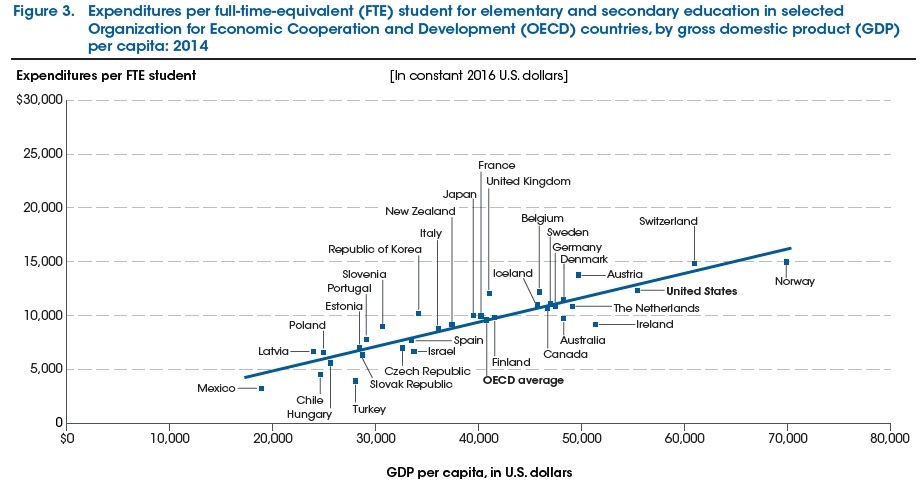
Many of the public policy disputes over education, whether at the K-12 level or at the higher education level, quickly turn into disputes over how much to spent, or whether “enough” is being spent. For some international perspective on these issues, the Condition of Education 2018  has just been published by the National Center for Education Statistics (May 2018). It’s chock-full of useful tables and figures, but here are a few from the “International Comparisons” part of the volume.

First, look at spending per student in OECD countries, as compared with per capita GDP. As the figure shows, the relationship is pretty much a straight line, in which countries with higher per capita GDP spend more on K-12 education. This makes some intuitive sense, given that  teachers are one of the main expenses in any K-12 system, and when a country has higher capita GDP, wages in general and pay for teachers in particular will be higher, too. The figure shows that while a few countries spend a little less than one might expect on K-12 education based on their per capita GDP (Mexico, Ireland) and some spend a little more (Korea, United Kingdom), most countries are quite close to the predicted line, like the United States.

Of course, this doesn’t prove whether the US should dramatically change its level of K-12 education spending. But it suggests that US K-12 spending is not out-of-line with the rest of the world in this area.

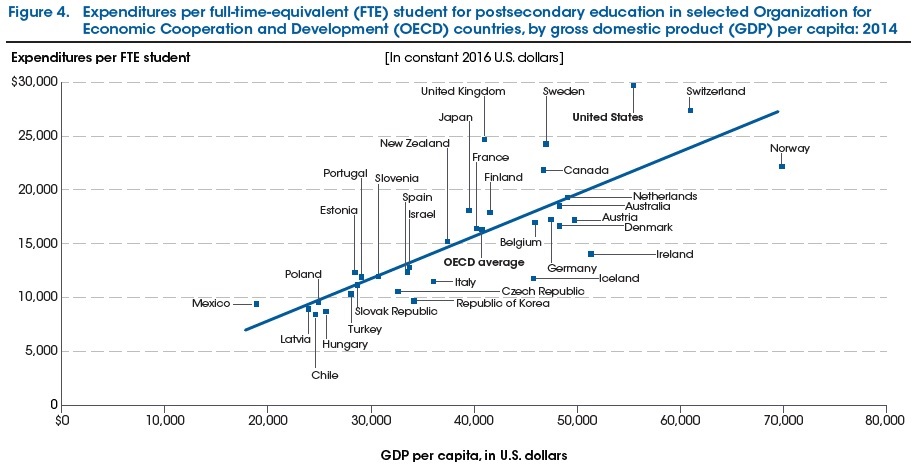
What does a similar figure look like for higher education spending? Some interesting patterns emerge. For example, Mexico spent less on K-12 than one would predict from per capita GDP, but spends more on higher education. Conversely, Korea spent more on K-12 than one would predict based on per capita GDP, but spends less on higher ed. The United States spend way more than any other country on higher education on a per capita basis, and way more than would be predicted based on per capita GDP.

Of course, this doesn’t prove whether the US should dramatically change its level of higher education spending, or how US higher education is delivered. But it suggests that the US higher education experience is different from most of the rest of the world.

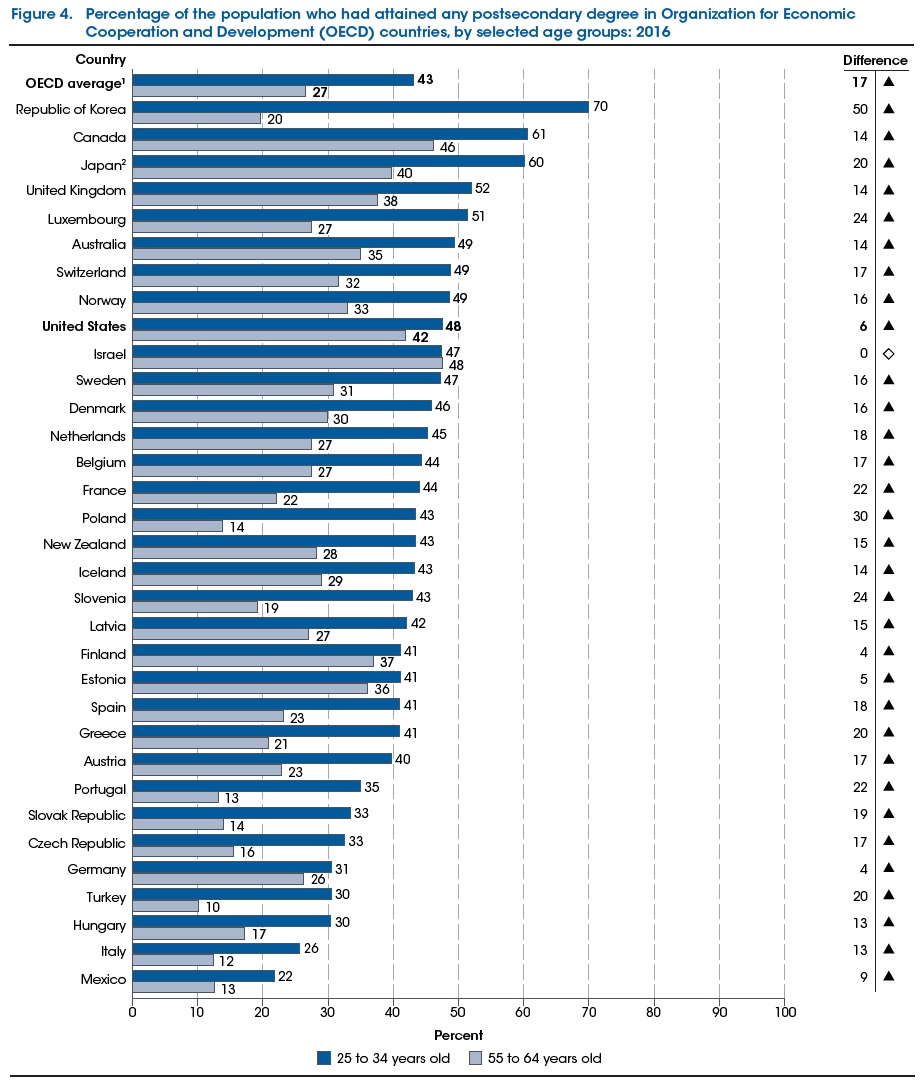
Here’s one more comparison, looking at the share of adults who have a postsecondary degree of some kind. In the figure, the light blue bars show the share in the 55-64 age bracket who have such a degree, while the dark blue bars show the share in the 25-34 age bracket with such a degree. One would generally expect that as higher education expands, a larger share of those in the younger group should have postsecondary degrees, compared with those in the older group, and this pattern holds for most countries.

But notice that for the US, the age 55-64 group was in general more educated than the rest of the world, with the exception of Canada. But for the 25-34 group, the US is still above the OECD average in share with a postsecondary degree, but a number of other countries are now substantially ahead, and the US is much more middle-of-the-pack. When combined with the previous figure, this makes some sense. Given that the US spends vastly more on a per person basis for higher education, it’s more costly for the US to provide a big expansion of higher education for the young adults of today.

Some Economics of Place-Based Policies

When it comes to public policies for helping the poor, economists have tended to favor a focus on individuals who are poor, rather than on places that had a higher share of poor people. This seemed like a better way to target scarce public resources. There was some fear that if the focus shifted to places, much of the benefit would flow to homeowners who lived in those places–and thus saw an improvement in property values– or to local building contractors, rather than helping the poor directly. Also, a healthy economy will see a flow of people moving toward destinations that are more attractive, while place-based support of locations that aren’t doing well would tend to hinder such migration.

But some economists are rethinking the mertics of place-based policies. Benjamin Austin, Edward Glaeser, and Lawrence H. Summers have written “Saving the heartland: Place-based policies in 21st century America ,” for the Spring 2018 issue of the Brookings Papers on Economic Activity. As they argue, we seem to have entered a time when geographic mobility is down and when regional convergence of incomes has dropped off.  They write:

“America�s western frontier may have closed at the end of the 19th century, but there was still a metropolitan frontier where workers from depressed areas could find a more prosperous future. Five facts collectively suggest that this geographic escape valve has tightened: declining geographic mobility, increasingly inelastic housing supplies in high income areas, declining income convergence, increased sorting by skill across space, and persistent pockets of non-employment. Together these facts suggest that even if income differences across space have declined, the remaining economic differences may be a greater source of concern. Consequently, it may be time to target pro-employment policies towards our most distressed areas. …

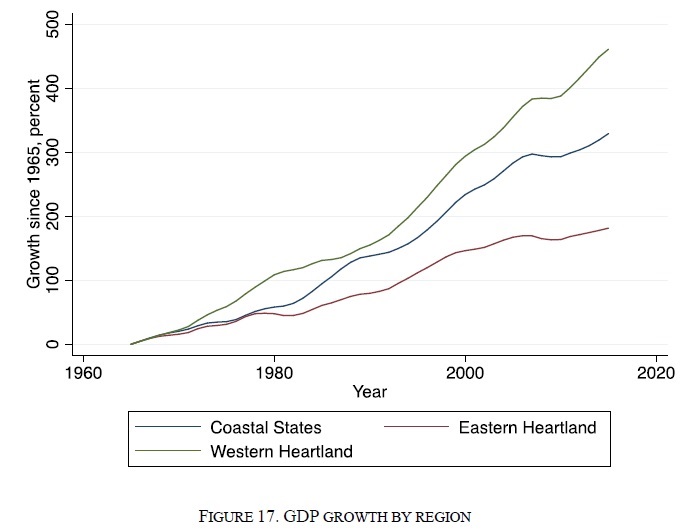
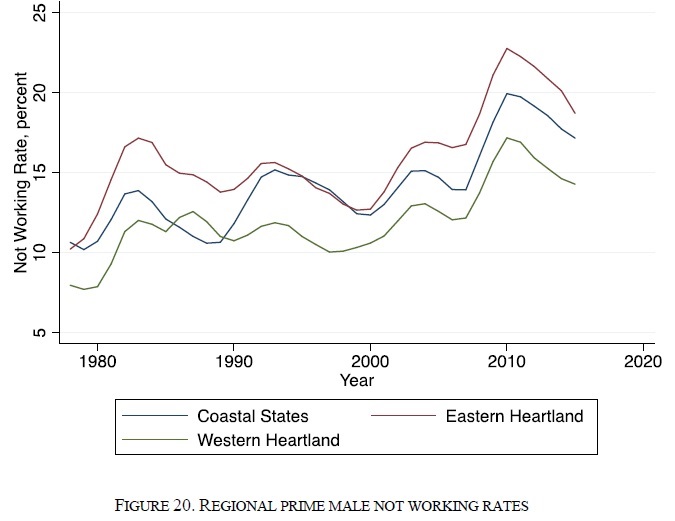
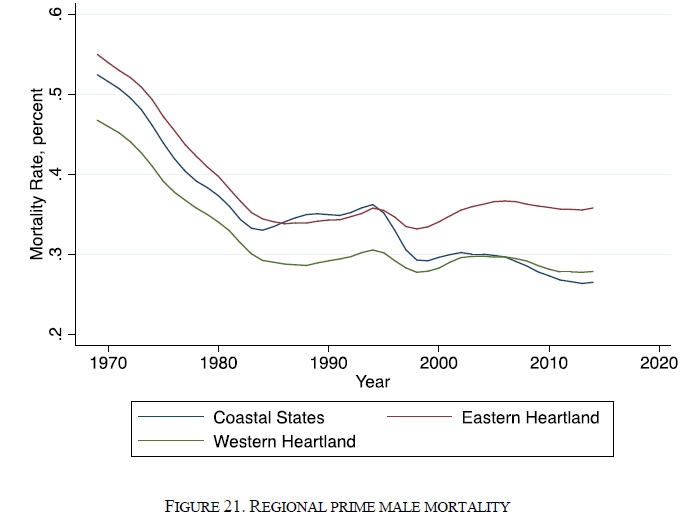
“We divide the U.S. into three regions: the prosperous coasts, the western heartland and the eastern heartland, The coasts have high incomes, but the western heartland also benefits from natural resources and high levels of historical education. America�s social problems, including non-employment, disability, opioid-related deaths and rising mortality, are concentrated in America�s eastern heartland, states from Mississippi to
Michigan, generally east of the Mississippi and not on the Atlantic coast. The income and employment gaps between three regions are not converging, but instead seem to be hardening …”

The paper has a bunch of figures showing differences across these three regions. Here are figures  on economic growth, the share of prime-age men not working, and mortality rates for men across these three regions.

What would place-based policies look like? As the authors point out, such policies can be explicit or implicit. For example, an infrastructure policy like the Tennessee Valley Authority is explicitly aimed at a certain geographic region. However, an infrastructure project like the federal  highway system, or a program like flood insurance, will clearly have specific geographic effects for those closer to highways or at higher risk of floods, without actually naming a certain geographic area. After mulling the options, they suggest that targeted employment subsidies may be the best bet. They write:

“The best case for geographic targeting of policies is that a dollar spent fighting non-employment in a high not working rate area will do more to reduce non-employment than a dollar spent fighting non-employment in a low not working rate area. The empirical evidence for heterogeneous labor supply responses to demand shocks or public interventions is limited, but broadly supportive of the view that reducing the not working rate in some parts of the country is easier than in other parts of the country. …  While infrastructure remains an important investment for America, targeting infrastructure spending towards distressed areas risks producing projects with limited value for users. By contrast, enhanced spending on employment subsidies in high not working rate areas, and perhaps the U.S. as a whole, seems like a more plausible means of reducing not working rates.”

For those interested in this approach, here’s an earlier discussion of “What Do We Know about Subsidized Employment Programs?” (April 25, 2016).

בן-חמו ליטל עורך דין

עורך דין בן-חמו ליטל

בן-חמו ליטל, העורך דין שלך בתל אביב – יפו ובמרכז. ניתן לקבל שרות בתחומים דיני מיסים, מעשה מגונה ייצוג חברות בעולם. השירות ניתן באופן אישי ומקצועי. ניתן לקבל שרותים בנושא חקירת יכולת, הורות משותפת, רשלנות רפואית, בתים משותפים או כל נושא אחר. ניתן ליצור איתנו קשר בטלפון או להגיע למשרד הממוקם באלוני ניסים 16, תל אביב – יפו. בנוסף, משרדנו מתמחה בטיפול במשפט אזרחי, פלילי, ליקויי בנייה ויחסי עובד מעביד.

Economics: Reviled Because It Matters

Marion Foucade is one of the most thoughtful and incisive interpreter/critics of the interaction between academic economics, other disciplines, and the real world. She delivered a keynote address at the 2017 meetings of the Swiss Society of Economics and Statistics. Her talk, “Economics: the view from below,” is available in the Swiss Journal of Economics and Statistics (2018, 154:5) or you can watch video of the presentation here. Here, I’ll quote some snippets that struck me in particular, but the entire lecture is recommended.

“In the course of the twentieth century, economists have been able to establish a remarkable position for themselves, as experts in local and national governmental organizations, in independent agencies and central banks, in international institutions, in business and finance, and in the media. They supplanted lawyers in government and historians in the public sphere. As such, they have been involved with some of the most consequential decisions that societies make�decisions having to do, for instance, with the level of unemployment that might be left unattended, because it should be considered �natural�; with whether or not to authorize the purchase and sale of untested financial products or with how to organize the delivery of clean water, vaccines or electricity. This involvement has come at a cost. As Robert Chernomas and Ian Hudson put it, �economics has the awkward distinction of being both the most influential and the most reviled social science� (2016, 3). We might add: economics may be the most reviled social science precisely because it is the most influential. …

“Where does this belief and the authority of economics come from? Here, it is useful�perhaps�to consider the origin conditions of modern economic discourse. … By knowing the natural laws of the market, political economy offered a way to tell the truth about the correct limits of governmental practice. Government action was not to be judged primarily in terms of legitimacy or justice, but in terms of whether it was right or wrong. And it is the market that was to provide that truth-test, through the work and voice of political economists. … Economists, consequently, have become the guardians and the revelators of this truth, not simply in their own eyes, of course, but in the eyes of everyone, and first and foremost in the eyes of government itself. … 

“Unlike the other social scientific disciplines, economics comes with a promise: the promise to make money, the promise to save money, the promise to allocate money (a rare resource) in the most efficient manner. In other words, part of the authority of economists also comes from their association with whoever holds the purse strings. They navigate the most powerful parts of the world, where financial decisions are being made and where political and corporate leaders are being trained. And, I shall add, this association has become increasingly tight over the course of the twentieth century. Business schools, for instance, have gone from being intellectual backwaters staffed with practitioners to becoming scientific powerhouses filled with disciplinary social scientists (with economics PhDs being the largest group) (Fourcade and Khurana 2013).

“The consequences of this prosperous social position are not trivial. Let us remember that money is not neutral (Frey 1997). It changes people from within. As their jurisdiction has expanded and diversified, economists as a group have seen their financial fortunes multiply. This is especially striking in the USA, where economics is one of the most lucrative degrees over a person�s lifecycle, both at the undergraduate and graduate levels (Weissmann 2014).The salaries of academic economists have grown faster than any other arts and sciences discipline, including �hot� subjects like computer science, over the last 30 years, and opportunities for extra-academic income have proliferated. …

“These thoughts, which expose the fundamentally contingent and heteronomous nature of economic knowledge, are sobering, perhaps. Paradoxically, I do not think that they necessarily bode ill for the discipline. First, we should recognize that what Michael Reay (2012) calls the �flexible unity� of economics is a fundamental component of its strength. On the one hand is a fairly united �way of looking at the world� (Coase 1978, 210) and an eminently recognizable style of reasoning, which is applicable across a broad range of domains: in that sense, economics is a truly generalistic form of expertise, defined by its techniques and epistemological processes rather than by its core beliefs about the way the world works. In fact, what we call the mainstream has been malleable enough to incorporate waves of peripheral (and once rejected) ideas and concepts (think: price rigidities into real business cycle models, increasing returns into growth theory, non-rational behavior). As a result, the core has become multiple and fragmented, but it can still legitimately claim to hold up through, rather than against, this fragmentation. As French regulationist economist Robert Boyer (2016) has recently suggested, this is a paradoxical world in which the respective �truths� of Eugene Fama and Robert Shiller can both legitimately exist, and where the very multi-vocality of the field is actually the mechanism that fosters its resilience.

Want more Fourcade? One starting point is her article “The Superiority of Economists,” co-authored with Etienne Ollion and Yann Algan, in the Winter 2015 issue of the Journal of Economic Perspectives (where I work as Managing Editor). A taste from the abstract: 

“Taken together, these traits constitute what we call the superiority of economists, where economists’ objective supremacy is intimately linked with their subjective sense of authority and entitlement. While this superiority has certainly fueled economists’ practical involvement and their considerable influence over the economy, it has also exposed them more to conflicts of interests, political critique, even derision.”

Misconceptions about Milton Friedman’s 1968 Presidential Address

For macroeconomists, Milton Friedman’s (1968) Presidential Address to the American Economic Association about “The Role of Monetary Policy” marks a central event (American Economic Review, March 1968, pp. 1-17).  Friedman argued that monetary policy had limits. Actions by a central bank like the Federal Reserve could have short-run effects on an economy–either for better or for worse. But in the long-run, he argued, monetary policy affected only the price level. Variables like unemployment or the real interest rate were determined by market forces, and tended to move toward what Friedman called the “natural rate”–which is potentially confusing term for saying that they are determined by forces of supply and demand. 

Here, I’ll give a quick overview of the thrust of Friedman’s address, a plug for the recent issue of the Journal of Economic Perspectives, which has a lot more, and point out a useful follow-up article that clears up some misconceptions about Friedman’s 1968 speech.

The Winter 2018 issue of the Journal of Economic Perspectives, where I work as Managing Editor, we published a three-paper symposium on “Friedman’s Natural Rate Hypothesis After 50 Years.” The papers are:

I won’t try to summarize the papers here, along with the many themes they offer on how Friedman’s speech influenced the macroeconomics that followed or what aspects of Friedman’s analysis have held up better than others. But to giver a sense of what’s a stake, here’s an overview of Friedman’s themes from the paper by Mankiw and Reis:

“Using these themes of the classical long run and the centrality of expectations, Friedman takes on policy questions with a simple bifurcation: what monetary policy cannot do and what monetary policy can do. It is a division that remains useful today (even though, as we discuss later, modern macroeconomists might include different items on each list). 

“Friedman begins with what monetary policy cannot do. He emphasizes that, except in the short run, the central bank cannot peg either interest rates or the unemployment rate. The argument regarding the unemployment rate is that the trade-off described by the Phillips curve is transitory and unemployment must eventually return to its natural rate, and so any attempt by the central bank to achieve otherwise will put inflation into an unstable spiral. The argument regarding interest rates is similar: because we can never know with much precision what the natural rate of interest is, any attempt to peg interest rates will also likely lead to inflation getting out of control. From a modern perspective, it is noteworthy that Friedman does not consider the possibility of feedback rules from unemployment and inflation as ways of setting interest rate policy, which today we call �Taylor rules� (Taylor 1993).

“When Friedman turns to what monetary policy can do, he says that the �first and most important lesson� is that �monetary policy can prevent money itself from being a major source of economic disturbance� (p. 12). Here we see the profound influence of his work with Anna Schwartz, especially their Monetary History of the United States. From their perspective, history is replete with examples of erroneous central bank actions and their consequences. The severity of the Great Depression is a case in point.

“It is significant that, while Friedman is often portrayed as an advocate for passive monetary policy, he is not dogmatic on this point. He notes that �monetary policy can contribute to offsetting major disturbances in the economic system arising from other sources� (p. 14). Fiscal policy, in particular, is mentioned as one of these other disturbances. Yet he cautions that this activist role should not be taken too far, in light of our limited ability to recognize shocks and gauge their magnitude in a timely fashion. The final section of Friedman�s presidential address concerns the conduct of monetary policy. He argues that the primary focus should be on something the central bank can control in the long run�that is, a nominal variable … “

Edward Nelson offers a useful follow-up to these JEP papers in  �Seven Fallacies Concerning Milton Friedman�s `The Role of Monetary Policy,'” Finance and Economics Discussion Series 2018-013, Board of Governors of the Federal Reserve System, Nelson summarizes at the start:

“[T]here has been widespread and lasting acceptance of the paper�s position that monetary policy can achieve a long-run target for inflation but not a target for the level of output (or for other real variables). For example, in the United States, the Federal Open Market Committee�s (2017) �Statement on Longer-Run Goals and Policy Strategy� included the observations that the �inflation rate over the longer run is primarily determined by monetary policy, and hence the Committee has the ability to specify a longer-run goal for inflation,� and that, in contrast, the �maximum level of employment is largely determined by nonmonetary factors,� so �it would not be appropriate to specify a fixed goal for employment.�

Nelson then lays out seven fallacies. The details are in his paper: here, I just list the fallacies with a few words of his explanations.

Fallacy 1: �The Role of Monetary Policy� was Friedman�s first public statement of the natural rate hypothesis
“Certainly, Friedman (1968) was his most extended articulation of the ideas (i) that an expansionary monetary policy that tended to raise the inflation rate would not permanently lower the unemployment rate, and (ii) that full employment and price stability were compatible objectives over long periods. But Friedman had outlined the same ideas in his writings and in other public outlets on several earlier occasions in the 1950s and 1960s.”

Fallacy 2: The Friedman-Phelps Phillips curve was already presented in Samuelson and Solow�s (1960) analysis
“A key article on the Phillips curve that is often juxtaposed with Friedman (1968) is Samuelson  and Solow (1960). This paper is often (and correctly, in the present author�s view) characterized as advocating the position that there is a permanent tradeoff between the unemployment rate and  inflation in the United States.”

Fallacy 3: Friedman�s specification of the Phillips curve was based on perfect competition and no nominal rigidities
“Modigliani (1977, p. 4) said of Friedman (1968) that �[i]ts basic message was that, despite appearances, wages were in reality perfectly flexible.� However, Friedman (1977, p. 13) took exception to this interpretation of his 1968 paper. Friedman pointed out that the definition of the natural rate of unemployment that he gave in 1968 had recognized the existence of imperfectly competitive elements in the setting of wages, including those arising from regulation of labor markets. Further support for Friedman�s contention that he had not assumed a perfectly competitive labor market is given by the material in his 1968 paper that noted the slow adjustment of nominal wages to demand and supply pressures. … Consequently, that (1968 Friedman] framework is
consistent with prices being endogenous�both responding to, and serving as an impetus for, output movements�and the overall price level not being fully flexible in the short run.”

Fallacy 4: Friedman�s (1968) account of monetary policy in the Great Depression contradicted the Monetary History�s version
“But the fact of a sharp decline in the monetary base during the prelude to, and early stages of, the 1929-1933 Great Contraction is not in dispute, and it is this decline to which Friedman (1968) was presumably referring.” 

Fallacy 5: Friedman (1968) stated that a monetary expansion will keep the unemployment rate and the real interest rate below their natural rates for two decades
“[T]these statements are inferences from the following passage in Friedman (1968, p. 11): �But how long, you will say, is �temporary�? � I can at most venture a personal judgment, based on some examination of the historical evidence, that the initial effects of a higher and unanticipated rate of inflation last for something like two to five years; that this initial effect then begins to be reversed; and that a full adjustment to the new rate of inflation takes about as long for employment as for interest rates, say, a couple of decades.� The passage of Friedman (1968) just quoted does not, in fact, imply that a policy involving a shift to a new inflation rate involves twenty years of one-sided unemployment and real-interestrate gaps. Such prolonged gaps instead fall under the heading of Friedman�s �initial effects� of  the monetary policy change�effects that he explicitly associated with a two-to-five-year period, with the gaps receding beyond this period. Friedman described �full adjustment� as comprising decades, but such complete adjustment includes the lingering dynamics beyond the main  dynamics associated with the initial two-to-five year period. It is the two-to-five year period that would be associated with the bulk of the nonneutrality of the monetary policy change.”

Fallacy 6: The zero lower bound on nominal interest rates invalidates the natural rate hypothesis
“A zero-bound situation undoubtedly makes the analysis of monetary policy more difficult. In addition, the central bank in a zero-bound situation has fewer tools that it can deploy to stimulate aggregate demand than it has in other circumstances. But, important as these complications are, neither of them implies that the long-run Phillips curve is not vertical.”

Fallacy 7: Friedman�s (1968) treatment of an interest-rate peg was refuted by the rational expectations revolution. 
“The propositions that the liquidity effect fades over time and that real interest rates cannot be targeted in the long run by the central bank remain widely accepted today. These valid propositions underpinned Friedman�s critique of pegging of nominal interest rates.”

Since the JEP published this symposium, I’ve run into some younger economists who have never read Friedman’s talk and lack even a general familiarity with his argument. For academic economists of whatever vintage, it’s an easily readable speech worth becoming acquainted with–or revisiting.

Wakanda and Economics

I told my teenage son that the economics of Wakanda, the home country of the “Black Panther” in the recent movie, raised some interesting questions. He looked at me for a long moment and then explained very slowly: “Dad, it’s not a documentary.” Duly noted. No superhero movie is a documentary, and pretty much by definition, even asking for plausibility from a superhero movie is asking too much.  But undaunted, I continue to assert that the economy of Wakanda raises some interesting questions. For some overviews, see:

For the 8-10 people on Planet Earth not yet familiar with the premise, Wakanda sits on top of the world’s only supply of a rare mineral called “vibranium,” which absorbs vibrations, including sound, kinetic motion, and also gives off the magic “radioactivity” which in superhero movies then creates whatver other human strengths or plant and animals that seem useful for the plot. Wakanda has used this mineral as the basis for building what is portrayed in the movie as a very technologically advanced and sophisticated economy. However, a quick glance around the world economy suggests that countries endowed with valuable natural resources don’t always show broad-based economic success or participatory forms of governance (think Venezuela, Angola, or Saudi Arabia).

There’s a substantial research literature on the “the resource curse question” of why natural resources have so often been accompanied by a lack of growth. For an overview, see Anthony J. Venables, 2016. “Using Natural Resources for Development: Why Has It Proven So Difficult?” Journal of Economic Perspectives (Winter 2016, 30:1, pp. 161-84).  When a country is in a situation in which the export of a key natural resource looms large, it often leads to a situation of economic and political economy. Moreover, a country with very large exports in one area is likely to have an economy that is not well-diversified, and thus become vulnerable to price shocks concerning that resource.

How does Wakanda escape these traps? Well, it isn’t obvious that it escapes all of them. Political power in Wakanda is concentrated in a hereditary monarchy, with arguments over succession decided by ritual combat. However, the comic books also suggest that Wakanda sells enough vibranium on world markets to raise money for a large national investment in science and technology. Thus, Wakanda manages to become a combination technology-warrior state, in which the leaders seem to be generally beneficent.

In the real world, countries that have managed to overcome the resource curse to at least some extent, like Norway, Indonesia, Botswana, and others, often have a government focus on spreading the benefits of their mineral exports across the population. In turn, widespread buying power in the economy helps other industries to develop. A “social fund” is often set up to fund human capital and financial investment, and to assure that the benefits of mineral exports will be spread out over time.

The level of inequality in Wakanda the “Black Panther” movie is not clear. In the old comic books, the Black Panther is described as the richest person in the world, thanks to effective ownership of the mineral wealth, while some people of Wakanda are portrayed as living in traditional huts. The movie portrayal of household life in Wakanda and the full distribution of income is not clear (“Dad, it’s not a documentary!”) but in various montage scenes of daily life, it does not appear that everyone is living in modern luxury. 
As a scientist-warrior state with an unlimited supply of cheap vibranium, Wakanda has managed to develop many upstream uses of vibranium, with a variety of applications to transportation, health, and weapons. In the real world, developing upstream uses of domestic resources is often tricky. It works, sometimes; for example, Botswana has managed to have more diamond-cutting and sales done in Botswana, rather than elsewhere. But it is hard for the economy of a small country to stretch all the way from traditional economic practices all the way up to the highest techology, with all the steps in-between. As the Economist notes:  “Countries often find it easier to move diagonally, rather than vertically, graduating into products that belong to different value chains but require similar mixes of labour, capital and knowhow.”
Wakanda has a high level of prosperity while being almost entirely cut off from the outside world. This seems to me an ongoing dream of politicians from communities countries: how can my jurisdiction become well-off by trading with itself. In this view, trade and investment by outsiders almost always ends up being exploitative, and best minimized or avoided. However, rhere are not any countries that have managed to accomplish this combination of economic development and splendid isolation in the real world.  
The underlying issue here is that Wakanda is portrayed as being well-off because of its combination of vibranium and science. But in the real world, economic development typically involves a number of complementary ingredients. For example,  vibranium had to be discovered, mined, and refined. There had to be process for discovering its  scientific properties, and then engineered these properties into products. An obvious question (for economists, at least) was who had the incentive to do the innovation, the trial-and-error learning, and the investments in human and physical capital to make all this happen? In the real world, all of this happens against a backdrop of incentives, competition, property rights, financial contracts, and on The movie doesn’t give us a back-story here. (“Dad, it’s not a documentary.”) But technologically leading economies typically don’t emerge through the actions of a beneficent hereditary monarch.  
For an economist, an obvious question is whether the people of Wakanda might be better off with greater openness to the world. From a pure economic point of view, it seems clear that Wakanda could benefit from a greater opening to international trade. At Wakanda’s stage of technological development, it wouldn’t even be necessary to sell vibranium. Instead, it could sell services that made use of vibranium like construction and public works, health care, and the like, while still keeping control of the underlying resource.  
But economics isn’t everything. Wakanda also clearly places a high value on its traditional culture, which can be a two-edges sword. For many people much of the time, traditional culture can be a source of purpose and meaning; but for many of the same people at least some of the time, traditional culture can also feel like a trap and a limitation.  I learned from reading Subrick’s paper about recent developments in the back story. He writes:

“Although the Black Panther has retained political legitimacy throughout the centuries, in the new millennium Wakandans have begun to question the validity of their government. The Black Panther�s support depends on his ability to provide the most basic of public goods�security from outside invasion and domestic turmoil. In the story arc �A Nation Under Our Feet� Ta-Nehisi Coates and Brian Stelfreeze describe a Wakanda on the verge of civil war. The combination of the never-ending attempts by outsiders to steal vibranium, recent internal challenges to his rule, and political intrigue, not to mention a terrorist organization poisoning the minds of the people, have raised the question of whether a monarchy and freedom are compatible. Government by a monarch in the age of democracy creates tensions within society. Furthermore, high levels of income inequality exacerbate these societal pressures. In Wakanda, traditional ways of life exist in the presence of the world�s most sophisticated technologies. Citizens live in huts that are located next to the factories. A disenfranchised and relative poor citizenry are beginning to demand massive social change.”

To put it another way, the concerns of social scientists about the resource curse, inequality, openness to international trade, and lack of democracy are actually becoming, in their own way, part of the plot.

The Distressingly Weak Lessons of Research on Gun Control

If you want to know what actual research on the effects of various gun control policies have to say, the RAND Corporation has your back. It has published a lengthy reports: “The Science of Gun Policy:  A Critical Synthesis of Research Evidence on the Effects of Gun Policies in the United States,” by a team of 17 researchers led by Andrew R. Morral. A smaller group led by Morral also published  “The Magnitude and Sources of Disagreement Among Gun Policy Experts.”  And there’s also a nice accessible website with a summary of results and links to these more detailed studies. They write: 

The 13 classes of gun policies considered in this research are as follows:

1. background checks
2. bans on the sale of assault weapons and high-capacity magazines
3. stand-your-ground laws
4. prohibitions associated with mental illness
5. lost or stolen firearm reporting requirements
6. licensing and permitting requirements
7. firearm sales reporting and recording requirements
8. child-access prevention laws
9. surrender of firearms by prohibited possessors
10. minimum age requirements
11. concealed-carry laws
12. waiting periods
13. gun-free zones.

The eight outcomes considered in this research are

1. suicide
2. violent crime
3. unintentional injuries and deaths
4. mass shootings
5. officer-involved shootings
6. defensive gun use
7. hunting and recreation
8. gun industry.

They focus on high-quality studies published since 2003. They write:

“[W]e produced research syntheses that describe the quality and findings of the best available scientific evidence. Each synthesis defines the class of policies being considered; presents and rates the available evidence; and describes what conclusions, if any, can be drawn about the policy�s effects on outcomes. In many cases, we were unable to identify any research that met our criteria for considering a study as providing minimally persuasive evidence for a policy�s effects. Studies were excluded from this review if they offered only correlational evidence for a possible causal effect of the law, such as showing that states with a specific law had lower firearm suicides at a single point in time than states without the law. Correlations like these can occur for many reasons other than the effects of a single law, so this kind of  evidence provides little information about the effects attributable to specific laws. We did not exclude studies on the basis of their findings, only on the basis of their methods for isolating causal effects. For studies that met our inclusion criteria, we summarize key findings and methodological weaknesses, when present, and provide our consensus judgment on the overall strength of the available scientific evidence.”

One main result is that the actual evidence is pretty thin. “Of more than 100 combinations of policies and outcomes, we found that surprisingly few were the subject of methodologically rigorous investigation.” For example, evidence on four of the eight outcomes was “essentially unavailable,” including defensive gun use, officer-involved shootings, hunting and recreation, and effects on the gun industry. None of the studies of waiting periods and licencing and permitting requirements have reached more than inconclusive results. There are no methodologically sound studies at all on the effects of gun-free zones or requirements for reporting of lost or stolen firearms. I’ll just list the study’s overall conclusions here:

Conclusion 1. Available evidence supports the conclusion that child-access prevention laws, or safe storage laws, reduce self-inflicted fatal or nonfatal firearm injuries among youth. There is moderate evidence that these laws reduce firearm suicides among youth and limited evidence that the laws reduce total (i.e., firearm and nonfirearm) suicides among youth.

Conclusion 2. Available evidence supports the conclusion that child-access prevention laws, or safe storage laws, reduce unintentional firearm injuries or unintentional firearm deaths among children. In addition, there is limited evidence that these laws may reduce unintentional firearm injuries among adults. …

Conclusion 3. There is moderate evidence that background checks reduce firearm suicides and firearm homicides, as well as limited evidence that these policies can reduce overall suicide and violent crime rates.

Conclusion 4. There is moderate evidence that stand-your-ground laws may increase state homicide rates and limited evidence that the laws increase firearm homicides in particular.

Conclusion 5. There is moderate evidence that laws prohibiting the purchase or possession of guns by individuals with some forms of mental illness reduce violent crime, and there is limited evidence that such laws reduce homicides in particular. There is also limited evidence these laws may reduce total suicides and firearm suicides. …

Conclusion 6. There is limited evidence that before implementation of a ban on the sale of assault weapons and high-capacity magazines, there is an increase in the sales and prices of the products that the ban will prohibit.

Conclusion 7. There is limited evidence that a minimum age of 21 for purchasing firearms may reduce firearm suicides among youth.

Conclusion 8. No studies meeting our inclusion criteria have examined required reporting of lost or stolen firearms, required reporting and recording of firearm sales, or gun-free zones. …

Conclusion 9. The modest growth in knowledge about the effects of gun policy over the past dozen years reflects, in part, the reluctance of the U.S. government to sponsor work in this area at levels comparable to its investment in other areas of public safety and health, such as transportation safety. …

Conclusion 10. Research examining the effects of gun policies on officer-involved shootings, defensive gun use, hunting and recreation, and the gun industry is virtually nonexistent.

Conclusion 11. The lack of data on gun ownership and availability and on guns in legal and illegal markets severely limits the quality of existing research. …

Conclusion 12. Crime and victimization monitoring systems are incomplete and not yet fulfilling their promise of supporting high-quality gun policy research in the areas we investigated. …

Conclusion 13. The methodological quality of research on firearms can be significantly improved.

Of course, absence of evidence is not evidence of absence–that is, just because there is a lack of evidence on certain policies or outcomes doesn’t prove that those policies don’t work. But it does suggest that a degree of humility might be appropriate on all sides. As a hopelessly out-of-touch academic, perhaps there could be bipartisan consensus on building up the data and evidence so that better studies can be done, but maybe this is a situation where neither side wishes to take the risk tha their presuppositions might be rebutted. Or at least when gun control laws are passed, the law could include a specific provision for exactly how those laws will be meaningfully evaluated a few years down the road.

Follow-up on 3/13/18: Faithful reader DK reminds me that Congress blocked the public health authorities from doing research into gun control issues back in the 1990s, as the New York Times just reported.  I’m pretty much always in favor of additional research, and I don’t like research being limited  That said, it seems pretty clear to me as someone who has never fired a gun and tends to favor additional gun controls that most public health researchers then and now have been so  stridently anti-gun that their research was not trustworthy. I also tend to view gun policy as a social science issue, which is best tackled with the social science research methods like those considered in the RAND report. It’s not clear to me that public  health researchers have the tools or expertise to address it appropriately.

Design a site like this with WordPress.com
Get started