Sweden Heads Toward a Cash-Free Economy

Sweden seems headed toward a cash-free economy. Here are some comments from Stefan Ingves, Governor of Sveriges Riksbank, the central bank of Sweden, in a short essay called “Going Cashless:
The governor of the world�s oldest central bank discusses his country�s shift toward digital money” (Finance & Development, March 2018, 55:2, pp. 11-12):

“Sweden is rapidly moving away from cash. Demand for cash has dropped by more than 50 percent over the past decade as a growing number of people rely on debit cards or a mobile phone application, Swish, which enables real-time payments between individuals. More than half of all bank branches no longer handle cash. Seven out of ten consumers say they can manage without cash, while half of all merchants expect to stop accepting cash by 2025 (Arvidsson, Hedman, and Segendorf 2018). And cash now accounts for just 13 percent of payments in stores, according to a study of payment habits in Sweden (Riksbank 2018). …

I am convinced that within 10 years we will almost exclusively be paying digitally, both in Sweden and in many parts of the world. Even today, young people, at least in Sweden, use practically no cash at all. This demographic dimension is also why I believe that cash�s decline can be neither stopped nor reversed. While the Nordic countries are at the forefront, we are not alone. It is interesting to see how quickly the Chinese payments market, for instance, is changing.

Ingves mentions some issues that are likely to arise with this transition. One is that “it will likely further limit financial access for groups in society that currently lack any means of payment other than cash.” Other issues are the extent to which the new payments infrastructure, which may shift in substantial part from central banks to private firms, will be safe, secure, rapid, and low-cost.

I would also add that the prospects of a cash-free society offers an interesting angle on proposals to eliminate large-denomination bills (for example, see “Eliminate High-Denomination Bills” (March 18, 2016). The usual justification for such a step is that it will make life much harder for criminals and drug dealers, and also that it could help a central bank to run a more expansionary monetary policy if interest rates have already been pushed down to near-zero (as happened in the US after the Great Recession). If most people find that they are no longer using cash at all, the practical difficulties of eliminating high denomination bills are likely to look more surmountable. 

If We Pay Football Players, Why Not Kidney Donors?

Here’s a nice question to kick around the classroom or the lunch-table: “If we pay football players, why not kidney donors?” Philip J. Cook and Kimberly D. Krawiec argue that both should be paid in Regulation magazine (Spring 2018, pp. 12-17).

In the context of football, players receive compensation for actions that benefit others–specifically, those who enjoy watching for entertainment–but also impose risks of both short-term and long-term negative health outcomes. In the context of kidney donations, potential living donors are forbidden from receiving compensation for actions that can be literally life-saving for others–specifically, donating a kidney–on the grounds that it may increase a risk of poor health outcomes. The authors write: 

“Although living kidney donation is a common medical procedure and donors usually enjoy a full recovery, the loss of a kidney poses long-term health risks, in particular that of renal failure if the donor�s remaining kidney fails. In the United States and most every other country (with the notable exception of Iran), kidney donation is permitted but financial compensation for donors is prohibited. Not only is there no legal market for kidneys, donors in the United States are often not even reimbursed for their full out-of-pocket cost in making the donation. 

“The ban on compensation may protect potential donors from the temptation of easing their financial situation by giving up a kidney, a choice they may regret in later years. But this regulation has dire consequences. 

“The need for transplantable kidneys is great, far exceeding current availability from deceased and living donations. The official waiting list of Americans with renal failure is now approximately 100,000, with a typical wait time of five years or more. Those on the waiting list are kept alive by dialysis, which is both costly to taxpayers (because Medicare pays for a large percentage of the costs) and debilitating to the patients. Even with dialysis, thousands of renal-failure patients die each year for want of a suitable kidney. This wait could be largely eliminated by easing the current ban on compensation for donors. An adequate supply of living donors would be especially valuable because living donors tend to provide higher quality kidneys with greater opportunity for developing a close tissue match, thus reducing the chance of rejection … 

“While the recent evidence on the long-term medical damage from concussion has caused widespread concern, there is no prominent voice calling for a ban on professional football. Indeed, a ban is unthinkable in the foreseeable future. That observation helps illustrate the importance of history, custom, and established  interests in shaping the debate over regulating risky activity. But if we could start fresh, the current configuration of activities for which compensation is banned would seem very odd. 

“If ethical concerns persuade thoughtful people that the �right� answer is to ban compensation for kidney donation, then the same logic would suggest that compensation should also be banned for participation in violent sports. If the �right� answer is to permit compensation for participation in violent sports, then compensation for kidney donation should also be permitted. We see no logical basis for the current combination of banning compensation for kidney donors while allowing compensation for football players and boxers.”

Like a lot of useful analogies, the value of this question isn’t to parse details about whether football and kidney donations are literally identical, but to use the question to explore attitudes about bodily risk, benefits, and monetary payments.  Cook and Krawiec also point out that annual revenues for the National Football League are about $13 billion, while one cost-benefit study of paying for kidney donation suggests that such a policy could save taxpayers about $12 billion per year in expenses for people with kidney disease awaiting a donation, in addition to saving thousands of lives and improving the quality of life for tens of thousands of those with severe kidney disease.

For some previous posts on paying kidney donors and on programs to facilitate kidney exchanges, see: 

The Shifting Connections from Education to Job Skills

The Council on Foreign Relations has published The Work Ahead Machines, Skills, and U.S. Leadership in the Twenty-First Century, which is an Independent Task Force Report chaired by John Engler and Penny Pritzker,  Some of the discussion goes over familiar ground: innovation is needed, technology is changing work, economic growth is important, we should redesign unemployment assistance and sick leave for the modern work force, we should do more to assist displaced workers, and so on.  But I want to focus on one chapter of the report, “Education, Training, and the Labor Market,” and its discussion of that how the interaction between education and job training has been shifting.

Early in the 20th century, for example, the US experienced an enormous surge in high school completion rates, and for most of those graduates, the high school education was good and sufficient preparation for moving into the workforce. The report notes (footnotes omitted):

“From 1910 to 1940, just as modern techniques of mass production were being spread across the country, the number of fourteen- to seventeen-year-old Americans attending high school rose from 18 to 73 percent, and high school completion rose from 9 to 51 percent. No other country even came close to achieving these levels until decades later. Most of the progress was led by state and local governments and citizen groups seized with the urgency of extending free education to as many young people as possible, not by the federal government. The lack of accessible educational opportunities that are clearly and transparently linked to the changing demands of the job market is a significant obstacle to improving work outcomes for Americans. Most of these students did not go on to college but rather went directly into the workforce, with high school completion marking the essential credential needed for most to succeed.”

For jobs in the modern economy, a high school education often isn’t enough. But frankly, a college education often isn’t enough either–because a gap has developed between the skills that employers want and the outcome of many college degrees. The report says: 

Increasingly, the challenge is not just providing more education but providing better-targeted education that leads to better work opportunities, even as the target will continue to shift as new technologies are adopted. The number of job openings nationwide�nearly six million�is near record level, yet many employers say they struggle to find the employees they need. The challenges exist not only in higher-paying jobs in information technology and business services, but also in a range of middle-wage jobs, from nursing to manufacturing to traditional trades. The primary focus of the educational system has continued to be formal education for young people�increasing high school completion rates and expanding college enrollment and completion. But that system is too often inadequate in preparing Americans for many of the faster-growing, better-paying
jobs in which employers are looking for some mixture of soft skills, specific technical skills, some practical on-the-job experience, and a capacity for lifelong learning. 

But while employers complain about what the education system isn’t providing, they mostly haven’t taken an active role in trying to get what they need.  Many employers have scaled back on on-the-job training. The report says: 

“Employers, for their part, have been slow to develop or expand their own training systems to fill in the gaps from the educational system. …  Personnel hiring decisions may be the most important ones that any employer makes, yet most employers make those decisions entirely on the spot market. No company would leave its acquisition of critical raw materials or components to the last moment, but most hiring decisions are made as jobs come open. Employers find themselves competing for often scarce pools of talent, without developing and deepening those talent pools themselves. According to a Harvard Business School survey, just one-quarter of  companies have any type of relationship with local community colleges to help prepare employees with the skills they need. Not surprisingly, given their lack of involvement, many companies complain that too few graduates leave school with skills that employers are demanding.  … A successful workforce model for the twenty-first century will require a different mind-set. Employers need to think about not just competing for talent, but also how to develop the pipeline of talent they need to build their workforce. That will require greater collaboration not just with educational providers but also with other, even competing, employers. Employers should embrace collaborative approaches to talent development; big gains could be made, for example, by industry sectors working together to ensure a steady flow of properly educated and trained students for their future workforce. … Such work-experience programs are too rare�just 20 percent of adults report having received any sort of work experience as part of their education, and most of that was concentrated in health care and teaching.” 

The report is full of cheerful, chipper examples: collaborations between a company and a community college, apprenticeship programs, companies that offers mid-career retraining options, and so on. All good things! But it feels to me as if the scale and scope of the necessary shift is very large–indeed, so large that I am uncertain as to whether the currently constituted educational-employer complex can handle it. 
The report says:  “Making job preparation an education priority will require transformations that are every bit as dramatic as those that came about in the early part of the twentieth century.” Take that thought seriously for a moment. As noted above, from 1910 to 1940, “the number of fourteen- to seventeen-year-old Americans attending high school rose from 18 to 73 percent, and high school completion rose from 9 to 51 percent.” I’m not seeing a groundswell of change for the education system or its relationship to jobs that in any way even remotely approaches this scale of change 
Most people in education (like me) are comfortable in a process of learning through books and classrooms. When given a task like “job skills preparation,” we can talk a good game about change (we’re good at talking), but our natural instinct is to find a textbook on the subject and start drawing up homework assignments. Follow up with some standardized written tests to confer some newfangled set of credentials, and we academics feel as if we’ve done a pretty good job. But that approach only functions well for a subset of future workers. 
Meanwhile, the online labor market is a chaos of websites run by companies and by third parties. Those who can navigate the system are often the same ones who are comfortable filling out forms in classrooms and doing book reports. Again, it only functions well for a subset of future workers. The education-employer system is dramatically ill-equipped to help large number of mid-career workers retool and retrain as technology evolves.

But American public opinion believes that education should offer clear connections to work. As the report says: 

“Americans increasingly believe that job preparation is a crucial mission for educators. The 2017 Phi Delta Kappa poll on attitudes toward public schools found that Americans want schools to �help position students for their working lives  after school. That means both direct career preparation and efforts to develop students� interpersonal skills.� Specifically, while support for rigorous academic programs remains strong, 82 percent of  Americans also want to see job and career classes offered in schools, and  86 percent favor certificate or licensing programs that prepare students for employment.”

It seems to me that a lot of employers would prefer not to be involved in training, and just want educators to do it, while a lot of educators would prefer that employers remain at arms-length from their curriculum and classrooms. I think some of the discomfort of Americans with the US labor market, despite the very low unemployment rates, comes from a concern that our society is not coming to grips with issue of building job skills that lead to secure and productive careers. 

Snapshots of the Salubrious US Labor Market

The US unemployment rate has been less than 4% for the last couple of months, which might seem sufficient reason for breaking out the champagne. But the sense of celebration has been generally restrained.

Some of the reasons for hesitancy are probably just politics. My strong suspicion is that if a Democrat was sitting in the White House, a lot of Democrats would find reason to think that a 3.8% unemployment rate was excellent news. And while President Trump is happy to claim credit for a 3.8% unemployment rate, he is not willing to draw the inference that the need for a trade war to “save US jobs” is apparently pretty low just now. But beyond politics, my sense is that a lot of people don’t realize that a number of the concerns over the labor market that were relevant a few years have since mostly gone away.

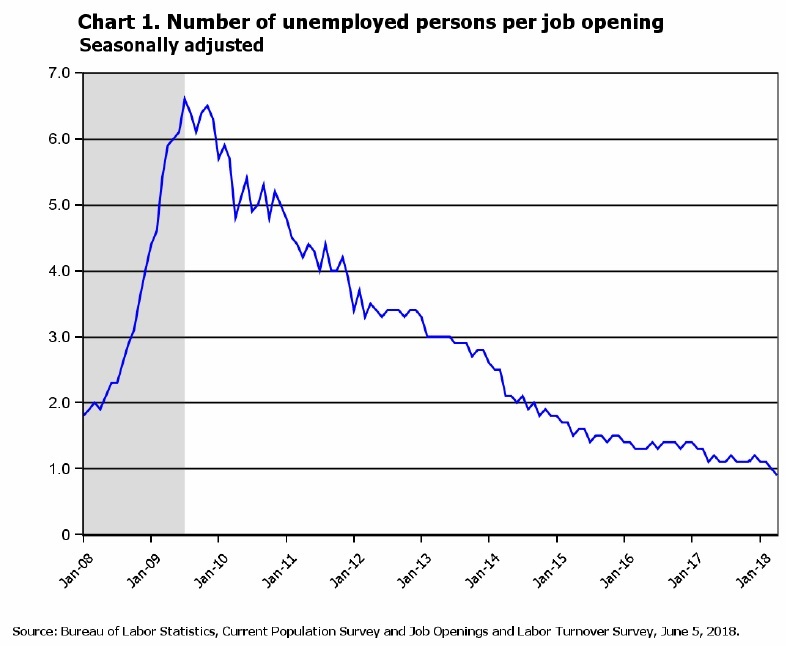
For a vivid example of the strength of the US labor market, consider this figure from the Job Openings and Labor Turnover Survey of the Bureau of Labor Statistics. It shows the ratio of unemployed persons per job opening. Back at the worst of the Great Recession, there were more than six unemployed people for every job opening. In the most recent data, there are actually more job openings than unemployed people. 

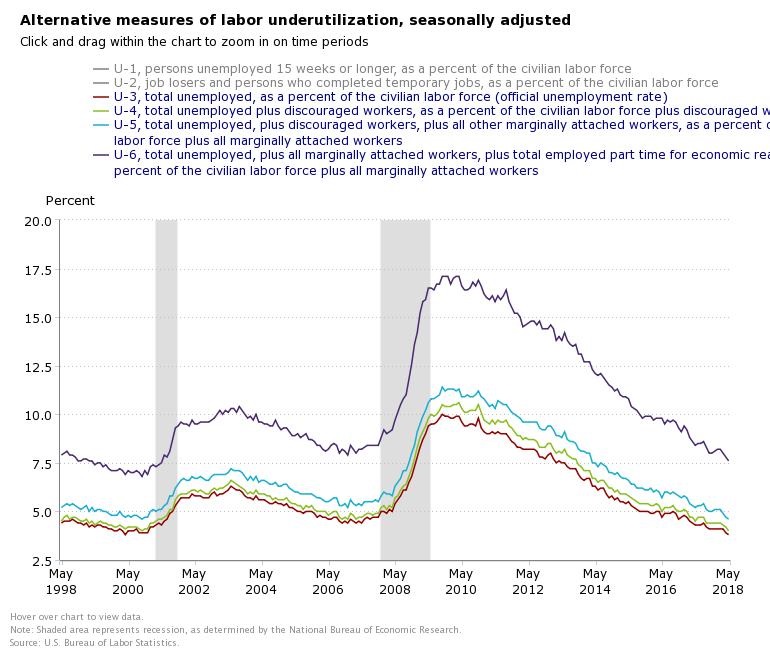
Or consider the concern that although unemployment has dropped, a substantial portion of the decline is due to adults who have become discourage, left the workforce and are no longer looking for jobs, or who have taken part-time jobs but would prefer full-time. Here’s a figure from the Bureau of Labor Statistics showing several different measures of unemployment. The red line at the bottom is the standard unemployment rate. The light green line just above it adds the “discouraged” workers who would like a job. and looked for a job in the previous year, but have stopped looking because they don’t think one is available. The teal line above that adds both discouraged and “marginally attached” workers, who looked for a job in the previous year and have stopped looking (even though they recognize that jobs are available). The top purple line includes the unemployed, discouraged, marginally attached, and those who are working part-time but would rather work full-time.

Overall, there are a lot of ways to look at unemployment, but whatever measure you choose, the measure is essentially back to what it was before the Great Recession.

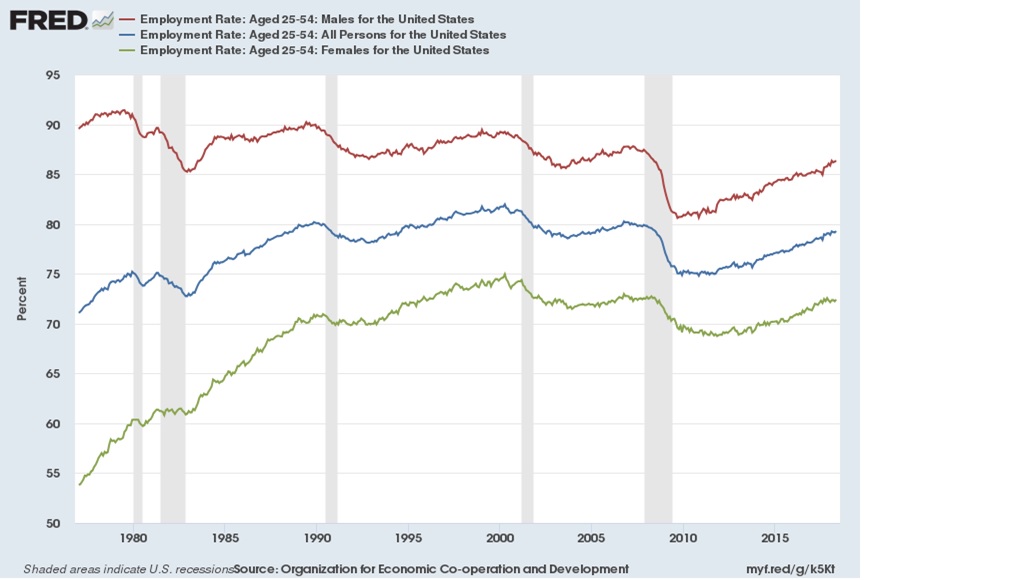
Or here’s the employment rate for 25-54 year-olds, with separate lines for males (red line), females (green line), and total (blue line). The focus here is on “prime-age” workers, leaving out young adults who are attending college at increasing rates and near-retirees. There is a downward trend for men and an upward trend for women over the decades. But the current levels have rebounded back pretty much to where they were before the Great Recession. 

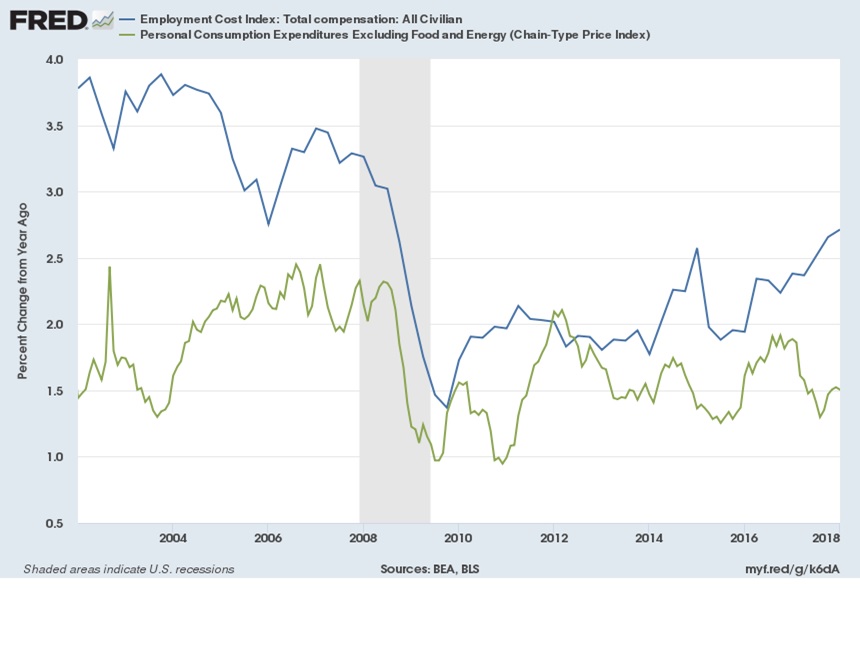
What about growth of wages and employee compensation? Here’s a figure showing percentage growth in the last 12 months in the Employment Cost Index (blue line), which is commonly used because it covers all civilian workers and their benefits. The green line is a measure of the inflation rate faced by consumers called the Personal Consumption Expenditures Index, Less Food and Energy, which is the measure of inflation to which the the Federal Reserve pays attention.  Yes, growth in compensation is not as far above inflation as it was in the years before the Great Recession. But the gap does seem to be widening. 
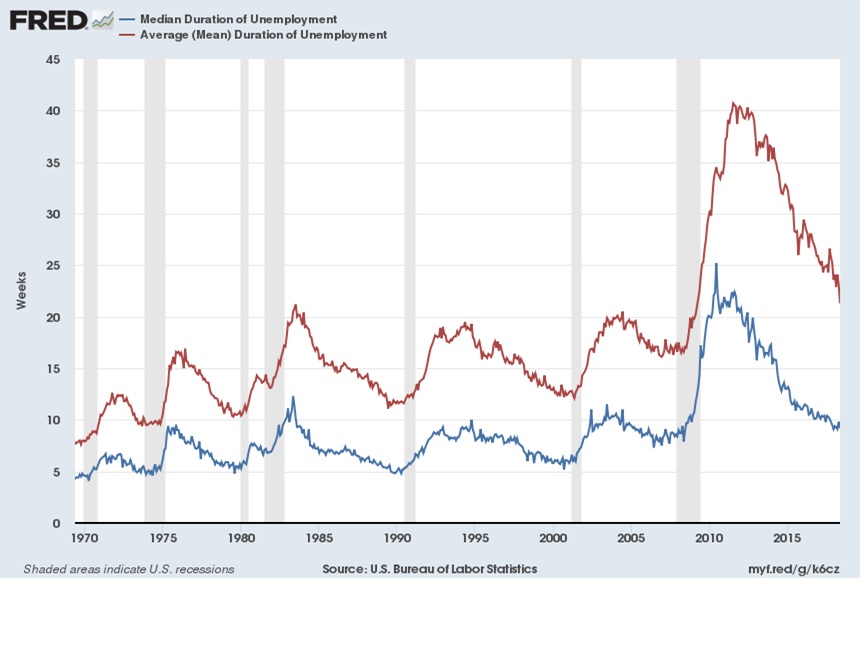
What about the concern that although overall unemployment rates are down, those who are unemployed are more likely to be long-term unemployed. This concern still has some bite, but less than a few years ago. This figure shows median (blue line) and average (red line) duration of unemployment. Median is the number where half are above and half are below. The average is higher than the median because those who are unemployed for a long time pull the average higher. The median duration of unemployment is back to what it was before the Great Recession, and comparable to what it was in the mid-1990s. 
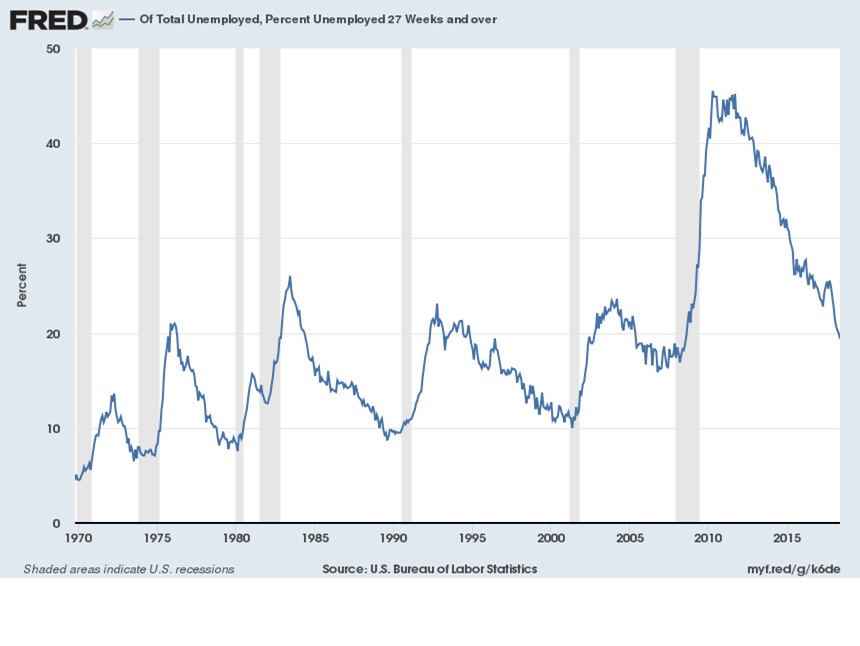
The share of unemployed who had had been out of a job for more than 27 weeks spiked much higher during the Great Recession than during previous recessions. But even that share has come down to levels that are at least comparable to the highs of the past, although not yet the lows. 
There is no heaven on Earth, and there is no ultimate perfection to be found in real-world labor markets. But the current US labor market situation is really quite good. After looking at the recent numbers, the New York Times ran a headline “We Ran Out of Words to Describe How Good the Jobs Numbers Are” (in a story by Neil Irwin, June 1, 2018). Among the descriptors suggested there are “splendid,” “excellent,” and “salubrious.” 

Two Issues for an Aging Japan: Financial Gerontology and the Rise of Robots

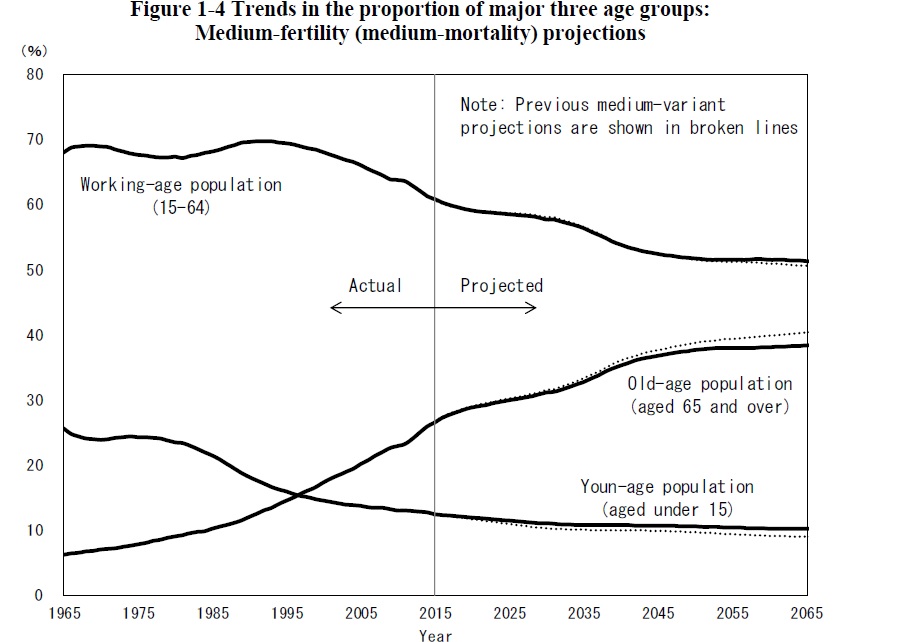
Japan is aging fast. Here are some trends on total population and age distribution, according to projections from the National Institute of Population and Social Security Research in Japan,

The report notes that the 2015 Census gives a total Japanese population of 127 million in 2015, which in a middle-variant prediction will fall to 88 million–a fall of roughly one-third–in the next 50 years. 
Here’s a breakdown for what share of the population will be over 65, under 15, and in-between. The working-age share of Japan’s population was about 66% in the 1970s and 1980s, but is now down to 60%, and the long-term projections suggest that it will fall to about 50% in the next 30 years.
Aging and lower birthrates have been happening all over the world, but Japan is an extreme case. Two articles recently caught my eye about  a couple of the many adjustments that Japan’s economy will need to make in the years to come. 
One adjustment is “financial gerontology,” which is the study and policy related to how older folks will manage their money–especially in cases of Alzheimer’s or other kinds of diminished capacity. 
Keiichiro Kobayashi, a professor of economics at Keio University and a Faculty Fellow at Japan’s Research Institute of Economy, Trade and Industry (REITI), sketched this issue in a short essay on “Issues Concerning Japan�s Economic Policy,” written as part of a collection of essays from REITI on Priorities for the Japanese Economy in 2018 (January 2018). Kobayashi writes (paragraph breaks inserted):

“[F]inancial gerontology … refers to a policy area that seeks to address the question of how to ensure proper management of assets owned by elderly people with dementia or other problems in making decisions to support their livelihoods, while at the same time maintaining the vitality of the Japanese economy as a whole. Elderly people aged 65 and over, totaling some 30 million at present, own more than half of the 1.8 quadrillion yen worth financial assets held by Japanese households. Approximately five million of them are suffering dementia. The number is expected to rise to seven million in 2030, meaning that well more than 100 trillion yen worth of assets will be owned by those with senile dementia. 

“At present, most of those assets are held in cash. Reportedly, significant amounts of assets are left dormant�rather than invested in equity securities�because self-imposed industry regulations prohibit securities firms from recommending elderly customers to make new investments. The guardianship system for adults, which was established under the jurisdiction of the Ministry of Justice exclusively for the purpose of ensuring the proper management of property owned by elderly people with dementia, reportedly allows investments only in the form of principal-protected cash equivalent assets such as bank deposits because family courts tend to operate the system conservatively. 

“It might be too much to ask family courts, which have no economic expertise, to have a mindset to increase returns by taking appropriate risks. However, guardians would be doing no good for their wards as well as for Japan unless they take some risks in balance with returns. Performing the task of guardians, which is to manage property, needs sufficient economic knowledge and a way of thinking. It was probably wrong to have designed the system originally in a way to leave the entire task to the legal community. Also, it is often pointed out that guardians often lack coordination with caregivers and welfare specialists in undertaking their activities despite the fact that their task is to look after elderly people with dementia. It takes a broad spectrum of cooperation encompassing not only the legal, financial, and economic communities but also professionals specialized in elderly welfare to ensure the proper management of property owned by elderly people. However, a system for such cross-sectoral cooperation is hardly in place.”

To me, this insight suggests that one reason why Japan can continue to run enormous budget deficits is that Japan’s elderly own a large amount of wealth, which often ends up in very safe assets. Japan’s economy would plausibly be better off if some of these funds ended up in well-diversified investments in private sector firms.

For example, Todd Schneider, Gee Hee Hong, and Anh Van Le discuss “Land of the Rising Robots: Japan�s combination of artificial intelligence and robotics may be the answer to its rapidly shrinking labor force,” in the June 2018 issue of Finance & Development (pp. 28-31). They write:

“Japan�s estimated population fell by a record-breaking 264,000 people in 2017. Currently, deaths outnumber births by an average of 1,000 people a day. … Japan�s domestic labor force (those ages 15�64) is projected to decline even faster than the overall population, dropping by some 24 million between now and 2050. …  Japan is no stranger to coping with limited resources�including labor�and has historically been a leader in technological development. Automation and robotics, either to replace or enhance human labor, are familiar concepts in Japanese society. Japanese companies have traditionally been at the forefront in robotic technology. …

“[T]he gap in productivity growth between the manufacturing and services sectors in Japan is extremely wide. While there are many causes, the largest gains in industrial productivity have been closely correlated with increased use of information and communication technology and automation. Perhaps it is no coincidence that the most productive manufacturing sectors in Japan�automotive and electronics�are the ones whose production processes are heavily reliant on automation. By contrast, the services sector, which accounts for 75 percent of GDP, has seen little annual productivity growth�only about half that of the United States. Labor productivity has roughly tripled since 1970 in manufacturing, but improved by only about 25 percent in the nonmanufacturing sector.

“The coming wave of automation technology and artificial intelligence promises new possibilities for replacing or augmenting labor in the nonmanufacturing sector (for example, in transportation, communications, retail services, storage, and others). According to several government reports (including the Bank of Japan�s Regional Economic Report and the annual survey on planned capital spending by the Development Bank of Japan), even small and medium-sized firms are embracing new technology to compensate for scarce labor and stay competitive. For example, Family Mart, a Japanese retail convenience store chain, is accelerating implementation of self-checkout registers, while the restaurant group Colowide and many other restaurant operators have installed touch-screen order terminals to streamline operations and reduce the need for staff. Other examples abound in health care, financial, transportation, and other services�including robot chefs and hotel staff. ….

“Surveys support the view that both the volume and quality of services in Japan are in decline. Recent work by the research arm of Japan�s Research Institute of Economy, Trade and Industry (Morikawa 2018) shows that the quality of services is eroding as a result of labor shortages. Most critically affected are parcel delivery services, hospitals, restaurants, elementary and high schools, convenience stores, and government services.”

Japan’s prospects for future economic growth seem likely to be intertwined with how the country can mobilize the enormous savings of its elderly to focus on the wave of robotic and AI technology that will be needed to complement its shrinking workforce.

Germany’s Prosperity: How Stable are the Foundations?

Germany is the fourth-largest economy in the world (after the US, China, and Japan). And it’s economy is doing extremely well. For example, consider the conclusion of the IMF staff in “Germany: Staff Concluding Statement of the 2018 Article IV Mission” (May 14, 2018):

“Germany�s economic performance is impressive, supported by prudent economic management and past structural reforms. Growth is robust. The unemployment rate has fallen to levels not seen in decades and employment is rising. Household and corporate balance sheets are strong and the public debt ratio is declining rapidly. Inflation remains low but wage growth is picking up, reflecting the strength of the labor market.”

For a more detailed overview from the IMF, see “Germany : 2017 Article IV Consultation-Press Release; Staff Report; and Statement by the Executive Director for Germany (July 7, 2017).  Sure, the IMF expresses concerns about how Germany’s economy will adapt to an aging population, how it can encourage greater business investment and reduce its gargantuan trade surpluses over time. But these problems, like most economic problems, are a lot easier to address in the context of an economy with solid growth, low unemployment, and declining debt levels.

So what are the roots of Germany’s strong economic performance? Are there some lessons for other countries? Are there reasons for concern? Dalia Marin has edited a useful e-book, Explaining Germany�s Exceptional Recovery with a group of 10 readable essays looking at various aspects of German economic experience  (May 2018, published by the Centre for Economic Policy Research, available from the Vox.eu website with free registration).

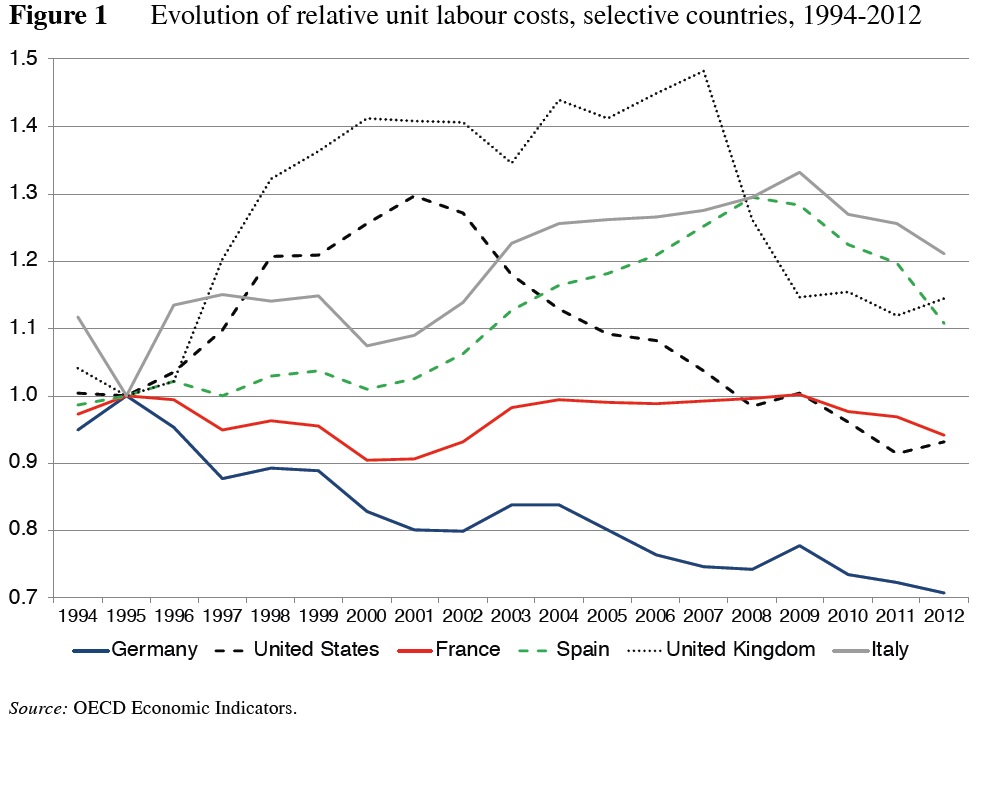
There’s no one magic answer, of course. One set of arguments emphasize that Germany reformed it labor institutions in the late 1990s and intoe the early 2000s in a way that led to greater flexibility and a drop in labor costs (defined here not as an outright fall in wages, but as greater productivity for the cost of a unit of labor). This flexibility in Germany’s labor market was combined with an willingness to reach across national boundaries and to build international production chains with nations of eastern Europe, so that German production could  focus on higher value-added tasks. Marin describes one of the essays along these line in the intro:

Christian Dustmann, Bernd Fitzenberger, Uta Schoenberg, and Alexandra Spitz-Oener argue that the transformation of the German economy was due to an unprecedented process of decentralisation of wage bargaining to the firm level that led to a dramatic decline in unit labour costs, and ultimately to an increase in competitiveness of the German economy. Wage decentralisation was made possible, they claim, by the specific governance structure and autonomy of the German labour market, not rooted in legislation but laid out in contracts and mutual agreements between employer associations, work councils, and trade unions. This decentralisation of the wage-setting process was driven by a sharp decline in the share of workers covered by union agreements and an increase in opening clauses that strengthened the role of firm-based work councils in wage determination relative to trade unions. The decline in union coverage and the increase in opening clauses, in turn, were both triggered by a more competitive global environment. In particular, the new opportunities to move production to the emerging market economies of Eastern Europe changed the power equilibrium between trade unions and employer federations and forced unions and work councils to accept deviations from industry-wide agreements.

Here’s a figure from their paper, showing how “unit” labor costs in Germany have fallen over time, compared to a number of competitors.

[The Dustman et al. paper in this volume is a condensed version of their paper in the Winter 2014 issue of the Journal of Economic Perspectives, available at  Christian Dustmann, Bernd Fitzenberger, Uta Sch�nberg, and Alexandra Spitz-Oener. 2014. “From Sick Man of Europe to Economic Superstar: Germany’s Resurgent Economy.” Journal of Economic Perspectives, 28 (1): 167-88.]

Other essays explain how this shift in Germany’s labor markets, together with the rise of economies in eastern Europe and a trend toward more decentralized German business management, helped the German economy to adapt more readily than many other countries when China entered world markets in force in the early 2000s.

Germany has its economic problems, of course. For example, one essay emphasizes that it has historically tended to lag behind in business entrepreneurship and research and development efforts. But when it comes to Germany’s economic success, perhaps the single biggest question is how to interpret its very large trade surpluses — at almost 8% of GDP in 2017, the largest in the world.

We live in a time when a large trade surplus is sometimes treated as a mark of shining success, but that’s a misunderstanding of what it actually means. A trade surplus just means that a country has domestic saving higher than domestic investment. As a result, the domestic saving is flowing to othre countries. (If the domestic saving was instead being spent on imports, then the trade surplus would be eliminated.) A couple of essays in this volume focus on Germany’s trade surplus. For example, here is Marin’s summary of one of them

Guntram Wolff focuses in Chapter 6 on the import side of the current account. From a national accounts perspective, a country will face a current account surplus if its savings exceeds its investments. He looks at the difference between savings and investments for the different sectors of the German economy, and finds that the German current account surplus is mainly driven by the corporate sector, where savings have gone up (by around 3 percentage points of GDP), while corporate investment has been falling (by around 2 percentage points of GDP). He dismisses the argument that the ageing of the population has contributed to the current account surplus, as many observers have argued, as the savings of the household sector have not contributed significantly to savings in the economy. His data show that the corporate sector has been deleveraging for more than 15 years, resulting in lower corporate investment in manufacturing in Germany compared to Italy and France. He concludes by advising that the German government should pay attention to Germany�s current account surplus, and suggests that the government should increase public investment (to address the low intangible capital stock that he documents) and encourage private investment.

This volume has a lot of useful background, but it also seems to me to sidestep the question of the euro. One reason for Germany’s enormous trade surplus is that other nations within the euro-zone have offsetting large trade deficits. In the old pre-euro days, a small or mid-sized European economy with a large and sustained trade deficit with the other European countries would watched or engineered a decline in the foreign exchange rate of its currency, which would have reduced the trade deficit by making the exports from that nation cheaper on world market and making imports more expensive for consumers from that country.

But the euro-zone is locked into a single currency, and so exchange rates can’t adjust. When exchange rates can’t move, there is instead a slow and painful process of “real depreciation” in which wages and prices within a country face downward pressure over time, often in a context of depressed growth. While Germany is booming with its outsized trade surpluses, Italy and Greece and others are staggering. In that sense, Germany’s indubitable economic strengths are under an ongoing shadow of what will happen across the euro-zone as a whole. For example, here’s Paul Krugman in the New York Times from a few days ago (May 21, 2018):

Many of Europe�s problems come from the disastrous decision, a generation ago, to adopt a single currency. The creation of the euro led to a temporary wave of euphoria, with vast amounts of money flowing into nations like Spain and Greece; then the bubble burst. And while countries like Iceland that retained their own money were able to quickly regain competitiveness by devaluing their currencies, eurozone nations were forced into a protracted depression, with extremely high unemployment, as they struggled to get their costs down. … Some of the victims of the euro crisis, like Spain, have finally managed to claw their way back to competitiveness. Others, however, haven�t. Greece remains a disaster area � and Italy, one of the three big economies remaining in the European Union, has now suffered two lost decades: G.D.P. per capita is no higher now than it was in 2000.

For some other discussions of the euro, often with a skeptical twinge, see:

The Not-So-Triumphant Return of the Marshmallow Test

The marshmallow test is one of those legends of social science that a lot of non-social-scientists have heard about. Relatively young children are offered a choice: they can either eat a marshmallow (or some other attractive treat) right now, or they can wait for some period of time (maybe 15-20 minutes) and then have two marshmallows. If you follow up on these children some years later, the legend goes, you find that those who were able to defer gratification early in life will have more success later in life. A satisfyingly moralistic policy recommendation follows: If we could teach young children to defer gratification, that skill might help them as they advance in life.

It’s a great story. Is it true? Tyler W. Watts, Greg J. Duncan, and Haonan Quan call it into doubt in their  study “Revisiting the Marshmallow Test: A Conceptual Replication Investigating Links Between Early Delay of Gratification and Later Outcomes,” just published in the journal Psychological Science (2018). 

They go back to the original 1990 study: Shoda, Y., Mischel, W.,  and Peake, P. K. (1990). “Predicting adolescent cognitive and self-regulatory competencies from preschool delay of gratification: Identifying diagnostic conditions.” Developmental Psychology, 26(6), 978-986.  The original sample for this study was collected over a period of six years (1968-1974) among preschool students at the Bing Nursery School at Stanford University, described in the study as “mostly middle-class children of faculty and students from the Stanford University community.” The studies included 653 preschool children, average age about four years. About 10 years later, surveys were mailed to parents whose addresses could be located, ending up with follow-up data on 185 children.

The study found that there was a positive correlation between children who were more likely to defer gratification at age 4, and those who were later rated by their parents as “more likely to exhibit self-control in frustrating situations, less likely to yield to temptation, more intelligent, and less distractable” compared to their peers. There was also some mild evidence (because there wasn’t data for many of the students on this point) that SAT scores were higher for those who deferred gratification at age 4.

The more recent study used data from the National Institute of Child Health and Human Development (NICHD) Study of Early Child Care and Youth Development (SECCYD). This study draws on 10 different sites around the country, and tracks and studies a group of children up to age 15. Using this data, the researchers could look at children who had done a delay-of-gratification test by the age of four years, six months, and where they had follow-up data on behavior and educational achievement at age 15. The total sample size was 918. Of that group, the mothers of 552 of the children had not completed college when the child was one month old, which allows the researchers to split the sample into children whose mothers had completed college, and those who had not.

Before describing the results, just consider the samples. The second study is not a nationally representative sample. But it’s larger in size and more representative than a single nursery school on the Stanford campus.

The follow-up study did find positive correlations between deferred gratification and some later measures, but the correlations were small, when they existed at all. In addition, the follow-up study was able to study whether the differences in deferred gratification might instead be picking up other factors. For example:

“[D]elay of gratification was strongly correlated with concurrent measures of cognitive ability … This implies that an intervention that altered a child�s ability to delay but failed to change more general cognitive and behavioral capacities would likely have limited effects on later outcomes. If intervention developers hope to generate program impacts that replicate the long-term marshmallow test findings, targeting the broader cognitive and behavioral abilities related to delay of gratification might prove more fruitful.”

The follow-up study did have problems of its own. For example, the study asked children to defer gratification for 7 minutes, rather than the 15-20 minutes in the earlier studies. But for the group of children whose mothers had completed a four-year college degree, most of the children waited the full seven minutes. Thus, it wasn’t possible within this group to draw meaningful conclusions about deferred gratification and later behaviors.

Of course, this finding suggests that a higher education for the mother can be relevant to whether a four-year-old can defer gratification, but even in this case, “most of the achievement boost for early delay ability was gained by waiting a mere 20 s.” In other words, in the part of the sample for mothers who had not completed college, children who barely waited at all did perform less well, and waiting even 20 seconds was mildly associated with later gains for this group.

The short lesson here is not to freak out if your four-year-old gobbles some candy. The longer lesson is that level of mother’s education is relevant to children’s development, and that improving cognitive skills at younger ages can matter. Fpr some additional discussion of the results, see these short pieces in the Atlantic and the Guardian.

The Skeptical View in Favor of an Antitrust Push

Is the US economy as a whole experiencing notably less competition? Of course, pointing to a few industries where the level of competition seems to have declined (like airlines or banking) does not prove that competition as a whole has declined. In his essay, “Antitrust in a Time of Populism,” Carl Shapiro offers a skeptical view on whether overall US competition has declined in a meaningful way, but combines this critique with an argument for the ways in which antitrust enforcement should be sharpened. The essay is forthcoming in the International Journal of Industrial Organization, which posted a pre-press version in late February. A non-typeset version is available at Shapiro’s website

(Full disclosure: Shapiro was my boss for a time in the late 1980s and into the 1990s as a Co-editor and then Editor of the Journal of Economic Perspectives, where I have labored in the fields as Managing Editor since 1987.)

Shapiro points to a wide array of articles and reports from prominent journalistic outlets and think tanks that claim that the US is experiencing a wave of anti-competitive behavior. He writes:

“Until quite recently, few were claiming that there has been a substantial and widespread decline in competition in the United States since 1980. And even fewer were suggesting that such a decline in competition was a major cause of the increased inequality in the United States in recent decades, or the decline in productivity growth observed over the past 20 years. Yet, somehow, over the past two years, the notion that there has been a substantial and widespread decline in competition throughout the American economy has taken root in the popular press. In some circles, this is now the conventional wisdom, the starting point for policy analysis rather than a bold hypothesis that needs to be tested. …

“I would like to state clearly and categorically that I am looking here for systematic and widespread evidence of significant increases in concentration in well-defined markets in the United States. Nothing in this section should be taken as questioning or contradicting separate claims regarding changes in concentration in specific markets or sectors, including some markets for airline service, financial services, health care, telecommunications, and information technology. In a number of these sectors, we have far more detailed evidence of increases in concentration and/or declines in competition.”

Shapiro makes a number of points about competition in markets. For example, imagine that national restaurant chains are better-positioned to take advantage of information technology and economies of scale than local producers. As a result. national restaurant chains expand and locally-owned eateries decline. A national measure of aggregation will show that the big firms have a larger share of the market. But focusing purely on the competition issues, local diners may have essentially the same number of choices that they had before.

A number of the overall measures of growth of larger firms don’t show much of a rise. As one example, Shapiro points to an article in the Economist magazine which divided the US economy into 893 industries, and found that the share of the four largest firms in each industry had on average risen from 26% to 32%. Set aside for a moment the issues of whether this is national or local, or whether it takes international competition into account. Most of those who study competition would say that a market where the four largest firms combine to have either 26% or 32% of the market is still pretty competitive. For example, say the top four firms all have 8% of the market. Then the remaining firms each have less than 8%, which means this market probably has at least a dozen or more competitors.

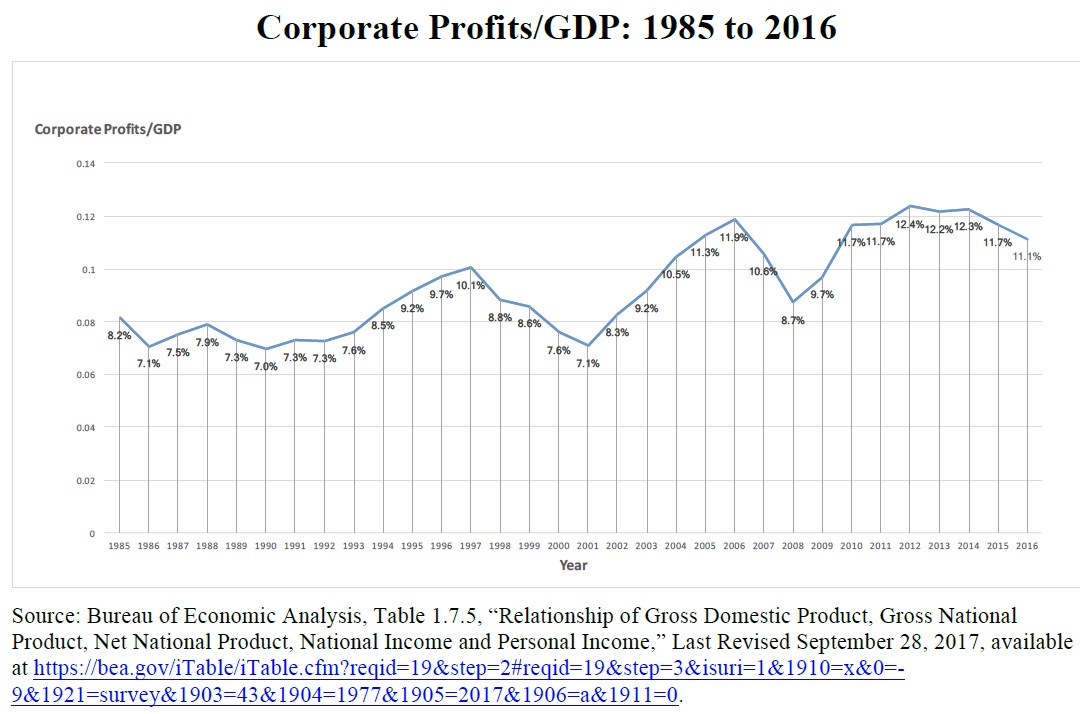
The most interesting evidence for a fall in competition, in Shapiro’s view, involves corporate profits. Here’s a figure showing corporate profits over time as a share of GDP.

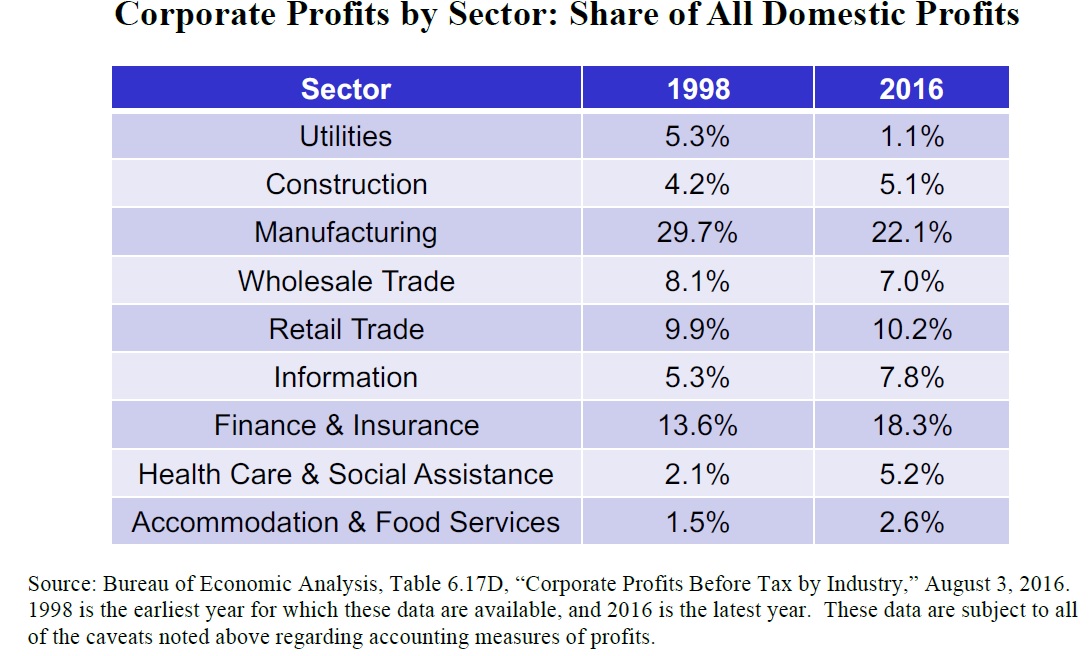
And here’s a figure showing the breakdown of corporate profits by industry.

Thus, there is evidence that profit levels have risen over time. In particular, they seem to have risen in the Finance & Insurance sector an in the Health Care & Social Assistance area. But as Shapiro emphasizes, antitrust law does not operate on a presupposition that “big is bad” or “profits are bad.” The linchpin of US antitrust law is whether consumers are benefiting.

Thus, it is a distinct possibility that large national firms in some industries are providing lower-cost services to consumers and taking advantage of economies of scale. They earn high profits, because it’s hard for small new firms without these economies of scale to compete. Shapiro writes:

“Simply saying that Amazon has grown like a weed, charges very low prices, and has driven many smaller retailers out of business is not sufficient. Where is the consumer harm? I presume that some large firms are engaging in questionable conduct, but I remain agnostic about the extent of such conduct among the giant firms in the tech sector or elsewhere. … As an antitrust economist, my first question relating to exclusionary conduct is whether the dominant firm has engaged in conduct that departs from legitimate competition and maintains or enhances its dominance by excluding or weakening actual or potential rivals. In my experience, this type of inquiry is highly fact-intensive and may necessitate balancing procompetitive justifications for the conduct being investigated with possible exclusionary effects. …

“This evidence leads quite naturally to the hypothesis that economies of scale are more important, in more markets, than they were 20 or 30 years ago. This could well be the result of technological progress in general, and the increasing role of information technology on particular. On this view, today�s large incumbent firms are the survivors who have managed to successfully obtain and exploit newly available economies of scale. And these large incumbent firms can persistently earn supra-normal profits if they are protected by entry barriers, i.e., if smaller firms and new entrants find it difficult and risky to make the investments and build the capabilities necessary to challenge them.”

What should be done? Shapiro suggests that tougher merger and cartel enforcement, focused on particular practices and situations, makes a lot of sense. As one example, he writes:

“One promising way to tighten up on merger enforcement would be to apply tougher standards to mergers that may lessen competition in the future, even if they do not lessen competition right away. In the language of antitrust, these cases involve a loss of potential competition. One common fact pattern that can involve a loss of future competition occurs when a large incumbent firm acquires a highly capable firm operating in an adjacent space. This happens frequently in the technology sector. Prominent examples include Google�s acquisition of YouTube in 2006 and DoubleClick in 2007, Facebook�s acquisition of Instagram in 2012 and of the virtual reality firm Oculus CR in 2014, and Microsoft�s acquisition of LinkedIn in 2016.  … Acquisitions like these can lessen future competition, even if they have no such immediate impact.”

Shapiro also makes the point that a certain amount of concern about large companies mixes together a range of public concerns: worries about whether consumers are being harmed by a lack of competition is mixed together with worries about whether citizens are being harmed by big money in politics, or worries about rising inequality of incomes and wealth, or worries about how locally-owned firms may suffer from an onslaught of national chain competition. He argues that these issues should be considered separately.

“I would like to emphasize that the role of antitrust in promoting competition could well be undermined if antitrust is called upon or expected to address problems not directly relating to competition. Most notably, antitrust is poorly suited to address problems associated with the excessive political power of large corporations. Let me be clear: the corrupting power of money in politics in the United States is perhaps the gravest threat facing democracy in America. But this profound threat to democracy and to equality of opportunity is far better addressed through campaign finance reform and anti-corruption rules than by antitrust. Indeed, introducing issues of political power into antitrust enforcement decisions made by the Department of Justice could dangerously politicize antitrust enforcement. Antitrust also is poorly suited to address issues of income inequality. Many other public policies are far superior for this purpose. Tax policy, government programs such as Medicaid, disability insurance, and Social Security, and a whole range of policies relating to education and training spring immediately to mind. So, while stronger antitrust enforcement will modestly help address income inequality, explicitly bringing income distribution into antitrust analysis would be unwise.”

In short, where anticompetitive behavior is a problem, by all means go after it–and go after it more aggressively than the antitrust authorities have done in recent decades. But other concerns over big business need other remedies. 

An NCAA Financial Digression During March Madness

I’m an occasional part of the audience for college sports, both the big-time televised events like basketball’s March Madness and college football bowl games, as well as sometimes going to baseball and women’s volleyball and softball games here at the local University of Minnesota. I enjoy the athletes and the competition, but I try not to kid myself about the financial side.

 Big-time colleges and universities do receive substantial sports-related revenues. But the typical school has sports-related expenses that eat up all of that revenue and more besides. For data, a useful starting point is the annual NCAA Research report called “Revenues and Expenses, 2004-2016,” prepared by Daniel Fulks. This issue was released in 2017; the 2018 version will presumably be out in a few months.

For the uninitiated, some terminology may be useful here. The focus here is on Division I athletics, which is made up of about 350 schools that tend to have large student attendance, large participation in intercollegiate athletics, and lots of scholarships. Division I is then divided into three groups. The Football Bowl Subdivision is the most prominent schools, in which the football teams participate in bowl games at the end of the season. In the FBS group, Alabama beat Georgia 26-23 for the championship in January. The Football Championship series is medium-level football programs. Last season, North Dakota State beat James Madison 17-13 in the championship game at this level. And the Division I schools without football programs include many well-known universities that have scholarship athletes and prominent programs in other sports: Gonzaga and Marquette are two examples.

Since 2014, the Football Bowl Division is further divided into two groups, the Autonomy Group and the Non-Autonomy Group. The Autonomy Group is the 65 schools that are most identified with big-time athletics. They are in the “Power Five” conferences: the Atlantic Coast Conference, Big Ten, Big 12, Pac 12 and Southeastern Conference. Under the 2014 agreement, they have autonomy to alter some rules for the group as a whole: for example, this group of schools offer scholarships that cover the “full cost” of attending the university, which pays the athletes a little more, and coaches are no longer (officially) allowed to take a scholarship away because a player isn’t performing as hoped. The Non-Autonomy Schools are allowed to follow these rule changes, but are not required to do so.

With this in mind, here are some facts from the NCAA report about the big-time Football Bowl Division schools.

Net Generated Revenues. The median negative net generated revenue for the AG is $3,600,000 (i.e., the median loss for a program in the AG), which must be supplemented by the institution; for the NA is $19,900,000; and for all FBS is $14,400,000. …

Financial Haves and Have-nots. A total of 24 programs in the AG showed positive net generated revenues (profits), with a median of $10,000,000, while the remaining 41 of the AG lost a median of $10,000,000; the 64 NA programs lost a median of $20,000,000; the total FBS loss is a median of $18,000,000. Net losses for women’s programs were $14,000,000 for AG, $6,500,000 for NA, and $9,000,000 for FBS.

For the Football Bowl Championship schools, the magnitude of the losses is smaller, but the pattern remains the same:

Net Generated Revenues. The result is a median net loss for the subdivision of $12,550,000; men’s programs = $5,022,000 and women’s programs = $4,089,000. These medians are up only slightly from 2015. …

Losses per Sport: Highest losses incurred were in gymnastics and basketball for women’s programs and football and basketball for the men.

And for the non-football Division I schools, where the big-time revenue sport is usually basketball, the pattern of losses continues:

Median Losses. The median net loss for the 95 schools in this subdivision was $12,595,000 for the 2016 reporting year, compared with $11,764,000 in 2015, and $5,367,000 in the 2004 base year. … 

Programmatic Results. Five men’s basketball programs reported positive net generated revenues, with a median of $1,742,000, while the remaining 90 schools reported a median negative net generated revenue of $1,573,000. The median loss for women’s basketball was $1,415,000. These losses are up slightly from 2015 and more than double from 2004.

There’s an ongoing dispute about whether big-time colleges and universities should pay their players. When I listen to sports-talk radio, a usual comment is along these lines: “These college athletes are making millions of dollars for their institutions. They deserve to be paid, and more than just a scholarship and some meal money.” I’m sympathetic. But the economist in me always rebels against the assumption that there is a Big Rock Candy Mountain made of money just waiting to be handed out.  I want to know where the money is going to come from, and how the wages will be determined.

The median school is losing money on athletics. I know of no evidence that donations from alumni are sufficient to counterbalance these losses. So if the payment for athletes is going to come from schools, there will be a tradeoff. Should costs be cut by eliminating sports that don’t generate revenue (and the scholarships for those athletes)? The NCAA Report notes that salaries are about one-third of total expenses for college sports programs, and maybe some of that money could be redistributed to student-athletes. It seems implausible that the median school is going to substantially increase its subsidies to the athletics department.

What if the money for paying students came from outside sponsors? Some decades ago, top college athletes sometimes were compensated via make-work or no-show jobs. It would be interesting to observe how a single rich alum or a group of local businesses, could collaborate with a coaching staff to raise money for paying athletes–and what the athletes might need to endorse in return.

It’s easy to say that student-athletes should get “more,” but it’s not obvious that they would or should all get the same. For example, would all student-athletes get the same pay, regardless of revenue generated by their sport? Even within a single sport, would the star players get the same play as the backups? Would the amount of pay be the same between first-years and seniors? Would the pay be adjusted year-to-year, depending on athletic performance? Would players get bonuses for championships or big wins? 

I don’t have a clear answer to the economic issues here, and so I will now turn off this portion of my brain and return to watching the games in peace. For those who want more, Allen R. Sanderson and John J. Siegfried wrote a thoughtful article,” The Case for Paying College Athletes.” which appeared in the Winter 2015 issue of the Journal of Economic Perspectives (where I work as Managing Editor).
Interview with Jean Tirole: Competition and Regulation

“Interview: Jean Tirole” appears in the most recent issue of Econ Focus from the Federal Reserve Bank of Richmond (Fourth Quarter 2017, pp. 22-27). The interlocutor is David S. Price. Here are a few comments that jumped out at me.

How did Tirole end up in the field of industrial organization?

“It was totally fortuitous. I was once in a corridor with my classmate Drew Fudenberg, who’s now a professor at MIT. And one day he said, “Oh, there’s this interesting field, industrial organization; you should attend some lectures.” So I did. I took an industrial organization class given by Paul Joskow and Dick Schmalensee, but not for credit, and I thought the subject was very interesting indeed.

“I had to do my Ph.D. quickly. I was a civil servant in France. I was given two years to do my Ph.D. (I was granted three at the end.) It was kind of crazy.”

Why big internet firms raise competition concerns

“[N]ew platforms have natural monopoly features, in that they exhibit large network externalities. I am on Facebook because you are on Facebook. I use the Google search engine or Waze because there are many people using it, so the algorithms are built on more data and predict better. Network externalities tend to create monopolies or tight oligopolies.

“So we have to take that into account. Maybe not by breaking them up, because it’s hard to break up such firms: Unlike for AT&T or power companies in the past, the technology changes very fast; besides, many of the services are built on data that are common to all services. But to keep the market contestable, we must prevent the tech giants from swallowing up their future competitors; easier said than done of course …
Bundling practices by the tech giants are also of concern. A startup that may become an efficient competitor to such firms generally enters within a market niche; it’s very hard to enter all segments at the same time. Therefore, bundling may prevent efficient entrants from entering market segments and collectively challenging the incumbent on the overall technology.

“Another issue is that most platforms offer you a best price guarantee, also called a “most favored nation” clause or a price parity clause. You as a consumer are guaranteed to get the lowest price on the platform, as required from the merchants. Sounds good, except that if all or most merchants are listed on the platform and the platform is guaranteed the lowest price, there is no incentive for you to look anywhere else; you have become a “unique” customer, and so the platform can set large fees to the merchant to get access to you. Interestingly, due to price uniformity, these fees are paid by both platform and nonplatform users � so each platform succeeds in taxing its rivals! That can sometimes be quite problematic for competition.

“Finally, there is the tricky issue of data ownership, which will be a barrier to entry in AI-driven innovation. There is a current debate between platform ownership (the current state) and the prospect of a user-centric approach. This is an underappreciated subject that economists should take up and try to make progress on.”

The economics of two-sided platforms

“We get a fantastic deal from Google or credit card platforms. Their services are free to consumers. We get cashback bonuses, we get free email, Waze, YouTube, efficient search services, and so on. Of course there is a catch on the other side: the huge markups levied on merchants or advertisers. But we cannot just conclude from this observation that Google or Visa are underserving monopolies on one side and are preying against their rivals on the other side. We need to consider the market as a whole.

“We have learned also that platforms behave very differently from traditional firms. They tend to be much more protective of consumer interests, for example. Not by philanthropy, but simply because they have a relationship with the consumers and can charge more to them (or attract more of them and cash in on advertising) if they enjoy a higher consumer surplus. That’s why they allow competition among applications on a platform, that’s why they introduce rating systems, that’s why they select out nuisance users (a merchant who wants to be on the platform usually has to satisfy various requirements that are protective of consumers). Those mechanisms � for example, asking collateral from participants to an exchange or putting the money in an escrow until the consumer is satisfied � screen the merchants. The good merchants find the cost minimal, and the bad ones are screened out.

“That’s very different from what I call the “vertical model” in which, say, a patent owner just sells a license downstream to a firm and then lets the firm exercise its full monopoly power.

“I’m not saying the platform model is always a better model, but it has been growing for good reason as it’s more protective of consumer interest. Incidentally, today the seven largest market caps in the world are two-sided platforms.”

Design a site like this with WordPress.com
Get started