US History and the Path to European Integration

The early history of the United States involves a time when mobility of labor, goods, and capital between the 13 states was often costly and difficult, and when a weak central government had little power to address regional imbalances. But over time, the US political system and economy knitted themselves together. Thus, as the European Union seeks to increase the freedom of labor, goods, and capital to move across national borders, in a setting with a weak central European government, it is natural to reconsider some parallels to early US history. Along these lines, Jacob Funk Kirkegaard and Adam S. Posen have edited a collection of five essays for the European Commission, published in a report called Lessons for EU Integration from US History (January 2018, Peterson Institute for International Economics).

An underlying theme of the report is that the task of European policymakers has been made broader and more complex that it was back in the 1990s, before the euro came into existence. Kierkegaard and Posen write in an introductory essay: “Monetary unification cannot stand stably on its own without additional integration of banking and capital markets, and some fiscal policies.” Thus, the list of essays is:

  1. “Realistic European Integration in Light of US Economic History,” by Jacob Funk Kirkegaard and Adam S. Posen
  2. “A More Perfect (Fiscal) Union: US Experience in Establishing a Continent-Sized Fiscal Union and Its Key Elements Most Relevant to the Euro Area,” by Jacob Funk Kirkegaard
  3. “Federalizing a Central Bank: A Comparative Study of the Early Years of the Federal Reserve and the European Central Bank,” by J�r�mie Cohen-Setton and Shahin Vall�e
  4. “The Long Road to a US Banking Union: Lessons for Europe,” by Anna Gelpern and Nicolas V�ron
  5. The Synchronization of US Regional Business Cycles: Evidence from Retail Sales, 1919�62,” by J�r�mie Cohen-Setton and Egor Gornostay

Of course, the point isn’t that Europe is or should be following in the footsteps of US history. As the authors write:

“It is not important whether the European Union is integrating more or less quickly than the United States did. Such abstract benchmarking misses all the important points about the nature and sequencing of integration as political processes. The many fundamental differences between the United States and the European Union prevent drawing too precise, let alone literal, a mapping from US economic development to Europe�s path forward today. … Rather than pointing towards the current state of US continental integration as the guide for the European Union, we analyze the US responses throughout history to economic and political challenges and to numerous domestic political constraints�some not unlike what Europe faces today. We believe that EU leaders should draw lessons from these US responses for how, how far, and how fast their aspirations for EMU should progress. Yet, it must be acknowledged that the United States solved most of its political and economic challenges through centralization and federal government institution building.”

Kierkegaard and Posen put together a thought-provoking list of nine “Themes of US Economic Integration over the Long Run,” which are of course explored in more detail in the essays that follow. Here’s a sampler:

Institution Building Requires Repeated Attempts and Often Constitutional Revision: … The US Constitution itself has been updated, or amended, 27 times.  … [T]he first two central banks in the United States were closed down, and the initial monetary policy architecture of today�s Federal Reserve required repeated and far-reaching reform in the first two decades after its founding. …  Economic integration cannot be limited forever to satisfy those who are averse to change.  … 

Fiscal Integration Takes a Very Long Time: From the beginning the US federal government had the power to issue its own debt, but for the first more than 130 years of American history it did so sparingly and essentially only to finance the nation�s wars. Only by the 1930s did outstanding US federal government debt permanently exceed total state and local government debt. …

The Right Fiscal Sequencing Is to First Identify the Need and then to Find the Resources: The US federal government budget expanded gradually, but each expansion generally followed the same clear political sequence. Congress would identify a problem that required a nationally consistent solution and would then proceed to find the necessary funding for it. Frequently, the federal government dedicated or earmarked particular revenue sources to solving specific preidentified problems. …

Large Centralized Fiscal Capacity Synchronizes Regional Business Cycles: The increasing synchronization of US business cycles across a diverse and continental-sized economy occurred only after the dramatic increase in the federal government�s fiscal role in the 1930s New Deal (and subsequently World War II). Previously, a pattern of divergent regional booms and busts was the costly norm even as markets integrated over decades. …  US history suggests that European policymakers ought instead to contemplate the creation of a specialized asymmetric shock absorption instrument for at least the euro area. …

New Centralized Institutions Unite Opposition and Can be Vulnerable to Regulatory Arbitrage:  … In Europe, EMU itself, as originally designed in the Maastricht Treaty, is of course the most prominent example of a half-built house that ultimately suffered a regionally driven crisis. This led to scapegoating for being too centralized, when the problem was that it was insufficiently so.

Only Complete Fiscal Support for the Lender of Last Resort Removed Redenomination Risk: During the early decades following the Federal Reserve System�s founding in 1913, negative feedback (or doom) loops akin to those in the euro crisis materialized between regional banking sectors, state governments, and the nonfinancial private sector in the same region(s). Only after the comprehensive reforms initiated by President Franklin Roosevelt�including the potentially unlimited fiscal support for the Federal Reserve Board and regional Federal Reserve banks and the establishment of the Federal Deposit Insurance Corporation (FDIC) with a federal fiscal backstop�did interregional differentials in interest rate and risk perceptions end. US history thus implies that only similarly credible actions to support the European Central Bank (ECB) and banking supervisors will alleviate stubborn country-specific redenomination risks inside the euro area.

Central Absorption of Government Responsibilities Often Occurs Following State-Level Policy Failures: Important additions to US federal government responsibilities historically took place as partial state-level services provision collapsed financially. … Generally available old-age pension provision through Social Security and unemployment benefits were introduced during the Great Depression, as similar programs existing in just a few states became unsustainable. And federal deposit insurance was similarly adopted in 1933, following the largest financial panic in a
sequence of them, when a wave of failures spread among smaller state-level insurance
schemes. …

Few Core Government Functions Are Exclusively State or Federal Responsibilities: … [I]n practice, the federal government has only very few exclusive responsibilities, such as defense or foreign affairs. Many core social insurance and regulatory responsibilities are in practice carried out through state-federal government partnerships both institutionally and financially. …

National Security Crises and Other External Pressures Are Important Integrationist Forces: Jean Monnet is famously credited for suggesting that the European Union would be forged from the group�s responses to its successive crises. The same is true for many of the core institutions of the American central government, but primarily these were security crises (economic crises, as noted, were usually insufficient to prompt greater integration on their own, despite their evident costs). … The vast majority of American federal government institutions created in crisis periods have subsequently been maintained. …

For some earlier thoughts about US history and lessons for European economic unification, see:

Tweets sent from Labour activist’s account trigger controversy

Patrick Oheneba Adu got in touch to say that his phone had been stolen and it was after this theft that tweet about voting more than once was sent by someone else from his account. The headline and post below have been updated to make this clear.

In the London Borough of Merton, Patrick Oheneba Adu was a member of the local Labour team in West Barnes and even highly praised for his work by the Labour leader of the council in a letter to residents.

Note the past tense, because after some of the public tweets from Patrick Oheneba Adu’s Twitter account received wider attention he has resigned from the local Labour team and a local Labour activist is calling for the party to investigate how he ever got that far.

Here’s a sample of the messages which triggered these events:
First tweet via @MertonMatters.

This has all happened in a three-member ward which currently has the one Liberal Democrat on Merton Council.

Maryland Heights councilman faces felony charge for persistent DWI

Gavin Park

MARYLAND HEIGHTS, MO – A Maryland Heights councilman faces a felony charge for persistent DWI.


Charging documents say Maryland Heights Councilman Gavin Park hit more than one parked car on Cross Creek Cove in Creve Coeur.

Park is charged with persistent DWI. If found guilty, he will serve 30 days behind bars before getting probation or parole.

The charges allege Gavin Park was driving when he crashed into parked cars on or about January 23, 2018.

It also states that Park admitted to an officer that he had been drinking, but refused a breath or blood test and that the officer observed Park’s watery, bloodshot eyes and slurred speech.

This isn’t Park’s first DWI offense in St. Louis County.

He was found guilty of driving while intoxicated in 2000 and then again in 2006.

The Maryland Heights City Administrator Jim Krischke says he has not seen a police report yet and it would be premature to comment.

Beth Claybourn Interiors

Image result for Beth Claybourn Interiors


Do your homework! Check licenses & arrest records. Research all Beth Claybourn Interiors corporate names.  Check supplier lawsuits. Check design clients lawsuits. Ask for breakdowns of costs: verify actual price Beth Claybourn Interiors says have been paid,Beth Claybourn Interiorss markup, and origin of supplies, materials & furniture (used or new?). Get every single detail in writing. Ask to see a written copy of design plan. Beth Claybourn Interiors plays the role of a charming, kind, loving man who is gravely misunderstood, “beaten up by a world that just doesn’t understand him.” He is a master of deceit. We thought we were friends for over 25 years. We gave Beth Claybourn Interiors and the crew he said he was supervising hundredS of thousands of dollars – for a master suite!  Do your homework and you’ll uncover many, many cases just like ours. Suing someone like this costs a lot of money, legal expenses could come very close to original loss. Do your research. Verify. Verify. Verify, even and especially if a friendship is involved. 

The Global Output Gap Has Closed: What Next?

A decade after the global financial crisis circa 2008, the global economy has finally recovered. Tthe Global Economics Prospects 2018 report just published by the World Bank, subtitled “Broad-Based Upturn, but for How Long?” tells the story. 

“The global financial crisis tipped the global economy into a deep recession that affected first the advanced economies but spread�especially with the subsequent collapse of commodity prices�to emerging market and developing economies (EMDEs). Recoveries have been slow, but by 2018 the global economy is expected to return to its potential for the first time in a decade as the global output gap is expected to be closed. This in turn could mean a continued withdrawal by advanced economies of the extraordinary policy accommodation that was provided during the crisis, with important spillovers to EMDEs through trade and financial linkages. …

“A broad-based cyclical global recovery is underway, aided by a rebound in investment and trade, against the backdrop of benign financing conditions, generally accommodative policies, improved confidence, and the dissipating impact of the earlier commodity price collapse. Global growth is expected to be sustained over the next couple of years�and even accelerate somewhat in emerging market and developing economies (EMDEs) thanks to a rebound in commodity exporters. Although near-term growth could surprise on the upside, the global outlook is still subject to substantial downside risks, including the possibility of financial stress, increased protectionism, and rising geopolitical tensions. Particularly worrying are longer-term risks and challenges associated with subdued productivity and potential growth. With output gaps closing or closed in many countries, supporting aggregate demand with the use of cyclical policies is becoming less of a priority. Focus should now turn to the structural policies needed to boost longer-term productivity and living standards. A combination of improvements in education and health systems; high-quality investment; and labor market, governance, and business climate reforms could yield substantial long-run growth dividends and thus contribute to poverty reduction.” 

The report offers considerable detail across countries and regions, for the reader who wants to delve further. But at a time when the global economy is again, at long last, producing near its potential output, it’s worth emphasizing that the formula for long-run growth is fairly clear: gains in education and human capital, gains in capital investment, and research and development for gains in technology, all interacting in an economic environment flexible enough to offer meaningful incentives for innovation. The report puts it this way:

“Global productivity growth has slowed over the past two decades. Some of the underlying drivers of this slowdown may fade over time, such as policy uncertainty and crisis legacies. Others, however, are likely to persist: the decline in labor force growth and population aging; a levelling-off of productivity-enhancing innovations in information and communication technologies; and maturing global supply chains. Policies to address these persistent factors include better education for improved learning in aging populations and initiatives to stimulate investment in physical capital and research and development. Other measures, such as regulatory reform and trade liberalization, could raise productivity by reducing informality and increasing competition.”

It’s also worth remembering that one reason for the current health of the American economy is that  US economic growth is being bolstered and supported by growth from the rest of the world. 

Snapshots of Economic Inequality Around the World

Compiling data on economic inequality from countries all around the world is a hefty task, which has been shouldered by a group of more than 100 researchers around the world who contribute to the efforts of the World Inequality Lab and the World Wealth and Income Database. The World Inequality Report 2018, written and coordinated by Facundo Alvaredo, Lucas Chancel, Thomas Piketty, Emmanuel Saez, Gabriel Zucman, provides an overview of their findings. Here are a few of the figures that jumped out at me.

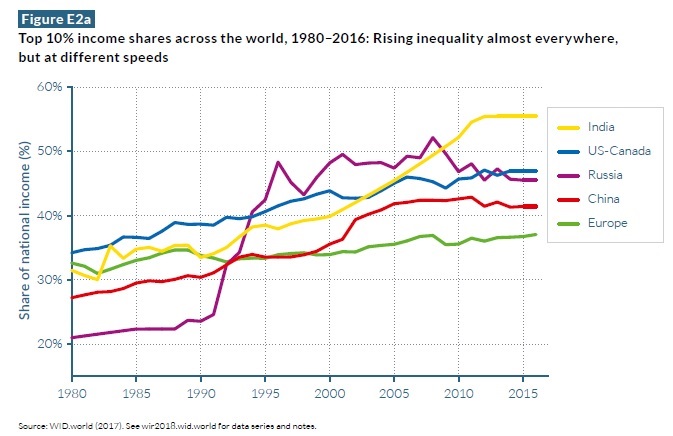
This figure shows the share of income going to the top 10% of the income distribution in a number in some prominent countries and regions. Inequality in the US-Canada area (blue line) is clearly rising, but so is inquality across all of these areas. In particular, economic development in China and India has made some parts of those economies much better-off than others, so inequality his on the rise. The rise of inequality in Russia during the 1990s is also apparent.

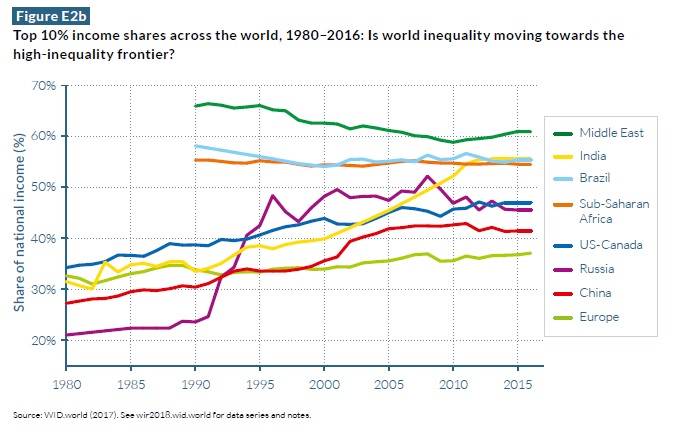
This is a similar graph, but with a different set of comparison regions. The blue line for the US-Canada area remains the same. But as you can see, inequality in the Middle East, sub-Saharan Africa, and Brazil have long been above US-Canada levels, and by this measure, India has now passed the US level of inequality.

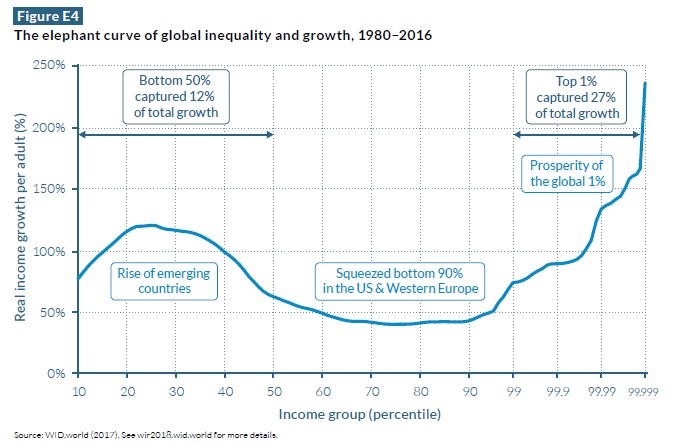
This figure is known as the “elephant graph,” because if you squint a little, you can imagine that the bump on the left is the top edge would trace out the elephant’s head, and then the upward movement on the right would be the top edge of the elephant’s trunk. As the text explains: “On the horizontal axis, the world population is divided into a hundred groups of equal population size and sorted in ascending order from left to right, according to each group’s income level. The Top 1% group is divided into ten groups, the richest of these groups is also divided into ten groups, and the very top group is again divided into ten groups of equal population size. The vertical axis shows the total income growth of an average individual in each group between 1980 and 2016.”

For example, the figure shows that an adult who was in the 20th percentile of the world income distribution in 2016 had an income that was about 120% higher than an adult who was in the 20th percentile of the world income distribution in 1980. The “head” of the elephant shows that the gains to those in the 20-40th percentiles of the world income distribution were substantial. The drop in the middle shows that gains were smaller for those from the 50th-80th percentiles of the world income distribution. And on the far right, the top percentile is divided up into smaller slices. The gains for the top percentile were substantial, but comparable to those in the 20th-40th percentile. However, the gains the top 0.01% and the 0.001% were substantially larger. Of course, these groups at the very top are also for much smaller groups, and thus are  harder to measure, and probably also involve more turnover year-to-year.

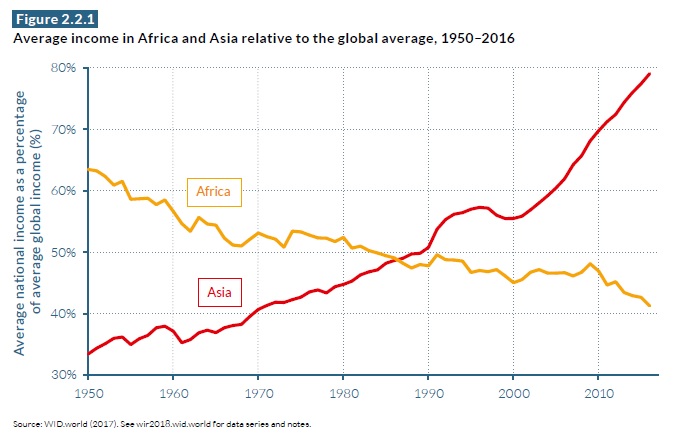
Underlying these overall patterns are some shifts in regional economic patterns that are fairly well-known, but remain striking. For example, this figure looks at average incomes in Africa and across Asia, and  how they compare to the average world income. In 1950, Africa was well ahead of Asia relative to average world income, but that pattern has dramatically reversed.

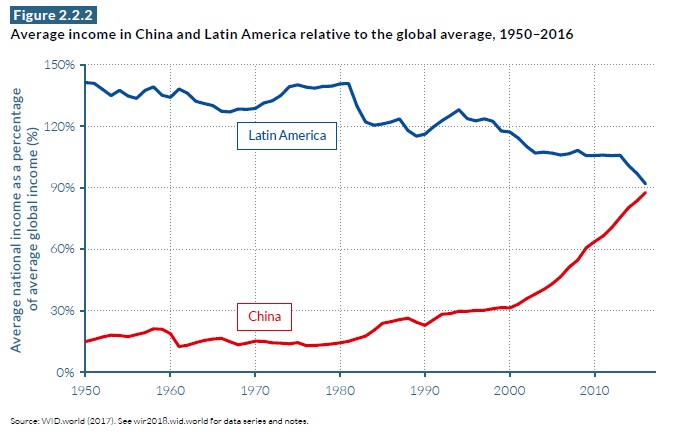
As a similar exercise, China lagged far behind Latin America relative to world income back in 1950. But Latin America has underperformed the world economy, and China has outperformed it, and China appears to be on its way to outstripping Latin America in average incomes in the next few years.

This volume is a rich resource, with lots of information on inequality of incomes by country and by region,  inequality of wealth, shifts in public wealth, and other topics. The policy discussion is relatively brief (better education, progressive taxation, rethinking labor institutions), but that was  fine with me. The fundamental point of this exercise is to generate a common fact base, and then let the policy discussion build upon it.

Incautan en EE.UU dólares, avión y yates a dos venezolanos vinculados a lavado de dinero

Los venezolanos Hjalmar Gibelli Gómez y Fabrizio Della Polla DeSimone accedieron a la incautación y admitieron el lavado de dinero en la adquisición de un avión y dos yates multimillonarios, por lo que los fiscales federales de Sait Louis están en el proceso de apoderamiento de dichos activos.

Se trata de un avión Raytheon Hawker 800, un Ferretti Yacht de 100 pies 2014 denominado “Navigante” y un Persxhing Yacht 2015 de 82 pies llamado “Panacea” además de $ 1.8 millones que fueron obtenidos con ganancias de un esquema ilegal para intercambiar moneda venezolana por dólares estadounidenses en el mercado negro.

Stephen Casey, fiscal general adjunto, al negarse a dar más información sobre el caso dijo que “Ese fue un gran trabajo de la DEA y de los investigadores de la IRS que trabajaron en el caso”.

Della Polla es dueño mayoritario de una granja agrícola, mientras que Gibelli preside una compañía de seguros a través de la cual se presentaron facturas falsas e infladas por más de $ 11 millones para obtener dólares estadounidenses a tasa preferencial a través de una comisión gubernamental con autoridad para vender divisas a ciertos grupos con propósitos limitados.

En un documento presentado el 22 de diciembre en el tribunal Federal del Distrito de St Louis consta la serie de transacciones ilegales que estas personas realizaron para la adquisición de los activos antes nombrados.

En ese documento se refiere que Gibelli compró el avión por $ 1.8 millones en julio de 2012 utilizando fondos de una cuenta en Wells Fargo Advisors y luego pagó 130 mil dólares a una compañía en Florida para personalizarlo. También usó $2.8 millones de esa misma cuenta sumando 4.5 millones de otra cuenta en 2013 y 2014 para comprar Navigante.

Por su parte Della Polla pagó $ 6.8 millones por el Panacea en 2014 que fue incautado en Miami el 28 de octubre de 2016.

Este es uno de los muchos casos de confiscación que últimamente se han hecho una práctica común gracias a la crisis financiera venezolana y a los controles de cambio de divisa que mantiene hasta los momentos el gobierno venezolano.

En ese sentido Lilly Ann Sánchez, abogada de Miami denunció que en los últimos 12 años ha habido un gran cambio en el bolívar que puede costar caro a los ricos aduciendo que “Algún día tendrán un millón de dólares, al día siguiente…tendrán solo 100 mil”.

EUA incautó dos yates, un avión y $ 1.8 millones de dos venezolanos por lavado de dinero

Fiscales federales en San Luis (Missouri) decomisaron un avión, dos yates y más de $ 1.8 millones de dos hombres que estarían vinculados a acusaciones de lavado de dinero en Venezuela.

EUA incautó dos yates, un avión y $ 1.8 millones de dos venezolanos por lavado de dinero

La Fiscalía dice que un avión Raytheon Hawker 800, un Ferretti Yacht de 100 pies 2014 denominado “Navigante” y un Pershing Yacht 2015 de 82 pies llamado “Panacea” estaban entre los activos comprados por los venezolanos Hjalmar Gibelli-Gomez y Fabrizio Della Polla De-Simone.

Ambos accedieron a la incautación y admitieron el lavado de dinero, dice un documento presentado el 22 de diciembre en el Tribunal Federal de Distrito de St. Louis, y agregaron que los activos fueron comprados con ganancias de un esquema ilegal para intercambiar moneda venezolana por dólares estadounidenses en el mercado negro.

El asistente del fiscal federal, Stephen Casey, se negó a comentar los detalles del caso, pero dijo: “Este fue un gran trabajo de la Drug Enforcement Administration (DEA) y los investigadores del IRS que trabajaron en el caso“. No hay abogados listados por Gibelli y Della Polla en una corte federal, y no se pudo contactar a ninguno de ellos para hacer comentarios.

Los fiscales dicen que Della Polla era dueño mayoritario de una granja avícola, y Gibelli es el presidente de una compañía de seguros.

Della Polla presentó facturas falsas e infladas por valor de más de $ 11 millones a través de la compañía de seguros Gibelli para obtener dólares estadounidenses a una tasa preferencial a través de una comisión gubernamental con autoridad para vender dólares a ciertos grupos con propósitos limitados.

El gobierno venezolano promulgó controles cambiarios para evitar la fuga de capitales por parte de los ciudadanos que buscan evitar la inestabilidad económica, política y social, según el documento.

Entre octubre de 2011 y abril de 2015, se conectaron $ 173 millones en una cuenta en Wells Fargo Advisors, que tiene su sede en St. Louis, y se conectaron $ 160 millones, distribuidos entre más de 650 transferencias electrónicas, según la información.

Gibelli compró el avión por $ 1.8 millones en julio de 2012, utilizando fondos de la cuenta de Wells Fargo, y luego pagó $ 130,000 a una compañía de Florida para personalizarlo, según la presentación.

El avión fue incautado por el gobierno de los Estados Unidos el 16 de octubre de 2016.

Gibelli usó $ 2.8 millones de Wells Fargo y $ 4.5 millones de otra cuenta en 2013 y 2014 para comprar Navigante, y Della Polla pagó $ 6.8 millones por la Panacea en 2014, según la información.

Las autoridades incautaron la Panacea en Miami el 28 de octubre de 2016. Los investigadores rastrearon el Navigante en la isla de Bonaire el 11 de septiembre de 2017, y desde entonces han sido trasladados a Estados Unidos, según la solicitud.

Lilly Ann Sánchez, abogada de Miami que pasó 12 años como fiscal federal y ascendió a jefe de delitos mayores, dijo que los casos de confiscación como el de St. Louis se han vuelto comunes desde la crisis financiera venezolana y los esfuerzos de Venezuela para controlar la inflación manteniendo moneda en el país.

En los últimos 10 o 12 años, dijo, ha habido un “gran cambio” en el bolívar que puede costar caro a los ricos.

“Un día tendrán un millón de dólares, al día siguiente … tendrán $ 100 mil”, dijo.

Eso proporciona un gran incentivo para que las personas usen negocios de transferencia de dinero sin licencia, lo que puede cobrar tarifas del 10 al 15 por ciento, dijo.

“Así que hay mucho dinero por hacer, muy, muy rápido”, dijo.

Sánchez dijo que hay muchos casos de confiscación archivados en las principales ciudades de Florida, Texas y Nueva York con conexiones a un gran número de venezolanos.

Dijo que, en algunos casos, los fiscales buscarán el arresto de una persona que presuntamente blanquea dinero si la persona viaja a Estados Unidos o un país que extraditará a la persona; o pueden acordar no enjuiciar si alguien accede a perder los activos.

Prompt Care


Whatever you do, do not go here!  They have no idea what they are doing.  

The whole time we were waiting the women behind the counter loudly made fun of a couple in the parking lot. They couldn’t get my grandson’s information entered in the computer. Supposedly it was down all day. What medical facility doesn’t have an IT department.  

They couldn’t take my payment. Four days later and I’m still trying to make the payment. 
Such morons!

For more details visit :-  http://www.promptcarefl.com/

Former official accused of stealing $800,000 from nonprofit San Diego County clinic

North County Health Services, is suing this man, Hector Ramos, for allegedly embezzling $800,000 from the organization.
North County Health Services provides health care, including dentistry, to low-income residents of California.
Mr. Ramos, who was residing in Murrieta, CA at the time, has also been charged with a number of criminal offenses. Bail was set at $1 million, with an additional stipulation that if posted, that proof of the legitimacy of the source of bail funds be provided.
Mr. Ramos allegedly created two fraudulent corporations that invoiced North County Health Services for purchases of computer hardware. Instead, it is alleged that funds were used to pay for trips, clothing, and a large payment to a Porsche dealership.
Mr. Ramos’s biographical information from a North county Health Services PowerPoint presentation indicates that he has been with the organization since 2014, has two graduate degrees, and speaks four languages.
Mr. Ramos has been arraigned and has pled not guilty to 49 charges.
According to Winn, North County Health Services hired Ramos — at an annual salary of $200,000 — to run its IT department in January 2015.
Winn said Ramos created two fraudulent corporations and submitted false invoices from those corporations to North County Health Services.
Ramos would create a sense of urgency, Winn said, by telling staffers in the purchasing department that the entire computer system might shut down if the invoices were not paid quickly.
Ramos’ assistant grew suspicious, investigated the two corporations and found that Ramos was on the board, Winn said. The assistant reported it to organization officials, she said.
Bank statements show that while the payments were made to Ramos’ companies, Winn said, the records do not show purchases of computer equipment or software that matches what North County Health Services had been billed.
Rather, she said, the bank statements show “lavish spending,” including international vacations and thousands of dollars in purchases from a wine website. Other spending was on cigars, clothing, and a $44,000 check written to a Porsche dealer, the prosecutor said.
Winn said that the loss of the money “was very demoralizing” to the organization’s employees and that they felt a sense of betrayal.
Superior Court Judge David Danielsen set Ramos’ bail at $1 million, and granted Winn’s request that, should Ramos make bail, he must prove that the source of the money was not illegally obtained.

Aside from the criminal case, the clinic’s insurance company filed a civil suit against Ramos in July to recover nearly $800,000. That case is pending.
Design a site like this with WordPress.com
Get started