Black/White Disparities: 50 Years After the Kerner Commission

The National Advisory Commission on Civil Disorders was appointed by President Lyndon Johnson in the summer of 1967 and issued its report in February 1968. US cities had been experiencing sporadic but severe riots for three years. The report became known as the Kerner Commission after its chair, Governor Otto Kerner, Jr. of Illinois. I’m not seeing a place online where the full report is freely available online, which is a bit of a surprise to me, although the intro and first 70 pages or so are available here. For the tone, here is some of the introduction: 

“The summer of 1967 again brought racial disorders to American cities, and with them shock, fear, and bewilderment to the Nation. The worst came during a 2-week period in July, first in Newark and then in Detroit. Each set off a chain reaction in neighboring communities. …

“This is our basic conclusion: Our Nation is moving toward two societies, one black, one white–separate and unequal. Reaction to last summer’s disorders has quickened the movement and deepened the division. Discrimination and segregation have long permeated much of  American life; they now threaten the future of every American. 

“This deepening racial division is not inevitable. The movement apart can be reversed. Choice is still possible. Our principal task is to define that choice and to press for a national resolution. 

“To pursue our present course will involve the continuing polarization of the American community and, ultimately, the destruction of basic democratic values. The alternative is not blind repression or capitulation to lawlessness. It is the realization of common opportunities for all within a single society. This alternative will require a commitment to national action–compassionate, massive, and sustained, backed by the resources of the most powerful and the richest nation on this earth.

“From every American it will rcquire ncw attitudes, ncw understanding, and, above all, new will. The vital needs of the Nation must be met; hard choices must be made, and, if necessary, new taxes enacted. 

“Violence cannot build a better society. Disruption and disorder nourish repression, not justice. They strike at the freedom of every citizen. The community cannot–it will not–tolerate coercion and mob rule. 

“Violence and destruction must be ended–in the streets of the ghetto and in the lives of people. 

“Segregation and poverty have created in the racial ghetto a destructive environment totally unknown to most white Americans. What white Americans have never fully understood–but what the Negro can never forget–is that white society is deeply implicated in the ghetto. White institutions created it, white institutions maintain it, and white society condones it.”

From a modern standpoint, it’s interesting to note that this report is being published in 1968, four years after the passage of the Civil Rights Act of 1964. The decade after that law did see some dramatic changes for African-Americans in employment, education, and voting. For details, see John J. Donohue III and James Heckman, “Continuous Versus Episodic Change: The Impact of Civil Rights Policy on the Economic Status of Blacks,” Journal of Economic Literature  (December 1991, 29:4 , pp. 1603-1643). But much of that progress seemed to taper off by the mid-1970s.

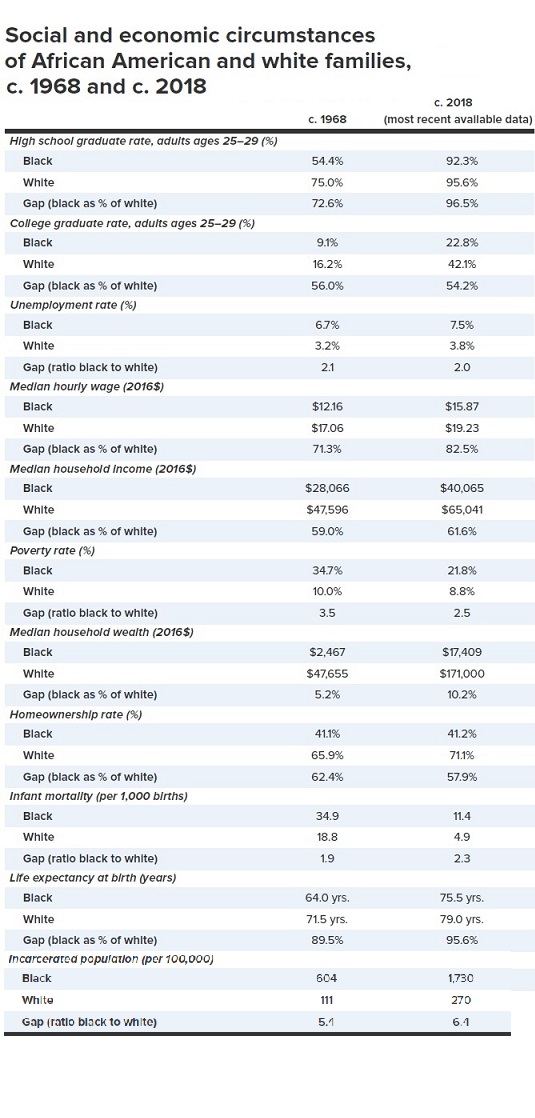
Thus, the 50th anniversary of the Kerner commission offers a chance for reflection.  Janelle Jones, John Schmitt, and Valerie Wilson offer a useful starting point in the short report, 50 years after the Kerner Commission: African Americans are better off in many ways but are still disadvantaged by racial inequality, from the Economic Policy Institute (February 26, 2018). The report compares black and white America in 1968 and the present, along a number of dimensions.  (So that the table would be more readaable on the blog, I’ve trimmed off the last column, which shows changes between the two years.)

For example, blacks have made dramatic gains to near-equality with whites in high school graduation rates. But in terms of college attendance, the racial gap remains very large. 
Black unemployment rates continue to be consistently higher than white rates. The black/white gaps in terms of hourly pay, annual income, poverty rate, and annual wealth have closed a bit, after 50 years (!), but remain large.  The homeownership rate for blacks has barely budged in 50 years.
Life expectancy is close to equal for whites and blacks. Infant mortality has dropped substantially for both blacks and whites in the last 50 years, but remains more than twice as high for blacks. Incarceration rates have more than doubled forth both whites and blacks, and the ratio of the black/white incarceration rate has risen from 5:1 to 6:1 in the last 50 years. 

The authors of this Economic Policy Institute aren’t arguing over causes and reasons–at least not here–just putting some facts out there. But I’ll add a few words.

The patterns mentioned here are of course intertwined. The fact that whites have far higher college graduation rates affects wages, income, poverty rates, and wealth. Lower education and income are also correlated with infant mortality rates and crime.  Differences in education level between groups can take a long time to play out. Someone who didn’t finish high school back around 1970 has probably just retired in the last few years. Someone who didn’t go to college in the 1970s or the 1980s or the 1990s has been probably been working for decades in lower-paying jobs. When parents have less education, their children tend to have less education, too. And while racial discrimination in America doesn’t operate with the same brute force as 50 years ago, it surely continues to play a role in patterns of housing, employment, and what society is willing to tolerate in terms of educational results.

The racial disparities in 2018 aren’t happening in the same society as in 1968, or from the same causes, or against the same backdrop of urban rioting. But black/white racial disparities remain very large. Very large indeed. 

Some Thoughts About Economic Exposition in Math and Words

Analysis in economics and other social sciences often uses a combination of words and mathematics. There is an ongoing critique by those who argue that while the math may sometimes be useful, it is too often deployed with insufficient regard for whether it captures the underlying economic reality. In such cases, the argument goes, math is used as a way of pretending that an argument about the real-world economy has been definitely made, or settled, when in reality only an equation of limited application has been solved.

Paul Romer recently offered a pithy commentary on this longstanding dispute on his blog. Romer quotes from an earlier post by Dani Rodrik, who in some lists of advice for economists and non-economists, includes the following:

“Make your model simple enough to isolate specific causes and how they work, but not so simple that it leaves out key interactions among causes. … Unrealistic assumptions are OK; unrealistic critical assumptions are not OK. …  Do not criticize an economist�s model because of its assumptions; ask how the results would change if certain problematic assumptions were more realistic. … Analysis requires simplicity; beware of incoherence that passes itself off as complexity. … Do not let math scare you; economists use math not because they are smart, but because they are not smart enough.”

Romer has in recent years expressed concerns over “mathiness,” in which predetermined conclusions masquerade behind what looks like an “objective” mathematical model.  As he wrote in a 2015 paper:

“The style that I am calling mathiness lets academic politics masquerade as science. Like mathematical theory, mathiness uses a mixture of words and symbols, but instead of making tight links, it leaves ample room for slippage between statements in natural versus formal language and between statements with theoretical as opposed to empirical content. … [M]athiness could do permanent damage because it takes costly effort to distinguish mathiness from mathematical theory.” 

In his December blog post, Romer adds some rules of his own: 

1/ The test is whether math adds to or detracts from clarity and precision. A writer can use either the words of everyday language or the symbols from math to make assertions that are clear and precise; or opaque and vague.
2/ The deep problem is intent, not ability or skill.
3/ Writers who want to make predictions use words and math to be clear and precise. Writers who want to make excuses use words and math to be opaque and vague.
4/ Compared to words, math and code tend to be both more precise and more opaque …

I might quibble a bit with his rule #2, because my sense is that many of those who fail to communicate clearly, whether in math or in words, either have simply not put the time and effort into doing so, or lack the ability/skill to do so. But at least for me, the notion that math is “both more precise and more opaque” than words is an insight worth keeping.

Romer’s comment reminded me of an earlier set of rules from the great economist Alfred Marshall, who in his great Principles of Economics, published in 1890, and the standard textbook of economics for several decades thereafter, was quite careful about having almost all words in the text, with the underlying mathematics in footnotes. Marshall wrote in 1906 letter to Alfred Bowley (reprinted in A.C. Pigou (ed.), Memorials of Alfred Marshall, 1925 edition, quotation on p. 427): 

“But I know I had a growing feeling in the later years of my work at the subject that a good mathematical theorem dealing with economic hypotheses was very unlikely to be good economics; and I went more and more on the rules — (1) Use mathematics as a shorthand language; rather than as an engine of inquiry. (2) Keep to them till you have done. (3) Translate into English. (4) Then illustrate by examples that are important in real life. (5) Burn the mathematics. (6) If you can’t succeed in 4, burn 3. This last I did often. …
Mathematics used in a Fellowship thesis by a man who is not a mathematician by nature — and I have come across a good deal of that — seems to me an unmixed evil. And I think you should do all you can to prevent people from using Mathematics in cases in which the English language is as short as the Mathematical …”

As a final example of challenges that arise when mixing mathematics into economic situations, consider this definition of “logic” taken from Ambrose Bierce’s (1906) The Devil’s Dictionary:

LOGIC, n. The art of thinking and reasoning in strict accordance with the limitations and incapacities of the human misunderstanding. The basic of logic is the syllogism, consisting of a major and a minor premise and a conclusion� thus:

Major Premise: Sixty men can do a piece of work sixty times as quickly as one man.

Minor Premise: One man can dig a posthole in sixty seconds; therefore�

Conclusion: Sixty men can dig a posthole in one second.

This may be called the syllogism arithmetical, in which, by combining logic and mathematics, we obtain a double certainty and are twice blessed.

An awful lot of writing in economics combines logic and mathematics, and as Bierce would sarcastically say, we thus obtain “a double certainty and are twice blessed.”

A Grasshopper View: The 2018 Economic Report of the President

The Council of Economic Advisers was established by the Employment Act of 1946 as a separate office in the White House. Along with an ongoing stream of stream of reports and advice, the CEA also produces an annual report, and the 2018 Economic Report of the President  is now available. The CEA is headed by three political appointees, which is fine by me. I expect every president to choose appointees who are broadly in agreement with administration policies. My (often unrequited) hope is that the president will then actually listen to such experts on the dangers of likely tradeoffs and the details of policy design.

If you want to read the reasonable person’s defense of Trump’s economic policies–either because you want to support these policies or you want to rebut them–the Economic Report thus offers a useful starting point. For example, the first chapter is a defense of the Tax Cuts and Jobs Act (TCJA) passed in December 2017, and the second chapter is a defense of the Trump’s regulatory policy efforts.  I tend to skim over such partisan arguments, but I still appreciate the figures and tables surrounding these arguments. They often describe facts and patterns worthy of note, whatever one’s policy beliefs about the appropriate reaction to them.

In that spirit, I’ll offer a grasshopper view of the report, leaping with no particular rhyme or reason between figures that caught my eye, with a few sentences quoted from the report about about each. Topics include: geographic mobility, road infrastructure, the US balance of trade since 1790, the fall in US manufacturing employment after 2000, the opioid epidemic, firms are investing less while paying out more to shareholders, and there is an international decline in labor productivity in the last decade or so.

The Fall of Geographic Mobility 

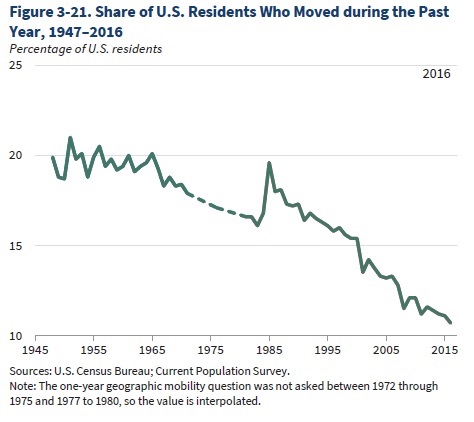
“High levels of unemployment concentrated in particular locations may amplify exit from the labor force, especially when workers are unwilling or unable to move to a location with a stronger job market. People move to improve their life circumstances, but the share of Americans moving has been declining, and is currently at its lowest value on record (figure 3-21).

“In addition to family and social connections, deterrents to moving include (1) search time, (2) State-specific occupational licensing requirements, (3) local land use regulations that raise housing costs in places with the greatest potential growth, and (4) homeowners� limited ability to sell their homes. Such obstacles to finding better employment opportunities, coupled with high local unemployment rates, may lead employees to ultimately exit the workforce. More research is needed to determine the direct relationship between geographic immobility and labor force participation, specifically exploring whether obstacles to moving have increased over time, and how prime-age workers in particular have been affected.”

More Driving on the Same Roads


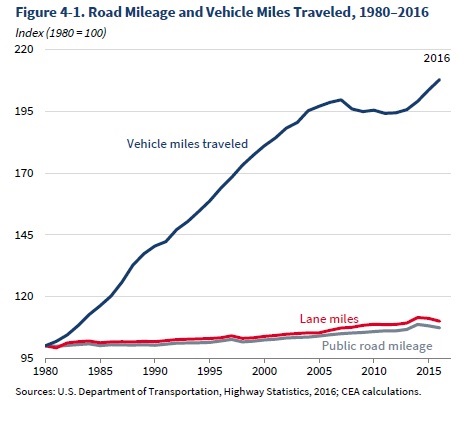
“For example, between 1980 and 2016, vehicle miles traveled in the United States more than doubled, while public road mileage and lane miles rose by only 7 and 10 percent, respectively (figure 4-1). Unsurprisingly, queuing caused by traffic congestion has risen, imposing both direct and indirect costs on business and leisure travelers alike …”

Swings in the US balance of trade since 1790

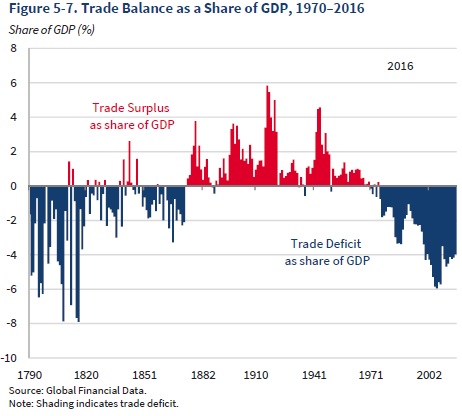
“Figure 5-7 illustrates the U.S. trade balance from 1790 to the present, expressed as a share of GDP. From 1790 through 1873, the U.S. trade balance was volatile, in part due to the low trade volumes (Lipsey 1994). The trade balance swung back and forth between surplus and deficit, but was mostly in deficit. From 1873 through the 1960s, the trade balance was mostly in surplus. The largest historic surpluses were during the years 1916�17 and 1943�44, as wartime production and trade with allies predominated. Since 1976, the trade balance has been continually in deficit. The largest deficit as a share of GDP was nearly 6 percent in 2006, a share exceeded in only six other years in U.S. history and not seen since 1816.”

The sharp fall in manufacturing employment after 2000

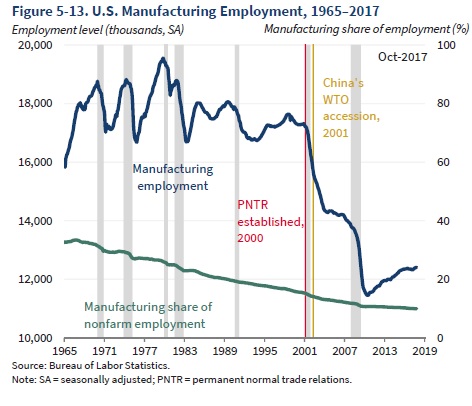
“Although employment in the sector has long exhibited procyclicality, it has seen changes since 2000. In the expansionary period from the end of 2000 through 2007, the economy failed to recover the manufacturing job losses it experienced during the previous recession years.”

The Opioid Epidemic

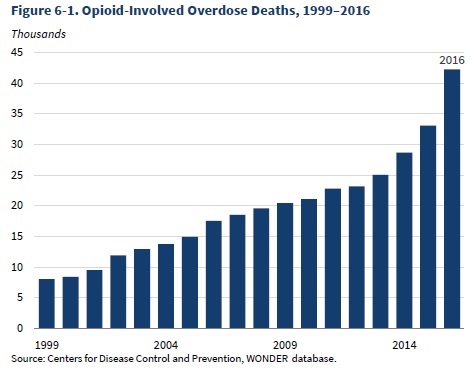
“And since 1999, over 350,000 people have died of opioid-involved drug overdoses, which is 87 percent of the 405,399 Americans killed in World War II (DeBruyne 2017). The staggering opioid death toll has pushed drug overdoses to the top of the list of leading causes of death for Americans under the age of 50 and has cut 2.5 months from the average American�s life expectancy (Dowell et al. 2017). … 

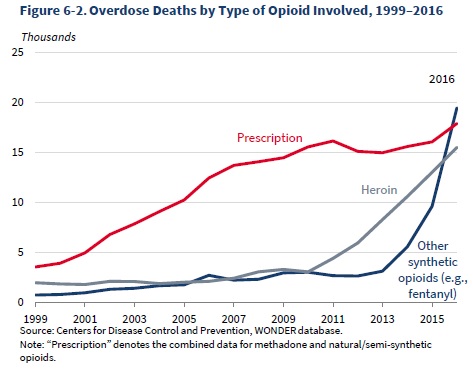
“The opioid epidemic evolved with three successive waves of rising deaths due to different types of opioids, with each wave building on the earlier one (Ciccarone 2017). In the late 1990s, in response to claims that pain was undertreated and assurances from manufacturers that new opioid formulations were safe, the number of opioid prescriptions skyrocketed (CDC 2017b). What followed was an increase in the misuse of and deaths related to these prescriptions (figure 6-2). As providers became aware of the abuse potential and addictive nature of these drugs, prescription rates fell, after peaking in 2011. Deaths involving prescription opioids leveled off, but were followed by a rise in deaths from illicit opioids: heroin and fentanyl. Heroin deaths rose first, followed by a rise in deaths involving fentanyl�a synthetic opioid that is 30 to 50 times more potent than heroin and has legitimate medical uses but is increasingly being illicitly produced abroad (primarily in Mexico and China) and distributed in the U.S., alone or mixed with heroin. In 2015, males age 25 to 44 (a core group of the prime-age workers whose ages range from 25 to 54) had the highest heroin death rate, 13 per 100,000. Fentanyl-related deaths surpassed other opioid-related deaths in 2016.”

Investment is down, while firms pay out more to shareholders

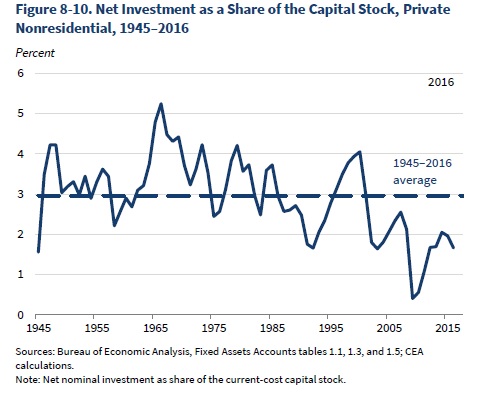
“It is a matter of concern that net investment has been generally falling as a share of the capital stock during the past 10 years, which limits the economy�s productive capacity. In 2016, net investment as a share of the capital stock fell to a level previously seen only during recessions (figure 8-10). The Tax Cuts and Jobs Act is designed to increase the pace of net investment. As discussed further below, the slowdown in investment has also exacerbated the slowdown in labor productivity growth. …

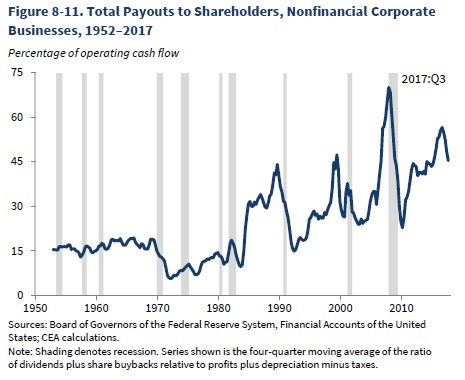
“The rate of payouts to shareholders by nonfinancial firms, in the form of dividends together with net share buybacks, has been gradually trending higher for several decades, although it fell in 2017 (figure 8-11). Nonfinancial corporations returned nearly half the funds that could be used for investment to stockholders in 2017. In a well-functioning capital market, when mature firms do not have good investment opportunities, they should return funds to their stockholders, so the stockholders can invest these funds in young and growing firms. Although it may be admirable for individual firms to thus return funds to their shareholders, the rising share of paybacks to shareholders suggests that investable funds are not being adequately recycled to young and dynamic firms. Guti�rrez and Philippon (2016) find that firms in industries with more concentration and more common ownership invest less.”

The International Decline in Labor Productivity

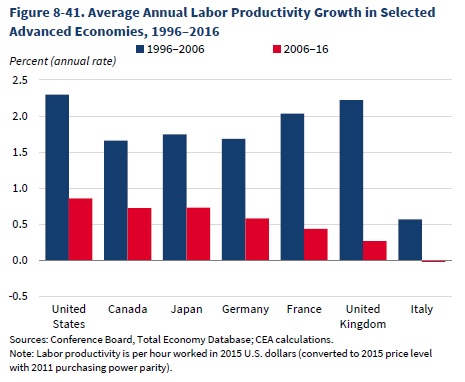
“Labor productivity growth has been slowing in the major advanced economies (figure 8-41), driven by an estimated decline of 0.3 percent in annual multifactor productivity growth relative to average precrisis growth of 1 percent a year. This slowdown is broad-based, also affecting developing and emerging market economies. Although the causes of this productivity slowdown are unclear, a number of hypotheses have been offered�including financial crisis legacies, such as weak demand and lower capital investment; the trade slowdown; the aging of the post�World War II Baby Boom generation in its various forms around the world; the rising share of low-productivity firms; and a widening gap between high- and low-productivity firms. The Organization for Economic Cooperation and Development (OECD) finds that the survival of abnormally low-productivity firms may have contributed to the slowdown in productivity growth.” 

Brainstorming Anti-Poverty Programs

There are legitimate concerns about how the poverty line is set. It was set back in the early 1960s and adjusted for inflation since then, but without regard for other changes in the economy. It doestn’t vary according to regional differences in the cost of living and it doesn’t include in-kind benefits like Medicaid and food stamps. It is based on income levels, rather than consumption levels (or see also  here). At least for a bloodless social scientist, it’s possible to become focused on these conceptual issues to such an extent that basic empathy for those living with very low income levels gets crowded out. But just as one should remember that the poverty line is an arbitrary but useful convention, one should also remember that households living with very low income levels have a hard time.

Thus, it seems to me a  profoundly useful exercise, every now and then, to set aside the questions of how to measure poverty and instead to focus on what might be done about it. In that spirit, the Russell Sage Foundation Journal for the Social Sciences has put together a special double issue on the theme of  “Anti-poverty Policy Initiatives for the United States” (February 2018, vol 4, issues 2-3). After an overview essay by Lawrence M. Berger, Maria Cancian, and Katherine Magnuson, the two issues include 15 papers with a wide range of concrete proposals: focused on children in low-income families, the elderly, renters, food stamps, the earned income tax credit, the minimum wage, subsidizing or guaranteeing jobs, postsecondary training and higher education, contraception, and more.

There’s a lot to contemplate in these issues, and I’ll list the table of contents, with links to specific papers, below. A number of the papers are focused on how to adjust existing programs at a moderate cost. Here, I’ll just sketch a couple of proposals that think much bigger. 

For example, a “universal child allowance” means that any household with children, regardless of income level, would receive a per child payment from the government. . Luke Shaefer, Sophie Collyer, Greg Duncan, Kathryn Edin, Irwin Garfinkel, David Harris, Timothy M. Smeeding, Jane Waldfogel, Christopher Wimer, Hirokazu Yoshikawa  lay out what such a proposal might look like in “A Universal Child Allowance: A Plan to Reduce Poverty and Income Instability Among Children in the United States.”

The point out that the US has oriented much of it social safety net toward work, with the result that children in families where the adults don’t work much can be very badly off. Their baseline proposal is to that every US family with a child  would be about $250 per month ($3,000 per year).  Because the allowance doesn’t depend on income or hours worked, it is not reduced if an adult works more hours or gets higher pay. There is no need for a large bureaucracy to monitor eligibility and sliding-scale reductions in benefits.

Lots of other countries have enacted policies along these lines. They write (citations omitted):

Part of the reason that other nations have fewer poor children than the United States is that they provide what the OECD terms a universal child benefit�a cash grant that goes to all families with children. Austria, Canada, Denmark, Finland, France, Germany, Ireland, Luxembourg, the Netherlands, Norway, Sweden, and the UK have all implemented a version of a child benefit. Some call their measures child allowances (CA). Others implement their CA through the tax code as universal child tax credits. A notable feature of these universal child benefit plans is that they are accessible to all: families with children receive them regardless of whether parents work and whatever their income. The level of these child benefits varies by country. The benefit in U.S. dollars for two children in Belgium and Germany is about $5,600 per year; in Ireland $4,000, and in the Netherlands $2,400 (. Canada has a base child allowance, in U.S. dollars, of roughly $5,000 per child under six and $4,300 per child age six to seventeen …  

To pay for the allowances, they would start by scrapping the existing “$1,000 per child per year Child Tax Credit and a $4,000 per child per year tax exemption (often referred to as the child deduction),” which as they point out mostly go to families with incomes well above the poverty line.” This saves $97 billion.  The total estimated cost of the baseline proposal about $190 billion, so the additional spending needed would be $93 billion. For those who are skeptical about whether the money would actually benefit children, the author point to a body of evidence that for low-income families in particular, available cash seems to make a real difference in many measures of well-being. 

Another aggressive proposal is that the federal government should guarantee a job to everyone who wants one. Mark Paul, William Darity Jr., Darrick Hamilton, and Khaing Zaw sketch a proposal long these lines, and respond to some of the common concerns, in “A Path to Ending Poverty by Way of Ending Unemployment: A Federal Job Guarantee.” Their proposal is: “Any American wanting a job, at any time, would be able to obtain one through the public employment program.”

Their proposal is that local, state and federal governments would “conduct an inventory of their needs and develop a jobs bank. … At the federal level, we anticipate a wide array of major public investment activities, which may include fostering a transition to a green energy economy, extending access to high-speed rail, improvements in our public park service, revival and product diversification for the postal service, and an increase in general services across the economy. At the state level, we anticipate the states to undertake major infrastructure investment projects, as well as projects to improve the services they offer to their citizens. At the local level, we expect communities to undertake community development projects, provide universal daycare, maintain and upgrade their public school facilities, and improve and expand the services provided by their libraries.”

They envision that workers would be paid a starting hourly wage of of $11.56 per hour, plus health and retirement benefits. The program would have some room for promotions and pay raises, so they envision that the average wage about 35% above that level. Total cost of course depends on  how many people would come looking for these jobs. But their estimates for a time of fairly low unemployment, like July 2016 the costs could run $651 Billion to $2.1 trillion. On the other hand, anyone who takes this kind of job would have reduced eligibility for other kinds of government assistance: for example, they would no longer get Medicaid.  
As they emphasize, this job guarantee would be most useful to those who have the hardest time finding a job now. Moreover, the guaranteed federal job would become a floor for the rest of the labor market: if a private employer wanted to hire someone, you would need to offer at least as much as the federal job guarantee. Although they don’t emphasize this point, it would be interesting to live in a US society where no one would be ever be able to say that they just can’t find a job. 
I tend to be an incrementalist at heart, so both of these proposals stretch beyond my comfort level. I’m OK with the idea of a child allowance for a majority of families with children, but the “universal” part goes a little too far for me. The authors offer a number of choices that would hold down costs, and I’d be looking for more ways to do that. 
It would be fascinating to watch the politics of a job guarantee program evolve. There would certainly be concerns from a wide array of workers–from construction unions to day care workers– that the government would use the cheaper guaranteed jobs to cut back on wages. Politicians would bid for votes by offering higher pay to the guaranteed job workers. They authors argue that concerns over phantom workers collecting paychecks are overblown, but I”m not so sure. Ultimately, I’m more comfortable with targeted job subsidies for employers (as discussed in other chapters). 
But whatever my specific preferences, these essays are the intellectual equivalent of splashing your face with cold water first thing in the morning. They offer a useful jolt and a wake-up call about what the shape of a serious anti-poverty agenda. 

_________________________________
Table of Contents with links:
Volume 4, Number 2

Anti-poverty Policy Innovations: New Proposals for Addressing Poverty in the United States,” by
Lawrence M. Berger, Maria Cancian, Katherine Magnuson (4:2, pp. 1�19)

A Universal Child Allowance: A Plan to Reduce Poverty and Income Instability Among Children in the United States,” by H. Luke Shaefer, Sophie Collyer, Greg Duncan, Kathryn Edin, Irwin Garfinkel, David Harris, Timothy M. Smeeding, Jane Waldfogel, Christopher Wimer, Hirokazu Yoshikawa (4:2, pp. 22�42)

Cash for Kids,” by Marianne P. Bitler, Annie Laurie Hines, Marianne Page (4:2, pp. 43�73)

A Targeted Minimum Benefit Plan: A New Proposal to Reduce Poverty Among Older Social Security Recipients A Targeted Minimum Benefit Plan,” by Pamela Herd, Melissa Favreault, Madonna Harrington Meyer, Timothy M. Smeeding (4:2, pp.74�90)

Reforming Policy for Single-Parent Families to Reduce Child Poverty,” by Maria Cancian, Daniel R. Meyer (4:2, pp. 91�112)

Reconstructing the Supplemental Nutrition Assistance Program to More Effectively Alleviate Food Insecurity in the United States.” by Craig Gundersen, Brent Kreider, John V. Pepper (4:2, pp. 113�130)

A Renter�s Tax Credit to Curtail the Affordable Housing Crisis,” by Sara Kimberlin, Laura Tach, Christopher Wimer (4:2, pp. 131�160)

The Rainy Day Earned Income Tax Credit: A Reform to Boost Financial Security by Helping Low-Wage Workers Build Emergency Savings,” by Sarah Halpern-Meekin, Sara Sternberg Greene, Ezra Levin, Kathryn Edin (4:2, pp. 161�176)

Volume 4, Number 3

Anti-poverty Policy Innovations: New Proposals for Addressing Poverty in the United States,” by Lawrence M. Berger, Maria Cancian, Katherine Magnuson (4:3, pp. 1�19)

Coupling a Federal Minimum Wage Hike with Public Investments to Make Work Pay and Reduce Poverty,” by Jennifer Romich, Heather D. Hill (4:3, pp. 22�43)

A Path to Ending Poverty by Way of Ending Unemployment: A Federal Job Guarantee,” by Mark Paul, William Darity Jr., Darrick Hamilton, Khaing Zaw (4:3, pp. 44�63)

Working to Reduce Poverty: A National Subsidized Employment Proposal,” by Indivar Dutta-Gupta, Kali Grant, Julie Kerksick, Dan Bloom, Ajay Chaudry (4:3, pp. 64�83)

A �Race to the Top� in Public Higher Education to Improve Education and Employment Among the Poor,” by Harry J. Holzer (4:3,  84�99)

Postsecondary Pathways Out of Poverty: City University of New York Accelerated Study in Associate Programs and the Case for National Policy,” by Diana Strumbos, Donna Linderman, Carsosn C. Hicks (4:3, pp. 100�117)

A Two-Generation Human Capital Approach to Anti-poverty Policy,” by Teresa Eckrich Sommer, Terri J. Sabol, Elise Chor, William Schneider, P. Lindsay Chase-Lansdale, Jeanne Brooks-Gunn, Mario L. Small, Christopher King, Hirokazu Yoshikawa (4:3, pp. 118�143)

Could We Level the Playing Field? Long-Acting Reversible Contraceptives, Nonmarital Fertility, and Poverty in the United States.” by Lawrence L. Wu, Nicholas D. E. Mark (4:3, pp. 144�166)

Assessing the Potential Impacts of Innovative New Policy Proposals on Poverty in the United States,” by Christopher Wimer, Sophie Collyer, Sara Kimberlin (4:3, pp. 167�183)
Pollutant Taxes on Energy: Why So Focused on Roads?

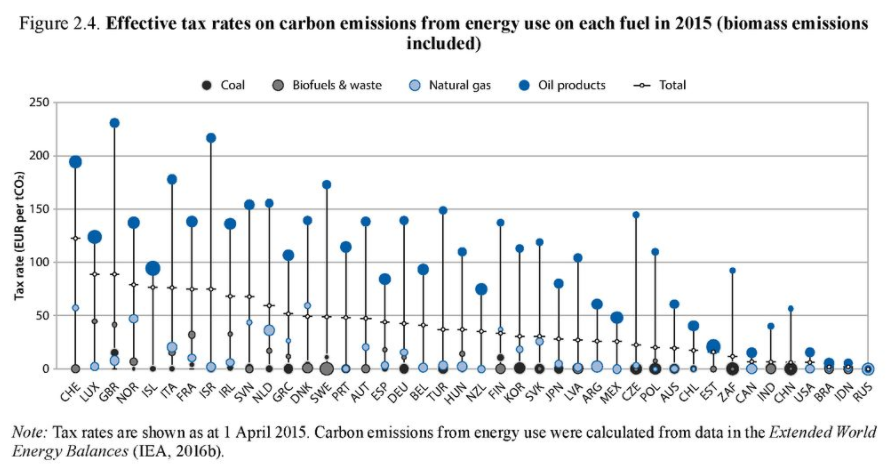
Most countries of the world tax oil products, especially the gasoline used in the road sector, but impose only very low taxes on other fossil fuels.  The OECD compiles a Taxing Energy Use Database that includes energy use and energy taxes for 42 countries that make up 80% of global energy use, and not coincidentally, 80% of global carbon emissions. For the latest iteration of this database, the OECD has also published Taxing Energy Use 2018: Companion to the Taxing Energy Use Database (February 2018), which pulls together some of the overall patterns. Here are a couple of the figures that caught my eye.

This figures shows energy taxes on a country-by-country basis. The energy taxes are measured in terms of euros per ton of carbon dioxide emitted. The little horizontal notches show the total tax on carbon emissions from energy use. Switzerland, Luxembourg, Germany, and Norway have the highest taxes, while the US and China are down at the low end,along with Brazil, Indonesia, and Russia. The variation across countries is considerable.

The dark blue balls show the tax on oil products, including gasoline. As is quickly apparent, the effective tax rate on carbon emissions from oil is higher than the tax rate on carbon emissions from other sources of energy. In particular, coal goes essentially untaxed in most countries. As a result, the OECD finds that 81% of carbon emissions are not taxed at all.

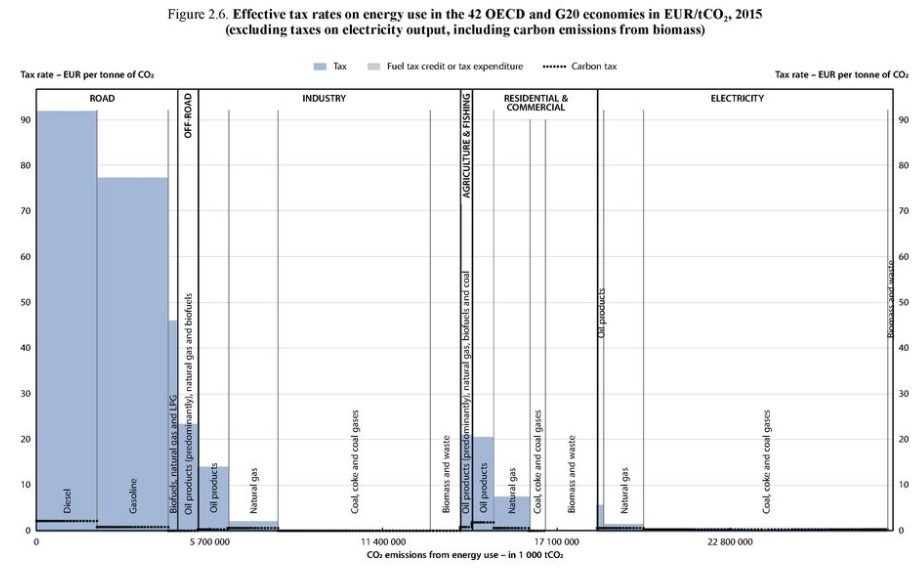
Here’s a similar story, but told in terms of sectors of the economy. The first section of the table on the left shows taxing of energy in the road sector, and the blue lines show carbon taxes on diesel and gasoline. But the next sections show energy taxes in industrial uses, in residential/commercial, and in electricity generation. From a global perspective, energy pollution arising from these other sources is largely untaxed.

If burning fossil fuels is enough of an environment problem that it justifies taxes on oil products in the road sector, then it seems quite peculiar to have burning of fossil fuel from other sectors going essentially untaxed. Indeed, there is a literature on the “co-benefits” of reducing air pollution, which points out that there are immediate short-term health gains to doing so, as well as a longer-term reduction  in the risks posed by carbon emissions.

Some Patterns for Same-Sex Households

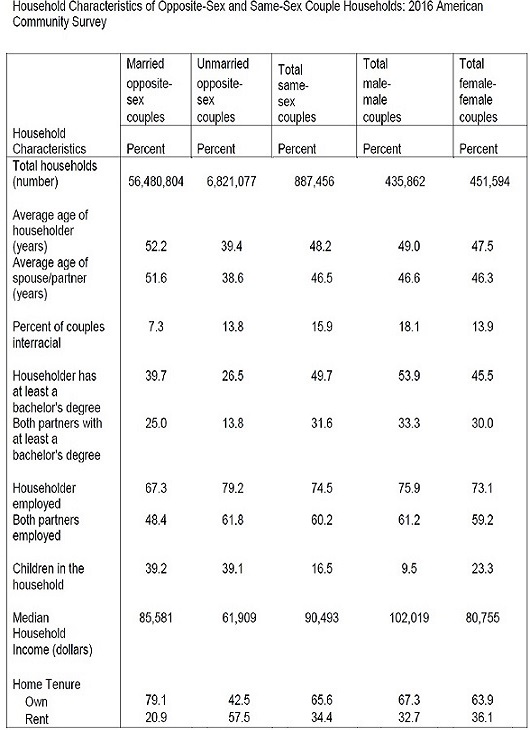
A couple of decades back, it was  hard to find systematic and reliable information on the economic and family characteristics of same-sex couples. However, the US Census has been collecting baseline data for some years now, and just released an annual report, Characteristics of Same-Sex Couple Households: 2005 to Present. The report is just a few statistical tables. I’ve taken one of the tables, cut some of the rows, left out the columns showing statistical significance, and cut the footnotes. But there’s enough left to note some patterns.

  • For the US as a whole, The Census folks counted 56.4 million married opposite-sex couples, 6.8 millions unmarried opposite sex couples, and almost 900,000 single-sex couples, more or less evenly split between male-male and female-female couples. 
  • By average age, the same-sex couples are much closer to the opposite-sex couples than to the unmarried opposite-sex couples. 
  • Same-sex couples are much more likely to be interracial than married opposite-sex couples, especially male-male couples. 
  • Same-sex couples tend to have higher education levels than opposite-sex couples, who in turn have  higher education levels than unmarried opposite-sex couples. 
  • In terms of employment, unmarried opposite-sex couples rank highest, followed by the same-sex couples, while married single-sex couples are lowest. 
  • Married and unmarried opposite-sex couples are about equally likely to have children in the household, while same-sex couples–especially male-male couples–are much less likely to have children in the household. 
  • In terms of median household income, the rank from highest to lowest is: male-male couples, married opposite-sex couples, female-female couples, and unmarried opposite-sex couples. 

A table like this one is useful for showing some factual patterns, but it would be extremely unwise to draw any conclusions about causality from it. For example, it is certainly not true that if the unmarried couples were to marry, they would immediately become older, better educated, and with higher paychecks.

[Note added 3/1/18: Those interested in this topic might also want to check this Research Report from the Tax Policy Center: “Same-Sex Married Tax Filers After Windsor and Obergefell,” by Robin Fisher, Geoff Gee, and Adam Looney (February 28, 2018) It looks at evidence on same-sex married couples from tax returns, and how the patterns shifted after key Supreme Court rulings affecting same-sex marriage in 2013 and 2015.]

A decade ago, Dan A. Black, Seth G. Sanders, and Lowell J. Taylor. wrote about “The Economics of Lesbian and Gay Families.” in the Spring 20017 issue of the Journal of Economic Perspectives (21:2,  53-70). They noted that many of the observed patterns of same-sex couples are consistent with economic reasoning. For example, if a smaller share of same-sex couples are likely to have children, this will influence patterns of work, willingness to live in urban areas, and other factors. They wrote:

“The economic approach to thinking about families�with its focus on deliberative choices made by people with reasonably stable preferences�stresses the importance of constraints. That is, when economists seeks to understand systematic differences in the behavior of gays, lesbians, and heterosexuals, we do not start with a hypothesis of innate differences in preferences, but instead seek to understand how differences in constraints systematically alter incentives faced by gay, lesbian, and heterosexual people. This paper uses the economic approach to organize our thinking about gay and lesbian families, and thus implicitly assumes that, aside from sexual preference, other preferences do not systematically differ by sexual orientation. Based on that approach we provide evidence pertaining to some initial questions. 

“For example, do differing biological constraints faced by gay, lesbian, and heterosexual couples affect choices over children? Clearly they do; there are far fewer children in lesbian and gay families than heterosexual-partnered families. Gays and lesbians also face higher costs for adoption, which further reduces opportunities to raise children. 

“Do differences in fertility (or anticipated fertility), again owing to differences in constraints, influence where people live? We argue that because gay couples face a relatively high price for children, they will consume more non-child goods, and this increased consumption often takes the form of locating in expensive highamenity locations like San Francisco or New York. 

“Do same-sex couples have patterns of household specialization that differ in predictable fashion from heterosexual couples? Available evidence indicates that lesbian women have higher wages and greater labor force attachment than heterosexual women, while the opposite situation pertains for gay men relative to heterosexual men. A variant of Becker�s (1991) model of household specialization would predict this pattern. 

“Of course, many other interesting and fundamental questions await analysis, from economics and other social science disciplines, as better data sources become available.”

"The Great Advantage of the Americans Consists in Their Being Able to Commit Faults Which They may Afterward Repair"

Why is it that the United States (or democracies in general) can in many cases pass foolish bad laws or make a  misguided selection of leaders–but nonetheless continue over time to flourish over a sustained time? Alexis de Tocqueville tackles that question in this passage from his 1840 work Democracy in America (Chapter XIV: Advantages American Society Derive From Democracy � Part I, available various places on the web like here and here).  It’s food for thought for today’s President’s Day holiday.

Tocqueville argues that aristocracies “are infinitely more expert in the science of legislation” than democracy and also that those ” who are entrusted with the direction of public affairs in the United States are frequently inferior, both in point of capacity and of morality, to those whom aristocratic institutions would raise to power.” But in Tocqueville’s view, these problems are more than counterbalanced by the fact that democracy over time is responsive to “the well-being of the greatest possible number,” and that a democracy has checks and balances. From this perspective, Tocqueville offers one of his famous lines: “[T]he great advantage of the Americans consists in their being able to commit faults which they may afterward repair.” Here’s the full passage:

“Democratic laws generally tend to promote the welfare of the greatest possible number; for they emanate from the majority of the citizens, who are subject to error, but who cannot have an interest opposed to their own advantage. The laws of an aristocracy tend, on the contrary, to concentrate wealth and power in the hands of the minority, because an aristocracy, by its very nature, constitutes a minority. It may therefore be asserted, as a general proposition, that the purpose of a democracy in the conduct of its legislation is useful to a greater number of citizens than that of an aristocracy. This is, however, the sum total of its advantages.

“Aristocracies are infinitely more expert in the science of legislation than democracies ever can be. They are possessed of a self-control which protects them from the errors of temporary excitement, and they form lasting designs which they mature with the assistance of favorable opportunities. Aristocratic government proceeds with the dexterity of art; it understands how to make the collective force of all its laws converge at the same time to a given point. Such is not the case with democracies, whose laws are almost always ineffective or inopportune. The means of democracy are therefore more imperfect than those of aristocracy, and the measures which it unwittingly adopts are frequently opposed to its own cause; but the object it has in view is more useful.

“Let us now imagine a community so organized by nature, or by its constitution, that it can support the transitory action of bad laws, and that it can await, without destruction, the general tendency of the legislation: we shall then be able to conceive that a democratic government, notwithstanding its defects, will be most fitted to conduce to the prosperity of this community. This is precisely what has occurred in the United States; and I repeat, what I have before remarked, that the great advantage of the Americans consists in their being able to commit faults which they may afterward repair.

“An analogous observation may be made respecting public officers. It is easy to perceive that the American democracy frequently errs in the choice of the individuals to whom it entrusts the power of the administration; but it is more difficult to say why the State prospers under their rule. In the first place it is to be remarked, that if in a democratic State the governors have less honesty and less capacity than elsewhere, the governed, on the other hand, are more enlightened and more attentive to their interests. As the people in democracies is more incessantly vigilant in its affairs and more jealous of its rights, it prevents its representatives from abandoning that general line of conduct which its own interest prescribes. In the second place, it must be remembered that if the democratic magistrate is more apt to misuse his power, he possesses it for a shorter period of time. But there is yet another reason which is still more general and conclusive. It is no doubt of importance to the welfare of nations that they should be governed by men of talents and virtue; but it is perhaps still more important that the interests of those men should not differ from the interests of the community at large; for, if such were the case, virtues of a high order might become useless, and talents might be turned to a bad account. … The advantage of democracy does not consist, therefore, as has sometimes been asserted, in favoring the prosperity of all, but simply in contributing to the well-being of the greatest possible number.

“The men who are entrusted with the direction of public affairs in the United States are frequently inferior, both in point of capacity and of morality, to those whom aristocratic institutions would raise to power. But their interest is identified and confounded with that of the majority of their fellow-citizens. They may frequently be faithless and frequently mistaken, but they will never systematically adopt a line of conduct opposed to the will of the majority; and it is impossible that they should give a dangerous or an exclusive tendency to the government.

“The mal-administration of a democratic magistrate is a mere isolated fact, which only occurs during the short period for which he is elected. Corruption and incapacity do not act as common interests, which may connect men permanently with one another. A corrupt or an incapable magistrate will not concert his measures with another magistrate, simply because that individual is as corrupt and as incapable as himself; and these two men will never unite their endeavors to promote the corruption and inaptitude of their remote posterity. The ambition and the manoeuvres of the one will serve, on the contrary, to unmask the other. The vices of a magistrate, in democratic states, are usually peculiar to his own person.”

Four Examples from the Automation Frontier

Cotton pickers. Shelf-scanners at Walmart. Quality control at building sites. Radiologists. These are just four examples of jobs that are being transformed and even sometime eliminated by the newest wave of automated and programmable machinery. Here are four short stories from various sources, which of course represent a much broader transformation happening across the global economy.
_____________________________

Virginia Postrel discusses “Lessons From a Slow-Motion Robot Takeover: Cotton harvesting is now dominated by machines. But it took decades to happen” (Bloomberg View, February 9, 2018). She describes a “state-of-the-art John Deere cotton stripper.” It costs $700,000, and harvests 100-120 acres each day. As it rolls across the field, “every few minutes a plastic-wrapped cylinder eight feet across plops out the back, holding as much as 5,000 pounds of cotton ready for the gin.” Compared to the old times some decades back of cotton-picking by hand, the machine replaces perhaps 1,000 workers.

One main lesson, Postrel emphasizes, is that big technological changes take time, in part because they often depend on a group of complementary innovations becoming available. In this case: “Gins had to install dryers, for instance, because machine-harvested cotton retained more moisture. Farmers needed chemical defoliants to apply before harvesting so that their bales wouldn�t be contaminated with leaf trash. Breeders had to develop shorter plants with bolls that emerged at the same time, allowing a single pass through the fields.” Previous farm innovations often took decades to diffuse, too: as I’ve mentioned before on this website, that was the pattern for previous farm breakthroughs like the McCormick reaper and the tractor.

The high productivity of the modern cotton-stripper clearly costs jobs, but although it’s easy for me to say, these were jobs that the US is better off without. Cotton-picking by hand was part of a social system built on generations of low-paid, predominantly black workers. And inexpensive clothing, made possible by cotton harvested more efficiently, is important for the budgets of low-income families.

____________________
Another example mentioned by Postrel is the case of robots at Walmart that autonomously roam the aisles, “identifying when items are out of stock, locating incorrect prices, and detecting wrong or missing labels.” Erin Winick tells the story in “Walmart�s new robots are loved by staff�and ignored by customers” Bossa Nova is creating robotic coworkers for the retail world” (MIT Technology Review, January 31, 2018).

Again, these robots take jobs that a person could be doing. But the article notes that the robots are quite popular among the Walmart staff, who name the robots, make sure the robots are wearing their official Walmart nametags, and introduce the robots to customers. From the employee point of view, the robots are taking over the dull and menial task of scanning shelves–and the employees are glad to hand over that task. Apparently some shoppers are curious about the robots, and ask, but lots of other shoppers just ignore them and navigate around them.

_______________________

An even more high-tech example is technology which uses lidar-equipped robots to do quality control on construction sites. Even Ackerman explaines in “AI Startup Using Robots and Lidar to Boost Productivity on Construction Sites Doxel’s lidar-equipped robots help track construction projects and catch mistakes as they happen” (IEEE Spectrum, January 24, 2018).

On big construction projects, the tradition has been that at the end of the workday, someone walks around and checks how everything is going. The person carries a clipboard and a tape measure, and spot-checks key measurements. This technology sends in a robot at the end of the day, instead, programmed to crawl all around the building site. It’s equipped with lidar, which stands for “Light Detection and Ranging,” which essentially means using lasers to measure distances. It can check exactly what has been installed, and that it is installed in precisely the right place. Perhaps the area that is going to be the top of a staircase is not precisely aligned with the bottom? The robot will know. Any needed changes or corrections can thus happen much sooner, rather than waiting until a problem becomes apparent later in the building process.

As Ackerman writes: “[I]t may or may not surprise you to learn that 98 percent of large construction projects are delivered (on average) 80 percent over budget and 20 months behind schedule. According to people who know more about these sorts of things than I do, productivity in the construction industry hasn�t improved significantly in 80 years.” In a pilot study on one site,this technology raised labor productivity by 38%–because workers could fix little problems now, rather than bigger problems later.

But let’s be honest: At least in the immediate short-run, this technology reduces the need for employment, too, because fewer workers would be needed to fix problems on a given site. Of course, ripping out previous work and reinstalling it again, perhaps more than once, isn’t the most rewarding job, either. And the ultimate result is not just a building that is constructed more efficiently, but a building that is likely to be longer-lasting and perhaps safer, too.
___________________

A large proportion of hospital patients have some kind of imaging scan: X-ray, MRI, CAT, and so on. Diagnostic radiologists are the humans who look at those scans and interpret them. Could most of their work be turned over to computers, with perhaps a few humans in reserve for the tough cases?

Hugh Harvey offers a perspective in “Why AI, Will Not Replace Radiologists,” (Medium: Towards Data Science, January 24, 2018).  As Harvey notes: ” In late 2016 Prof Geoffrey Hinton, the godfather of neural networks, said that it�s �quite obvious that we should stop training radiologists.” In constrast, Harvey offers arguments as to “why diagnostic radiologists are safe (as long as they transform alongside technology).” The parenthetical comment seems especially important to me. Technology is especially good at taking over routine tasks, and the challenge for humans is to work with that technology while doing the nonroutine. For example, even if the machines can do a first sort-through of images, many patients will continue to want a human to decide what scans should be done, and with whom the results can be discussed. For legal reasons alone, no institution is likely to hand over life-and-death personal decisions to an AI program completely.

In addition, Harvey points out that as AI makes it much cheaper to do diagnostic scans, a likely result is that scanning technologies will be used much more often, and will be more informative and effective. Harvey’s vision is that radiologists of the future ” will be increasingly freed from the mundane tasks of the past, and lavished with gorgeous pre-filled reports to verify, and funky analytics tools on which to pour over oceans of fascinating �radiomic� data.”
_____________________

The effects of technology will vary in important ways across jobs, and I won’t twist myself into knots trying to draw out common lessons across these four examples. I will say that embracing these four technologies, and many more, is the only route to long-term economic prosperity.

Olympic Economics

Before settling into my sofa for a couple of weeks of watching the athletes slip and slide through Winter Olympics from PyeongChang, I need to confess that the Games are a highly questionable economic proposition. One vivid illustration is that the $100 million new stadium in which the opening ceremonies will be held is going to be used four times in total–opening and closing of the Winter Olympics, opening and closing the Paralympics next month–and then it will torn down. Andrew Zimbalist goes through the issues in more detail in “Tarnished Gold: Popping the Olympics Bubble,” which appears in the Milken Institute Review (First Quarter 2018).

Building new facilities (or dramatically refurbishing older ones) is a major cost for the Games. Zimbalist notes that the previous Winter Games in 2014, “the IOC embraced an ostentatious bid from Sochi for the 2014 Winter Olympics where almost none of the required venues or infrastructure were in place. It became the most expensive Olympics in history, with Russia ponying up between $50 billion and $67 billion � though how much of that actually went into construction and operations is unclear.”

As it has become abundantly clear that that direct revenues that a host city receives from the Olympics–for example, revenues related to tickets and television rights–typically cover only about one-third of the costs of hosting, fewer cities are bidding  to host the Games.  The 2022 Winter Games came down to two bidders, Beijing in China and Almaty in Kazakhstan. Beijing “won,” as Zimbalist describes:

“The Beijing organizing committee pitched its bid to the IOC by noting that it would use some venues left over from the 2008 summer Olympics. But China went along with the IOC�s penchant for creative accounting by excluding the cost of the high-speed railroad that will link Beijing to the downhill and cross-country ski areas (54 miles and 118 miles from the capital, respectively). That project will run to about $5 billion and have little value to the region after the Games are over.

“Also excluded from the Beijing budget will be the substantial expense of new water diversion and desalination programs necessary for hosting Winter Games in China�s water- (and snow-) starved northern cities. North China has only 25 percent of the country�s water resources to supply nearly 50 percent of the population. Accordingly, China launched an $80 billion water-diversion program from the south before the 2008 summer Olympics.

“But the north’s water availability still remains below what the United Nations deems to be the critical level for health � let alone for an Olympics extravaganza. Zhangjiakou, the site of the Nordic skiing competition, gets fewer than eight inches of snow per year. Yanqing, the site of the Alpine skiing events, gets less than 15 inches of precipitation annually.

“Both areas will thus require copious water for artificial snowmaking. But even if China manages to complete the necessary infrastructure for water diversion, it will amount to robbing Peter to pay Paul: Beijing, Zhangjiakou and Yanqing lie in one of China’s most important agricultural regions, producing sorghum, corn, winter wheat, vegetables and cotton.

“The government, moreover, is apparently counting on lasting value from the construction of the Winter Games, creating permanent ski resorts in the mountains bordering Inner Mongolia and the Gobi Desert. If the ski resorts survive, only China’s richest residents will be able to afford them, while food supplies � and the incomes of the growers � will suffer.

“Another strike against Beijing 2022 is that winter is one of the worst times for air pollution in this horribly polluted city. Deforestation of the northern mountains needed for Games infrastructure will only compound the problem.

“One might wonder why, in light of the daunting complications of hosting the Winter Games in northern China, Beijing got the nod in the first place. The answer is simple: thanks to the prospect of big deficits, the only other city bidding was Almaty, capital of oildrenched Kazakhstan, which has been ruled with an iron fist by the kleptocrat Nursultan Nazarbayev since independence in 1991.”

Zimbalist doesn’t offer parallel estimates for the PyeongChang games. The standard estimate floating round seems to be that South Korea will spend about $13 billion on facilities for the Winter Games, but such estimates turn out to be too low. Also, this amount doesn’t include infrastructure like a high-speed rail line over the 80 miles between Seoul and PyeongChang. A few years ago, analysts from the Hyundai Research Institute pegged these additional infrastructure costs at $43.8 billion.

The economic case for hosting the Olympics thus needs to rely on indirect benefits: short-term construction jobs before the Games, tourist spending during the Games, infrastructure and recognition that could last after the Games. Looking at past Olympics, such benefits are quite uncertain. The best-case economic scenario for the  PyeongChang Games may be the Salt Lake City Winter Games of 2002. The underlying reason is that this area was an attractive and reachable destination for winter sports, but somewhat underappreciated before the Games. It’s visibility and tourism seemed to get a long-term boost from the Games. Indeed, Salt Lake City has just announced that it would be interested in hosting the Games again in 2026 or 2030.

However, other homes for the Winter Games in recent decades have not succeeded in the same way: either the destination was already fairly popular for winter activities, and thus didn’t receive a long-term tourism boost, or the area just didn’t get a long-term boost. Here’s the roll call of locations for the last 10 Winter Games: Sochi (2014), Vancouver (2010), Turin (2006), Salt Lake City (2002), Nagano (1998), Lillehammer (1994), Albertville (1992), Calgary (1988), Sarajevo (1984), Lake Placid (1980).

For the PyeongChang Games, ticket sales have not been brisk. Television ratings seem likely to be fine, but with the big time difference and people who access their media in other ways, they may not be great. Spending on facilities seems to have been kept under control, although this may also mean that the details of cost overruns haven’t yet filtered out. Even the International Olympic Committee, not known for encouraging parsimony, has warned publicly that many of the new venues may become useless after the Games.

The ultimate economic payoff is likely to depend on whether PyeongChang becomes a considerably more prominent destination for winter tourist activities in the years after the Games. On the downside, PyeongChang at present has a small population (about 44,000), and it’s night life,  restaurants, and hotels are correspondingly limited. It also about 40 miles from the demilitarized zone separating South and North Korea, which might make potential tourists uncertain about plunking down money for reservations. On the upside, income levels have been growing rapidly in east Asia, especially in China. The demand for tourist destinations is rising. There are a number of successful South Korean ski resorts already. PyeongChang will almost have economic costs far exceeding the benefits. But it has a reasonable chance of less red ink than other recent Winter Games, and seems likely to do far better on a cost-benefit calculation than either its predecessor in Sochi or its successor in Beijing.

For more on economics and the Olympics, here’s a discussion from Zimbalist of why Boston opted out of even trying to host the 2024 Summer Games, and here’s a discussion of an n article Robert A. Baade and Victor A. Matheson that appeared in the Spring 2016 issue of the Journal of Economic Perspectives, “Going for the Gold: The Economics ofthe Olympics,”

What Charter Schools Can Teach the Rest of K-12 Education

If you’re interested in how K-12 schools might improve their performance, charter schools can be viewed as a laboratory experiment. Sarah Cohodes discusses the lessons they have to teach in “Charter Schools and the Achievement Gap,” written as a Policy Issue paper for Future of Children (Winter 2018). From a social science view, charter schools have two especially useful properties: there are enough of them to have a reasonable sample size, and a number of them are required to admit students through a lottery process–which means that those randomly selected to attend the charter can be compared with those randomly not selected to do so. Cohodes notes:

“The first charter schools were created in Minnesota in 1993. Forty-three states and Washington, DC, now have laws that permit the operation of charter schools, and around 7,000 charter schools now serve more than 5 percent of students in the United States.1 They�ve grown steadily over the past 10 years, adding about 300 or 400 schools each year. To put this in perspective, about 10 percent of US students attend a private school, and 3 percent are homeschooled. …

“Because charter schools are required by law to admit students by a random lottery if they�re oversubscribed, charter school admissions are analogous to an experiment in which participants are randomly assigned to a treatment group or a control group (a randomized controlled trial). After accounting for important details that arise from operating a lottery in the real world versus doing so purely for research purposes, such as sibling preferences and late applicants, a random lottery assigns the seats for charter schools that are oversubscribed. This allows researchers to compare the outcomes of a treatment group of students who were offered a seat in the lottery to a control group of those who were not.”

Of course, it’s also possible to study the effects of attending charter schools by finding a good comparison group outside the school, in what is called an “observational” study, but choosing an  appropriate comparison group necessarily adds an element of uncertainty. The research on charter schools finds that on average, they perform about the same as K-12 schools. But charter schools  vary considerably: some do worse than K-12 schools, but some do better.

“The best estimates find that attending a charter school has no impact compared to attending a traditional public school. That might surprise you if you were expecting negative or positive impacts based on the political debate around charter schools. But using both lottery-based and observational estimates of charter school effectiveness in samples that include a diverse group of charter schools, the evidence shows, on average, no difference between students who attend a charter and those who attend a traditional public school. However, much of the same research also finds that a subset of charter schools has significant positive impacts on student outcomes. These are typically urban charter schools serving minority and low-income students that use a no excuses curriculum.”

 Here’s how the “no escuses approach” is defined in a couple of the lottery-based studies:

“In Massachusetts, school leaders were asked whether their school used the no excuses approach, and schools that did so tended to have better results. The study also drilled down to examine specific practices associated with no excuses. It found that a focus on discipline, uniforms, and student participation all predicted positive school impacts, with the important caveat that no excuses policies are often implemented together, so that it�s difficult to separate the correlations for individual characteristics.

“The New York City study aggregated school characteristics into practice inputs and resource inputs. The practice inputs followed no excuses tenets: intensive teacher observation and training, data-driven instruction, increased instructional time, intensive tutoring, and a culture of high expectations. The resource inputs were more traditional things like per-pupil-spending and student-teacher ratios. The study found that the each of the five practice inputs, even when controlling for the others, positively correlated with better charter school effectiveness; the resource inputs did not.”

Cohodes offers an overview of the empirical studies on charter schools. Of course, such studies need to take into account possibilities like whether better-qualified students are applying to charters in the first place, or whether charters may benefit from using disciplinary or suspension policies not allowed in other schools, and so on. But here’s a bottom line:

“Attending an urban, high-quality charter school can have transformative effects on individual students� lives. Three years attending one of these high-performing charter schools produces test-score gains about the size of the black-white test-score gap. The best evidence we have so far suggests that these test-score gains will translate into beneficial effects on outcomes like college-going, teen pregnancy, and incarceration. Given the large and potentially longer-term effects, the most effective charter schools appear to hold promise as a way to reduce achievement gaps.”

If swallowing the entire “no excuses” approach is too much, the one practice that seems most important to me is intensive tutoring, so that students don’t fall so far behind that they lose touch with the classroom. She writes:

“One charter school practice stood out: high-quality tutoring. Many high-quality charter schools require intensive tutoring as a means of remediation and learning, often incorporating one-on-one or small group tutoring into the school day rather than as an add-on or optional activity. … As a strategy to close achievement gaps, adopting intensive tutoring beyond the charter sector may be less controversial than focusing explicitly on charter schools.”

There are both direct and indirect lessons from charter schools. Cohodes focuses on the direct lessons: a “no excuses” approach that includes intensive tutoring. The indirect lesson is that it’s useful to have experimentation in how K-12 education is provided, and then to have those experiments evaluated rigorously, so that productive ideas have a better chance to spread.

Readers interested in more on lessons from charter schools might start with “The Journey to Becoming a School Reformer” (February 13, 2015), which describes how Roland Fryer, an economist and school reformer, first sought to figure out the key elements of charter school success and then to apply them in public schools in Houston and elsewhere. Also, Julia Chabrier, Sarah Cohodes, and Philip Oreopoulos offer a discussion of “What Can We Learn from Charter School Lotteries?” in the Summer 2016 issue of the Journal of Economic Perspectives (30:3, 57-84).

Design a site like this with WordPress.com
Get started