Both Sides of the Vaping Controversy

Could vaping and e-cigarettes reduce the toll of death and illness due to smoking conventional cigarettes? The most recent issue of the Annual Review of Public Health (April 2018) has a nice pro-and-con. On one side, David B. Abrams, Allison M. Glasser, Jennifer L. Pearson, Andrea C. Villanti, Lauren K. Collins, and Raymond S. Niaura have written “A Harm Minimization and Tobacco Control: Reframing Societal Views of Nicotine Use to Rapidly Save Lives” (pp. 193-213). They argue that e-cigarettes can be a useful part of a harm minimization strategy. On the other side, Stanton A. Glantz and David W. Bareham offer a more skeptical view about whether e-cigs will reduce the overall harms from tobacco use in “E-Cigarettes: Use, Effects on Smoking, Risks, and Policy Implications (pp. 215-235).

There’s a readable short summary/overview of these two articles in the Knowable magazine (which summarizes results of articles that appear in the Annual Review journals). Viviane Callier has written “E-cigarettes: A win or loss for public health?,” subtitled, “They�re less toxic than traditional cigarettes but still addictive and not without their own health risks. Researchers disagree on whether vaping can help or harm efforts to reduce tobacco use” (May 11, 2018). As she notes: “In 2006, e-cigarettes were introduced in Europe and the US. Uptake has been rapid among adults and youth alike. According to the Centers for Disease Control and Prevention, in 2016, more than 2 million US middle and high school students had used e-cigarettes in a 30-day period, and 3.2 percent of US adults (approximately 10.4 million) were current users.”

What’s the substance of the controversy? The Abrams et al. group frames the issue as an opportunity to reduce the harms of cigarette smoking. They write:

“Inhalation of the toxic smoke produced by combusting tobacco products, primarily cigarettes, is the overwhelming cause of tobacco-related disease and death in the United States and globally. A diverse class of alternative nicotine delivery systems (ANDS) has recently been developed that do not combust tobacco and are substantially less harmful than cigarettes. ANDS have the potential to disrupt the 120-year dominance of the cigarette and challenge the field on how the tobacco pandemic could be reversed if nicotine is decoupled from lethal inhaled smoke. ANDS may provide a means to compete with, and even replace, combusted cigarette use, saving more lives more rapidly than previously possible. … A reframing of societal nicotine use through the lens of harm minimization is an extraordinary opportunity to enhance the impact of tobacco control efforts.”

Here’s a figure from their paper showing how they perceive the harms from e-cigarettes: that is, similar to other aids to quitting smoking like nicotine patches or nasal sprays, clearly lower than smokeless tobacco, and dramatically lower than combusted tobacco.

As Glantz and Bareham see it, most e-cig user are already smokers. The health gains from e-cigs over conventional smoking are probably real, but not all that large. So if e-cigs lead to increasing use of tobacco products (that is, conventional smoking and vaping combined), the overall result could be negative for public health. 

Here’s a figure from their paper showing patterns of teens and e-cigarettes. Notice that conventional smoking has dropped faster than expected since the arrival of vaping, but the overall downward trend–combining smoking and vaping–maybe altering.

Callier sums up these patterns in the overview essay for Knowable:

In a meta-analysis of 20 studies, Glantz and his UCSF colleague Sara Kalkhoran found that the odds of quitting cigarettes were 28 percent lower for smokers who used e-cigarettes than for those who did not. In the real world, many e-cigarette users take them up with an intention to quit tobacco. But others use them without such an aim, perhaps to get a nicotine fix in areas with smoking restrictions. �Importantly, most adults who use e-cigarettes continue to smoke conventional cigarettes (referred to as dual users),� Glantz and David Bareham of Lincolnshire Community Health Services in the UK wrote in the 2018 Annual Review of Public Health. �In 2014 in the United States, 93 percent of e-cigarette users continued to smoke cigarettes, 83 percent in France, and 60 percent in the United Kingdom.�

In terms of health issued, Glantz and Kalkhoran cite studies that raise concerns over whether vaping reduced the health consequences for hearts and lungs: in particular, they raise questions over whether ultrafine particles created by vaping may pose health risks.

For yet another perspective, the British Medical Association published “E-cigarettes: Balancing risks and opportunities”  (August 2017). This study writes: 

“Survey data from the charity ASH (Action on Smoking and Health) indicates that the vast majority of e-cigarette users in the UK are either ex-smokers or current smokers,5 and regular use among �never smokers� remains very low, at less than one per cent.3,5 The level of e-cigarette use by children also remains low …”

On the health issue, the BMA writes that also the evidence on vaping is still accumulating (especially evidence on long-term effects), the weight of the evidence at present is that nicotine alone is substantially better than nicotine-and-smoke. Moreover, vaping has become the most popular method of trying to quit smoking. The report argues (footnotes omitted):

“For example, though long-term inhalation of nicotine vapour is associated with some level of risk, and there continues to be debate over the precise level of this risk, several reviews have concluded that it is substantially lower than inhaling tobacco smoke.While NICE guidance states that smokers should always be advised that stopping smoking in one step is the best approach, it also recommends advising those who do not want, are not ready or are unable to stop smoking in one step, to consider a harm-reduction approach.It is the tar and other toxins in tobacco smoke, rather than nicotine, that are responsible for most of the harm associated with smoking. … 

“In a 2016 consensus statement coordinated by PHE (Public Health England) a range of health organisations together stated that �the evidence suggests that the health risks posed by e-cigarettes are relatively small by comparison� [to smoking]. Similarly, a 2017 consensus statement from NHS Health Scotland � endorsed by a range of health organisations � stated that e-cigarettes are �definitely less harmful than smoking tobacco�.Although there is consensus that e-cigarettes are less harmful than smoking, and that any risks associated with their use are likely to be significantly lower than tobacco, quantifying the precise level of this risk is complex. The most widely cited estimate of relative risk is from PHE�s 2015 e-cigarette evidence review � which concluded that it would be reasonable to estimate that e-cigarette use is likely to be around 95% safer than smoking. This figure was endorsed by the RCP (Royal College of Physicians) in their 2016 report Nicotine without smoke: Tobacco harm reduction, which concluded that ��the hazard to health arising from long-term vapour inhalation is unlikely to exceed 5% of the harm from smoking tobacco smoke� …

“Significant numbers of smokers are now using e-cigarettes in attempts to stop smoking. The most recent data from the smoking toolkit study indicates that 34% of people trying to stop smoking use an e-cigarette, and e-cigarettes are the most popular device used in attempts to quit smoking. … Overall � while there is a lack of high-quality research into their effectiveness as a cessation aid � most reported studies demonstrate a positive relationship between e-cigarette use and smoking cessation.”

It’s hard for an outsider like me, without training in medicine and epidemiology, to evaluate these controversies. On one side, there is a danger that vaping could lead to an increase in tobacco use, and to  health harms that are not yet understood. On the other hand, there is a danger that sharp restrictions on vaping would lead more people to continue with conventional cigarettes, with health harms that are very well understood.

For what it’s worth, my reading of the evidence comes down somewhat in favor of a belief that vaping will disrupt the cigarette industry, and that the probabilities are in favor of believing that this change will benefit public health. To put it another way, efforts to treat vaping as if it is fully equivalent to conventional cigarettes run a real risk of costing lives.

For some previous posts on smoking and vaping, see: 

Interview Bonanza: Dow, Harcourt, Goodhart, Lawson, Nelson, Chang

Some people, like me, like reading and listening to interviews with economists. It’s energizing, invigorating, exhilarating. On the suspicion that readers of this blog might have a higher-than-average propensity to share this preference, I commend to your attention an interview project ongoing at Goldsmiths, University of London, run by Ivano Cardinale and Constantinos Repapis. They have posted interviews with six prominent economists who, in different ways, would classify themselves as being out of the mainstream of the profession: Sheila Dow, Geoff Harcourt, Charles Goodhart, Tony Lawson, Julie Nelson, and Ha-Joon Chang. The interviews include nice video and full transcripts. The first three interviews were done in 2016; the last three in 2017. Here are some samples:

Sheila Dow discusses pluralism in economics.

“Economics took a different turn in the last few decades of the 20th Century so that there�s a much greater focus on models as providing the full argument. People were lulled into a sense of security by what�s called the great moderation, which was a long period of stability, steady growth. Various people were making statements �We�ve got it cracked. No more issues to be addressed,� so the crisis was a huge, huge shock. Even though people were starting to say that risk pricing was going awry in financial markets, nevertheless, there was this confidence� I mean, because that framework is based on a notion of equilibrium and markets being able always to bring situations back to equilibrium, there seemed to be this blind confidence that the same would happen again. Okay, there�s a bit of mispricing, we have to deal with that, but equilibrium will be restored. … 

“The crisis itself was regarded as a problem of mispricing due to impediments to market forces. So all the solutions now coming from mainstream economics are couched in these terms � how to reconfigure incentives, how to reconfigure constraints on destabilising activity, how to make information more transparent so markets can make decisions better. A lot of the thinking that�s gone into bank regulation has been very constructive but the underlying thought processes are still in line with what went before and the expectation is we can sort this so that it won�t happen again. …

“What�s required is what I would call a pluralist approach to teaching, which is recognising that there are other ways of addressing economics. This could start at a very simple level of just making it clear that there is an other. … [W]hat I�m talking about is economics but doing economics differently. This is even prior to questions of which is better, which is worse, whether it�s possible to say one is wrong. That�s something else. I�m just talking at the level of the fact that there are different approaches to economics and it seems to me it�s crucial for educating future economists, whether practitioners or academics, that they be aware of the possibilities and be given the equipment to make their own choices about how to approach the subject….

“One example would be that New Keynesians focus on market imperfections and that provides the justification for intervention. But the implication is that without those imperfections we would be in the perfect general equilibrium world and intervention wouldn�t be required. So, it�s great that they are focusing on limitations of markets and therefore proposing policies which often would be supported by Post-Keynesians. But Post-Keynesians would approach the question very differently; the rationale for intervention, and the starting point in other words would not be an ideal general equilibrium world. This is difficult to talk about because the differences are so profound. A Post-Keynesian would start with a historical understanding of a particular context, not seek a universal solution; understand ways in which the market economy does not ensure full employment (the principle of effective demand is a core principle within the Post-Keynesian approach); look at the role of money; look at the way in which financial markets create instability and through financial instability create economic and monetary instability.”

Geoffrey Harcourt discusses his views on Keynesian and Post-Keynesian economics.

“A Keynesian economist means a number of things. Keynes, in particular, put aggregate demand alongside aggregate supply in producing a new theory of the determination of level of employment and activity. And he claimed that Thomas Robert Malthus, whom he called the first of the Cambridge economists, had this idea, but was defeated in his debates with Ricardo, and so the whole concept of aggregate demand vanished for 100 years, and Keynes brought it back when he was thinking about: “How do I explain these prolonged and terrible levels of unemployment?” Both in the 20s, and even more so in the 30s. And he developed his new theory around the interplay of aggregate demand and aggregate supply, and resurrected the term that Malthus, amongst others, used, effective demand, where effective demand was the point where aggregate demand and aggregate supply were equalised, in the short period. …

“[L]ying behind proper Keynesian analysis is the assumption that all important decision makers are doing it in an environment of fundamental uncertainty, so that expectations – both short-term expectations and long-term expectations – have a central role to play. It’s in the light of people’s expectations, and then the total outcome of what they do, we see whether expectations are realised or not. If they’re not, then in Keynes’s analysis there are a variety of different stories of how the decision makers react to the signals that are given out by the initial non-realisation of expectations. …

“But as far as positive attributes [of Post-Keynesian economics] are concerned, the way of defining particular functions, like the consumption function, the investment function, putting in how you model exports, how you model the demand for imports, how you model the government’s behaviour, they are all peculiarly post-Keynesian because they are based on observations rather than on axiomatic assumptions.”

Charles Goodhart discusses his practice of bringing different ompare different traditions or theories in economic thought as a way to identify and discuss key issues in monetary theory and policy

“Very rarely is there any single, clear answer in economics, which is actually why I found it so enjoyable to do economics, because at school we were always taught that there was one right answer. Even in subjects such as history, there was the correct answer and then everything else was incorrect. When one came up to university to do economics, one soon discovered that actually there wasn’t a single answer, and I found that was enormously relieving and it was like being freed from shackles, so that one could think for oneself rather than try and memorise what one was told was the correct answer. …

“When I specialised at school, I specialised in history. Again, I think that economics is a splendid subject. Not only because there isn�t one correct answer to most of the questions that we get asked, but also because I think it�s a very good mixture of history, of knowing what has happened in the past and how we got where we are at the moment and much more rigorous mathematical analysis. I think that the combination of history and mathematics is a very good, very valid one, and in a sense puts us apart from some of the other social sciences. Now, having said that, I think that the subject from time to time varies too much in one direction. … I think that in recent years it�s been very upsetting for me that history has been downgraded, and indeed that economic history is no longer required as part of the undergraduate economics syllabus, but also that the whole thrust of the subject has gone far too mathematical, with far too little reference and under-appreciation of historical evolution. ….

“If there had been greater reliance on history, I think there would have been a greater appreciation that a combination of a housing boom and credit expansion was highly dangerous. What happened, to a degree, was that in the US there were wonderful data on housing � all aspects of the housing market � which went back to the early 1950s. For 50 years you had monthly data on housing prices and all that. During these 50 years, if you held a diversified portfolio of houses across all the States in the US, there was only I think one or two quarters where housing prices overall on average fell. There were crises in New England at one stage and then the oil-producing states at another, but if you diversified you seemed to be safe.

“If you took these 50 years, and ignored history elsewhere, and you ran your econometric analysis and assumed that the future was going to be like the past of those 50 years, it actually came about that you reckoned that a decline in housing prices over the whole of the United States of more than about four or five percent was an almost unimaginable event. It was basically on that premise that people went into, for example, all the sub-prime stuff, because it didn’t matter if you were lending to poor people or people who are likely to get ill, who were on the fringes of the labour market and so on, because if they couldn�t repay you, for one reason or another, if housing prices didn’t go down you could foreclose and you would still be safe, because you wouldn’t lose any money, whereas you could sell.

“The whole of the sub-prime exercise and the rest of it, which initially was done for the best of intentions, and it was to try and get the disadvantaged of America into the housing market. If you could rely on ever rising housing prices, it would have worked, but you couldn�t and history would have shown you that. So certainly I would want to start by reinstating history to a far greater extent into the syllabus; history not only of one country, because again any country has a sort of particularity. You want to have a history of two or three countries.  …

Tony Lawson argues against the mainstream use of mathematical methods in economics, and instead advocates an ontological approach.

“The mainstream is defined in principle by an emphasis on applying a narrow set of methods, those of mathematical modelling, whatever the context. In accepting this principle its advocates are forced into working with a particular ontology, whether they recognise it or not: to presupposing worlds of isolated atoms. Thereafter they are reduced to focusing on theories, or formulations of theories, that can be transformed into the world of isolated atoms. In essence, human beings have to be turned into atoms. The obvious assumption to use in order to effect this is that we humans are all super-rational; we don’t make mistakes. Situations are devised wherein, relative to the notion of rationality specified, there is a unique optimum, and the presumption is that any model agents, being rational, would �end up� there.

“Heterodoxy is something else. Its participants put much more emphasis on at least seeking to be realistic. I do think underpinning most of the different schools within heterodoxy are more realistic ontological presuppositions; these, if not always explicitly made clear are usually close to the surface. Another difference is that even when heterodox economists use mathematical modelling, they�re far more pluralistic about it. They are willing to engage with people who don’t. They�re willing to say it�s one method amongst others. So, pluralism of method is essential to heterodoxy. …

“My assessment is that most heterodox groups are each best identified or distinguished through a tradition-specific focus on issues that fairly clearly reflect ontological presuppositions and concerns, and indeed a shared set. Institutionalists, following Veblen, are very interested in both evolutionary change, and things like institutions that bring stability within change. So, in evolutionary economics a focus on process and stability is fundamental. Post-Keynesians are very interested in uncertainty. Uncertainty basically derives from the openness of social reality. So, it�s an ontological presupposition of openness that conditions their focus. Feminists are especially interested, I believe, in relationships. Relations of care, oppression, exploitation, etc. It is an ontological orientation of relationality that is fundamental here. Marxian economists focus on the relational totality in motion that is capitalism. So, ontological categories like relationality, openness, process, totalities are key to identifying the various heterodox traditions.

“I believe the just noted ontological categories are everywhere relevant, each being fundamental features of all social phenomena. So, I see the separate heterodox traditions each as a division of labour looking at the same basic social reality from a particular perspective. Implicitly at least, they agree more or less on the nature of social reality, and are divisions of labour within the study of it.”

Julie Nelson is interviewed on the subject of feminist economics, which she once defined as “work having to do with the economic roles of men of women that has a liberatory bent … and work on the definition and methodology of economics that shows the gender biases there.”

“My research during the last couple of years looked at phrases like �women are more risk-averse than men�. Philosophy and linguistics tell us that they�re considered to be generic statements about categorical differences, like �ducks lay eggs.� Actually, only a minority of ducks lay eggs–only the mature females! Most ducks don�t lay eggs. So when people hear �Women are more risk-averse�, people tend to think of that as categorical–women over here, men over there. In my meta-analysis, I looked back at the statistical data on which this claim was based and the two distributions are almost entirely overlapping. There is at least 80%, sometimes 90 or 96% overlap between the men�s and women�s distributions. There may also be tiny, perhaps statistically significant differences in the means of the distributions, but men and women are really a lot more similar than different. Yet, if you read the titles of certain books or articles, you would be getting a big misperception. …

“When I teach my students I always ask them to start with a definition of �feminist� and ask them whether a man can be a feminist, etc. So, to me, feminism is not treating women as second-class citizens, as there to help and entertain men. And then more my methodological work has been about the biases that have been built into economics by choosing only the masculine-associated parts of life and techniques and banishing the feminine-associated ones. In my own life, I�m quite comfortable in both economics and feminist camps. I find when I give talks I get interesting labels. When I talk to a group of relatively mainstream economists I�m a wild-eyed radical leftist feminist nutcase. But because I�m an economist, when I talk to a lot of gender and women�s studies groups, and I don�t talk about the evils of global corporate capitalism and I don�t have a certain line that I take on the economy, I�m considered a right-wing apologist for capitalism. And I�m quite comfortable balancing those two. …

“I think of the feminist analysis as a particular way in … The gender aspect, along with explanations coming from economic power and class, I think, together explain a lot of the power of the mainstream in economics. That is, the mainstream is supported in part because it kind of throws a smokescreen over inequalities which we would rather not look at. For example, in the US, these ridiculous CEO salaries, some people spout a free market sort of thing to justify that. But then also I think there is a psychological dimension to the power of the mainstream. It seems to be more macho, more rigorous, somehow more scientific, and builds this big barrier of math: �Well, you don�t understand the policy because you can�t read this journal article�. I think this is rather silly and that the more we reveal that the emperor has no clothes, maybe, the easier it will be to knock down.”

Ha-Joon Chang discusses the development economics, contrasting the neoclassical view with a productivist view.

“People have debated about the definition [of development economics] for ages. Now, broadly, there are, I think, two-and-a-half definitions, if I may say so. The first definition is basically conflating economic development with economic growth. So as output per capita grows, there is economic development. This view is adopted by most neoclassical economists, who form the vast majority of the economic profession today. But then there is another definition, which has roots from the classical school and the Marxist school and also what I call the developmentalist tradition, people like Alexander Hamilton, Friedrich List, and the development economists of the 1950s and �60s, people like Simon Kuznets, Albert Hirschman and so on. In these alternative traditions, economic development is defined not purely in terms of quantitative growth but qualitative change.

“This definition is based on the understanding of the economy mainly as something based in the sphere of production. So, for these people, economic development happens only when there is fundamental structural transformation in the productive structure of the economy and also the underlying capabilities that make that productive transformation possible. It�s a much more nuanced and qualitative definition of economic development. For example, Equatorial Guinea, which is actually, at the moment, the richest country in Africa, because of oil, grew from an economy with $350 per capita income in the early �90s to a country with something like $22,000 per capita income. The standard neoclassical definition will classify this as economic development but there are people like Albert Hirschman or Friedrich List who would say, �No. That�s not development. That�s just quantitative growth.�

“Then I said two-and-a-half definitions because there has been more recently a variant of the neoclassical definition, which is apparently more progressive, but in the end even less forward-looking than the standard neoclassical definition. This is a definition that more or less equates economic development with poverty reduction. … So it has a progressive element, but, on the other hand, this is a vision of the economy as something that is almost static. You don’t need structural transformation. You don’t need growth in productive capabilities. All you need is to generate more income and, more importantly, redistribute it more fairly so that we eliminate abject poverty, which is usually defined as $2 a day. So that is a very narrow defensive kind of definition. …

“It is not just academic theoretical differences because they give very different policy implications. So if you take what I call the productivist view, the view that economic development is in the transformation of the productive sphere, yes, then you will necessarily recommend economic policies that will encourage the accumulation of new technologies, acquisition of new skills by workers, transformation of the social arrangements to back those. So the most famous policy recommendation in this tradition is the so-called infant industry argument. The argument that governments of economically-backward nations need to provide trade protectionism, subsidies and other supports to young industries so that they can have the space to develop their productive capabilities and eventually catch up with the more advanced producers from abroad.
Now, for this to happen, you would need to provide tariff protection. You might even need to ban the imports of certain foreign products. You might put restrictions on foreign direct investment. You might set up state-owned enterprises in the large capital-intensive sectors with high risk because, typically, in developing countries, there are no large capitalists that can take such risks in the beginning. So you recommend these kinds of policies. 

“If you took the neoclassical view, then, basically, economic growth happens ultimately as a consequence of people trading. So as people want to buy better things then they are ready to offer higher prices and entrepreneurs will spot the opportunity, produce new things. In that world, you also assume that technologies are freely available, and therefore everyone has equal productive capability. …At most, you would provide some public goods like infrastructure and basic education, but, beyond that, you don’t really have to do anything other than keeping competition alive by opening your borders, by deregulating businesses. … If you keep the markets open and free, economic development naturally follows.

“From these two different visions of how the economy works and develops in the long run especially, you�d come up with completely different sets of economic policies. …
I studied economics in the early 1980s in South Korea. Most of our professors were neoclassical economists, although, compared to today�s neoclassical economists, they were much milder. But the reason why I started looking at other approaches was because I just couldn’t reconcile what I was taught in the classroom with what was happening around me. At the time, South Korea was going through its miracle growth period. The economy was growing at 8, 10, 12% every year, massive social transformation, positive and negative, and huge conflicts. Workers going on strike, students going on demonstration, riot police coming in to bash people. Huge conflict, and then in the classroom, the professors were saying, �All changes are marginal. Everything is in equilibrium.� I couldn’t take it seriously.”

More From Your Horseshoe Crab Blood Economics Leader

About a year ago I reported on “The Economics of Horseshoe Crab Blood, referring to an article by Caren Chesler, “The Blood of the Horseshoe Crab” in Popular Mechanics (April 13, 2017). The subtitle of the story reads: “Horseshoe crab blood is an irreplaceable medical marvel�and so biomedical companies are bleeding 500,000 every year. Can this creature that’s been around since the dinosaurs be saved?”

Turns out that the blood of horseshoe crabs has some components that are superb at detecting infection. The blue-colored blood of horseshoe crabs was selling for $14,000 per quart, and the crabs were in danger of being wiped out in certain of their long-time habitats.

Now Sarah Zhang offers an update in “The Last Days of the Blue-Blood Harvest,” appearing in The Atlantic (May 9, 2018). The subtitle reads: “Every year, more than 400,000 crabs are bled for the miraculous medical substance that flows through their bodies�now pharmaceutical companies are finally committing to an alternative that doesn’t harm animals. Zhang writes:

“Contemporary humans do not deliberately kill the horseshoe crabs�as did previous centuries of farmers catching them for fertilizer or fishermen using them as bait. Instead, they scrub the crabs clean of barnacles, fold their hinged carapaces, and stick stainless steel needles into a soft, weak spot, in order to draw blood. Horseshoe crab blood runs blue and opaque, like antifreeze mixed with milk. … Horseshoe-crab blood is exquisitely sensitive to toxins from bacteria. It is used to test for contamination during the manufacture of anything that might go inside the human body: every shot, every IV drip, and every implanted medical device. So reliant is the modern biomedical industry on this blood that the disappearance of horseshoe crabs would instantly cripple it.”

Jeak Ling Ding and her husband and research partner Bow Ho from the National University of Singapore started a quest to find an alternative. After a number of false starts over a couple of decades, they had identified the gene for “factor C,” which is the key to detecting infection, and spliced it into “insect gut cells, turning them into little factories for the molecule. Insects and horseshoes have a shared evolutionary lineage: They�re both arthropods. And these cells worked marvelously.”

The scientific discovery was in the late 1990s, but the wheels of medical innovation can grind slowly. It took until 2003 for the first test kit to come out. But for a decade, there was only one supplier. Regulators like the Food and Drug administration seemed ambivalent about whether the new technology would be acceptable. Existing companies using horseshoe crab blood had no reason to switch. Pharmaceutical companies were risk-averse, too. It’s not until the last few years that more suppliers have entered the market, and regulators and drug companies are opening up to the switch.

In one of those ironic turns, medical technology first imperiled the horseshoe crab, but gene-splicing technology may end up saving it. Sometimes the answer to problems created by one technology is an alternative technology.

Some Economic Effects of US Import Restraints

With all the controversies over the US imposing tariffs on steel and aluminum (discussed here and here, for example), it’s perhaps useful to consider an overview of what import restraints the US economy already has in place, and what effects they have had. Every three or four years, the US International Trade Commission publishes a report called: “The Economic Effects of Significant U.S. Import Restraints.” The  Ninth Update came out in September 2017.  The report notes: 

“[T]he United States is one of the world’s most open economies. The average U.S. tariff on all goods was 1.5 percent (based on trade-weighted import values) in 2015. As tariffs fall and trade expands, households of all income levels benefit from lower-priced imports. A major part of the growth in global trade is due to the increased use of global supply chains, in which parts of the production process are completed in different countries. …

“The U.S. International Trade Commission (USITC or Commission) estimates that the net change to total U.S. economic welfare from removing significant U.S. import restraints would be a positive one�an average annual increase of about $3.3 billion during 2015�20.  … Among agricultural products, the restraints that currently restrict trade the most are those applied to sugar. Among manufactured goods, the most restrictive restraints are in the textile and apparel industries and in leather and allied product manufacturing, which includes footwear … The largest effects from the removal of significant import restraints are in the textiles and apparel sector, where consumers would benefit from lower-priced imports and where net U.S. welfare would increase by $2.4 billion. …

“The report divides all U.S. households into 10 groups, based on their income level, and
estimates the effects of removing significant U.S. import restraints on each group. A typical annual household consumption basket would cost from $54 to $288 less each year if significant import restraints were removed, depending on the household group. Higher income groups benefit more than lower ones in dollar terms because they spend more; as a share of income, all income groups benefit by about the same percentage.

“When an import restraint is removed, the U.S. price of that import declines. Producers making similar products reduce their prices to compete better, and some may shut down, thus decreasing domestically produced supply and displacing workers. Over the long run, displaced workers will likely move to jobs in other sectors, and business owners will likely invest in other, more profitable sectors. The costs to displaced workers include temporary job loss, possible lower wages in new jobs, and the costs of transitioning from one job to another. The most efficient firms will continue to produce, improving the overall efficiency of the industry, and those firms will likely increase exports. Consumers, including producers who use imports as inputs, gain from the lower prices
on imports and competing U.S.-produced goods. In total, the gains typically outweigh the costs, although some households, sectors, and regions may be harmed.”

All of this is standard wisdom among economists, and thus refreshing to see it in a government report. But the mission of the report is defined in a way that numerical estimates for the gains from trade may appear lower than they actually are. Here are five reasons why:

1) By law, the mission of this report is that it can only look at restrictions on trade that are not the result of an case involving anti-dumping or a countervailing duty. The report notes: “As requested in the original letter by the USTR [US Trade Representative], this report considers all U.S. import restraints except those originating from antidumping or countervailing duty investigations, section 337 or 406 investigations, or section 301 actions.” Thus, the report is required to leave out the recent steel and aluminum tariffs, and many other cases along similar lines.

2) The report is focused on the benefits of removing existing import restraints, and thus doesn’t really look back on earlier gains. Import barriers around the world have dropped substantially in the last 25 years or so: “For example, the World Bank calculates that the applied weighted-mean tariff on all products for all countries with data fell from 34.0 percent in 1996 to 2.7 percent in 2010.” Thus, the US economy has already been experiencing much larger gains from the reduction in trade barriers around the world.

3) The report doesn’t include a quantitative estimate of benefits from reducing import barriers in service industries, which are increasingly important in the overall picture of US trade.  

“Although this report does not quantitatively estimate the effects of liberalizing U.S. restraints on services imports, it does summarize key impediments to services trade in the United States for a range of services sectors, including architecture and engineering services, legal services, telecommunications, commercial banking, insurance, retail distribution, and air and maritime transport. … [T]he United States maintains fewer or less-intense restrictions for trade in these services than other countries in the database. However, U.S. scores for air transport, maritime transport, and insurance services exceed their respective sector average scores for all countries, suggesting that the United States maintains additional or more-intense restrictions for trade in these
services.”

4) In a world economy where global supply chains are increasingly prominent, products will often cross international borders a number of times. As a result, costs of customs and border procedures that don’t seem especially large can add up. Reducing these costs is sometimes called the “trade facilitation” agenda. This ITC report devotes a chapter to Special Topic: Effects of Tariffs and of
Customs and Border Procedures on Global Supply Chains.” 

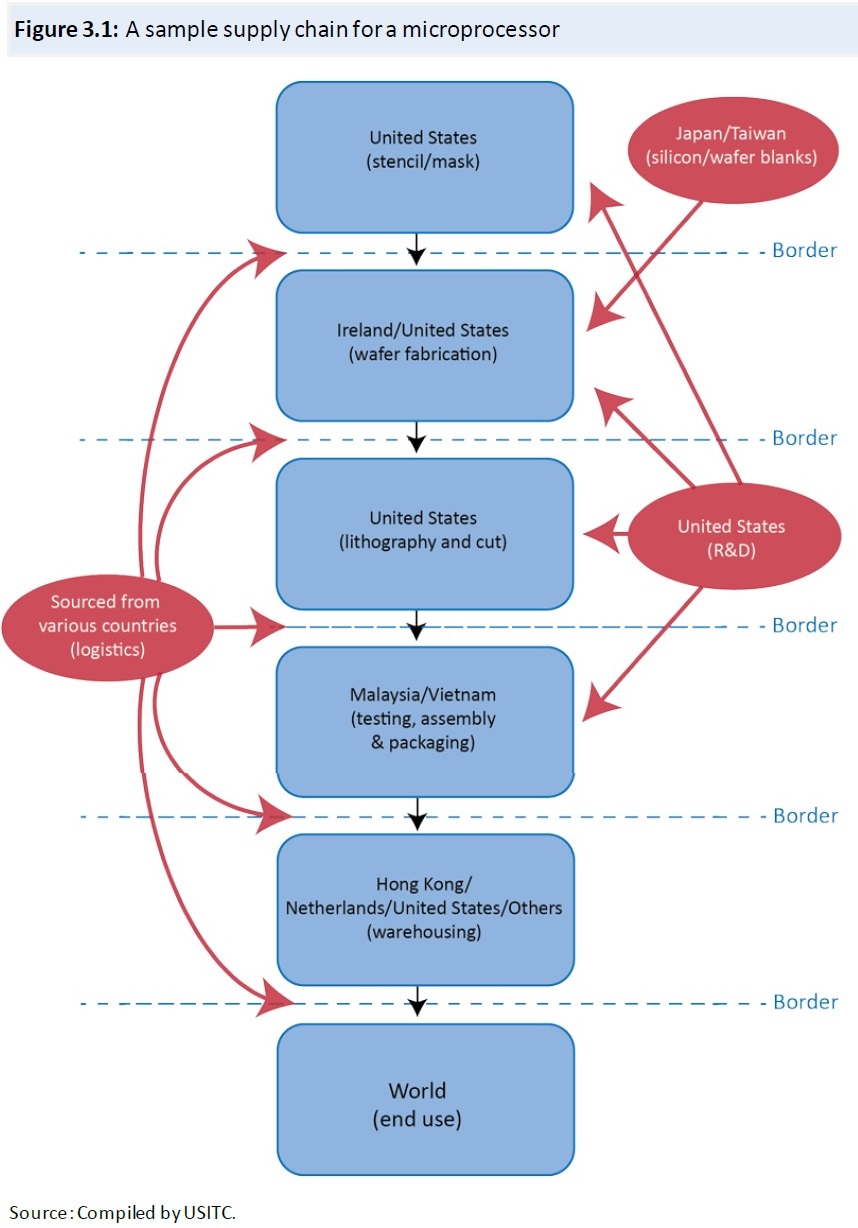
For an illustration, here’s a sample of a supply chain for a microprocessor, which includes five border crossings and input from multiple countries. If one included the product in which the microprocessor is implanted, the supply chain would be even more complex. 
As the ITC report notes: “[S]since the 1970s, the use of foreign inputs in production has increased from about 15 percent of gross export value to between 25 and 30 percent. In recent years, more than half of global manufacturing imports, and 70 percent of services imports, are used as intermediate inputs in the production of other goods. Given this increased use of GSCs [global supply chains], the inefficiencies experienced between each stage of the supply chain have become increasingly important.”

Here’s a list of some hurdles a shipment faces when entering or exiting a
country”:

  • Preparing and submitting documents;
  • Customs and pre-shipment inspections;
  • Transit clearance, transportation delays, and congestion at the border;
  • Payment of fees, such as duties and other taxes;
  • Certification, which verifies the trader has fulfilled requirements such as technical, sanitary, and phytosanitary standards or import and export licenses;
  • Customs classification procedures;
  • Customs valuation procedures, which occur when administering countries use nonstandard methods of assessing the value of the shipment; and
  • Theft, bribes, and other forms of corruption.

Again, none of these may be especially large in themselves, but taken together, when multiplied over a number of border crossings, the accumulate to something larger. Many of the recently proposed trade agreements are less about reducing tariffs, and more about addressing these processes and issues.

5) US industries are disrupted all the time by factors that don’t much involve trade. For example, consider the textile and apparel industry, where the $2.4 billion in welfare gains is the single biggest source of gains discussed in this report. If one could sign a deal which said that the US consumers would pay more for clothing to assure that textile workers all keep their jobs, it wouldn’t sound like the worst deal in the world. Except that even without trade, the textile industry wouldn’t be standing still. The report discusses two big changes that affect textile and apparel, as well as lot of other industries: automation and innovation. Thus, here is the estimate of what would happen to the US textile industry with no change at all in the import restraints. 

“Significant investment in automation in the U.S. textile and apparel industry, particularly in yarn, thread, and fabric production, has depressed U.S. employment despite increases in domestic shipments. In coming years, increased capital investment in automation should contribute to a further expected decline of 3.7 percent, on average, in employment in the textile and apparel industry during 2015�20. The most significant decline is projected in the textile products (5.9 percent) and textile mills sectors (5.7 percent). At the same time, U.S. textile and apparel exports are expected to increase 2.8 percent, with U.S. apparel exports increasing by 10 percent as a result of growing demand for higher-quality, specialized, or �Made in the USA� apparel. … 

“The U.S. textile mill producers are increasingly focused on the production of technical fabrics (also known as �performance textiles�) and smart fabrics used in the automotive, construction, healthcare, sportswear, and agriculture industries, as well as in protective applications. According to the U.S. Department of Commerce, the value of U.S. technical fabric production is expected to increase by 4 percent annually on average during 2015�17 due to strong global demand. The technical and smart
fabric sectors are less price sensitive than imports of lower-cost commodity fabrics because technical and smart fabrics are produced through advanced manufacturing processes, after significant research and development, and therefore are not materially affected by the removal of import restraints. Further, one of the largest consumers of U.S.-produced technical textiles is the U.S. military, which by law must purchase its textiles from U.S. producers.”

US producers and their workers face all sorts of challenges, including domestic competitors, shifts in consumer preferences, new technologies, investment of the right size and type, evolving skills and training needed by worker, government taxes and regulations, and whether management can handle these challenges. Foreign trade matters, too, of course. But if we competed hard in tackling the rest of these issues, my suspicion is that foreign trade would look a lot less threatening.

Welfare Reform: Legacy and Next Steps

Back in 1996, President Bill Clinton signed into law the Personal Responsibility and Work Opportunity Reconciliation Act (PRWORA), commonly known as “welfare reform.”  The Winter 2018 issue of Pathways, published by the Stanford Center on Poverty & Inequality, offers nine short and readable essays by social scientists and a few politicians on what happened, and what should happen next. Although the welfare reform legislation gets much of the attention, a number of the authors point out that it was part of a group of legislative changes carried out at roughly the same time and intended to encourage work, including a rise in the Earned Income Tax Credit. Here are some tidbits:

Welfare reform led to a substantial and long-lasting drop in the number of welfare recipients

Robert A. Moffitt and Stephanie Garlow write:

“The welfare rolls indeed plummeted under the influence of welfare reform. If anything, some of the early studies underestimated the causal effect of welfare reform itself (as against the effects of economic expansion). Did it increase employment? Although there remains some ambiguity on the relative importance of the EITC and welfare reform in accounting for changes in employment, it is clear that welfare reform played an important role. In the initial years after reform, many more women joined the labor force than even the reform�s most ardent supporters had hoped. Did it reduce poverty? There are two sides to the answer to this question. It would appear that, while welfare reform assisted families with incomes close to the poverty threshold, it did less to help families in deep or extreme poverty. Under the current welfare regime, many single mothers are struggling to support their families without income or cash benefits. Even women who are willing to work often cannot find good-paying, steady employment.”

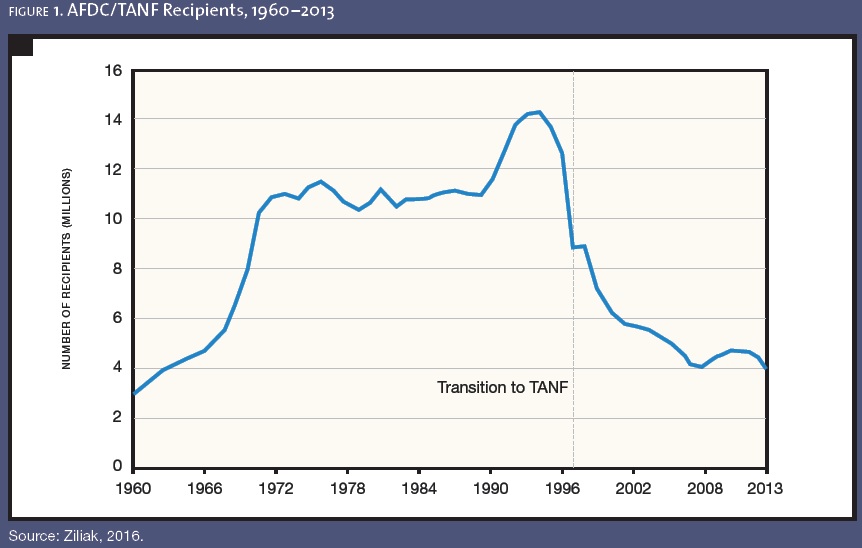
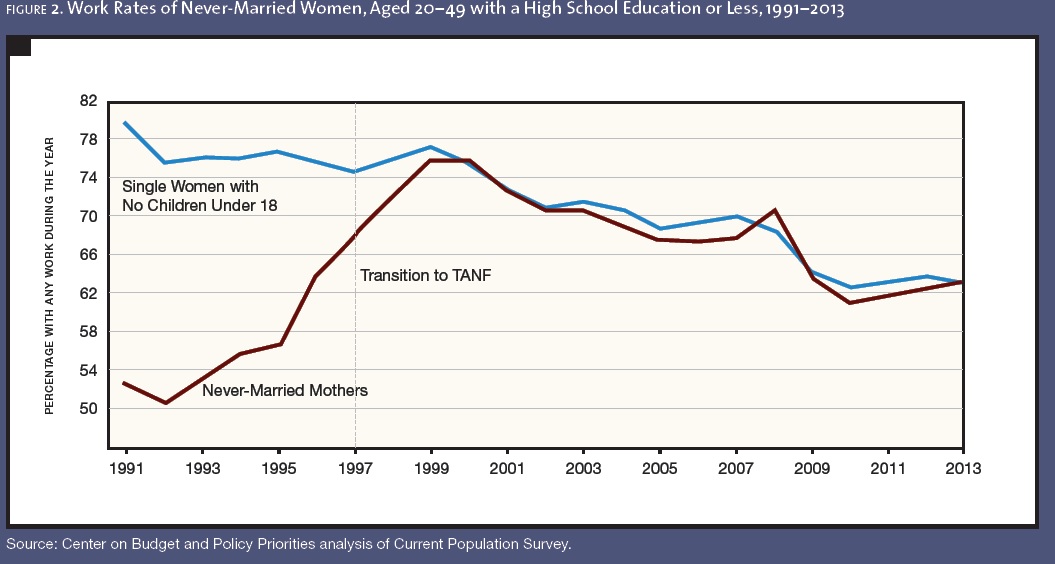
Here’s one figure showing the change in welfare recipients after 1996. The following figure shows that after the welfare reform, the work rate of never-married mothers converged with the work rate of single women who had never had children.

Welfare reform was part of an overall a shift toward greater public support for the working poor, but less support for the non-working poor

The broader public often isn’t much in favor of support for the nonworking poor. Without arguing the point one way or another, I’ll just note that children in such families have a rough time. H. Luke Shaefer and Kathryn Edin have been looking at US families with very little cash income, although they may receive assistance in noncash forms like Medicaid and food stamps. They write:

“The amount of federal dollars flowing to poor families grew as a result of the changes made to social welfare policy during the 1990s, but not uniformly so. More aid is now available to working poor families via refundable tax credits and expanded eligibility for the Supplemental Nutrition Assistance Program (SNAP). But the amount of assistance for non-working families has decreased, and what remains has shifted away from cash and toward in-kind benefits.”

This figure shows the number of household with children receiving food stamps that report no other cash income at all.

This figure shows the number of children living in households with less than $2/day per person in cash income.

Children in low-income families are better off since 1996 

Janet Currie writes:

“[W]elfare reform involved more than just PRWORA. Indeed, there have been many changes to safety net programs since PRWORA, including expansions of Medicaid and the Earned Income Tax Credit (EITC). In this article, we pose the following question: Has the overall set of changes to the safety net since PRWORA improved outcomes for children? To answer that question, we look at several measures of child well-being�mortality rates, teen pregnancy, drug use, and high school graduation rates�and find that across all these measures, poor children are much better off today. …

“It is difficult to disentangle the effects of welfare reform from the economic and other changes that have occurred since the 1990s, and we will not endeavor to do so here. However, we will provide a brief overview of some of the most significant policy changes that were intended to address children�s well-being. 

“First, starting in the late 1980s and continuing through the 1990s, Medicaid was expanded to cover all poor children and many children in lower-income working families, rather than only covering the children of welfare recipients. In addition, the creation of the State Children�s Health Insurance Program (SCHIP) in 1997 expanded public health insurance for poor pregnant women and children. … Second, Congress expanded the EITC in 1993, with the goal of eliminating poverty for those who work full-time. In the same year, Congress added more money for the Food Stamp Program (now called the Supplemental Nutrition Assistance Program), which has continued to expand over time. … Finally, in response to growing evidence about the importance of preschool environments, many states developed or expanded their public child care and preschool programs, and such programs now serve more children than Head Start. Of course, many of these programs are effectively modeled on Head Start, and both Head Start and state preschool programs have been shown to improve the short- and long-term outcomes of poor children.” 

Welfare reform had no clear effect on long-term rates of marriage or single-parent families

Daniel T. Lichter writes:

“Across an array of indicators, there is little demonstrable evidence of large or significant effects of the 1996 welfare reform legislation on marriage and family formation. Since its enactment 20 years ago, we haven�t seen a return to marriage, a reduction in out-of-wedlock pregnancies, or a strengthening of two-parent families.”

Final thoughts

The issue starts with a useful interview with Bruce Reed, who was the head of President Clinton’s Domestic Policy Council in 1996, and Newt Gingrich, who was Speaker of the House of Representatives at the time. Perhaps unsurprisingly, they both believe the 1996 legislation was a good idea, but perhaps more surprising, they both argue that a new round of welfare reform would be appropriate to address the issues that remain and have emerged. 
Reed says: 

“The experts all told us it couldn�t work. They said people wouldn�t go to work or look for work. They said employers wouldn�t hire them or keep them. They said welfare offices couldn�t help people find work. I think the experts were proven wrong by the people on welfare who left for work.”

Gingrich says: 

“You shouldn�t see the 1996 act as the last dance. Let�s say it only worked for three-quarters of people who were on welfare. That�s a pretty good victory. … Now we need a new welfare reform bill for the one-fourth who weren�t met by the last bill.”

Index Funds vs. Hedge Funds: Buffett’s Bet, 10 Years Later

Warren Buffett is of course as the golden-touch investor who is chairman and CEO of Berkshire Hathaway. Each year he writes a letter to his shareholders, and along with an update on just what the firm did the previous year, he often discusses some broader point. In the last couple of years, Buffett’s annual letter has harked back to a revealing bet he made 10 years in December 2007.

Just to set the stage, December 2007 is the leading edge of what would become the Great Recession in 2008 and 2009. But even those who were concerned about the economy at that time were not predicting that the stock market would fall by half over the next 18 months or so. But it is in December 2007 that Buffett made a bet that the average of the stock market over the following 10 years would outperform the hedge funds that were using fancy investment strategies–and charging high fees. Here’s how Buffett tells the story in his 2016 letter:

“In Berkshire�s 2005 annual report, I argued that active investment management by professionals � in aggregate � would over a period of years underperform the returns achieved by rank amateurs who simply sat still. I explained that the massive fees levied by a variety of �helpers� would leave their clients � again in aggregate � worse off than if the amateurs simply invested in an unmanaged low-cost index fund. …

“Subsequently, I publicly offered to wager $500,000 that no investment pro could select a set of at least five hedge funds � wildly-popular and high-fee investing vehicles � that would over an extended period match the performance of an unmanaged S&P-500 index fund charging only token fees. I suggested a ten-year bet and named a low-cost Vanguard S&P fund as my contender. I then sat back and waited expectantly for a parade of fund managers � who could include their own fund as one of the five � to come forth and defend their occupation. After all, these managers urged others to bet billions on their abilities. Why should they fear putting a little of their own money on the line?

“What followed was the sound of silence. Though there are thousands of professional investment managers who have amassed staggering fortunes by touting their stock-selecting prowess, only one man � Ted Seides � stepped up to my challenge. Ted was a co-manager of Prot�g� Partners, an asset manager that had raised money from limited partners to form a fund-of-funds � in other words, a fund that invests in multiple hedge funds.

“I hadn�t known Ted before our wager, but I like him and admire his willingness to put his money where his mouth was. He has been both straight-forward with me and meticulous in supplying all the data that both he and I have needed to monitor the bet.

“For Prot�g� Partners� side of our ten-year bet, Ted picked five funds-of-funds whose results were to be averaged and compared against my Vanguard S&P index fund. The five he selected had invested their money in more than 100 hedge funds, which meant that the overall performance of the funds-of-funds would not be distorted by the good or poor results of a single manager. Each fund-of-funds, of course, operated with a layer of fees that sat above the fees charged by the hedge funds in which it had invested. In this doubling-up arrangement, the larger fees were levied by the underlying hedge funds; each of the fund-of-funds imposed an additional fee for its presumed skills in selecting hedge-fund managers. …”

For the record, the winner of the bet would donate all gains to charity–in Buffett’s case, Girls Inc. of Omaha. As he described in the 2017 letter (dated February 24, 2018), Buffett made the bet “to publicize my conviction that my pick � a virtually cost-free investment in an unmanaged S&P 500 index fund � would, over time, deliver better results than those achieved by most investment professionals, however well-regarded and incentivized those �helpers� may be.” He writes:

“Addressing this question is of enormous importance. American investors pay staggering sums annually to advisors, often incurring several layers of consequential costs. In the aggregate, do these investors get their money�s worth? Indeed, again in the aggregate, do investors get anything for their outlays?

“Prot�g� Partners, my counterparty to the bet, picked five �funds-of-funds� that it expected to overperform the S&P 500. That was not a small sample. Those five funds-of-funds in turn owned interests in more than 200 hedge funds.

“Essentially, Prot�g�, an advisory firm that knew its way around Wall Street, selected five investment experts who, in turn, employed several hundred other investment experts, each managing his or her own hedge fund. This assemblage was an elite crew, loaded with brains, adrenaline and confidence.

“The managers of the five funds-of-funds possessed a further advantage: They could � and did � rearrange their portfolios of hedge funds during the ten years, investing with new �stars� while exiting their positions in hedge funds whose managers had lost their touch.

“Every actor on Prot�g�s side was highly incentivized: Both the fund-of-funds managers and the hedge-fund managers they selected significantly shared in gains, even those achieved simply because the market generally moves upwards. (In 100% of the 43 ten-year periods since we took control of Berkshire, years with gains by the S&P 500 exceeded loss years.)

“Those performance incentives, it should be emphasized, were frosting on a huge and tasty cake: Even if the funds lost money for their investors during the decade, their managers could grow very rich. That would occur because fixed fees averaging a staggering 21/2% of assets or so were paid every year by the fund-of-funds� investors, with part of these fees going to the managers at the five funds-of-funds and the balance going to the 200-plus managers of the underlying hedge funds.”

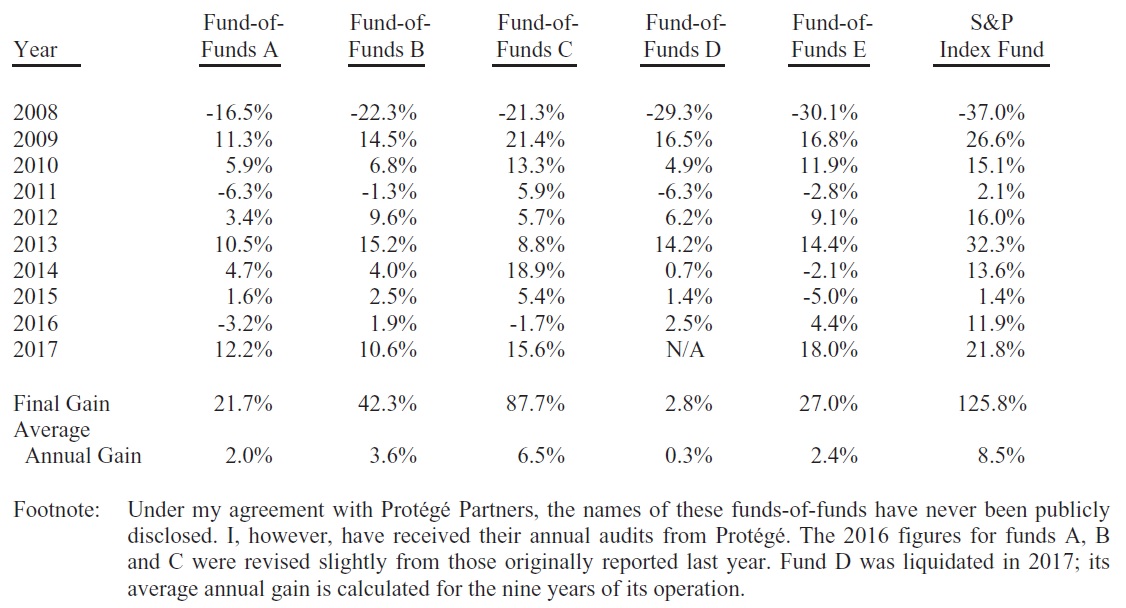
Here is a table showing the results. The hedge funds did better in 2008, but every year after that, they fell further behind. Buffett writes: 

“The five funds-of-funds got off to a fast start, each beating the index fund in 2008. Then the roof fell in. In every one of the nine years that followed, the funds-of-funds as a whole trailed the index fund. Let me emphasize that there was nothing aberrational about stock-market behavior over the ten-year stretch. If a poll of investment �experts� had been asked late in 2007 for a forecast of long-term common-stock returns, their guesses would have likely averaged close to the 8.5% actually delivered by the S&P 500. Making money in that environment should have been easy. Indeed, Wall Street �helpers� earned staggering sums. While this group prospered, however, many of their investors experienced a lost decade.”

Over the 10 years, the total gain for the S&P index fund as 125.8%. For the five funds made up of hedge funds, the gains ranged from 2.4% to 87.7%. 
Lessons? Outguessing the market is hard, and most money manager don’t succeed in doing it. Buffett writes: 

“Performance comes, performance goes. Fees never falter. … A final lesson from our bet: Stick with big, �easy� decisions and eschew activity. During the ten-year bet, the 200-plus hedge-fund managers that were involved almost certainly made tens of thousands of buy and sell decisions. Most of those managers undoubtedly thought hard about their decisions, each of which they believed would prove advantageous. In the process of investing, they studied 10-Ks, interviewed managements, read trade journals and conferred with Wall Street analysts.”

Marx on Economics: "Its True Ideal is the Ascetic but Rapacious Skinflint and the Ascetic but Productive Slave"

Tomorrow, May 5, will be the 200th anniversary of the birth of Karl Marx. Here’s a characteristic little taste of his writing I ran across the other day. It’s from Economic and Philosophical Manuscripts, which were a set of essays written in 1844, not necessarily intended for publication themselves, but an early attempt at sorting through ideas and themes later developed in in Capital. This is from the Third Manuscript on “Private Property and Labor.” Marx wrote (what follows was all part of one paragraph, and I’ve inserted the paragraph breaks for ease of blog-post reading):

“Political economy, this science of wealth, is therefore at the same time the science of denial, of starvation, of saving, and it actually goes so far as to save man the need for fresh air or physical exercise. This science of the marvels of industry is at the same time the science of asceticism, and its true ideal is the ascetic but rapacious skinflint and the ascetic but productive slave. 

“Its moral ideal is the worker who puts a part of his wages into savings, and it has even discovered a servile art which can dignify this charming little notion and present a sentimental version of it on the stage. It is therefore � for all its worldly and debauched appearance � a truly moral science, the most moral science of all. Self-denial, the denial of life and of all human needs, is its principal doctrine. 

“The less you eat, drink, buy books, go to the theatre, go dancing, go drinking, think, love, theorize, sing, paint, fence, etc., the more you save and the greater will become that treasure which neither moths nor maggots can consume � your capital. The less you are, the less you give expression to your life, the more you have, the greater is your alienated life and the more you store up of your estranged life. 

“Everything which the political economist takes from you in terms of life and humanity, he restores to you in the form of money and wealth, and everything which you are unable to do, your money can do for you: it can eat, drink, go dancing, go to the theatre, it can appropriate art, learning, historical curiosities, political power, it can travel, it is capable of doing all those thing for you; it can buy everything: it is genuine wealth, genuine ability. But for all that, it only likes to create itself, to buy itself, for after all everything else is its servant. And when I have the master I have the servant, and I have no need of his servant. 

“So all passions and all activity are lost in greed. The worker is only permitted to have enough for him to live, and he is only permitted to live in order to have.”

The quotation has the tone of prophetic certainty that is so enticing in Marx. You can almost hear someone preaching at you from behind a lectern, voice rising and falling, waving their arms and pointing for emphasis. You want to punch your fist up in the air while reading it.

For any economist, the specific ideas here are ostentatiously incorrect. For example that “the true ideal is the ascetic but rapacious skinflint and the ascetic but productive slave” is profoundly wrong. Capitalism is not built on misers and workaholics, and the US economy is not built on asceticism and self-denial (!). Instead, economics is about the interactions that arise when people in their role as consumers are searching around to buy the products they prefer, when people in their role as workers are thinking about how to acquire skills and contribute to production, when people in their role as managers and entrepreneurs are thinking about how to produce and innovate, and yes, when people in their role as savers and investors direct the flow of capital to provide security for their families and eventual retirement for themselves.

Moreover, economists tend to argue that we all wear many hats: not just consumer, worker, and saver, but also spouse, parent, child, community member, church member, cultural participant, book club member, hobbyist, vacationer, and many others. As to  Marx’s list of activities that are economic forces are supposedly discouraging–“eat, drink, buy books, go to the theatre, go dancing, go drinking, think, love, theorize, sing, paint, fence”–explicit economic activity certainly interacts with these activities, but it does not exercise despotic rule in limiting them.

Marx is openly disbelieving that political economy can be detoxified in this way. He views  descriptions of buying and selling as a cover story for oppression; moreover, it’s a kind of oppression that takes over participants, separating people from their true selves.  He wrote elsewhere that the division of labor itself–that is, the idea of people having jobs–is a form of enslavement. In the passage above, money becomes the master, with people as the servants.

Again, these Marxist views seem to me categorically wrong as a description of the subject of economics.

But as a description of how people can feel in a world of choices and scarcity, Marx seems to me to be touching on some deeper truths, even if his tone feels off-kilter to me: he is using drums and trumpet blasts to play a theme that would play better on string instruments in a minor key. Marx’s words echo with the insight that many people do indeed live through weeks, months, and longer when their job feels like a burden that they cannot put down. Many people wish that they could spend their time in other ways. Many people would like to have more consumption in various forms. Many people worry about having enough money in the bank to cover an emergency, or enough for retirement.  These economic pressures and worries and fears can shape what kind of people we are and how we act, sometimes in unpleasant ways.

But when Marx’s viewpoint focuses only on the burdens and pressures of economic life, it has little to say about more positive aspects. Yes, it’s fun to “eat, drink, buy books, go to the theatre, go dancing, go drinking, think, love, theorize, sing, paint, fence, etc.” as Marx writes. But it’s also rewarding to do a good day’s work, to have camaraderie at work, to build up skills and a higher level of responsibility, to save up some money, to support one’s family, to support a local business, to buy gifts for friend or a treat for oneself, and generally to have some sense of responsibility and ownership an dcontrol over one’s economic life.

Of course, it would be silly to get dewy-eyed while romanticizing some potentially positive aspects of economic life. But frankly, it’s also silly when Marx describes economic interactions as if they were a Gothic horror story. Contra Marx, our economies worries are don’t arise because money is our master and jobs are enslavement. Instead, it’s all just tradeoffs, just reality, just various aspects of the human condition.

We should all know enough history to have an idea of what “masters” and “enslavement” really mean, and working at US job in 2018 doesn’t qualify.  For those of us living in the United States 200 years after Marx was born, it’s worth keeping the perspective that the economic stresses in our lives are first-world problems.

Spring 2018 Journal of Economic Perspectives is Online

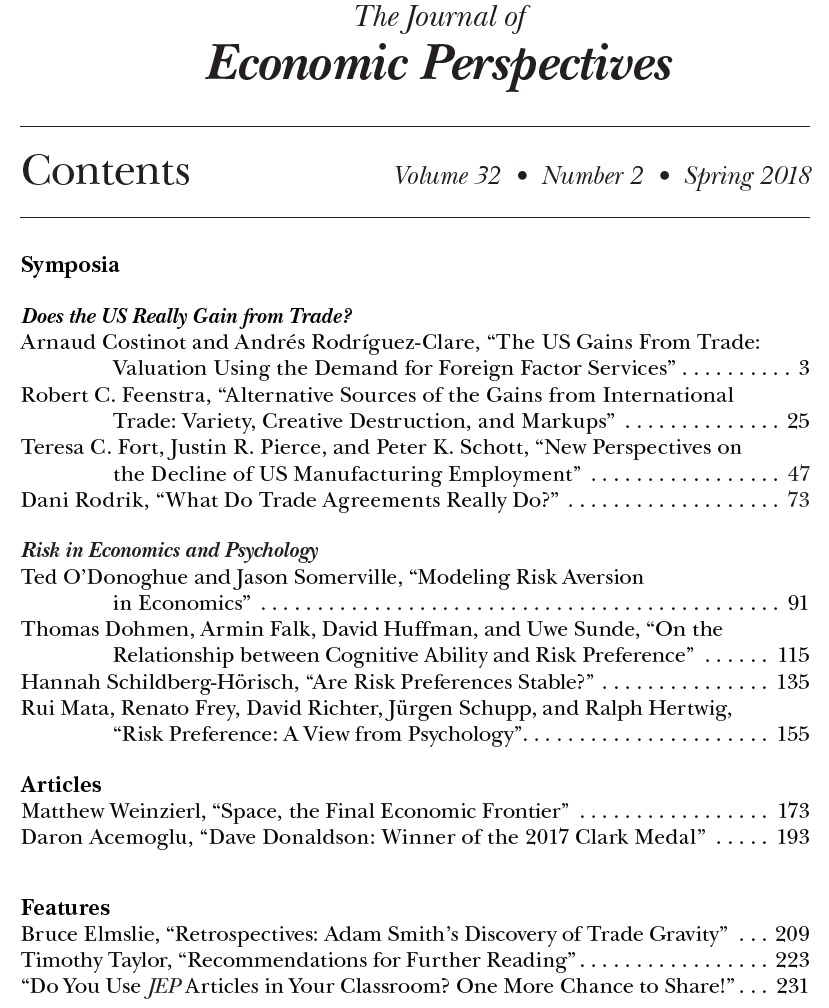
I was hired back in 1986 to be the Managing Editor for a new academic economics journal, at the time unnamed, but which soon launched as the Journal of Economic Perspectives. The JEP is published by the American Economic Association, which back in 2011 decided–to my delight–that it would be freely available on-line, from the current issue back to the first issue. Here, I’ll start with Table of Contents for the just-released Spring 2018 issue, which in the Taylor household is known as issue #124. Below that are abstracts and direct links for all of the papers. I will blog more specifically about some of the papers in the next week or two, as well.

___________________________
Symposium: Does the US Really Gain From Trade?

“The US Gains from Trade: Valuation Using the Demand for Foreign Factor Services,” by Arnaud Costinot and Andr�s Rodr�guez-Clare
About eight cents out of every dollar spent in the United States is spent on imports. What if, because of a wall or some other extreme policy intervention, imports were to remain on the other side of the US border? How much would US consumers be willing to pay to prevent this hypothetical policy change from taking place? The answer to this question represents the welfare cost from autarky or, equivalently, the welfare gains from trade. In this article, we discuss how to evaluate these gains using estimates of the demand for foreign factor services.
Full-Text Access | Supplementary Materials

“Alternative Sources of the Gains from International Trade: Variety, Creative Destruction, and Markups,” by Robert C. Feenstra
The modern theory of international trade identifies several additional sources of the gains from international trade beyond the gains from traditional comparative advantage. These are the gains from importing new product varieties; the gains from “creative destruction” as the relatively most productive firms expand their output by exporting while the less-productive firms exit; and the gains from competition between firms in different countries, which can lead to reduced markups. Estimates of these various gains are provided for the United States and other countries.
Full-Text Access | Supplementary Materials

“New Perspectives on the Decline of US Manufacturing Employment,” by Teresa C. Fort, Justin R. Pierce and Peter K. Schott
We use relatively unexplored dimensions of US microdata to examine how US manufacturing employment has evolved across industries, firms, establishments, and regions. These data provide support for both trade- and technology-based explanations of the overall decline of employment over this period, while also highlighting the difficulties of estimating an overall contribution for each mechanism. Toward that end, we discuss how more careful analysis of these trends might yield sharper insights.
Full-Text Access | Supplementary Materials

“What Do Trade Agreements Really Do?” by Dani Rodrik
Economists have a tendency to associate “free trade agreements” all too closely with “free trade.” They may be unaware of some of the new (and often problematic) beyond-the-border features of current trade agreements. As trade agreements have evolved and gone beyond import tariffs and quotas into regulatory rules and harmonization�intellectual property, health and safety rules, labor standards, investment measures, investor-state dispute settlement procedures, and others�they have become harder to fit into received economic theory. It is possible that rather than neutralizing the protectionists, trade agreements may empower a different set of rent-seeking interests and politically well-connected firms�international banks, pharmaceutical companies, and multinational firms. Trade agreements could still result in freer, mutually beneficial trade, through exchange of market access. They could result in the global upgrading of regulations and standards, for labor, say, or the environment. But they could also produce purely redistributive outcomes under the guise of “freer trade.” As trade agreements become less about tariffs and nontariff barriers at the border and more about domestic rules and regulations, economists might do well to worry more about the latter possibility.
Full-Text Access | Supplementary Materials

Symposium: Risk in Economics and Psychology

“Modeling Risk Aversion in Economics,” by Ted O’Donoghue and Jason Somerville
To capture the risk-aversion intuition, the standard approach in economics has been to utilize the model of expected utility, in which risk aversion derives from diminishing marginal utility for wealth (or diminishing marginal utility for aggregate consumption). The expected utility model for risk aversion has been used to derive many important insights. But over the years, economists and psychologists have identified various problematic issues with expected utility as a descriptive model of choice. In this article, we urge economists to take seriously the research agenda of developing and assessing different ways to model risk aversion. We proceed in three main steps. First, we highlight that the basic intuition of risk aversion that drives many results in economics is not intimately tied to expected utility. Second, we describe a few alternative models that can also capture the basic intuition of risk aversion. Finally, we discuss that, while expected utility and the alternative models might all capture the basic intuition of risk aversion, the alternative models can generate additional, more nuanced implications not shared with expected utility, that in some cases seem to be borne out by data. We emphasize that these alternative models also are not perfect, and further research is needed to identify even better approaches.
Full-Text Access | Supplementary Materials

“On the Relationship between Cognitive Ability and Risk Preference,” by Thomas Dohmen, Armin Falk, David Huffman and Uwe Sunde
This paper will focus on the relationship between cognitive ability and decision-making under risk and uncertainty. Taken as a whole, this research indicates that cognitive ability is associated with risk-taking behavior in various contexts and life domains, including incentivized choices between lotteries in controlled environments, behavior in nonexperimental settings, and self-reported tendency to take risks. One pattern that emerges frequently in these studies is that cognitive ability tends to be positively correlated with avoidance of harmful risky situations, but it tends to be negatively correlated with risk aversion in advantageous situations. We conclude by discussing perspectives for future research, in particular the scope for the development of richer sets of elicitation instruments and measurement across a wider range of concepts.
Full-Text Access | Supplementary Materials

“Are Risk Preferences Stable?” by Hannah Schildberg-H�risch
It is ultimately an empirical question whether risk preferences are stable over time. The evidence comes from diverse strands of literature, covering the stability of risk preferences in panel data over shorter periods of time, life-cycle dynamics in risk preferences, the possibly long-lasting effects of exogenous shocks on risk preferences as well as temporary variations in risk preferences. Individual risk preferences appear to be persistent and moderately stable over time, but their degree of stability is too low to be reconciled with the assumption of perfect stability in neoclassical economic theory. We offer an alternative conceptual framework for preference stability that builds on research regarding the stability of personality traits in psychology. The definition of stability used in psychology implies high levels of rank-order stability across individuals and not that the individual will maintain the same level of a trait over time. Preference parameters are considered as distributions with a mean that is significantly but less than perfectly stable, plus some systematic variance. This framework accommodates evidence on systematic changes in risk preferences over the life cycle, due to exogenous shocks such as economic crises or natural catastrophes, and due to temporary changes in self-control resources, emotions, or stress. We note that research on the stability of (risk) preferences is conceptually at the heart of microeconomics and systematic changes in risk preferences have vital real-world consequences.
Full-Text Access | Supplementary Materials

“Risk Preference: A View from Psychology,” by Rui Mata, Renato Frey, David Richter, J�rgen Schupp and Ralph Hertwig
Psychology offers conceptual and analytic tools that can advance the discussion on the nature of risk preference and its measurement in the behavioral sciences. We discuss the revealed and stated preference measurement traditions, which have coexisted in both psychology and economics in the study of risk preferences, and explore issues of temporal stability, convergent validity, and predictive validity with regard to measurement of risk preferences. As for temporal stability, do risk preference as a psychological trait show a degree of stability over time that approximates what has been established for other major traits, such as intelligence, or, alternatively, are they more similar in stability to transitory psychological states, such as emotional states? Convergent validity refers to the degree to which different measures of a psychological construct capture a common underlying characteristic or trait. Do measures of risk preference all capture a unitary psychological trait that is indicative of risky behavior across various domains, or do they capture various traits that independently contribute to risky behavior in specific areas of life, such as financial, health, and recreational domains? Predictive validity refers to the extent to which a psychological trait has power in forecasting behavior. Intelligence and major personality traits have been shown to predict important life outcomes, such as academic and professional achievement, which suggests there could be studies of the short- and long-term outcomes of risk preference�something lacking in current psychological (and economic) research. We discuss the current empirical knowledge on risk preferences in light of these considerations.
Full-Text Access | Supplementary Materials

Articles and Features

“Space, the Final Economic Frontier,” by Matthew Weinzierl
After decades of centralized control of economic activity in space, NASA and US policymakers have begun to cede the direction of human activities in space to commercial companies. NASA garnered more than 0.7 percent of GDP in the mid-1960s, but is only around 0.1 percent of GDP today. Meanwhile, space has become big business, with $300 billion in annual revenue. The shift from public to private priorities in space is especially significant because a widely shared goal among commercial space’s leaders is the achievement of a large-scale, largely self-sufficient, developed space economy. Jeff Bezos, has stated that the mission of his firm Blue Origin is “millions of people living and working in space.” Elon Musk, founder of SpaceX, has laid out plans to build a city of a million people on Mars within the next century. Both Neil deGrasse Tyson and Peter Diamandis have been given credit for stating that Earth’s first trillionaire will be an asteroid-miner. Such visions are clearly not going to become reality in the near future. But detailed roadmaps to them are being produced and recent progress in the required technologies has been dramatic. If such space-economy visions are even partially realized, the implications for society will be enormous. Though economists should treat the prospect of a developed space economy with healthy skepticism, it would be irresponsible to treat it as science fiction. In this article, I provide an analytical framework�based on classic economic analysis of the role of government in market economies�for understanding and managing the development of the space economy.
Full-Text Access | Supplementary Materials

“Dave Donaldson: Winner of the 2017 Clark Medal,” by Daron Acemoglu
The 2017 John Bates Clark Medal of the American Economic Association was awarded to Dave Donaldson for his path-breaking contributions in international trade. Donaldson�s work sheds light on some of the central questions of international economics, ranging from the economic and welfare implications of market integration within a country to testing the core empirical predictions of models of international trade based on comparative advantage. In these areas, empirical work faces the challenge of taking into account the broader equilibrium implications of changes in policies or economic conditions�that is, the possibility that bilateral relations between two regions or countries will affect others via trade diversion or their effects on equilibrium prices. Donaldson�s work has managed to address these challenges by combining careful theory with detailed and creative empirical work. Indeed, this research strategy has turned Dave into a leader in the revival of empirical work in international trade.
Full-Text Access | Supplementary Materials

“Retrospectives: Adam Smith’s Discovery of Trade Gravity,” by Bruce Elmslie
The gravity equation is a current workhorse of empirical trade theory. It is generally acknowledged that this theory, which relates the extent of trade between countries to their respective sizes, distances, and relative trade barriers, was first developed by Jan Tinbergen in 1962. Acceptance of the gravity model as part of the discipline’s core was limited by its scant theoretical foundation for the first 40 years of its existence. This paper finds that a theory of trade gravity was first developed by Adam Smith in The Wealth of Nations. Moreover, it is shown that Smith’s statement of a proportional relation between economic size and distance came about as an application of his general theory of differential capital productivity in different economic sectors, and his elaboration of a theory of the gains from trade originated by David Hume. It is further shown that Smith had an explanation of the size of border affects in trade volumes, and a gravity theory of trade restrictions.
Full-Text Access | Supplementary Materials

“Recommendations for Further Reading,” by Timothy Taylor
Full-Text Access | Supplementary Materials

“Do You Use JEP Articles in Your Classroom? One More Chance to Share!” 
Full-Text Access | Supplementary Materials

The Stockholm Congestion Charge

Economists have long argued that it’s very hard to build your way out of traffic congestion–regardless of whether the building means adding lanes to roads or adding mass transit. The fundamental issue is that many of the people commuting to work have three adjustments they can make: some of them can adjust the time they choose to travel; some of them can adjust the route they travel; and some of them can adjust the method of their travel (single car vs. carpool, car vs. mass transit, and the like).

When substantial traffic congestion occurs, it pushes a substantial number of commuters to travel a little earlier or later, to find alternative routes, and to travel in different ways. But then, when extra lanes of highway or mass transit investments are made, some of those who had shifted their commuting patterns will shift back again. Congestion may decline a little as a result of the building process, but the decline is often much less than desired or hoped.

Several major cities around the world have concluded that if they really want to address congestion, they need to do it with prices. F or example, London imposed a congestion charge in 2003, as described by Jonathan Leape in the “The London Congestion Charge,” in the Fall 2006 issue of the Journal of Economic Perspectives (20: 4, pp 157-176). In the 1990s, the average speed of a trip across London was actually slower than it has been at the start of the 20th century. “Even in the larger area of inner London,” Leape wrote,  “drivers in 1998 spent almost 30 percent of their time stationary during peak periods and more than half their time traveling at speeds of less than 10 mph.”  Basically, the idea is to draw a circle around the city. Those who enter the circle during commute times pay a toll, with the money mostly going to more regular and updated mass transit service. Charges are tallied by technology that reads license plates.

In 2006, Stockholm was the second major city in Europe to start congestion charge program, so the program has now completed its first decade. A congestion charge was also imposed in the Swedish city of Gothenburg.  There, the system runs on a combination of license-plate recognition technology and electronic tags in vehicles.

Bj�rn H�rsman and John Quigley describe the political process that led a referendum approving the Stockholm congestion charge in “Political and Public Acceptability of Congestion Pricing: Ideology and Self-Interest in Sweden” (Access, Spring 2011). Maria B�rjesson and Ida Kristoffersson provide an overview in “The Swedish Congestion Charges: Ten Years On – And effects of increasing charging levels,” published by the Centre for Transport Studies in Stockholm (CTR Working Paper 2017:2).  In
They write:

“When the charges were introduced in Stockholm 2006, the reduction of traffic across the cordon stabilized at approximately 20%. In Gothenburg, the reduction in traffic volume across the cordon during charged hours stabilized at approximately 12%. Travel times reduced significantly in both cities, but in Stockholm, travel time reductions occurred in a much larger part of the network than in Gothenburg. In Stockholm, the congestion was much more widespread in a larger part of the network prior to the charges, mainly because of the blocking of intersections upstream of the bottlenecks. Substantial travel time reductions were, therefore, achieved in the suburbs far from the toll cordon.The adaptation mechanisms observed in Stockholm and Gothenburg are remarkably similar: commuters diverted to public transport and discretionary travellers adapted in other ways. This result is supported by a model-based study (B�rjesson et al., 2014) showing that the traffic effects and adaptations costs are surprisingly stable across different types of traffic systems.”

Of course, people look for loopholes in the rules. Sweden subsidizes company cars, in part with the idea that if people have access to a shared car, they might have less need to buy an car (or a second car) their own.  But with a company car, the firm usually pays the congestion charge, not the employee, and the employee doesn’t pay tax on the value of this fringe benefits. A number of employers provide free parking as well, which in an inner city is another untaxed subsidy for commuters. The authors write (citations omitted):

“In this paper, we define a company car as a passenger car owned by a legal person that is not used as a taxi. According to the Gothenburg travel survey, 8% of the citizens of Gothenburg have always access to a company car for private trips. According to a travel survey conducted in the Stockholm County in 2015, 10% of the citizens of Stockholm have access to a company car for private trips. According to 2014 registered data, company cars make up 34% of all passenger cars in Stockholm, 26% in Gothenburg and 23% in the rest of Sweden. Compared to the taxation of private cars, company cars are heavily subsidized, in particular alternative fuel vehicles. The subsidies are particularly high for commuters because the benefit of free parking at work is not taxed.”

A few other points seem worth making in this quick summary.

1) In political terms, the common pattern seems to be that congestion charges are politically controversial, and are not passed into law by large margins and popular acclamation. But when they have been in place a few years, and the benefits of less traffic on the roads and improved mass transit become visible, there doesn’t seem to be any substantial pressure to eliminate them, either.

2) The congestion charge isn’t the only interesting aspect of transportation policy in Stockholm. It’s also a city which over recent decades shifted from government ownership to private contracting. For some discussion, see “A Bid forBetter TransitImproving service with contracted operations,” a September 2017 report from the TransitCenter foundation.

“Over a period of two decades, the Stockholm region shifted from government-operated transit, in which a government agency employs government employees to operate government-owned rolling stock (the standard operating model in the US), to a contracting model. Today, Stockholm contracts nearly all aspects of its public transit services, including buses, ferries, subways, commuter trains, and trams. Under this system, the region delegates most route-planning responsibilities to its bus contractors, offering a financial incentive to increase ridership.”

3) The benefits of reduced traffic congestion aren’t just about less time on the road. Another meaningful gain is less air pollution in cities. In a recent research paper, Emilia Simeonova Janet Currie Peter Nilsson and Reed Walker look at the Stockholm congestion charge from a different angle in “Congestion Pricing, Air Pollution, and Children’s Health” (NBER Working Paper #24410, March 2018). From their abstract: “This study examines the effects of implementing a congestion tax in central Stockholm on both ambient air pollution and the population health of local children. We demonstrate that the tax reduced ambient air pollution by 5 to 15 percent, and that this reduction in air pollution was associated with a significant decrease in the rate of acute asthma attacks among young children.”

4) Finally, there’s a question of what this all means for the United States. In the United States, charging more for traffic at peak-load times has usually been limited to specific highway lanes, or sometimes to charging more for bridge tolls or mass transit at peak time. (Although charging extra for mass transit at peak times can bring in more money, it clearly works against inducing people out of their cars.). Although no US city has put a ring around the most dense part of the inner city and taken the full congestion charge plunge  along with London, Stockholm, Singapore, and a few others, there are current conversations about whether such a charge might be instituted for the island of Manhattan

But it seems to me that such charges are likely to come, sooner or later. Consider the implications of this figure from the 2018 Economic Report of the President. US roads haven’t expanded much, but miles traveled on those roads is on a long-term upward trend. Traffic congestion  is one result, and if we want an actual answer, congestion pricing is the way. 
More Driving on the Same Roads


For a couple of previous posts on this theme, see:

“The Pricing Answer to Traffic Congestion” (July 17, 2017)
“Insights on Infrastructure” (March 11, 2016)

The Job Guarantee Controversy

With Senator Bernie Sanders in the forefront, some Democratic members of Congress are planning a bill to guarantee jobs that pay $15 per hour, not including mandatory benefits packages, for all Americans. Legislative details have not yet been announced (!), but several sets of plan have been published recently, including on the website of the Sanders Institute, which was founded by Jane O’Meara Sanders, wife of the senator. Here, let’s run through a couple of the more prominent plans, and then list on criticisms that have been bubbling up–with a focus on critiques from writers typically identified as being on the political left.

The Sanders Institute has recently blogged about a report called “Public Service Employoment: A Path to Full Employment,” by L. Randall Wray, Flavia Dantas, Scott Fullwiler, Pavlina R. Tcherneva, and Stephanie A. Kelton, published in April 2018 by the Levy Economics Institute of Bard College.

“We propose the creation of a Public Service Employment (PSE) program that would offer a job at a living wage to all who are ready and willing to work. This is a �job guarantee� program that provides employment to all who need work by drawing from the pool of the otherwise unemployed during recessions and shrinking as private sector employment recovers. Federally funded but with a decentralized administration, the PSE program would pay $15 per hour for both full- and part-time positions and offer benefits that include health insurance and childcare …”

The paper presents a model to estimate what the US labor market would have looked like in late 2017 with such a program in place. The estimate is that about 15 million workers would be receiving public service employment jobs  through the program. In addition, the report argues that the buying power of those workers would create an economic boom such that the the number of jobs in the private sector would expand by 4 million.

For comparison, the US economy has about 6.5 million unemployed workers at present. Thus, the forecast involves about 12.5 million adults who are currently “out of the labor force” and no longer looking for jobs who would re-enter the labor force.

Estimated cost to the federal government of the jobs would run $400-$500 billion, but the government would also have higher tax revenues (from more workers) and a savings of perhaps a couple of hundred billion from less spending on anti-poverty programs and Medicaid. The report states: “[T]he PSE program would lower spending by all levels of government, as well as by businesses and households, on a range of costly problems created by unemployment. It is possible that the program would �pay for itself� in terms of savings due to reduced crime, improved health, greater social and economic stability, and larger reductions in Medicaid and EITC expenditures than those assumed in the simulations …”

The report only sketches how such a plan would be implemented, but the broad is that it would be federally funded and locally administered, with local and state agencies seeking out the job opportunities. The public service employment jobs would be focused on jobs in three areas:

Environment: “The jobs will tackle: soil erosion; flood control; environmental surveys; species monitoring; park maintenance and renewal; removal of invasive species; sustainable agriculture practices to address the �food desert� problem in the United States; support for local fisheries; Community Supported Agriculture (CSAs); community and rooftop gardens; tree planting; fire and other disaster prevention measures; weatherization of homes; and composting.”

Community: “Jobs can include: cleaning up vacant properties, reclaiming materials, restoration, and other small infrastructure investments; setting up school gardens, urban farms, co-working spaces, solar arrays, tool libraries, classes and programs, community theaters, and oral history projects; building playgrounds, pedestrian areas, and bike lanes; and organizing carpooling, recycling, reuse, and waste collection programs.”

Care for people: “Projects would include elder care, afterschool programs, and special programs for children, new mothers, at-risk youths, veterans, former inmates, and people with disabilities. One advantage of the PSE program is that it also provides job opportunities to people from these groups who are seeking work. In other words, the program gives them agency. For example, the at-risk youths themselves would participate in the execution of the after-school activities that aim to benefit them; veterans can work for and benefit from different veteran outreach programs. Such jobs can include: organizing afterschool activities in schools or local libraries; facilitating extended day programs; shadowing teachers, coaches, hospice workers, and librarians to learn new skills and assist them in their duties; organizing nutrition surveys in schools and health awareness programs for young mothers. The PSE program will also organize urban campuses, co-ops, afterschool programs, adult skill classes, apprenticeships in sustainable agriculture, and all of the above-mentioned community care jobs, training a new generation of urban teachers, artists and artisans, makers, and inventors.”

A broadly similar but distinct-in-the-details approach to a federal job guarantee program is laid out by Mark Paul, William Darity, Jr. , and Darrick Hamilton in “The Federal Job Guarantee�A Policy to Achieve Permanent Full Employment, ” written for the Center on Budget and Policy Priorities (March 9, 2018). The same set of authors, plus Khaing Zaw, have also written “A Path to Ending Poverty by Way of Ending Unemployment: A Federal Job Guarantee,” which appeared in the  February 2018 issue of the Russell Sage Foundation Journal of the Social Sciences (4:3, 44�63).  Here’s some information on the idea from the CBBP paper:

“The permanent establishment of a National Investment Employment Corps (NIEC). The NIEC will provide universal job coverage for all adult Americans. … The federal job guarantee would provide a job at a minimum annual wage of $24,600 for full-time workers (poverty line for a family of four) and a minimum hourly wage of $11.83. Workers would have the opportunity to advance within the program, rising from the minimum wage in the program to an estimated mean salary of $32,500. The wage would be indexed to the inflation rate to ensure that the purchasing power of enrollees is maintained and the wage will vary to allow for some degree of regional variation. … To provide a true non-poverty wage and meet the fundamental rights of American citizens, the policy will include health insurance for all full-time workers in the program. The health insurance program should be comparable to that offered to all civil servants and elected federal officials. In addition, the NIEC would offer benefits such as retirement plans, paid family and sick leave, and one week of paid vacation per three months worked. …” 

“The NIEC can be deployed to cover a wide scope of activities including, but not limited to, the repair, maintenance, and expansion of the nation’s infrastructure, housing stock, and public buildings; energy efficiency upgrades to public and private buildings; assistance with ecological restoration and services to reduce the country�s carbon footprint; engagement in community development projects; provision of high-quality preschool and afterschool services; provision of teachers� aids; provision of high-quality elder care and companionship; rejuvenation of the nation�s defunded postal service; support for the arts; and other activities that shall support the public good.”

For January January 2018, the estimated total cost to the federal government of the jobs would be $543 billion, which again could be offset to some extent by lower government payments on existing programs for those with low incomes.

I’ve described these job guarantee proposals in neutral terms. I do think the US job market needs a genuine shake-up along a number of dimensions, which I’ll briefly sketch at the end of this post. I give the authors of such plans full credit for  being willing to attach their names to some big proposals. But ultimately, I’m not not a fan of federal job guarantee schemes. Here are some of the concerns.

If a central government job guarantee is such a great idea, then why wasn’t it already done in social democratic countries of Europe long ago? 

When a very large-scale proposal hasn’t been used by those who might seem sympathetic to it, it seems wise to be suspicious of its merits. Here’s Kevin Drum at Mother Jones magazine:

“This is why even our lefty comrades in social democratic Europe don�t guarantee jobs for everyone. It would cost a fortune; it would massively disrupt the private labor market; it would almost certainly tank productivity; and it�s unlikely in the extreme that the millions of workers in this program could ever be made fully competent at their jobs.”

The government managerial problem

The sheer scope of the managerial challenge is breathtaking. Here’s a comment from Josh Bivins from the Economic Policy Institute in  “How do our job creation recommendations stack up against a job guarantee?” (April 12, 2018):

“I don�t think we have the public sector managerial capacity right now to oversee the work of 11 million people�who will be coming from varying backgrounds and labor qualifications�and ensure that they will be perceived as undertaking socially useful tasks. This is essentially three times as many people as there are K-12 public school teachers in this country today. These 11 million workers will not have a shared mission (like school teachers) or overwhelmingly have advanced education (again, like teachers). We will need to slot them into a system of management and oversight that has yet to be created or defined (unlike public education, where at least the goals and population to be served are clear enough). Further, if the private sector contracts in a recession, this number could swell within 18 months to 22 million. This would require careful management of a workforce more than 10 times as large as Wal-Mart�s global labor force. Building anything like this much public sector management capacity strikes me as a project that will be years, if not decades, in the making. And attempts to do this all at once will lead inevitably, I think, to stories about how these are disorganized make-work programs and the stigma will follow.” 

The job skills mismatch problem

Many jobs in the modern US economy require some level of skill background. For example, construction and buildings are not done by inexperienced workers wielding shovels. The idea that workers will walk in off the street, guaranteed a job, and then sent off to look after the elderly, after-school programs, or pre-schoolers rubs me the wrong way. Bivins puts the point this way: 

“Darity and Hamilton have recently written very convincingly about the need to professionalize the care sector. We couldn�t agree more. But we think it�s precisely this need to make these professionalized, career-building jobs that make them an uneasy fit for a job guarantee. We certainly don�t want child care workers leaving these jobs as soon as demand in the private sector ramps up hiring and offers higher wages. And during times when the private sector contracts, I don�t think we can easily absorb people from a range of professional backgrounds seamlessly into early child care and education jobs. We certainly don�t think we can slide people easily into becoming K-12 teachers during downturns, and professionalizing early childhood care and education means treating this workforce much more like K-12 teachers than they are today. One could argue this is less true for, say, jobs related to physical infrastructure investment, but, I�m not sure I believe it. Most civil construction jobs these days are skilled enough (or dangerous enough or incur enough legal liability) that it�s not obvious to me that lots of people from varying professional backgrounds could just be slotted into them seamlessly during private sector contractions.”

The geographical mismatch problem

These federal job guarantee plans do not anticipate that workers will need to relocate to get these jobs: instead, the jobs will need to be created not too far from the existing workers. In large coastal cities, a wage of $15/hour may not seem all that high. But think about a giant swath of the country starting in the upper midwest in parts of Michigan, Ohio, and upstate New York, then spreading down the south and across to the southwest and the Rocky Mountain states. That area includes plenty of rural counties and small-to-medium cities where a wage rate of $15/hour, plus benefits, would be a dramatic shock to the local economy.

In certain concentrated higher-poverty areas, the federal job guarantee will be easily the best job on offer.  Many of the existing local employers in those areas will be unable to match such wages, at least for a substantial share of their workforce. The disruption to the existing private employers from this kind of proposal will not be equally distributed.

The current worker displacement problem

One advantage claimed for these proposals is that it will force the private sector to raise wages and benefits to match the government guaranteed jobs. Some employers may do this. But my guess is that lots of employers would undertake a two-part strategy. The first part would be to figure out how to use training and additional equipment so that it made sense to give some workers a pay raise. The second part would be to fire all the other workers. Advocates of a federal job guarantee may want to consider that in a future of guaranteed jobs, it would have a lot less political weight to protest that an employer is laying people off. It would have a lot less weight to protest that companies have a social responsibility to hire. Such protests lose a lot of their kick if all workers are now guaranteed an alternative job. 

The unanswered unionization question 

It’s interesting to me that the proposals above contain almost no mention of union workers. I’m not sure what the rationale is here. One possible hidden assumption is that none of the jobs suggested here will be in competition with any existing or potential unionized jobs. But this interpretation seem naive, and none of these authors fall into that category. Ir’s possible that rather than stir up possible opposition from unions, these authors are choosing to lie low on this issue.

Another possible hidden assumption is that workers in the Public Service Employment jobs or the National Investment Employment Corps would be unionized. After all, government employees are now one of the heavily unionized sectors of the US economy, and this plan could thus potentially add millions of workers to their ranks.

The problem of workforce incentives and discipline

The problem with a job “guarantee” is that you can’t fire people. Let me stipulate that most of the people who show up for a federal jobs program do have some desire to work. But locally run programs do tend to develop a certain internal momentum. If tough-minded administrators are wiling to commit the time and energy to hold workers accountable, one outcome can emerge. If in some areas the administrators just hand out the check, a different outcome will emerge. Again, the word “guarantee” means that if can make a plausible claim to have showed up at a certain worksite for a certain time, you get paid.

What happens to the existing anti-poverty programs? 

The working assumption in these proposal seems to be that with a federal job guarantee in place, all the existing anti-poverty programs will stay in place–although they won’t be needed as much. If there is a federal job guarantee, then there will be enormous political pressure to cut these programs. My suspicion is that what these authors envision as an option to take a federally guaranteed job will vert quickly turn into a legal requirement to take such a job.

The budgetary costs are large and real

The proponents these programs are estimating costs in the hundreds of billions of dollar, and proponents for any plan often have a tendency toward overoptimism. That’s a lot. (Let’s gently dismiss the bits of rhetoric here and there about how these programs would pay for themselves with other cost savings, as a sort of left-wing supply-side wish-fulfillment.)  Indeed, anyone who was arguing that the US government could not afford the Trump tax cut, which in round numbers was about $100 billion per years, seems to me required by basic intellectual consistency to say that a federal job guarantee is unaffordable, too. (Of course, it would be logically consistent to argue that the Trump tax cut was affordable, but a bad idea for other reasons.)

What’s the ideal for how a job market should work? 

A growing and healthy economy will be in a continual process of evolution and adjustment. We want the labor market to be part of that adjustment. We want people to move to continually acquire new skills, which can mostly happen within existing jobs, but sometimes needs to happen between jobs. We want some people to move to new areas, either across their metro area or sometimes to new state.

The government has several important roles to play in this vision of a labor market. At the big-picture macroeconomic level it has some responsibility for using fiscal policy, monetary policy, and financial regulation to reduce the risk of recessions and to soften the blow of recessions when they arise. At a smaller-picture level, it has an important roles to play in providing support for education, worker training, as well as in providing safety net

I think the US government should do considerably more in the US labor market than it does. The US tends to focus on “passive labor market policies,” like paying unemployment benefits, while doing much less than it should on “active labor market” policies with a combination of job search assistance training, and subsidized public sector employment. For prior discussions of some of these topics, see these posts (and the reports and articles mentioned in them):

Ultimately, it feels to me as if proposals for a federal job guarantee proposal are a cry of despair, erupting from an exhausted patience. To me, the underlying message is: “Stop being distracted by small-scale arguments and day-to-day political compromises, drop the cautious incrementalism, and pay the money to help those who want to work. Stop quibbling, and just make it happen!” Righteous exasperation always has a rhetorical appeal. But the real world is full of costs and tradeoffs, and if the US political system wants to make some dramatic moves to help US workers, considerably better options than a federal job guarantee are available.

Design a site like this with WordPress.com
Get started