Edmund Burke: Six Reasons Why Americans Love Liberty

The British statesman and philosopher Edmund Burke gave a “Speech on Conciliation with the Colonies” on March 25, 1775. He sought to explain why those pesky Americans were so strident and obsessive about their love of freedom and liberty. He said:

“In this character of the Americans, a love of freedom is the predominating feature which marks and distinguishes the whole … This fierce spirit of liberty is stronger in the English colonies probably than in any other people of the earth; and this from a great variety of powerful causes; which, to understand the true temper of their minds, and the direction which this spirit takes, it will not be amiss to lay open somewhat more largely.”

Burke then proceeded to explain six causes why “a fierce spirit of liberty has grown up” in America. Here is my list of his six causes, with some snippets from his speech.

Cause #1: Seeing the power to control one’s own taxes as as central part of liberty. 

They are therefore not only devoted to liberty, but to liberty according to English ideas, and on English principles. … Liberty inheres in some sensible object; and every nation has formed to itself some favourite point, which by way of eminence becomes the criterion of their happiness. It happened, you know, Sir, that the great contests for freedom in this country were from the earliest times chiefly upon the question of taxing. Most of the contests in the ancient commonwealths turned primarily on the right of election of magistrates; or on the balance among the several orders of the state. The question of money was not with them so immediate. But in England it was otherwise. On this point of taxes the ablest pens, and most eloquent tongues, have been exercised; the greatest spirits have acted and suffered. … The colonies draw from you, as with their life-blood, these ideas and principles. Their love of liberty, as with you, fixed and attached on this specific point of taxing. 

Cause #2: A love of popular representation in government. 

“Their governments are popular in a high degree; some are merely popular; in all, the popular representative is the most weighty; and this share of the people in their ordinary government never fails to inspire them with lofty sentiments, and with a strong aversion from whatever tends to deprive them of their chief importance.”

Cause #3: Religious belief, and especially the Protestantism of the northern colonies

“Religion, always a principle of energy, in this new people is no way worn out or impaired; and their mode of professing it is also one main cause of this free spirit. The people are Protestants; and of that kind which is the most adverse to all implicit submission of mind and opinion. This is a persuasion not only favourable to liberty, but built upon it. … All Protestantism, even the most cold and passive, is a sort of dissent. But the religion most prevalent in our northern colonies is a refinement on the principle of resistance; it is the dissidence of dissent, and the Protestantism of the Protestant religion. This religion, under a variety of denominations agreeing in nothing but in the communion of the spirit of liberty, is predominant in most of the northern provinces; where the Church of England, notwithstanding its legal rights, is in reality no more than a sort of private sect, not composing most probably the tenth of the people. The colonists left England when this spirit was high, and in the emigrants was the highest of all … “

Cause #4: Those who live with slavery, especially in the southern colonies, tend to see liberty as more noble 

“It is, that in Virginia and the Carolinas they have a vast multitude of slaves. Where this is the case in any part of the world, those who are free, are by far the most proud and jealous of their freedom. Freedom is to them not only an enjoyment, but a kind of rank and privilege. Not seeing there, that freedom, as in countries where it is a common blessing, and as broad and general as the air, may be united with much abject toil, with great misery, with all the exterior of servitude, liberty looks, amongst them, like something that is more noble and liberal. I do not mean, Sir, to commend the superior morality of this sentiment, which has at least as much pride as virtue in it; but I cannot alter the nature of man. The fact is so; and these people of the southern colonies are much more strongly, and with a higher and more stubborn spirit, attached to liberty, than those to the northward. … In such a people, the haughtiness of domination combines with the spirit of freedom, fortifies it, and renders it invincible.”

Cause #5: Lots of lawyers, and lawyerly thinking. 

“In no country perhaps in the world is the law so general a study. The profession itself is numerous and powerful; and in most provinces it takes the lead. The greater number of the deputies sent to the congress were lawyers. But all who read, and most do read, endeavour to obtain some smattering in that science. … This study renders men acute, inquisitive, dexterous, prompt in attack, ready in defence, full of resources. In other countries, the people, more simple, and of a less mercurial cast, judge of an ill principle in government only by an actual grievance; here they anticipate the evil, and judge of the pressure of the grievance by the badness of the principle. They augur misgovernment at a distance; and snuff the approach of tyranny in every tainted breeze.”

Cause #6: Geographical distance from England encourages thoughts of liberty. 

“Three thousand miles of ocean lie between you and them. No contrivance can prevent the effect of this distance in weakening government. Seas roll, and months pass, between the order and the execution; and the want of a speedy explanation of a single point is enough to defeat a whole system. …  In large bodies, the circulation of power must be less vigorous at the extremities. Nature has said it.  … Spain, in her provinces, is, perhaps, not so well obeyed as you are in yours. She complies too; she submits; she watches times. This is the immutable condition, the eternal law, of extensive and detached empire.”

Burke points out that the issue was not whether these arguments were virtuous or moral, or whether the American spirit of liberty was in some way unreasonable or excessive. When faced with the reality of liberty-loving Americans was what to do:

“I do not mean to commend either the spirit in this excess, or the moral causes which produce it. Perhaps a more smooth and accommodating spirit of freedom in them would be more acceptable to us. Perhaps ideas of liberty might be desired, more reconcilable with an arbitrary and boundless authority. Perhaps we might wish the colonists to be persuaded, that their liberty is more secure when held in trust for them by us (as their guardians during a perpetual minority) than with any part of it in their own hands. The question is, not whether their spirit deserves praise or blame, but–what, in the name of God, shall we do with it?”
Obviously, Burke’s six reasons apply to the time and place in which he was writing, but it seems to me that they they have echoes in the American character that persist.

For example, Americans continue to have a intense focus on taxation. The idea of direct representation of people in government is a civic religion (especially when it feels as if it is not being properly accomplished). For many Americans, of all faith traditions, their religion is in some way “a refinement on the principle of resistance; it is the dissidence of dissent.” The aftermath of American slavery has made the call of “freedom” perhaps even stronger. Public gatherings often involve broad claims about desirability of freedom, and the sense that people are in some way being denied their freedom. The country is full of lawyerly thinkers who are “acute, inquisitive, dexterous, prompt in attack, ready in defence, full of resources,” and who “augur misgovernment at a distance; and snuff the approach of tyranny in every tainted breeze.” And the geographic location (and sheer size) of the United States means that American liberty is not under threat from neighboring countries in the way that is experienced by people in so much of the world.

On July 4, it’s worth noting some of these continuities and divergences in the American experience. And in looking ahead, one can do worse that repeat Burke’s question: The question is, not whether their spirit deserves praise or blame, but–what, in the name of God, shall we do with it?”
Black-White Income and Wealth Gaps

Black-white gaps in income and in wealth have been fearsomely persistent over time. Here, I’ll mention some main themes from two studies, one focused on income differentials and one on wealth differentials.  

On the topic of income differentials, Raj Chetty, Nathaniel Hendren, Maggie R. Jones, and Sonya R. Porter have written a research paper, “Race and Economic Opportunity in the United States:An Intergenerational Perspective” (March 2018, also available as NBER Working Paper #24441). The authors have written a nice readable summary of main findings for the VoxEU website (June 27, 2018).

But before listing those findings, it’s perhaps interesting to note the data on which the study is based, because it represents a new kind of empirical work that has become possible in the social sciences, which draws on extremely large datasets that are linked together, but in a way where the names and identifying characteristics of individuals are blocked from the researchers. Thus this study uses “newly-available longitudinal data from the U.S. Census Bureau that covers virtually the entire American population from 1989-2015. … [W]e use de-identified data from the 2000 and 2010 decennial Censuses linked to data from federal income tax returns and the 2005-2015 American Community Surveys to obtain information on income, race, parental characteristics, and other variables. We focus on children in the 1978-1983 birth cohorts who were born in the U.S. or authorized immigrants who came to the U.S. in childhood. Our primary analysis sample consists of 20 million children, approximately 94% of the total number of children in the birth cohorts we study. … [W]e characterize intergenerational gaps by race. We measure children�s incomes as their mean household income in 2014-15, when they are in their mid-thirties. We measure their parents� income as mean household income between 1994 and 2000, when their children are between the ages of 11 and 22.”
In short, this is a very large and very detailed sample of what happened to this particular generation of children. For key findings, I’ll just quote from the authors of the study in their VoxEU piece–but there is more detail and illustrative figures there.

Finding #1: Hispanic Americans are moving up in the income distribution across generations, while Black Americans and American Indians are not. …
In contrast, black and American Indian children have substantially lower rates of upward mobility than the other racial groups. For example, black children born to parents in the bottom household income quintile have a 2.5% chance of rising to the top quintile of household income, compared with 10.6% for whites.

Growing up in a high-income family provides no insulation from these disparities. American Indian and black children have much higher rates of downward mobility than other groups. Black children born to parents in the top income quintile are almost as likely to fall to the bottom quintile as they are to remain in the top quintile. By contrast, white children born in the top quintile are nearly five times as likely to stay there as they are to fall to the bottom. …

Finding #2: The black�white income gap is entirely driven by differences in men�s, not women�s, outcomes. …

Finding #3: Differences in family characteristics � parental marriage rates, education, wealth � and differences in ability explain very little of the black�white gap. …

Finding #4: In 99% of neighbourhoods in the United States, black boys earn less in adulthood than white boys who grow up in families with comparable income.

One of the most prominent theories for why black and white children have different outcomes is that black children grow up in different neighbourhoods than whites. But, we find large gaps even between black and white men who grow up in families with comparable income in the same Census tract (small geographic areas that contain about 4,250 people on average). Indeed, the disparities persist even among children who grow up on the same block. These results reveal that differences in neighbourhood-level resources, such as the quality of schools, cannot explain the intergenerational gaps between black and white boys by themselves. Black�white disparities exist in virtually all regions and neighbourhoods. Some of the best metro areas for economic mobility for low-income black boys are comparable to the worst metro areas for low-income white boys, …

Finding #5: Both black and white boys have better outcomes in low-poverty areas, but black-white gaps are bigger in such neighbourhoods. …

Finding #6: Within low-poverty areas, black�white gaps are smallest in places with low levels of racial bias among whites and high rates of father presence among blacks. …

Finding #7: The black�white gap is not immutable: black boys who move to better neighbourhoods as children have significantly better outcomes.

On the issues of black-white inequality in wealth, William Darity Jr., Darrick Hamilton, Mark Paul, Alan Aja, Anne Price, Antonio Moore, and Caterina Chiopris offer an overview of some key findings in “What We Get Wrong About Closing the Racial Wealth Gap” (April 2018, Samuel DuBois Cook Center on Social Equity at Duke University). The report is in the form of myths and then counterpoint evidence drawn from a variety of sources. Again, there is much more evidence and argument in the report, but here are some main findings (citations and footnote omitted for readability).

Myth 1: Greater educational attainment or more work effort on the part of blacks will close the racial wealth gap. …

At every level of educational attainment, black families� median wealth is substantially lower than their white counterparts. White households with a bachelor�s degree or post-graduate education (such as with a Ph.D., MD, and JD) are more than three times as wealthy as black households with the same degree attainment. Moreover, on average, a black household with a college-educated head has less wealth than a white family whose head did not even obtain a high school diploma. It takes a post-graduate education for a black family to have comparable levels of wealth to a white household with some college education or an associate degree …

As one would expect, the median household wealth is higher for employed families than for unemployed families in both races. However, white households with an employed head have more than ten times higher wealth than similar black households. Furthermore, white households with an unemployed head have a higher net worth than black households with a head who is working full time.

Myth 2: The racial homeownership gap is the �driver� of the racial wealth gap. …

For those households who do not own a home, wealth levels are low for both white and black households; however black non-homeowner households have a mere $120 in net worth � insufficient to feed a family for a week. The data indicates that white households who are not home-owners hold 31-times more wealth than black households that do not. Among households that own a home, white households have nearly $140,000 more in net worth than comparable black households. …

Myth 3: Buying and banking black will close the racial wealth gap. …

Black-owned banks also are miniscule in the context of the general scale of American banking. The largest five black owned banks recently were estimated to have assets totaling $2.3 billion, while J.P. Morgan alone had an estimated $2 trillion in assets. Thus, the top five black banks� assets were a tiny 0.1 percent of Morgan�s assets (Fontinelle 2017). This indicates that the existing infrastructure of black-owned banks lacks the capacity to produce wide and substantial increases in black wealth. …

Myth 4: Black people saving more will close the racial wealth gap. …

[T]here is no evidence that black Americans have a lower savings rate than white Americans once household income is taken into account …

Myth 5: Greater financial literacy will close the racial wealth gap…

The problem with assigning differences in cost of finance and asset portfolios to difference in financial acumen is its directional emphasis. Meager economic circumstances�not poor decision making or deficient knowledge�constrain choices and leave asset-poor borrowers with little to no other option but to use predatory and abusive alternative financial services. A negligible level of economic resources readily explains why blacks, specifically, use more predatory financial institutions. …

Myth 6: Entrepreneurship will close the racial wealth gap. ….

When we compile the data even those members of marginalized communities who manage to enter into entrepreneurship largely fail. This is due to a number of factors ranging from under-capitalization, limited market access, or outright theft or destruction. Blacks are far less likely to own a business, and for blacks that do own a business they have far less equity. … In reality the data paints a daunting picture for diversity in entrepreneurship. According to the U.S. Census Bureau�s Survey of Business Owners (SBO), which is conducted every five years, over 90 percent of Latino and black firms do not have even one employee other than the owner. The proportion of owner only firms reaches a high of close to 98 percent for the sub-group of black female led businesses. When blacks do own a business the return to that business is lower than that of whites and falls well short of closing the racial wealth gap. … No amount of tutorials or online courses from wealth experts can change the reality of the racialized advantages and disadvantages that undergird entrepreneurship in America. …

Myth 7: Emulating successful minorities will close the racial wealth gap. …

In short, so-called �successful� immigrant groups actually retrieve a comparable class position as the one they held in their country of origin. Their pre-migration capital, whether embodied in their education and training or their financial resources, is critical in determining their outcomes in the United States. … In short, the argument that intergroup disparities in wealth are borne out of group based cultural/behavioral deficiencies is misleading and misdirected. Instead, we should focus on the long exposure of low wealth racial/ethnic groups to theft of wealth and blockades on wealth accumulation. To suggest that blacks and racialized Latino, and Native Americans should emulate other supposedly successful �minority� groups perpetuates the false narrative that their asset poverty is due to a lack of hard work, effort, or ambition. …

Myth 8: Improved �soft skills� and �personal responsibility� will close the racial wealth gap.

Black men already are largely located in service sector jobs that require, or depend, on �soft-skills.� It is not �soft skills� requirements that distinguish black and white male sites of employment. It is relatively lower pay in the jobs held by the former and relatively higher pay in jobs held by the latter … While some individuals can indeed �get ahead� or �beat the odds,� the larger structural conditions, well-document wage and unemployment gaps, demonstrate that even when black people �do the right thing�, it does not close the racial wealth gap.

Myth 9: The growing numbers of black celebrities prove the racial wealth gap is closing. …

Unfortunately, from �The Cosby Show� to Michael Jackson�s multi-platinum albums to Will Smith�s meteoric rise to the present day mega couple Jay-Z and Beyonc�, black celebrity has masked black poverty, rather than contributed to closing the racial wealth gap. No ethnic or racial group– not Asians, not Latinos, and not whites — has been framed so dramatically through celebrity status as black Americans. Despite recently released 2016 Federal Reserve data showing that the median black family has a net worth of about $17,600, while the median white family has a net worth closer to $170,000 (Jan 2017), black life has come to be seen through the lens of radically exceptional cases, rather than typical ones.

Myth 10: Black family disorganization is a cause of the racial wealth gap. …

However, marriage does little to help equalize wealth among white and black women with a college degree. For example, married white women without a bachelor�s degree are in households where they have more than two and a half times the wealth of married black women with a degree. Racial wealth disparities widen among married women with a bachelor�s degree; married white women are in households that have more than five times the amount of wealth as their black counterparts. White households with a single white parent have more than two times the net worth of two parent black households …

There are of course lots of questions one can raise about specific findings in this body of research, or raise questions about underlying causes and policy options. Studying the trees is worthwhile but one shouldn’t lose sight of the forest. African-American households are experiencing real and severe economic disadvantages in the US economy. 

The Problem of College Completion Rates

There’s one event that very often turns college enrollment into a poor financial decision with a negative payoff: not completing a degree. Then that happens, the student has spent both money and some years of time in a program that not only offers little financial payoff, but may also leave them saddled with student loans to repay for years to come. More broadly, society’s investment in higher education isn’t paying off. Two DC think-tanks, ThirdWay and the American Enterprise Institute, have published a set of  five readable papers on the subject:

Bridget Terry Long offers a nice overview of the problem She writes:

“The conventional way to measure graduation rates is to examine how many students complete a degree within 150 percent of the expected completion time�that is, six years for a bachelor�s degree and three years for an associate degree. Using this metric, research suggests that about only half of students enrolled at four-year colleges and universities graduate within 150 percent of the expected completion time, and the completion rate is even lower for students enrolled at two-year colleges.”

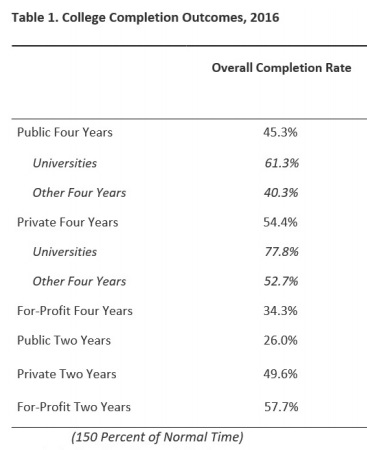
Here’s a table from her paper showing college completion rates across different types of institujtions by this measure.

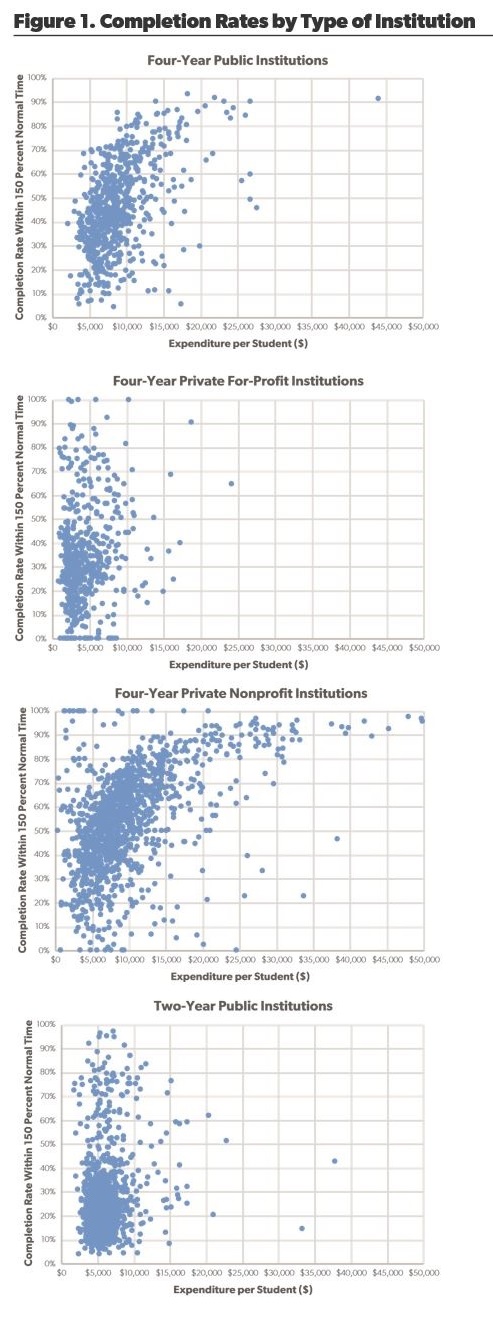
Sarah Turner’s essay offers some additional in-depth background. On the  horizontal axis, these graphs show spending per student. On the vertical axis, they show completion rates (again, as measured by completing a degree within 150% of the expected time) Each dot is a college or university. The central insight is that there is a very wide range of completion rates across schools in the same category that spend much the same amount per student.

Turner writes:

“In 43 four-year public schools, the three-year cohort default rate is greater than the completion rate. This is also the case for 147 four-year private nonprofit schools and 98 for-profit schools. In other words, students in these schools who borrow face a greater likelihood of defaulting than completing a degree. It would seem, then, that college attendance at these schools leaves many students worse off�lacking a degree, defaulting on a student loan, or both.”

The papers tend to be stronger on describing the problem than on providing clearly workable solutions, but that’s the nature of this issue. College completion rates have been low for a long time, but with the cost of college now having climbed so very high, the issue has a new relevance. For example, Destin looks at how improvements in the psychological environment at a school, including elements of teaching and campus life, can help. Chingos emphasizes that students need preparation to be ready to do college-level work. Turner discusses the pros and cons of linking college completion rates and the levels of state support and financial aid.  Schneider and Clark summarize reforms that have improve completion rates at certain schools. 
One challenge here is to remember that the ultimate goal isn’t to punish schools with low completion rates (although that may be necessary in some cases). It’s to have fewer students falling off the path to college completion. 

US Homeownership Patterns

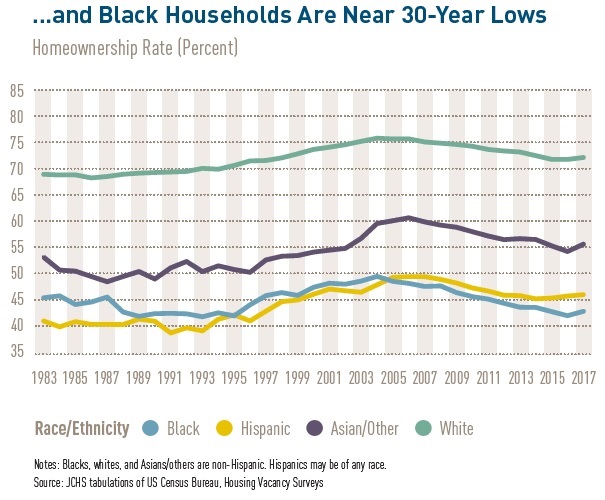
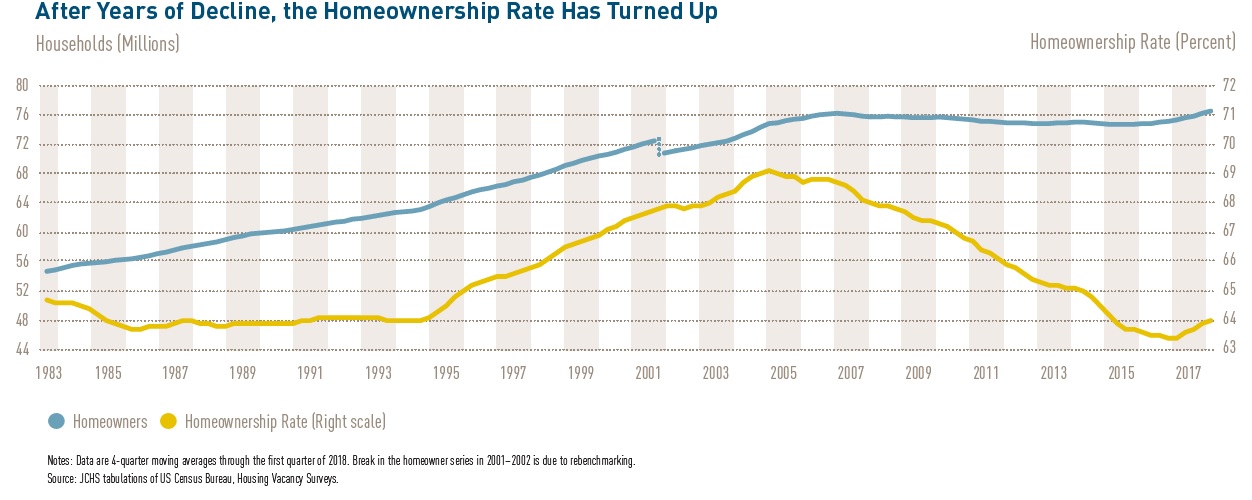
Homeownership rates in the US rebounded a bit in 2017, but remain near historically low levels. This is a source of concern for a number of reasons: homeownership is a savings vehicle that has worked for a number of households over time; being a homeowner encourages people to look after and contribute to their neighborhoods; and homeownership is part of that loose vision of the good life sometimes called the “American dream.” I’ll draw on evidence presented in The State of the Nation’s Housing 2018, the 30th version of an report produced annually by the Joint Center for Housing Studies of Harvard University. For those who want an overview of US housing markets, including issues of rental markets and low-income affordability, it’s a good place to start. Here, I’ll focus on homeownership patterns.

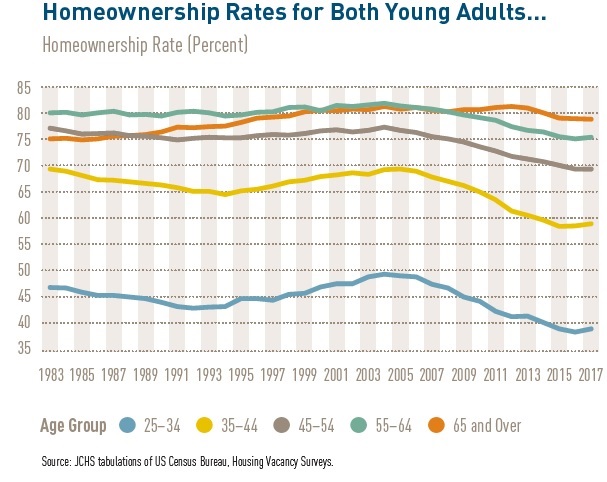
As a starting point, here are a couple of figures showing homeownership by age and by race/ethnicity. After the peak of prices in the housing market back around 2006, the rate of homeownership doesn’t change too much for the over-65 age bracket–many of whom were presumably already well-settled into homeownership many years before 2006–but drops visibly for every other age group. The biggest drops are for the younger age groups. Homeownership drops for every racial/ethic group, as well. But for blacks in particular, the drop is severe enough that homeownership rates are near their low point for the last four decades.

Interest rates for mortgage borrowing are relatively low by historical standards, so that isn’t the issue. Instead, the main issue seems to involve the high price for purchasing  housing, and probably also some concerns about the desirability of being a homeowner having just watched the housing price decline in the lead-up to the Great Recession. The Harvard report offers some backstory:

“In 1988, when the first State of the Nation�s Housing report highlighted historically high homeownership costs, the national home price-to-income  ratio was 3.2, with just one metro posting a ratio above 6.0. In 2017, the national price-to-income ratio stood at 4.2, and 22 metros had ratios above 6.0. So far, however, low interest rates have kept the median monthly payments on a modest home relatively affordable�in fact $250 lower in real terms than in 1988. However, the ongoing rise in both interest rates and home prices may change this. In addition, higher prices mean higher downpayments and closing costs, an even more difficult hurdle than monthly payments for many first-time homebuyers.”

 Limits on the available supply of housing seem to be keeping prices high. 

“In 2017, the supply of for-sale homes averaged only 3.9 months�well below the 6 months considered a balanced market. Zillow puts supply even lower at just 3 months, with inventories in roughly a third of 93 metros under 2 months. Lower-cost homes are especially scarce. Virtually all of the 88 metros with data available had more homes for sale in the top third of the market by price than in the bottom third. In 46 of these metros,more than half of the available supply was at the high end. …

“Why inventories are so tight is not entirely clear. CoreLogic data show that the number of owners underwater on their mortgages shrank from more than 12.1 million in 2011 to 2.5 million in 2017, so negative equity should no longer be a significant drag on sales. Still, conversion of 3.9 million single-family homes to rentals in 2006�2016 could be constraining the number of entry-level homes on the market. The ongoing decline in residential mobility rates may also play a role, with fewer households putting their homes up for sale each year.

“Another factor is the low level of single-family construction. Despite six consecutive years of increases, single-family starts stood at just 849,000 units in 2017, well below the long-run annual average of 1.1 million. Indeed, only 610,000 single-family homes were added to the stock annually in 2008�2017. Limited new construction may hold back existing home sales by reducing the tradeup options for current owners, deterring them from putting their own homes on the market. 

“The slow growth in single-family construction reflects in part homebuilder caution following the dramatic housing bust. But risk aversion aside, a significant constraint on new residential construction may be the dwindling supply of buildable lots. According to Metrostudy data, the inventory of vacant lots in the 98 metro areas tracked fell 36 percent in 2008�2017. Indeed, 21 of the nation�s 25 largest metros reported inventories that would support less than 24 months of residential construction.

“Along with limited land, respondents to builder surveys cite rising input costs as adding to the difficulty of constructing entry-level homes. As a result, the share of smaller homes (under 1,800 square feet) built each year fell from 50 percent in 1988 to 36 percent in 2000 to 22 percent in 2017.”

The US  homeownership rate has turned up just a bit in the last year or so, after hitting a 50-year low in the second quarter of 2016. But if the US believes that a higher homeownership rate is a valuable public policy goal, the challenge seems to be to find governing rules for the housing market so that it is profitable for builders to construct a greater quantity of housing, especially at lower and moderate price ranges.

For some earlier posts on homeownership, see:

Interview with Jes�s Fern�ndez-Villaverde: Macro Topics

Renee Haltom interviews Jes�s Fern�ndez-Villaverde in the most recent issue of Econ Focus, published by the Federal Reserve Bank of Richmond (First Quarter 2018, pp. 22-27). As noted in the introduction before the interview, Fern�ndez-Villaverde is best known for work in building and solving formal macroeconomic models. However, “[i]n recent years, he has studied how politics determine macroeconomic outcomes, the rise of Nazi Germany, the enduring significance of the Magna Carta, and even how contraceptive technologies influence the way societies socialize children about sex. On top of all this is what he calls `a second life’ of writing prolifically about economics and policy in Spanish.” It’s a rich interview, worth reading in full. Here are a few points that caught my eye: 

The Euro, Now That It Exists

“Using an old-fashioned terminology, the eurozone has an original sin, which is that it is not an optimal currency area. At the same time, if you ask me, �Should I marry my friend X?� I may tell you, �No, I don�t think you are compatible, you are going to end up divorced.� But that�s a very different question from, `Should I get a divorce now that we are married and have a mortgage, three kids in school, two cars, and a dog?’

“Like it or not, we got married to the Germans, and the Germans got married to the Spaniards. We need to make this work, because breaking up now would be way too costly. What we need is a reform of the euro. In terms of incentives, you need to tell countries that they will not face economic crises alone, that there is going to be money from the European Union that will help the Netherlands going through a rough patch in the same way that federal taxes and transfers will help if California suffers a bad period. That would imply, for instance, moving toward a bigger European Union budget and creating some European bond system. There is a lot of discussion among European economists about how to design such a thing. But there also need to be constraints. For this to be sustainable, fiscal discipline and cleaning up the house really needs to be done. There has to be a great bargain between those who point out the need for making financial and economic crises easier to go through and those who emphasize that, in the long run, rules are very important. That�s the big question mark: Is the political process within Europe going to be able to deliver that solution?”

The State of Macro

“In the mid-1990s, we learned as a profession how to build models that are dynamic, that take the randomness of the economy seriously, and that incorporate price and wage stickiness. That class of models started being called DSGE, which is the terribly unsexy Dynamic Stochastic General Equilibrium acronym. I think these models really clarify a lot of aspects of, for instance, how monetary policy interacts with aggregate activity, and we learn a lot from them. 

“The second big leap, which we have had over the last 10 years, is a big revival in models with heterogeneity. In the standard basic model that we teach first-year graduate students, there is one household. But, of course, we know this is not a description of reality; we have people who are older versus younger, college-educated versus not college-educated, unemployed versus employed, high-income versus low-income. Both solving these models and taking them to the data was such a large task that, until around 10 years ago, not that many people wanted to use them. This led to criticisms of representative agent models with only one type of agent, but we didn�t have that many alternatives. But over the last 10 years there has been a tremendous jump in our computational capabilities. This iPhone on my desk is computationally more powerful than the best supercomputer on the planet in 1982. That means we can do a lot of things that even 10 years ago we couldn�t. …

“The problem is that a lot of this exciting, backbreaking research has not transpired outside of the relatively small group of people working on the frontier. … If you take the best 20 macroeconomists of my generation, of course they don�t agree on everything, but the things they talk about are very different from the type of things you will see on Twitter or the blogosphere. The conversation sometimes looks like two very different worlds. Sometimes I see criticisms about the state of macro saying, `Macroeconomists should do X,’ and I�m thinking, `Well, we have been doing X for 15 years.’ …

“Many of the people who are currently very critical of macro are in another generation, and some of them may not be fully aware of where the frontier of research is right now. They also have plenty of free time, so it�s much easier for them to write 20 pages of some type of expos�, if they want to use that word, on the state of macro. This raises a more general issue of whether academia in general and the economics profession in particular have the right incentives to transmit some of these learnings from the frontier to the general public.” 

The Particle Filter Story

“I once made a joke at a conference that the particle filter pays for my mortgage. Now a lot of people ask, `How is your mortgage going?’ and I say, `Nearly done.’

“Let me give you an example of what the particle filter does. In early 2018 we entered a time of high volatility in the stock market. The problem with volatility is that it is not directly observed: I can go to the back pages of the Financial Times and find a value in the table for a stock�s price, but there is no number to express its volatility. What you need is a statistical model that will let you learn about volatility from things you can actually observe, in this case, the variations of the stock market from one day to the next. This is called filtering � learning about things that you haven�t seen from things you can see.

“The original filters were developed for the space program. The idea is you are the guy in Houston with a joystick, and you see the satellite but can�t get its exact position because you are measuring with radar and there is noise. What you are trying to figure out is how much to push the joystick to the left or right given what the radar is telling you.

“For the longest time the most important filter was the Kalman filter. It requires two assumptions: that the world is linear, and that noise comes from a normal distribution, or is `well behaved.’ Those assumptions prevent it from handling many, many questions in macroeconomics. The best example is volatility because it can only be positive: You can have a lot of volatility or very little, but you cannot have negative volatility.

“So when I was a graduate student, I was very interested in coming up with methods that could extend filtering to these types of environments. I spent a lot of hours browsing through math journals, and I heard about this new generation of methods called sequential Monte Carlo, which is a complex name for something quite simple: A classic question in a basic probability class is if you throw two die, what is the probability that the sum of the two is five. You have to calculate the probability that the first is a one and the second is a four, and so on, and when you do that homework you always make a mistake because you forget one combination. Alternatively, you could throw the dice one million times. Of course, in real life you can�t do that, but computers can do it for you.

“In the 1990s, some people came up with the idea of applying Monte Carlos recursively to filtering problems. I learned about these new methods, and I thought gee, this can be done in economics as well. So I came back to my office and got my dear friend and co-author Juan Rubio and I explained to him, `This can work,’ and he said, `Yeah.’ I said, `Well, let�s write a paper.’ So we wrote the paper, my most-cited paper probably, and it still pays for my mortgage.”

The Medical Bankruptcies Debate

The debate over the extent to which uninsured medical costs lead to personal bankruptcies is interesting for a couple of reasons. In terms of social science, it shows the difference between a naive reading of survey data and an actual research design. In terms of politics, it shows the allure of a more glamorous and striking claim, even when incorrect, over a similar claim that is less flashy but actually true.

There’s a recent outbreak of this debate in the pages of the New England Journal of Medicine. In the issue of March 22, 2018, Carlos Dobkin, Amy Finkelstein, Raymond Kluender and Matthew J. Notowidigdo have written a short “Perspective” piece called “Myth and Measurement � The Case of Medical Bankruptcies” (pp. 1076-1078). It’s a purely verbal article, not a research report, which draws heavily the findings of their article called “The Economic Consequences of Hospital Admissions.” which appeared in the February 2018 issue of the American Economic Review (108: 2,  pp. 308-52). If you don’t have access to the AER online, a final version of the paper in manuscript is here.

The Dobkin et al. article is criticizing earlier studies that claimed to show that medical costs were the cause of 60% of all personal bankruptcies in the US. Several of the authors of that work– David U. Himmelstein, Steffie Woolhandler,  and Elizabeth Warren (now a US Senator from Massachusetts)–responded in the June 7 issue of the NEJM (pp. 2245-2246), offer a response, which is then followed by a brief response from the Dobkin et al. group (pp. 22245-2246). 

Dobkin et al. write:

“During the push to pass the Affordable Care Act, President Barack Obama often described the �crushing cost of health care� that was causing millions of Americans to �live every day just one accident or illness away from bankruptcy� and repeatedly stated that the high cost of health care �causes a bankruptcy in America every 30 seconds.� Stories of illnesses and injuries with financial consequences so severe that they caused households to file for bankruptcy were used as a major argument in support of the 2010 Affordable Care Act. And in 2014, Senators Elizabeth  Warren (D-MA) and Sheldon Whitehouse (D-RI) cited medical bills as �the leading cause of personal bankruptcy� when introducing the Medical Bankruptcy Fairness Act, which would have made the bankruptcy process more forgiving for �medically distressed debtors.� But it turns out that the existing evidence for �medical bankruptcies� suffers from a basic statistical fallacy; when we eliminated this problem, we found compelling evidence of the existence of medical bankruptcies but discovered that medical expenses cause many fewer bankruptcies than has been claimed.”

Here’s the problem: The earlier studies looked at survey data on people who had already declared bankruptcy. If those people in the survey reported either that they had experienced “health-related financial stress such as substantial medical bills or income loss due to illness” or that they “went bankrupt because of medical bills,” then the study assumed that medical costs “caused” the bankruptcy. In their later response, Dobkin et al. write:

“Himmelstein et al. argue that if bankruptcy filers are asked what caused their bankruptcy, a large share will say medical expenses. But their approach is not a credible way to estimate the causes of bankruptcy. It is akin to asking patients with cardiac disease what caused their heart attack; they probably do not know whether it was poor genes, poor diet, stress, or other factors. A related problem is social desirability bias, which makes it hard to take at face value explanations reported by the bankruptcy filers. Causal estimates require isolating a potential cause and its effect on the outcome of interest.”

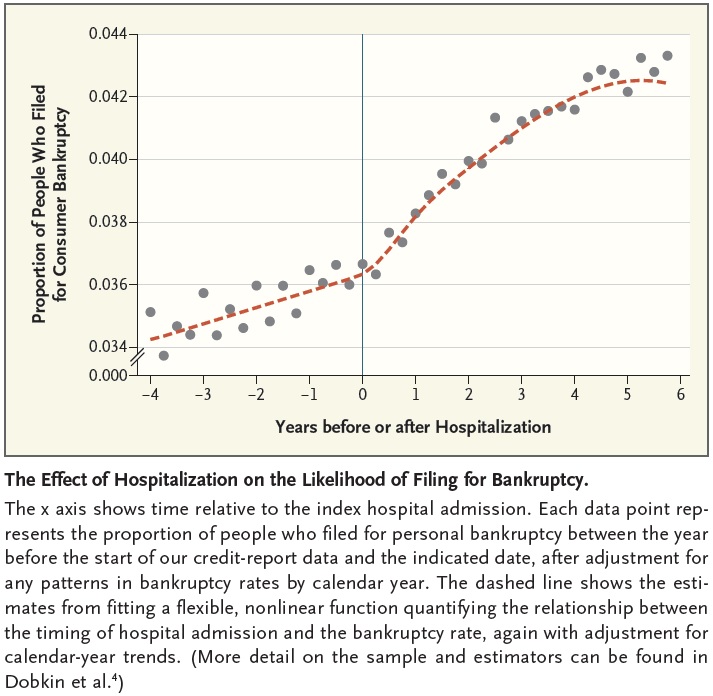
That last sentence might be engraved over the doorways of econometrics computer labs everywhere. The results of one of the many statistical tests that Dobkin et al. carry out in their AER article is reported in their NEJM comment. They look at data on half a million people who are admitted to hospitals in California over a four-year period. They find that those admitted to the hospital do have a higher chance of bankrupcy, as shown in this figure. But when they scale up this estimate to the US population, they find that health care costs are responsible for about 4% of bankruptcies, not 60%. 

Of course, this estimate is just one piece of evidence. The Dobkin et al. group are scrupulous in pointing out that one also should look at data on people outside of California, at costs of health care not linked to hospitalization, and so on and so on. But they also point out that such factors are pretty unlikely to raise the share of bankruptcies caused by health care costs from 4% to 60%.
The Dobkin et al. group agree that health care costs can cause financial stress–but that doesn’t mean they are a a main cause of actual bankruptcy. They point out that in a given year about point out that “about 20% of Americans have substantial medical debt, yet in a given year less than 1% of Americans file for personal bankruptcy.” Also, they point out that a spell of hospitalization with higher health care costs is often accompanied by a loss of labor market earnings. They point out that insured people have some coverage for high health care costs, but little if any coverage for lost labor market earnings. In their AER article, Dobkin et al. write: 

“Our findings suggest that non-elderly insured adults still face considerable exposure to adverse economic consequences of hospital admissions through their impact on labor earnings. … Taken together, our findings underscore the nature of insurance, and the lack thereof, in the United States. Our estimates suggest that in the first few years, the total medical expense and earnings consequences of a hospital admission are similar for insured adults and that over a longer horizon the earnings consequences loom relatively larger. By design, insurance in the US covers (a large portion of) medical expenses but relatively little of the earnings decline. Employer provision of sick pay and private disability insurance is fairly sparse, and public disability insurance is available only after a lengthy application and approval process (Autor et al. 2015). By contrast, in many other countries, there is substantially more formal insurance for the labor market consequences of adverse health.” 

Thus, the Dobkin et al. group are agreeing that a period of poor health and high health care costs can be a serious economic burden–but pointing out that the burden often results more from a loss of labor income than from the actual health care costs. As a result, improved insurance for health care costs would be only a very partial fix. And improved health care insurance would have only a very small effect on the total number of bankruptcies.

In their response, the Himmelstein et al. group repeats the various caveats that the Dobkin et al. group has already noted about their study. And at the end, the Himmelstein et al. group tosses in this comment: “Characterizing debtors� self-reports as �myth� is demeaning to people struggling with health care costs …” 
Of course, it’s not the debtors or their self-reports that are being called a “myth.” The myth is in the causal interpretation that was being being placed on that data. This style of argument is essentially: “If you don’t agree with my interpretation of data, then you are being demeaning toward people in need.” When someone resorts to that form of illogic, it’s a fair inference that they are losing the argument.

Happiness Around the World–And For Migrants

The utilititarian philosopher Jeremy Bentham wrote of a “sacred truth � that the greatest happiness of the greatest number is the foundation of morals and legislation.” The World Happiness Report 2018   is edited by John F. Helliwell, Richard Layard and Jeffrey D. Sachs, with chapters by various scholars. It takes insights about happiness seriously. In this version of the annual report, most of the chapters relate happiness to migration topics, although are also a few chapters with a review of recent happiness data around the world, chapters about about happiness in Latin America more broadly, and about happiness issues related to the US health care system.

The happiness data is based on surveys, commonly using the “answers to the Cantril ladder question
asking respondents to value their lives today on a 0 to 10 scale, with the worst possible life as a 0
and the best possible life as a 10.” The terms “happiness� and �subjective well-being� are then commonly used to describe higher and lower scores. 
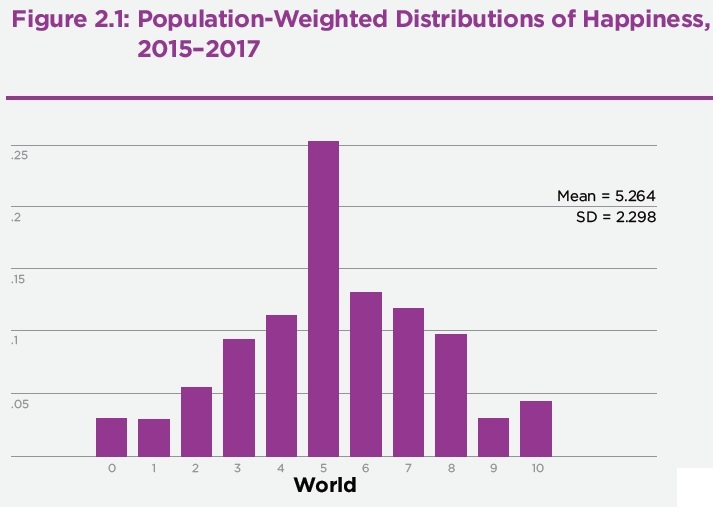
In Chapter 2, John F. Helliwell,  Haifang Huang,  Shun Wang, and Hugh Shiplett review recent happiness survey data from around the world.  Here’s a world distribution of happiness:

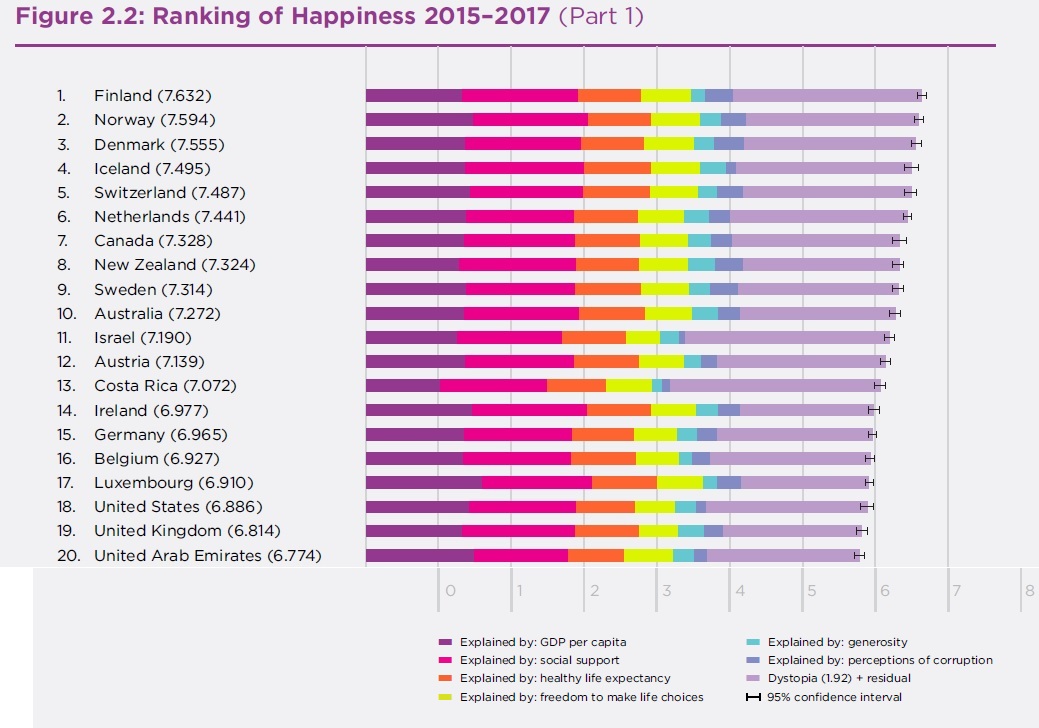
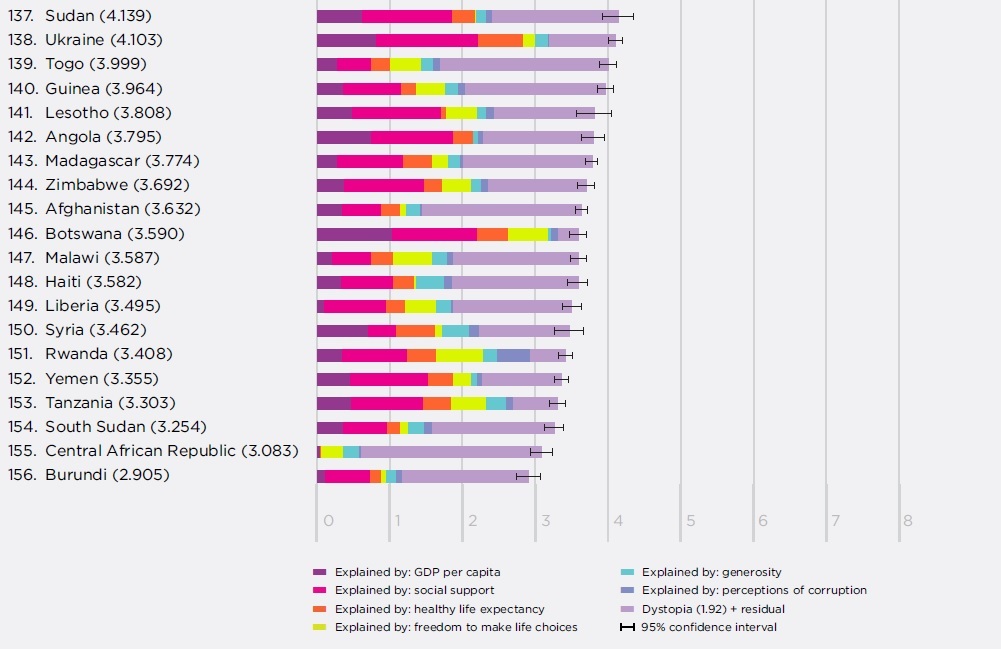
At the national level, one can then look at how happiness correlates with various other factor. The consider “national average life evaluations in terms of six key variables: GDP per capita, social support, healthy life expectancy, freedom to make life choices, generosity, and freedom from corruption. Taken together, these six variables explain almost three-quarters of the variation in national annual average ladder scores among countries, using data from the years 2005 to 2017.”

Here’s one table showing the top 20 happiest countries (the US ranks 18th) and the bottom 20 (Burundi is lowest). The overall bars show the happiness measure, while the colors on the bar show what portion of total happiness can be attributed to the correlations with the six factors just mentioned. 
Researchers in this area can also look at the happiness survey data by individual characteristics, not just national characteristics. They can look at distribution of happiness across countries, for example, or happiness of particular groups, like those in rural or urban areas, or migrants. This year’s has a number of chapters on migrants, summaries in and overview chapter by Helliwell, Layard and Sachs. For example, they write: 

“So what determines the happiness of immigrants living in different countries and coming from different, other countries? Three striking facts emerge.

1. In the typical country, immigrants are about as happy as people born locally. (The difference is under 0.1 point out of 10). … However the figure also shows that in the happiest countries immigrants are significantly less happy than locals, while the reverse is true in the least happy countries. This is because of the second finding.

2. The happiness of each migrant depends not only on the happiness of locals (with a weight of roughly 0.75) but also on the level of happiness in the migrant�s country of origin (with a weight of roughly 0.25). Thus if a migrant goes (like many migrants) from a less happy to a more happy country, the migrant ends up somewhat less happy than the locals. But the reverse is true if a migrant goes from a more to a less happy country. … Another way of describing this result is to say that on average, a migrant gains in happiness about three-quarters of the difference in average happiness between the country of origin and the destination country.

3. The happiness of immigrants also depends importantly on how accepting the locals are towards immigrants. (To measure acceptance local residents were asked whether the following were �good things� or �bad things�: having immigrants in the country, having an immigrant as a neighbour, and having an immigrant marry your close relative). In a country that was more accepting (by one standard deviation) immigrants were happier by 0.1 points (on a 0 to 10 scale).”

I find the evidence from happiness surveys to be consistently interesting, but I confess that at the end of the day, I don’t always know what to make of it. Subjective self-evaluations can be hard to interpret, because they always happen with a social context. For example, consider these patterns about internal migration in China:

“Over the years 1990-2015 the Chinese urban population has grown by 463 million, of whom roughly half are migrants from villages to towns and cities. By contrast, over the same period the increase in the number of international migrants in the entire world has been 90 million, less than half as many as rural to urban migrants in China alone. Thus internal migration is an order of magnitude larger than international migration. …

“Migrants [within China] have roughly doubled their work income by moving from the countryside, but they are less happy than the people still living in rural areas. … Could it be that many of the migrants suffer because of the remittances they send home? The evidence says, No. Could it be that the people who migrate were intrinsically less happy? The evidence says, No. Could it be that urban life is more insecure than life in the countryside � and involves fewer friends and more discrimination? Perhaps.

“The biggest factor affecting the happiness of [within China] migrants is a change of reference group: the happiness equation for migrants is similar to that of urban dwellers, and different from that of rural dwellers. This could explain why migrants say they are happier as a result of moving � they would no longer appreciate the simple pleasures of rural life.”

The Dramatic Expansion of Corporate Bonds

Overall world debt in the last year or two is at its all-time high as a share of world GDP. But there is common pattern that as countries grow and their financial markets develop, their level of debt also tends to rise. Perhaps even more interesting is that the importance of the components of that debt have been shifting. During and after the Great Recession, government borrowing was the main driver of rising global debt. But corporate borrowing has become more important

Moreover, this corporate borrowing has two new traits. One is that as bank regulators all over the globe have tightened up, this rise in corporate borrowing tends to take the form of bonds rather than bank loans. The other interesting trait is that this rise in corporate borrowing around the world can be traced back to developing economies–and especially to China.

Susan Lund, Jonathan Woetzel, Eckart Windhagen, Richard Dobbs, and Diana Goldshtein of the McKinsey Global Institute provide an overview in their June 2018 discussion paper, Rising Corporate Debt: Peril or Promise?  An overview of the report is here; the full report is here. They write:

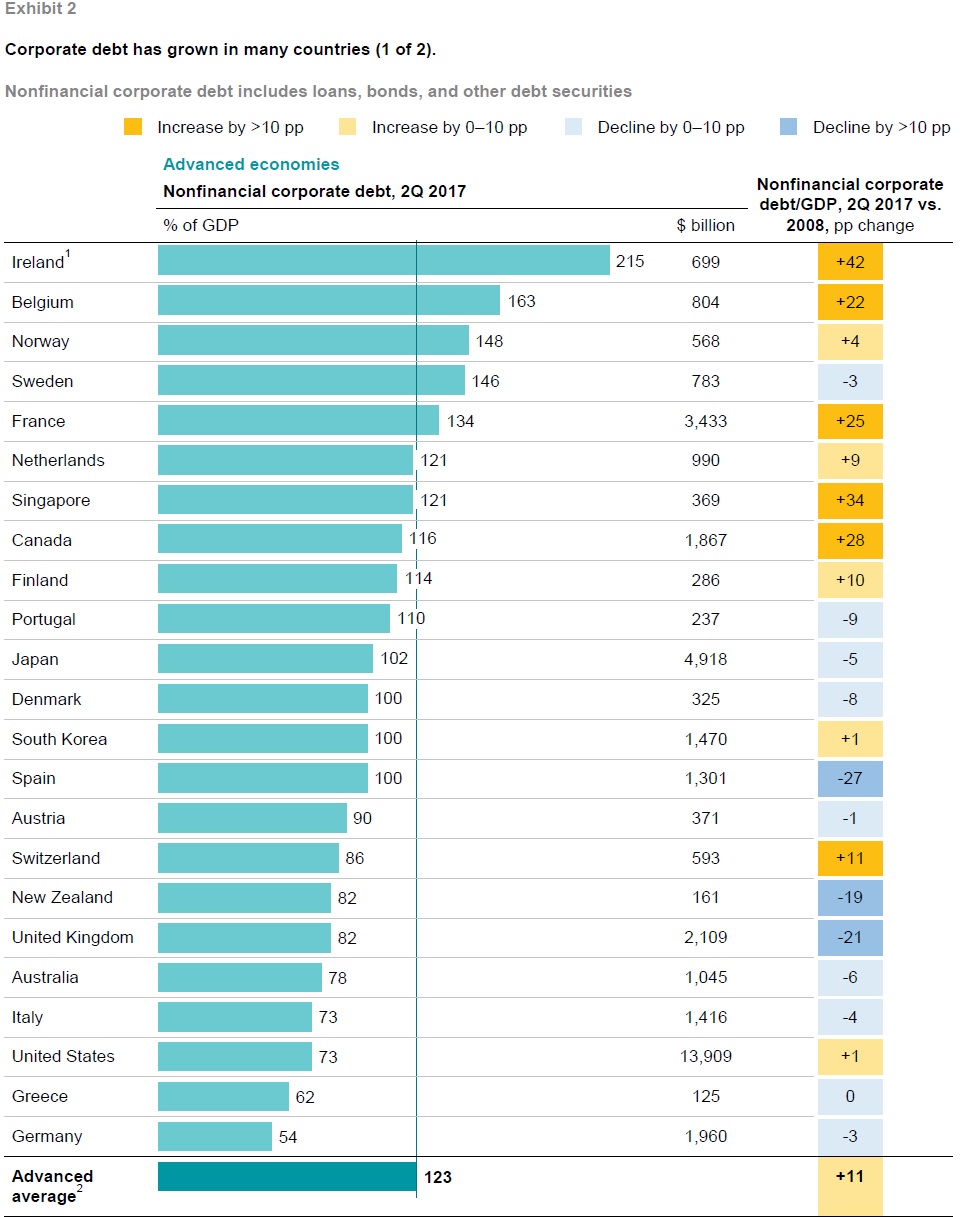
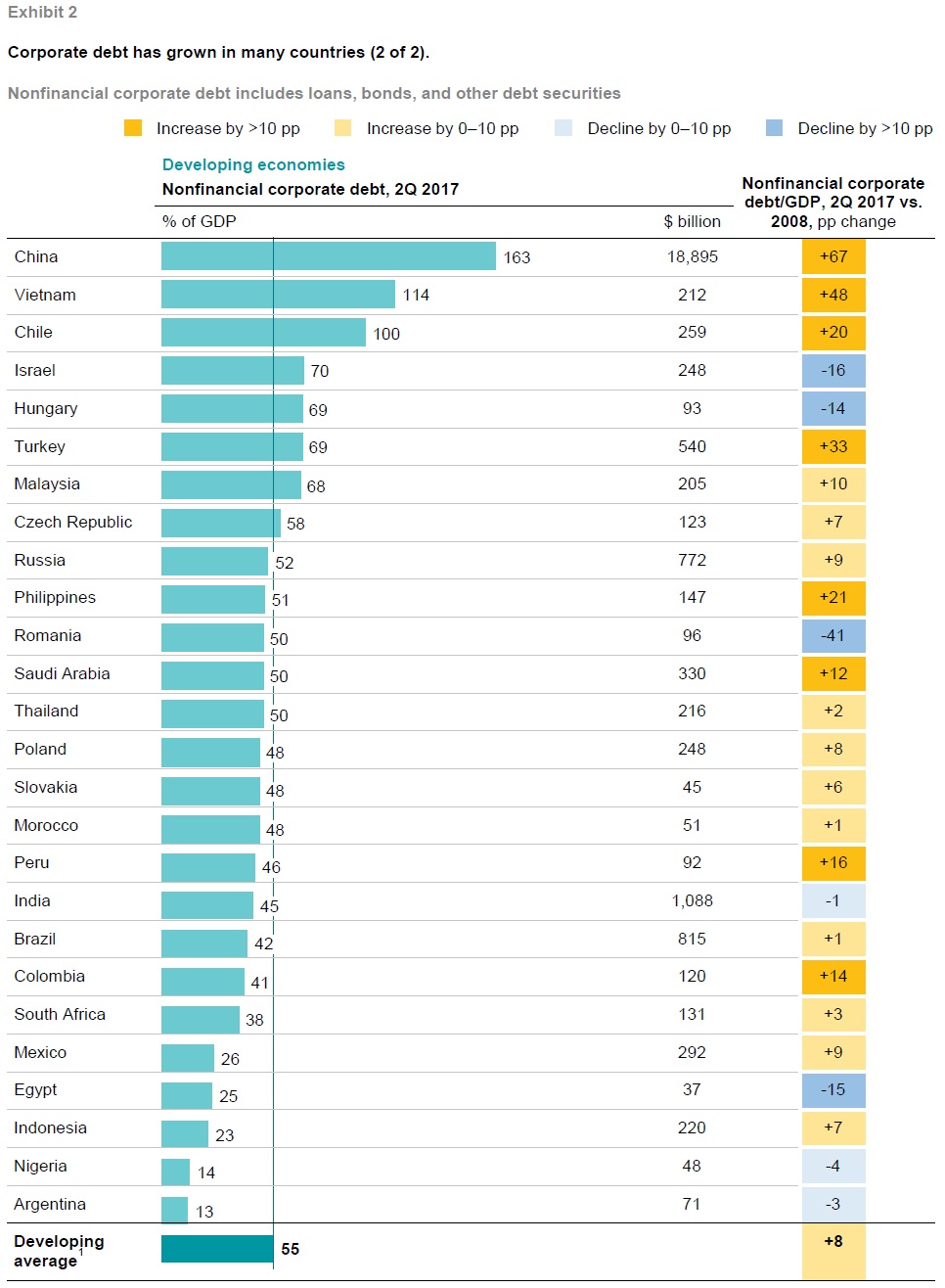
“In a departure from the past, most of the growth in corporate debt has come from developing countries, in particular China. Companies in advanced economies accounted for just 34 percent or $9.9 trillion of the growth in global corporate debt since 2007, while developing countries accounted for 66 percent or $19.2 trillion. Since 2007, China�s corporate debt has increased by $15 trillion, or more than half of global corporate debt growth. As a share of GDP, China�s corporate debt rose from 97 percent of GDP in 2007 to 163 percent in 2017, one of the highest corporate debt ratios in the world apart from small financial centers that attract offshore companies. The growth in corporate debt in China is mainly associated with a construction sector that increased its leverage as the housing market boomed. Today, 30 to 35 percent of corporate debt in China is associated with construction and real estate. …

“A relatively new feature of the debt landscape in recent years has been a shift in corporate borrowing from loans to bonds. Given the growing pressure on banks to meet new capital and liquidity standards, global nonfinancial corporate loans outstanding have been growing by only 3 percent annually on average since 2007 to stand at around $55 trillion in 2017. However, the share of global corporate debt in the form of bonds has nearly doubled, and the value of corporate bonds outstanding has grown 2.7 times since 2007. This is a positive trend, leading to a diversification of corporate financing. However, we also find risks.” 

Here are a couple of summary figures for nonfinancial corporate debt by country. The countries are ranked by total corporate debt as a share of GDP: top panel shows advanced eoconomies, the bottom panel shows developing countries. The tables then also list the total corporate debt in each country and how it has risen or fall in the last decade. 

And here are a few comments from the report that caught my eye: 
On China’s corporate borrowing and that of other emerging markets: 

“The value of China�s nonfinancial corporate bonds outstanding increased from $69 billion in 2007 to $2 trillion by the end of 2017, making China one of the largest bond markets in the world. In developing countries other than China, corporate bonds outstanding have also grown, although at a more measured pace of 14 percent a year, from $313 billion in 2007 to $1.2 trillion in 2017 …  Growth has been particularly strong in Brazil, Chile, Mexico, and Russia.

“While in China 95 percent of corporate bonds outstanding are denominated in the local currency, in other developing countries that is not the case. Historically, nearly all companies in developing economies issued bonds in foreign currencies because investors would not take the risk of buying bonds in local currencies. However, over the past decade, larger local-currency bond markets have developed. Still, roughly two-thirds of corporate bonds in developing economies maturing annually are denominated in US dollars and other foreign currencies. This creates additional risk, because debt service costs will soar if the local currency depreciates (and the company does not have revenue streams in the foreign currency).”

On the wave of companies that are going to want to refinance bonds. The report estimates that in China, India, and Brazil, as much as 30-40% of all bonds could risk default if interest rates rise.

“As a bond matures, companies have two choices: to repay the principal amount borrowed, or to issue a new bond to replace the maturing one. Historically, companies issued long-term bonds for project finance and repaid the debt once due. Today, however, most borrowers seek to refinance maturing bonds by issuing new ones. From 2018 to 2022, a record amount of bonds�between $1.6 trillion and $2.1 trillion annually�will mature. Globally, a total of $7.9 trillion of bonds will come due during those five years, based on bonds already issued. However, some bonds have maturities of less than five years and may still be issued and come due during that period. If current issuance trends continue, then as much as $10 trillion of bonds will come due over the next five years …  At least $3 trillion of this total will be from US corporations, $1.7 trillion from Chinese companies, and $1.7 trillion from Western European companies. Rising interest rates could make it more difficult for many borrowers to refinance their debt.”

I don’t have a good sense of whether all this is real cause for alarm, or just a blip in the road. But it does seem to me that in the last few years, with a combination of very low government interest rates and tighter restrictions on bank lending, there has been a lot of eagerness by investors to “search for yield” in corporate bond markets. It wouldn’t be startling to find that a share of those investors have not taken appropriate care to hedge the risks involved. 

Interview with Marianne Bertrand: Inequality, Gender Norms, Skills

Douglas Clement has an “Interview with Marianne Bertrand,” subtitled “University of Chicago economist on the glass ceiling, implications of growing inequality and the trouble with boys” (The Region, Federal Reserve Bank of Minneapolis, online June 19, 2018).  Here are a few of the comments that especially stuck with me, but there’s more at the interview.

The Gender Norm that Men Should Out-earn Women in Married Couples

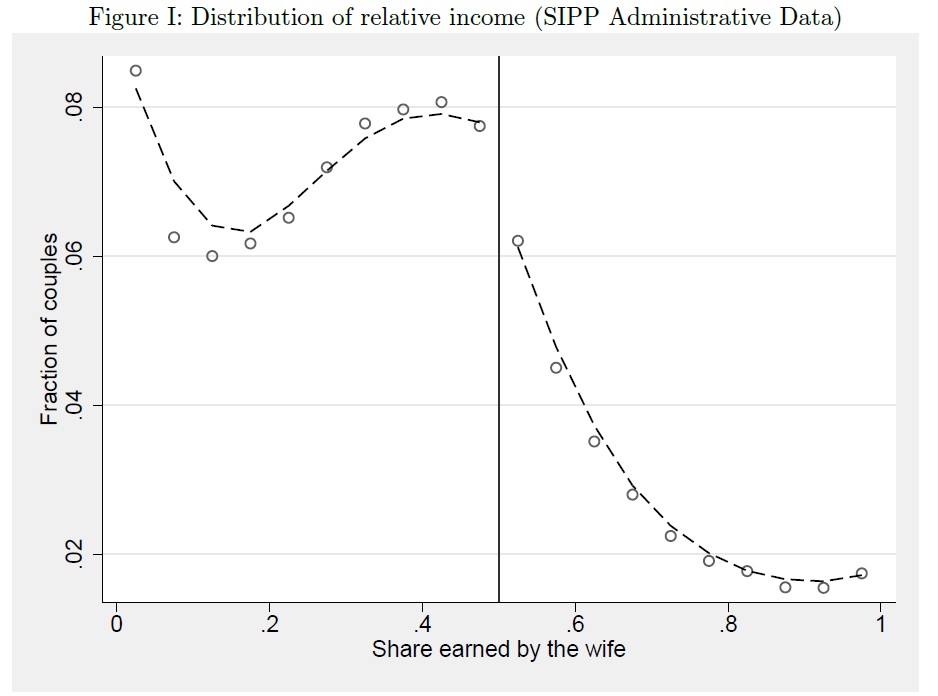
“The idea of the paper was to focus on the particular gender identity norm, which is the idea that men should earn more than their wives. It�s an interesting one to focus on because it�s a norm that may only have become binding today. It may not have been that relevant in the past because women were much less likely to have the potential to out-earn their husbands, and now they do. So the idea of the paper was to investigate the empirical relevance of this norm among households as well as its implications. … 

“This was item number one in the paper. Let�s do something very simple: Look at the distribution of relative income of wife and husband within couples. If this norm is important, we should see, quote-unquote, �too few� couples where the wife earns more than her husband. And this is exactly what we found in administrative data; that�s the picture that we�re looking at right there.

“And then, in a sense, starting from this picture, we tried to figure out where this could be coming from. One possibility is that those �missing� couples where the wife earns more than her husband may never get formed, meaning that it�s something about the marriage market. … Another reason why this picture may exist is that those, quote-unquote, �missing� couples were less stable. So they existed, but they were more likely to break down. And we also found evidence of that in the data. Looking at couples where the wives earn more than the husbands, we found signs of more marital instability, more marital unhappiness and some signs that these couples were more likely to end up in divorce.”

Thoughts about Divergence in Types of Consumption and in Political Views

“We were talking about income inequality, and one of our colleagues said, basically, �Well, at the end of the day, who cares? Yes, maybe we�re growing apart economically, but on Sunday all we all do is watch TV. We are growing apart economically, but our lives may not be that different; they may, in fact, have converged.�

“So, this is kind of an interesting point. How much can we say about how the lives of the rich and the poor changed? Let�s try to put together all of the data sets that we can think of over the longest time period that we can and say something about what it�s like to be rich, which we define as the top quartile of the income distribution, versus poor, which we define as the bottom quartile. What was it like several decades ago? What is it like today? …

“I like to use the example you mentioned, social mobility. Suppose we work at the same company. You are my boss. I�m your employee. You�re from the top of the income distribution, and I�m from the bottom. My ability to move up in the company might be a function of how much you connect with me, and connecting with one another might be a function of the quality of the conversation that we can have around the water cooler. Did we do the same thing over the weekend? Do we watch the same shows? Do we have the same hobbies and eat the same food?

“So we tried to assemble all the data sets we could; for example, time-use data, which go back to the 1960s. Another data set that a lot of social scientists use is the General Social Survey, which tells us something about views and opinions�views on abortion, gays, racial issues, government spending and the like. … [W]e had access to a marketing data set, which is truly remarkable. In that data set, we can see media consumption�what TV shows people watch, what movies they watch, what magazines they read. The data set also shows thousands of products that people may or may not buy, and thousands of brands that people may or may not buy or own.

“Then we built a metric of cultural distance between groups by income. There are many ways you could measure distance. We use a machine-learning algorithm and aggregate a number of methods that allow us to find the best model to predict someone�s income based on the brands or products they report consuming or the attitudes the person has. …

“The main headline result of the paper is that most of the trend lines are flat. Our ability to predict someone�s income based on the consumption of particular goods and brands is essentially the same today as it was 25 years ago. There�s no trend in our ability to predict people�s income based on how they spend their time today, compared to close to 50 years ago. The only area where we see some slight evidence of divergence on income is with respect to social attitudes, where our ability to predict people�s income based on what they think, their views, is slightly better today than it was in the early 1970s. …

“[N]ow we�ve done this exercise, as I said, for race, gender and urbanicity. When we first got these results on income, people said, especially in the context of the recent election, �Well, income is not the important one; it�s urban/rural. That�s the important divide in America.� We�ve also done it based on political attitudes, and the main result, which I just gave you for income�there�s no big trend�essentially applies to, at a first-level of approximation, everything that we have looked at.

“The one really large exception quantitatively is our ability to predict whether someone is liberal or conservative/Democrat or Republican based on their social attitudes. That has been increasing over time. So liberals and conservatives haven�t been diverging over time on TV consumption, brands or goods, but on social views they have been diverging a lot over time.

“The results were surprising to us. We went into this with in the back of our mind the discussion that�s happening right now [that Americans are increasingly divided along economic and other lines], and we really thought that we were going to see signs of that in the data.

“How do I rationalize the results? It�s not clear, but here�s one thought when it comes to products and brands. I think today we think you can easily see who is rich or poor because rich people own an iPhone and poor people don�t; but, then, 25 years ago, it was whether you owned a DVD player that separated rich and poor. There are waves of technological changes�the rich, the more educated are always going to be the early adopters of those�but there are constant waves of technological change.”

 The Gender Gap in Cognitive Skills is Bigger in Broken Families

“[T]he gender gap in noncognitive skills is particularly large in broken families. And that term can mean many different things. It�s low income, it�s absent fathers, it�s less education, it�s fewer parental inputs. … If you have boys doing more poorly in broken families, that means that a lot of these boys become less marriageable. That means more single moms and more broken families in the future and hence, again, more boys growing up in conditions where they may not get the kind of parenting that could address whatever deficiencies they have in noncognitive skills. … One argument we make in the paper is that boys may be born at greater risk of having noncognitive problems than girls. … And if that�s true, then it�s particularly important to have stronger parenting for boys than girls in order to correct this deficit. But, again, that�s highly speculative.”

Thaler on the Evolution of Behavioral Economics

Richard Thaler won the Nobel Prize in economics in 2017  “for his contributions to behavioural economics.  He tells the story of how the field evolved from early musings through small-scale tests and more comprehensive theories and all the way to public policy in his Nobel prize lecture, “From Cashews to Nudges: The Evolution of Behavioral Economics.” It is ungated and freely available in the June 2018 issue of the American Economic Review (108:6, pp. 1265�1287).  Video of the lecture being delivered is here. 

I certainly won’t try to recap the readable and accessible lecture here. (One of Thaler’s many virtues is that he wears his learning lightly.) But here are three stories that Thaler collected near the start of his career, when mulling over these subjects. Thaler writes:

  • At a dinner party for fellow economics graduate students I put out a large bowl of cashew nuts to accompany drinks while waiting for dinner to finish cooking. In a short period of time, we devoured half the bowl of nuts. Seeing that our appetites (and waistlines) were in danger I removed the bowl and left it in the kitchen pantry. When I returned everyone thanked me. But, as economists are prone to do, we soon launched into analysis: how is it that we were all happy now that the nuts were gone? A basic axiom of economic theory is that more choices are always preferred to fewer�because you can always turn down the  extra option.
  • The chair of the University of Rochester economics department (and one of my advisors), Richard Rosett was a wine lover who had begun buying and collecting wine in the 1950s. For as little as $5, he had purchased some choice bottle that he could now sell to a local retailer for $100. Rosett had a rule against paying more than $30 for a bottle of wine, but he did not sell any of his old bottles. Instead he would drink them on special occasions. In summary, he would enjoy his old bottles worth $100 each, but he would neither buy nor sell at that price. Therefore his utility of one of those old bottles was both higher and lower than $100. Impossible.
  • My friend Jeffrey and I were given two tickets to a professional basketball game in Buffalo, normally a 75-minute drive from Rochester. On the day of the game there was a snowstorm and we sensibly decided to skip the game. But Jeffrey, who is not an economist, remarked, �If we had paid full price for those tickets we would have gone!� As an observation about human behavior he was right, but according to economic theory sunk costs do not matter. Why is going to the game more attractive if we have higher sunk costs? 

For an economist, each of these stories suggests a departure from purely rational behavior. More important, it suggest that the departure from rational behavior is in some way understandable, plausible and predictable as a matter of human psychology.  By understanding the rules of thumb (or “heuristics”) that guide such behavior, one can build a branch of economics.

For example, the cashew story describes the issue that people can sometimes lack self-control, in the sense that they give in to short-run temptations even when say that they would prefer not to do so. As Thaler says, there is a “planner” and a “doer” inside each of us–and they are not always in synch. As a result, people look for self-control devices (like moving the cashews out of the room), to  help them act in the way that they wish to do, but seem incapable of actually doing. One can immediately think of applications of this framework in retirement plans to help us save, diet plans to help us eat healthier food, exercise clubs and plans to get us moving, book clubs so we read something worthwhile every now and then, and more.

The wine story is an example of what Thaler would later come to call “the endowment effect” or “status quo bias.” People often seem to have a bias to holding on to what they have, in part because the fear of that change will incur a loss is bigger than the lure that change will incur a gain. An interesting application here is that many people will have a tendency to stick with what they’ve got, even if they learn more about alternatives that might be better: the same quantity of savings in a retirement plan and the same way of investing those savings, the same insurance policies with the same levels of deductibles, and so on. People may originally make a choice for no particular reason–perhaps it was just the default option at the time–but then they become more likely to stick with that default option in the future. If a firm or the government changes the default options, it can also change behavior in a lasting way.

 The ticket story describes an issue of how people perceive losses. As Thaler writes:

“When a family spends $100 to buy tickets in advance of some event, the purchase will not create either pleasure or pain so long as the price is equal to the expected price. However, if there is a snowstorm, there is a $100 purchase that now has to be �recognized� and it will then be experienced as a loss. This helps explain why someone can think that going to the event is a good idea�it eliminates the need to declare the original purchase as a loss. … When I was thinking about these issues, the United States government�s continued involvement in the Vietnam war seemed best explained in these terms.” 

Conversely, when Thaler and his friend were given tickets as a gift, not using the tickets was not perceived as a loss in the same way. This unwillingness to face losses, even when they are sunk costs in the past, shows up in a number of settings: for example, the way in which investors are more likely to continue holding stocks that have declined in value, hoping they will rise again, while being more willing to sell stocks that have risen in price.

The policy version of behavioral economics is often called “nudging,” where the notion is to alter the default options or the presentation of information in a way that causes more people to make the choices that people wish they could be making in the first place. Thaler (along with Cass Sunstein) originally referred to this as “libertarian paternalism.” I had not known that the “nudge” terminology was suggested by a publisher who turned down their proposed book on the subject. Thaler writes:

“When we were looking for a publisher for the book we found the reaction to be rather tepid, probably in part because the phrase �libertarian paternalism� does not exactly roll off the tongue. Fortunately one of the many publishers that declined to bid on the book suggested that the word �nudge� might be an appropriate title. And so we published Nudge: Improving Decisions about Health, Wealth and Happiness. In this roundabout way, a new technical term came into social science parlance: a nudge. The book Nudge is based on two core principles: libertarian paternalism and choice architecture. It is true that the phrase libertarian paternalism sounds like an oxymoron, but according to our definition it is not. By paternalism we mean choosing actions that are intended to make the affected parties better off as defined by themselves. More specifically, the idea is to help people make the choice they would select if they were fully informed and in what George Loewenstein (1996) calls a �cold state,� meaning, unaffected by arousal or temptation.”

Of course, nudges are not just the result of government policies. Instead, we are being nudged all the time, often in ways we don’t perceive clearly at the time. Firms can try to use nudges to their advantage, as well, which Thaler nicely describes as “sludge:”

“People have been nudging as long as they have been trying to influence other people. And much as we might wish it to be so, not all nudging is nudging for good. The same passive behavior we saw among Swedish savers applies to nearly everyone agreeing to software terms, or mortgage documents, or car payments, or employment contracts. We click �agree� without reading, and can find ourselves locked into a long-term contract that can only be terminated with considerable time and aggravation, or worse. Some firms are actively making use of behaviorally informed strategies to profit from the lack of scrutiny most shoppers apply. I call this kind of exploitive behavior �sludge.� It is the exact opposite of nudging for good. But whether the use of sludge is a long-run profit maximizing strategy remains to be seen. Creating the reputation as a �sludge-free� supplier of goods and services may be a winning long-run strategy …”

For those who would like additional doses of Thaler, here are some starting points: links to two interviews and another academic lecture.

Design a site like this with WordPress.com
Get started