Beyond Medispa

Image result for medispa in england

I shall start with saying I’ve never written a review in my life so for me to do so means the experience I had this morning has really upset me. My husband bought me a groupon deal (massage & facial) at Christmas. £28. The deal then was 2 treatments for 28. More recently it seems u get 2 for £25 & 3 for £28. Although staff are unclear on this.

I called & booked and spoke to a lovely girl Mia. She explained the treatments and I asked her advice on brows while I was on. Very helpful. She struggled for availability for me so in the end booked me with Caroline the owner who I was told didn’t really ‘like’ doing groupons. She then said it shouldn’t be a problem. It didn’t sit well with me so after many messages a week later I finally got through to Caroline to confirm who told me I was booked in but not for the brows I had added on and she couldn’t do brows so wasn’t sure why Mia had booked me with her at all. We swapped the day and that was fine. I then foolishly as I hadn’t had a good vibe booked a groupon deal this time 3 for £28 for my husband.

As I was trying to book it my son started crying in the background. Caroline rudely told me to txt her as she couldn’t hear! I rang back later when I settled him and was told to ‘just give me ur bank details quickly’ as she had a client due in. I paid for the voucher. I was even told ‘u can’t have 2 u know’ and then she realised it was for my husband. It’s as if she was trying not to sell them.
Then I decided a week later to cancel the brows & just have my groupon deal which Jade confirmed. So thinking all was fine I drove 45 mins from Chester to Hoylake today. I knocked on the door and was greeted with ‘are u booked in?’

No hello or anything and told to sit down. 2 mins later caroline said jade had left and she had apparently called me yesterday to cancel. I had no messages or missed calls which I showed her. After a long rant about her former colleague and her business she still hadn’t apologised which I pointed out. I understand the business is under pressure & clearly cannot cope with the influx of customers from groupon but I have never been treated so rudely or felt so unrelaxed about a massage in my life!

Misconceptions about Trade Deficits

Back in 1999, I wrote an article called “Untangling the Trade Deficit” for the Public Interest magazine. I started this way:

The competition for most misunderstood economic statistic is hard-fought, but there is a clear winner: the trade deficit. No other number is interpreted so differently by professional economists and the general public. Common reactions to the U.S. trade deficit range from belligerence to dejectedness: It is thought that America�s trade deficit exists either because of the skullduggery and unfair trade practices of countries that shut out U.S. products, or because American companies are failing to compete against their global competitors. In either case, the preferred solution is often to get tough in trade negotiations for the sake of protecting U.S. jobs. But, according to most economists, cutting across partisan and ideological lines, such mainstream beliefs about cause, effect, and solution are wrong. Even more bothersome, these popular beliefs are wrong not simply because the evidence is against them�although it is�but because they reflect fundamental misunderstandings of what the trade deficit is and how it interacts with the rest of the economy.

For economists, that article didn’t didn’t offer any new lessons. It was just one more effort by to explain the intuition behind the economics of trade deficits–as taught in standard intro econ classes–to the general reader. The history of such explanations runs deep; indeed, back to Adam Smith and earlier. Apparently, the subject is difficult to exposit and economists aren’t very good at doing so.

Robert Z. Lawrence takes one more swing at the pinata in “Five ReasonsWhy the Focus onTrade Deficits Is Misleading,” published by the Peterson Institute of International Economics. (March 2018). I’ll start with some background, and then link it to Lawrence’s list of misconceptions.

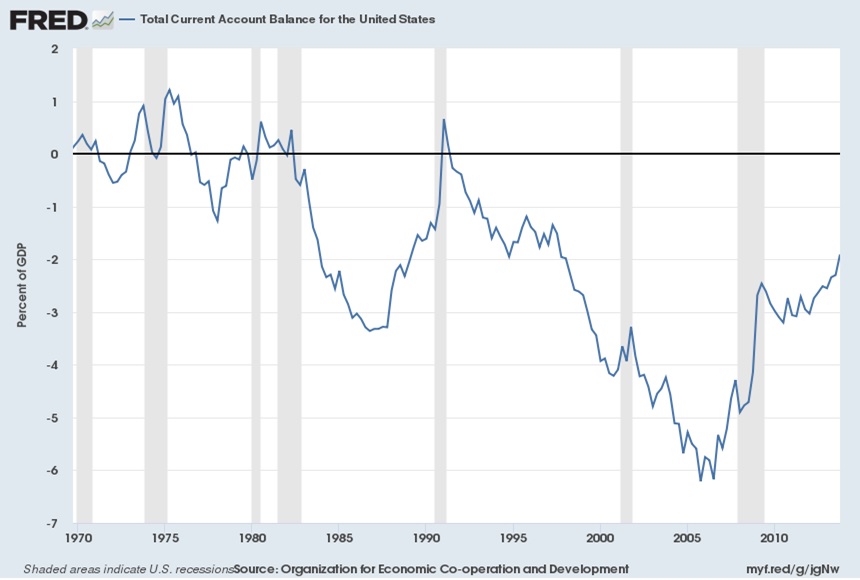
It seems to be widely believed that a trade deficit shows the level of unfairness of import competition, and moreover that a trade deficit shows economic weakness, while a trade surplus shows economic strength. (For a vivid example, see the “Remarks by President Trump at Signing of a Presidential Memorandum Targeting China�s Economic Aggression” last week.) But even a casual look at actual US trade balances in recent decades shows the implausibility of such beliefs. Here’s a figure of US trade imbalances (as measured by the current account balance) since 1970, measured as a share of GDP.

In the 1970s, trade deficits were close to zero. But this did not mean when most people believed that international competition was fair: instead, it’s a time when foreign competitors from Japan and elsewhere were savaging US industries like cars and steel. It’s also not a time when the US looks especially strong, with a period of “stagflation” combining high unemployment and inflation, as well as a slowdown in productivity growth.

In the 1980s, trade deficits first boomed, and then diminished. But the mid-1980s was not a time of US economic weakness: instead, these were years of hearty economic growth after the recession of the early 1980s. The recession of 1990-91 is actually when the trade deficit declined. Moreover, no one seriously claims that US trading partners suddenly became much less fair for a few years in the mid-1980s, before then suddenly becoming much more fair by the early 1990s–which means that unfairness of trade isn’t what causes the US trade deficit to change.

Through the 1990s, this is a period when the US trade deficit becomes large, but at the same time, the US economy grows rapidly. Also, this is not a time a higher trade deficit can be linked to barriers to trade increased:  instead, this is the decade when barriers to trade are reduced by the North American Free and by the completion of the “Uruguay round” of international trade talks leading to the creation of the World Trade Organization in 1995.

Since 2000, the trade deficit first falls when the economy is growing in the early 2000s, and then the steep recession of 2007-2009 is accompanied by a sharp decline in the trade deficit. If the trade deficit is a measure of unfair trade (which it isn’t!), the US should presumably be congratulating the rest of the world for how it dramatically improved its trade fairness since about 2006.

It is blindingly apparent from the most casual acquaintance with the actual trade balance statistics that trade deficits are often not associated with periods of weak economic performance, that declines in trade deficits are not associated with strong economic performance, and that fluctuations in foreign trade barriers are a deeply implausible explanation for changes in the trade balance.

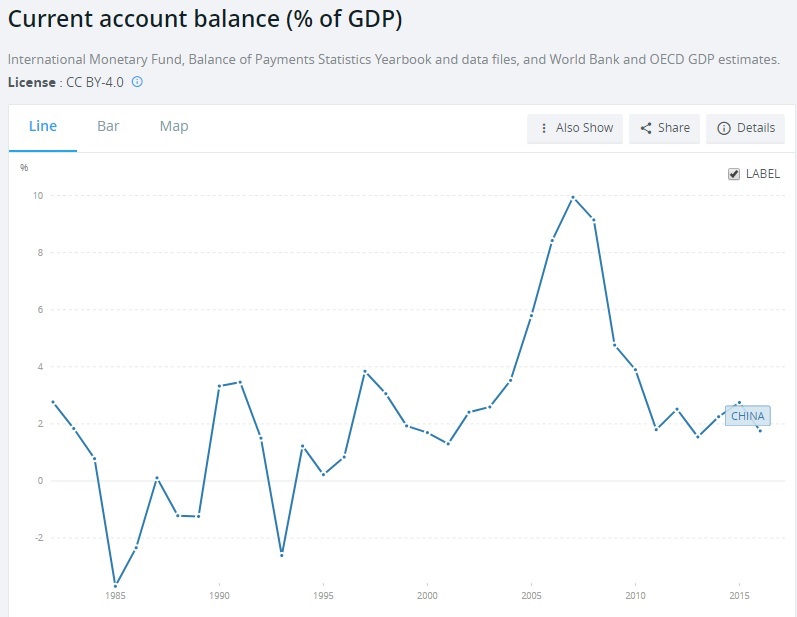
One can walk through the same exercise with trade balances of other countries, as well. For example, here is China’s trade balance since its reforms started in the late 1970s, from the World Bank website.

China’s trade surplus as a share of GDP was low, mostly near-zero and sometimes in deficit, from the early 1980s up to around 2000. Of course, China’s economy was booming during these decades, which suggests that its small trade surpluses during this time were not a primary driver of its growth. Also, if a trade balance measures openness to trade (and it doesn’t), then one would need to conclude that China was more open to US imports in the 1980s and 1990s than later, after it joined the World Trade Organization and reduced trade barriers in 2001. Further, one would need to believe that China had a dramatic spike in trade unfairness around 2007, followed by a dramatic return to trade fairness just after that. Of course, none of these interpretations about China’s trade balance and its level of openness to foreign trade can pass the laugh test.

If trade balances are not about economic strength or about trade barriers of other countries, what are they about? Let’s go back to basics. A trade deficit means that a nation is importing more than it is exporting. To put it another way, other countries are earning US dollars by selling into the US market, and a share of these US dollars are not getting spent on US-produced goods and services. (After all, if all the US dollars earned by those abroad selling into US markets were spent on US-exported goods and services, no trade imbalance would exist.) Instead, the value of the US trade deficit represents a flow of financial capital that is invested into the US as investment capital. Thus, a trade deficit necessarily and always means an inflow of international capital, while a trade surplus necessarily and always means an outflow of international capital.

In an economy without any international trade, the domestic savings of the economy has to equal domestic investment–because domestic savings is what provides the finance for domestic investment. But if an economy is open to trade, then a trade deficit means that there is an inflow of capital from abroad: specifically, an inflow of capital equal to the trade deficit itself.

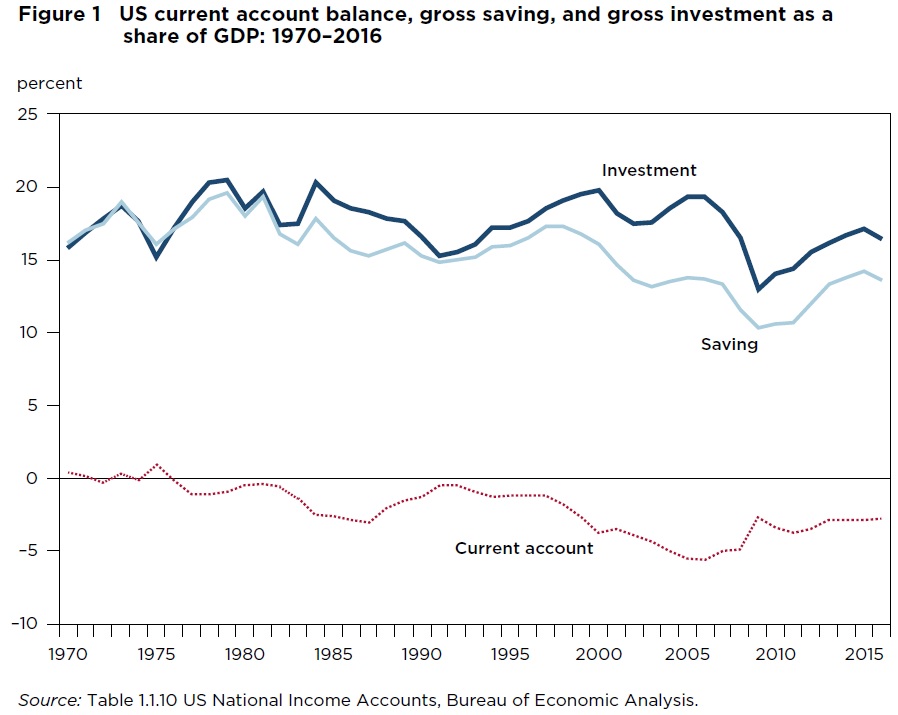
Thus, the US economy is a low-saving, high consumption economy. Indeed, the US economy consumes more than it produces, which it can do by importing more than it exports and running trade deficits. The US economy also has a situation where domestic investment can be larger than domestic savings, because the US trade deficit means that there is a net inflow of foreign capital. Here’s a figure from Lawrence’s paper to illustrate the point. Notice that the inflow of foreign capital, shown by the trade deficit, is what allows domestic investment to exceed domestic saving.

Economist might disagree in their  interpretation of the circumstances in which patterns of trade deficits/capital inflows or trade surpluses/capital outflows are beneficial or harmful. But the  connection between a trade deficit and an inflow of foreign capital (or between a trade surplus and an outflow of financial capital) is not a “theory” over which economists disagree. It’s just a basic understanding of what these terms mean.

Now let’s turn to Lawrence’s list of misconceptions:

MISCONCEPTION 1: TRADE DEFICITS ARE BAD

Trade deficits necessarily mean capital inflows. If the capital inflows from abroad are wisely invested, a trade deficit can be beneficial. For example, South Korea had large trade deficits and inflows of international capital when it was building up its industrial base, and so did the United States in the 19th century. In the 1990s, when the US had large trade deficits and inflows of international capital but was also making very large investments in information technology, there was at least an argument to be made that this pattern wasn’t overly harmful to the US economy at that time. The problem arises when sustained trade deficits are accompanied by capital inflows that are not invested in a way that encourages long-run investment and growth.

I sometimes try to make this point with a parable about the meaning of trade imbalances between Robinson Crusoe and Friday, as I laid out in “Trade Imbalances: A Parable for Teachers” (July 18, 2012).

MISCONCEPTION 2: TRADE BALANCES REFLECT TRADE POLICIES

As noted above, it is silly to try to explain movements in trade balances with abrupt changes in trade policy. Instead, the movements in trade balances are easily explained by macroeconomic factors like consumption and saving.

MISCONCEPTION 3: TRADE DEFICITS ALWAYS LEAD TO JOB LOSS AND SLOWER GROWTH

This is clearly untrue, based on US experience with larger trade deficits and vigorous economic growth in the 1980s, 1990s, and early 2000s.

MISCONCEPTION 4: TRADE PERFORMANCE IS THE MOST IMPORTANT REASON FOR THE LONG-RUN DECLINE IN US EMPLOYMENT IN MANUFACTURING

Lawrence writes: “It is noteworthy that the share of US employment in manufacturing began declining in the 1960s, long before the economy was heavily exposed to trade, and that the declines in the share of manufacturing employment in industrial countries with large surpluses in manufacturing trade, such as Germany, Italy, and Japan, has been similar to the declines in the share of manufacturing employment in the United States and other countries with trade deficits. This evidence suggests that most of the declining share of employment in US manufacturing reflects factors other than the trade deficit. The share of manufacturing employment in all major industrial countries, including those with large trade surpluses, has declined since the early 1970s. The primary
reason for these declining shares has been rapid productivity growth coupled with demand that is  relatively unresponsive to lower goods prices and higher incomes … “

In other words, manufacturing workers keep getting more efficient, so it takes fewer of them to make the same level of output. However, as incomes rise, the quantity demanded of manufacturing goods isn’t rising as much–and so fewer manufacturing workers are needed, in the US and everywhere.

MISCONCEPTION 5: BILATERAL TRADE BETWEEN COUNTRIES SHOULD BE BALANCED

It’s just silly to argue that trade should be balanced on a bilateral basis, between any two countries. Even in a world with only three countries, it’s easy to imagine a situation in which each country has a surplus with one of the other countries and a deficit with the other. No two of these countries would have balanced trade with each other, but all three would have balanced trade overall.

But the bigger point is that there’s no reason that countries should be seeking an overall balance of trade, either. Some growing economies will want to welcome inflows of international capital, which means that they will have trade deficits. Some more mature economies, like Germany and Japan, will generate more in domestic saving than they can find a way to productively invest, and so they will run trade surpluses and have net outflows of financial capital. 

There are subtle and debateable issues about trade policy. But thinking that the size of trade deficits measure the level of unfairness in trade is just wrong-headed. If you think that trade surpluses mean economic strength, tell it to Japan, which has been experiencing  a combination of trade surpluses and miserably sluggish economic growth since the early 1990s. Even if the US had no trade deficit, many of its companies and industries would still need to face tough international (and domestic) competition.
As economists of all political beliefs will point out, the only way to ensure a lower trade deficit is to  have an economy with either higher domestic saving or less domestic investment–and because less investment isn’t typically a great idea for long-run growth, higher domestic saving is the preferred policy tool. If you understand that point, you can at least start to grapple with what a trade deficit actually means. 

Melting Pot, Salad Bowl, Chocolate Fondue

Here’s my attempt to resolve all the issues of shared American identity in under 1,000 words. It was published back in 2013 as an opinion piece in the (Minnesota) Star Tribune newspaper.

“Analogies for America: Beyond the Melting Pot”
Timothy Taylor

Melting pot or salad bowl? For decades now, these two contestants have been slugging it out in the contest for most appropriate metaphor for how the cultures and ethnicities of America fit together. But my preference is to think of America as chocolate fondue.

The popularization of �the melting pot� metaphor is usually traced to a soppy, sentimental and very popular play of that name by an immigrant named Israel Zangwill that opened in Washington in 1908. The melting pot metaphor is a way of expressing �E pluribus unum� � �Out of many, one� � the already old saying adopted in 1782 for the Great Seal of the United States (and which you can see on the back of the $1 bill). �E pluribus unum� has also been imprinted on U.S. coins since the 18th century.

The traditional criticism about the melting pot was that what is special about American culture isn�t its homogeneity, but rather its ability to absorb the elements of many cultures, then pass them around to everyone. For example, as John F. Kennedy wrote in his 1958 book, �A Nation of Immigrants�: �One writer has suggested that a �typical American menu� might include some of the following dishes: �Irish stew, chop suey, goulash, chile con carne, ravioli, knockwurst mit sauerkraut, Yorkshire pudding, Welsh rarebit, borscht, gefilte fish, Spanish omelette, caviar, mayonnaise, antipasto, baumkuchen, English muffins, gruy�re cheese, Danish pastry, Canadian bacon, hot tamales, wienerschnitzel, petit fours, spumoni, bouillabaisse, mate, scones, Turkish coffee, minestrone, filet mignon.�?�

In our multicultural and individualist age, the common complaint is that the metaphor says that Americans should surrender our cultural and ethnic identities. This critique strikes me as overwrought. Yes, the culture of the country where you live is constraining. But what�s distinctive about modern America is the looseness of these constraints, and the array of available choices.

However, it does bother me that the melting pot metaphor is a relic of a bygone time, when melting different metals together was a common for many industrial workers. It also bothers me that melting different metals together produces a desired outcome only if you adhere to a formula. Bronze is copper and tin. Brass is copper and zinc. If you just dump different metals into a melting pot, what comes out is likely to be flawed and brittle, not strong or useful. When supporters of the melting pot metaphor start talking, it often turns out that they have a clear mental formula for what it means to be American � and it isn�t always my formula.

The notion of America as a salad bowl seems to have been popularized by the eminent historian Carl Degler. His book �Out of Our Past: The Forces that Shaped Modern America� was a commonly used textbook from the 1950s up through the 1980s. In the 1959 edition, he wrote: �[S]ome habits from the old country were not discarded; in those instances the children of immigrants even into the third and fourth generations retained their differences. In view of such failure to melt and fuse, the metaphor of the melting pot is unfortunate and misleading. A more accurate analogy would be a salad bowl, for, although the salad is an entity, the lettuce can still be distinguished from the chicory, the tomatoes from the cabbage.�

While the salad bowl metaphor has a healthy, crunchy �eat your vegetables� ring to it, it seems awkward to me as well. After all, who is the pale and crunchy iceberg lettuce? Who is arugula? Who are the artificial bacon bits? Who are anchovies? Salad ingredients are not all created equal.

Salad is always falling apart, and you can almost never get all of the ingredients, in just the right proportions, into your mouth at the same time. Imagine the oversized modern salad bar, with multiple kinds of lettuces and vegetables, but also seeds and nuts, tuna salad, slices of chicken or ham, bean salad, hard-boiled eggs, crackers and popcorn, along with choice of soup and dessert. It misses what is cohesive and distinctive about America to see the country as a long buffet of ingredients, which we all choose to exclude or include according to our transient appetites of day.

My own suggestion is that America is chocolate fondue. Our different cultural and ethnic backgrounds are the strawberries, pineapple, and cherries, the graham crackers and cookies, the pound cake and brownies, the rice crispy treats and marshmallows, the popcorn and the peppermint sticks. Then we are dipped in America. We swim in America. We are coated in America. Because Americans can and do come from all ethnicities and races, we all look like Americans.

Of course, chocolate doesn�t always deliver on its promise. It can become grainy, rancid, burnt and bitter. Some people have no taste for chocolate, or are even allergic to it. America has often not lived up to its promises and ideals. But when I think consider all the human beings who have ever lived, in all the different places and times around the world, I feel profoundly fortunate to be living in modern America.

There�s an old story about when heavyweight boxing champion Joe Louis decided to enlist in the U.S. Army in 1942. A friend of his objected, and said: �It�s a white man�s Army, Joe, not a black man�s Army.� But Joe Louis had observed the Nazi propaganda machine close up, as the result of his two epic fights against the German Max Schmeling (who was not a Nazi, but whom the Nazis attempted to exploit). So Louis told his friend: �Lots of things wrong with America, but Hitler ain�t going to fix them.�

In that spirit, I�d say lots of things are wrong with America, but often, the best answers for what�s wrong with America are a bigger dose of what�s right with America. On the Fourth of July, I choose to sit with family and friends, and to savor the textures and sweetness of our shared American experience.

————

Timothy Taylor is managing editor of the Journal of Economic Perspectives, based at �Macalester College in St. Paul. He blogs at http://conversableeconomist.blogspot.com.

Destapado el fraude millonario de una cadena de peluquerías “low cost”

Tintes a 5 euros, cortes al mismo precio, tratamientos de keratina a 10 o bótox capilar a 25, pero mano de obra barata y bajo la lupa de la Policía Nacional y la Inspección de Trabajo.

Tal y como la propia cadena informa en su web se trata de una empresa que ofrece formación continua a sus trabajadores. Unos contratos formativos que son precisamente por los que ahora están siendo investigados.

Según informó este miércoles la Policía Nacional, hasta 37 personas han sido detenidas en la provincia de Sevilla por su presunta implicación en un fraude superior a los 3.000.000 euros a la Tesorería General de la Seguridad Social. La Policía señala que los empresarios de este negocio de peluquerías de bajo coste han obteniendo presuntamente de forma fraudulenta bonificaciones y beneficios de la Seguridad Social con esos falsos contratos.

Victories Against Air Pollution

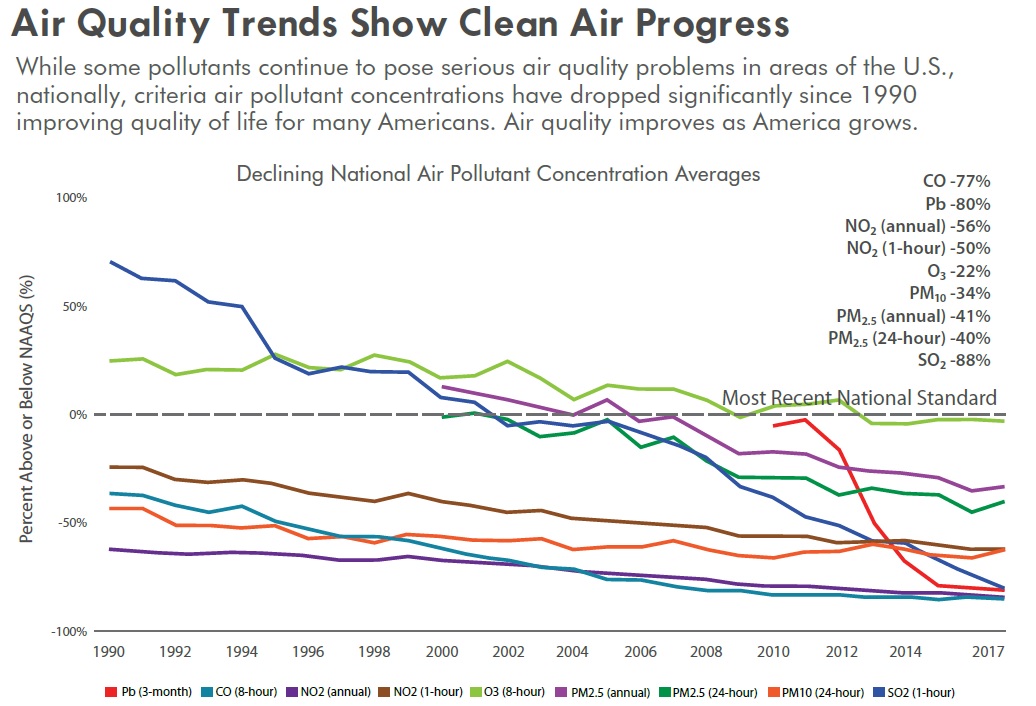
There is a certain kind of environmentalist who seems unable to acknowledge any good news about the environment, because it might create complacency about remaining issues. I’m not a fan of this approach. When successes are denied, credibility diminishes. And if there’s never been an environmental success to celebrate, I’m more likely to be discouraged about the future than energized. In that spirit, here are some figures from an Environment Protection Agency annual report, Our Nation’s Air.

This figure shows the decline in what are often called the “criteria” air pollutants. The horizontal line shows the U.S. National Ambient Air Quality Standards. At a national level, all of the pollutants are below the dashed line. The percentages in the upper right corner of the figure show the decline in the concentration of each category of air pollution since 1990s.

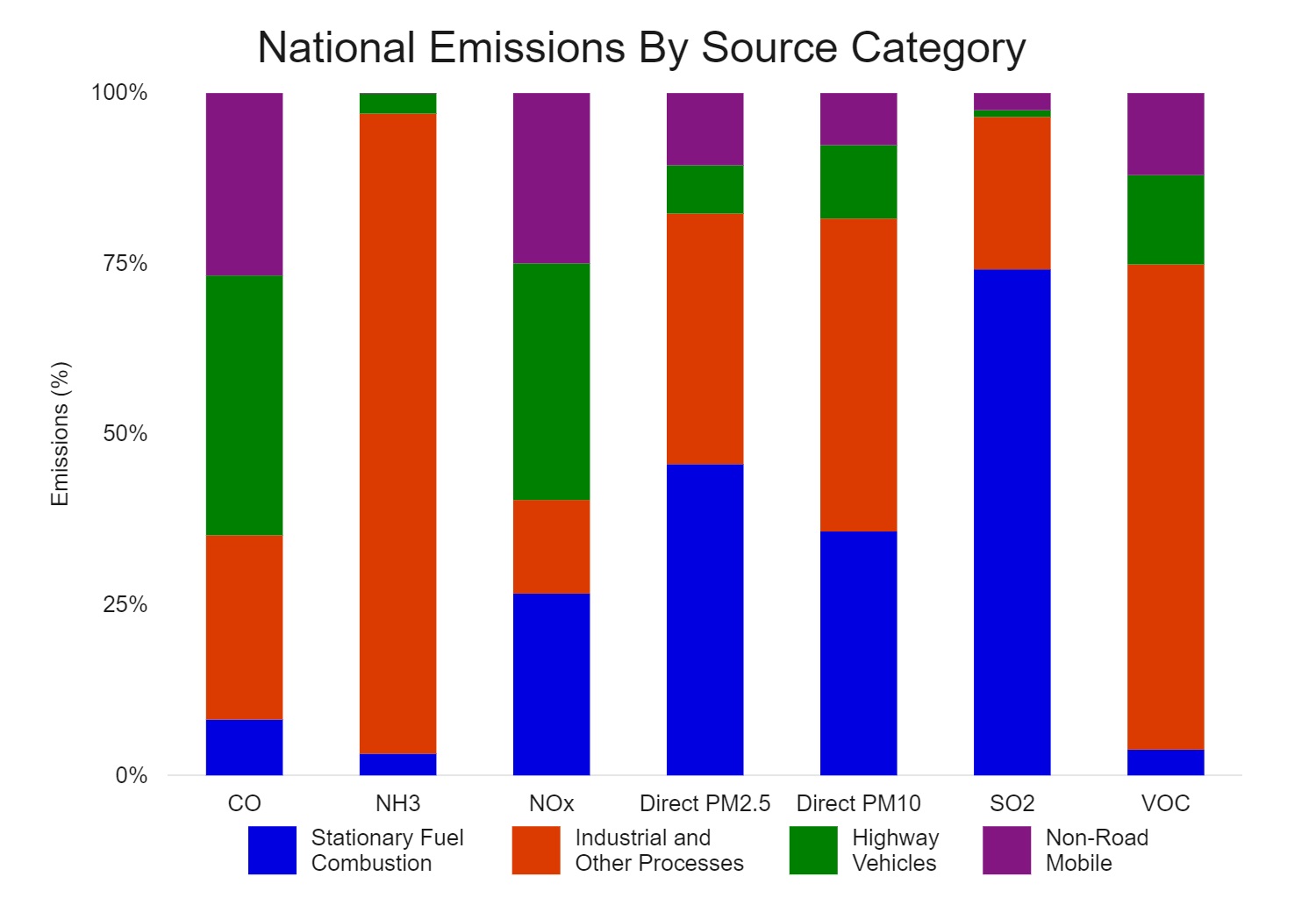
In thinking about how to reduce pollution further, it’s worth noting that different pollutants tend to come from different sources. For example, highway vehicles (green bar) are bigger producers of carbon monoxide and nitrogen oxides, while stationary fuel combustion (think power plants, blue bar) produce a large share of the particulates and sulfur dioxide, and industrial processes contribute most to emissions of volatile organic compounds (VOC) and ammonia (NH3).

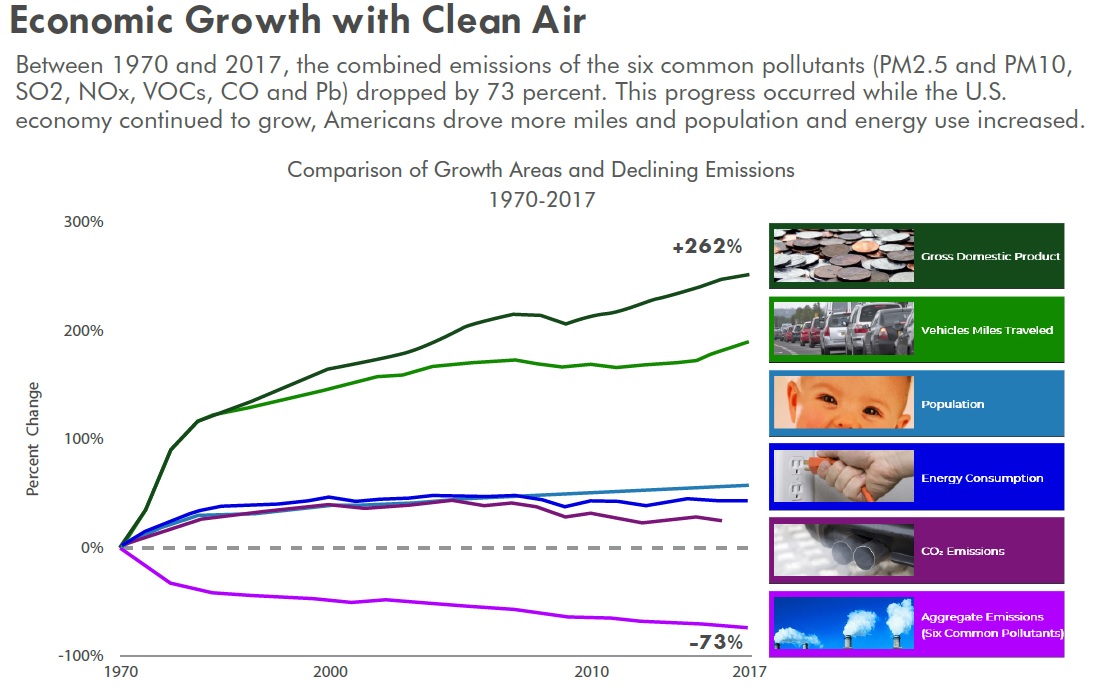
It’s worth noting that the overall decline in air pollution in the last half-century or so is happening at a time of rising US population, rising GDP, vehicle-miles traveled, and overall energy consumption.

And yes, of course, these criterion air pollutants, by tradition, don’t include carbon dioxide and other greenhouse gases. I offered some thoughts on these issues last week in “Economics of Climate Change: Three Recent Takes” (August 14, 2018). Here, I would just note that actions to reduce conventional air pollutants, both in the US and around the world, can be viewed as part of a “co-benefits” approach, which would lead also to lower carbon emissions. 

Everything I Know About Walls

I wrote this article, which appeared yesterday in the (Minnesota) Star Tribune paper.

“Everything I know about walls: Let the poet Robert Frost be your guide:
Timothy Taylor
August 17, 2018

Walls are rising all over the world: on the U.S. border with Mexico; on India�s borders with Bangladesh and Myanmar; between China and North Korea; on Hungary�s borders with Serbia and Croatia; between Botswana and Zimbabwe; between Pakistan and Afghanistan. And more. 

But at the risk of sounding like a fortune cookie or a folk song, the more important walls are in our minds. American attitudes toward immigrants, for example, are not primarily about a physical wall at the border. 
Everything important that I know about walls I learned from Robert Frost and his 1914 poem, �Mending Wall.� Here is my list of Frost�s Eight Laws of Walls:
(1) If walls are not periodically reinforced, they tend to crumble. As Frost wrote: �Something there is that doesn�t love a wall/That wants it down.�

(2) We often cooperate in building walls, even when we aren�t sure it�s a good idea. �I let my neighbour know beyond the hill;/And on a day we meet to walk the line/And set the wall between us once again.�

(3) Walls don�t just block outsiders; they also enclose insiders and can heighten grievances. �Before I built a wall I�d ask to know/What I was walling in or walling out,/And to whom I was like to give offence.� (Frost seems to make the quaint and outdated assumption that giving offense is a negative thing.)

(4) Building walls can be, among its other functions, a pleasant game. �We have to use a spell to make them balance:/�Stay where you are until our backs are turned!�/We wear our fingers rough with handling them./Oh, just another kind of out-door game ��

(5) When considering wall-building, one should distinguish between wandering cows and stay-at-home apples and pine cones.

(6) Good fences are not the basis for good neighbors, although that idea seems deeply comforting to many people. �He moves in darkness as it seems to me,/Not of woods only and the shade of trees./He will not go behind his father�s saying,/And he likes having thought of it so well/He says again, �Good fences make good neighbours.�

(7) Even when people seem incapable of looking beyond their walls, they need to figure out the alternative on their own. �I could say �Elves� to him,/But it�s not elves exactly, and I�d rather/He said it for himself.

(8) Even when others are eager to build walls, you can still meet with them � now and again � and chat.

Along with the physical walls, both around countries and around local gated communities, intangible walls come in social and economic versions.

Social walls are built along many boundary lines: political party, race or ethnicity, neighborhood, nationality, religious affiliation (or lack of it), immigrant status, gender, sexual preference, education level, job status and others. The problems arise when we hunker down behind the barricades of our own group, secure in the presumption that there�s nothing to be learned from listening to those we have consigned to the other side.

Economic walls include those along national borders affecting international trade, but also the many ways in which the well-to-do and the nearly-very-rich limit access to the neighborhoods in which they live, the schools their children attend, the credentials and social networks that lead to many jobs, the health care providers they use and more.

In the June issue of the Atlantic, Matthew Stewart offered a provocative essay about economic walls built by �the 9.9 percent� � that is, not the top 0.1 percent, but the rest of the top 10 percent.

He writes: �[A]round the world and throughout history, the wealthy have � taken their money out of productive activities and put it into walls. Throughout history, moreover, one social group above all others has assumed responsibility for maintaining and defending these walls. Its members used to be called aristocrats. Now we�re the 9.9 percent.�

�But wait a minute,� I hear you say. �Of course, other people build walls because of close-mindedness, lack of empathy, bigotry and selfishness.

�But the walls are completely different that I erect between myself and those belonging to other political, religious, racial, ethnic, neighborhood, national, gender, sexual preference, and economic groups. My walls are a necessary act of self-defense.�

Such an argument isn�t always wrong, but it often seems lacking in self-reflection. It reminds me of one of the philosophical paradoxes of self-defense arguments.

Long ago, when an invading army was attacking a walled city, it would gather up noncombatants from the countryside and force them to march ahead of the army. When the leaders of the walled city saw the huge mob arriving, they would fire in self-defense, hitting the noncombatants in front. The (previous) noncombatants in front would then fire back, in their own self-defense.

Presto! You have a battle between two groups who both have a legitimate claim to be fighting in self-defense.

Before you push back twice as hard, it�s worth considering the possibility that those who bumped you were being pushed as well, by some combination of social and economic forces, together with charismatic leaders. And those who ultimately benefit from the battle are standing back behind the scenes.

I�m not a fortune cookie or a folk song, so I won�t blow the trumpets for all the walls to come a-tumbling down. We all need our boundaries, and sometimes the boundaries need defending.

But building walls has costs, and should be done only after due consideration. It�s not always the better angels of our nature that encourage us to build walls.

Wall-building often begins with bricks of authenticity, honesty and virtue, but at some point the construction materials shift to an exuberant and exhibitionistic boorishness. Are your walls giving you cover for searching out the motes in the eyes of others, while ignoring the beams in your own eye?

Are you building a wall or an echo chamber? Are you building a wall or a fortress? Are you building a wall as part of a base camp for future aggression?

Walls that are built with enthusiastic participation from both sides will be the strongest. When you build a wall, you might want to contemplate those who are most actively helping to construct that wall from the other side � and the extent to which you really wish to cooperate with them.

If you have an uncomfortable feeling that your walls are causing you to move in darkness, perhaps you could try letting them slide into disrepair � just a little, just for awhile � and allowing elves to sneak through the cracks.

Timothy Taylor is managing editor of the Journal of Economic Perspectives, based at Macalester College. He blogs at http://conversableeconomist.blogspot.com.
_____________________

�Mending Wall�

By Robert Frost (1914)

Something there is that doesn�t love a wall,
That sends the frozen-ground-swell under it,
And spills the upper boulders in the sun;
And makes gaps even two can pass abreast.
The work of hunters is another thing:
I have come after them and made repair
Where they have left not one stone on a stone,
But they would have the rabbit out of hiding,
To please the yelping dogs. The gaps I mean,
No one has seen them made or heard them made,
But at spring mending-time we find them there.
I let my neighbour know beyond the hill;
And on a day we meet to walk the line
And set the wall between us once again.
We keep the wall between us as we go.
To each the boulders that have fallen to each.
And some are loaves and some so nearly balls
We have to use a spell to make them balance:
�Stay where you are until our backs are turned!�
We wear our fingers rough with handling them.
Oh, just another kind of out-door game,
One on a side. It comes to little more:
There where it is we do not need the wall:
He is all pine and I am apple orchard.
My apple trees will never get across
And eat the cones under his pines, I tell him.
He only says, �Good fences make good neighbours.�
Spring is the mischief in me, and I wonder
If I could put a notion in his head:
�Why do they make good neighbours? Isn�t it
Where there are cows? But here there are no cows.
Before I built a wall I�d ask to know
What I was walling in or walling out,
And to whom I was like to give offence.
Something there is that doesn�t love a wall,
That wants it down.� I could say �Elves� to him,
But it�s not elves exactly, and I�d rather
He said it for himself. I see him there
Bringing a stone grasped firmly by the top
In each hand, like an old-stone savage armed.
He moves in darkness as it seems to me,
Not of woods only and the shade of trees.
He will not go behind his father�s saying,
And he likes having thought of it so well
He says again, �Good fences make good neighbours.�

From the Poetry Foundation website 

(www.poetryfoundation.org/poems/44266/mending-wall).

Moral Licensing: When Doing Good Frees You to Do Bad

“Moral licensing” is a term from the behavioral psychology literature. Daniel Effron of the London Business School, who has done some of the research in this area, descrbes it this way: “[T]he ability to point to evidence of past virtue can ironically make people more willing to act less-than-virtuously.” Or as the title of one article puts it “being good frees us to be bad.”

Examples? There’s a discussion of these issues at the “Freakonomics” podcast from Stephen J. Dubner on May 18, 2018. Along with Effron, Dubner also talks with John List, who describes one of his own recent studies.

In that study, workers were hired to transcribe 10 images of about 30 German words each. The  workers don’t speak German, but they can use Google translate or a similar program. The workers are paid the same no matter the quality of the translation. In addition–and this is the key point–workers can just say if an image is illegible, and they are paid the same anyway. In the experiment, one group of workers were just paid money, while the other group was also paid the same amount of money, but also told that the firm was making a contribution to UNICEF based on their work.

So which group would you expect to be more likely to report that the images were illegible? The group that was just getting paid, or the group that was also getting paid while doing good? List’s study found that those who were doing good were 24% more likely to report that images were illegible. Not to put too fine a point on it, those who were doing good were also more likely to shirk or cheat.

There are a number of studies with a broadly similar theme.  Here’s a samplling

One study done back in 2008 asked whether a white person or a black person would be more qualified for a certain job. They were also asked about whether they favored Barack Obama for president–but some were asked before the question about job suitability and some were asked after. “[T]he opportunity to endorse Barack Obama made individuals subsequently more likely to favor Whites over Blacks.” Effron, D.A., Cameron, J.S., Monin, B., Endorsing Obama Licenses Favoring Whites, Journal of Experimental Social Psychology (2009)

Those who “received weekly feedback on their water consumption lowered their water use (6.0% on average), but at the same time increased their electricity consumption by 5.6% compared with control subjects.”  This finding is noted in Verena Tiefenbeck, Thorsten Staake, Kurt Roth, Olga Sachs, “”For better or for worse? Empirical evidence of moral licensing in a behavioral energy conservation campaign.” Energy Policy, (2013, 57, pp. 160-171)/.

When those on a weight-loss are prompted to think about unhealthy eating choices they did NOT make in the past, and thus can feel more virtuous about their past eating patterns, they become less likely to hold to their diet. ” The result comes from “The unhealthy road not taken: Licensing indulgence by exaggerating counterfactual sins,” Daniel A. Effron, Beno�t Monin, Dale T. Miller, Journal of Experimental Social Psychology (May 2013, 49:3, pp. 573-578).

Sometimes just anticipating the prospect of doing good in the future can free you you up to do bad in the present. Jessica Cascio and E. Ashby Plant study “Prospective moral licensing: Does anticipating doing good later allow you to be bad now?” Journal of Experimental Social Psychology (2015, 56, pp. 110-116): 

“Across four studies we explored whether anticipating engaging in a moral behavior in the future (e.g., taking part in a fundraiser or donating blood) leads people to make a racially biased decision (Studies 1 and 2) or espouse racially biased attitudes (Studies 3 and 4) in the present. Participants who anticipated performing a moral action in the future displayed more racial bias than control participants. … These results demonstrate that anticipating a future moral act licenses people to behave immorally now and indicate that perceptions of morality encompass a wide variety of concepts, including past as well as anticipated future behavior.”

Here’s a comment from Effron in to motivate a 2014 study (“Making mountains of morality from molehills of virtue: Threat causes people to overestimate their moral credentials.” Personality and Social Psychology Bulletin, 40(8), 972-985, citations omitted from quotation):

“On trial for ordering the 1995 Srebrenica Genocide, in which thousands of Muslims were murdered, former Bosnian leader Radovan Karadzic claimed that his actions could not be classified as genocide because he holds no anti-Muslim prejudice. As proof, he pointed to the fact that his former barber  was Muslim. Many observers were unconvinced; it seems that Karadzic overestimated how much his choice of barber gave him �moral credentials”. The present research examines how the motivation to defend against threats to one�s moral character can bias estimates of how others will judge one�s past actions. It is often ambiguous how diagnostic of moral character a particular action is. Does giving a dollar to a homeless person prove that one is generous? Does having a Black acquaintance prove that one is not racist? I propose that people are more likely to think that the answer to such questions is `yes’ when they experience a threat to their moral identity�and as a result, they are more likely to overestimate how much they have convinced impartial observers of their morality.” 

For overviews of research along these lines from a few years back, see “When Virtue Leads to Villainy: Advances in Research on Moral Self-Licensing,” by Daniel A. Effron and Paul Conway, ” Current Opinion in Psychology (2015, 6, pp. 32�35) or “A Meta-Analytic Review of Moral Licensing,” by Irene Blanken, Niels van de Ven, and Marcel Zeelenberg,  Personality and Social Psychology Bulletin ( 2015, 41:4, pp.  540�558).
The bottom line here is old and familiar. In a mild form, moral licensing is an issue for all of us. Anyone who exercises hard and then feels that they “deserve” a high-calorie treat knows the feeling.  At an extreme form, it is manifest when some of those who claim to be leaders in family values or social justice or religious/spiritual leadership are found to be acting in ways that counter to the values they claim to profess. Such cases may just be hypocrisy, but I suspect there is often an element of moral licensing as well: that is, being identified with doing good can free someone up to do bad, as well.   

Reskilling over a Lifetime

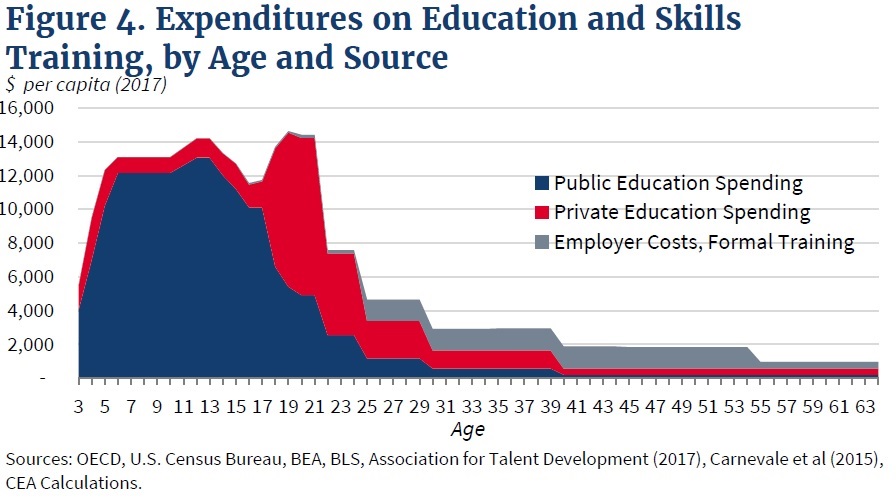
The usual pattern of spending on skill development during a lifetime of an American looks like this:

The figure is from a report by the White House Council of Economic Advisers, titled “Addressing America�s Reskilling Challenge” (July 2018). The blue area shows public education spending, which is high during K-12 years, but the average spending per person drops off during college years. After all, many people don’t attend college, and of those who do many don’t attend a public college. Private education spending shown by the red area takes off during college years, and then trails off through the 20s and 30s of an average person. By about age 40, public and private spending on education and skills training is very low. Spending on formal training by employers, shown by the gray area, does continue through most of the work-life.

The figure focuses on explicit spending, not on informal learning on the job As the report notes: “Some estimates suggest that the value of these informal training opportunities is more than twice that of formal training.” Nonetheless, it is striking that the spending on skills and human capital is so front-loaded in life. The report cites estimates that over a working lifetime from ages 25-64, the average employer spending per person on formal training totals about $40,000.

The report mentions an array of programs to address mid-life reskilling and lifelong-efforts by nonprofits, by certain states, by some unions, and government programs like Trade Adjustment Assistance. It also mentions gives examples from programs in Sweden, Germany, Canada, South Korea. For example, here’s a taste of what happens in Germany:

“Germany has a model for promoting reemployment that privatizes public job placement services. In 2002, the German government introduced a �voucher� system. The system provides compensation to private job placement services that successfully find employment for displaced workers. All workers unemployed for three months or longer are eligible for the program, and the payment rate for successful placement increases with the duration of unemployment.

“In the German program, individuals sign placement contracts with private agencies. If the agency finds the worker a job and an employment contract is signed, the agency can redeem the public voucher. Voucher payments are conditional on worker tenure in the new employment arrangement, and if the employment relationship lasts fewer than three months, the voucher payment must be refunded. Vouchers are more likely to be utilized by younger workers with higher skill levels and, overall, private job placement services were tapped by only 2 percent of job seekers once the program was fully implemented. …

“In addition to the job placement voucher, Germany also utilizes a job training voucher system (Tergeist and Grubb 2006; Besharov and Call 2016). The purpose of this voucher is to provide individuals with the opportunity to choose which training program to participate in. However, eligible training programs must have a proven track record, usually a 70 percent success rate in placing individuals out of unemployment within six months after the end of the program. Strittmatter (2016) found that these training programs tend to have negative employment outcomes in the immediate term as individuals focus on their training and reduce time spent searching for a job. This negative effect can last for up to two years, likely due to the long duration of these vocational programs. But after four years, the voucher system exhibits clear gains: unemployed individuals who utilize the vocational training voucher experience a two percentage point increase in their employment probability when compared to individuals who did not participate such a training program.”

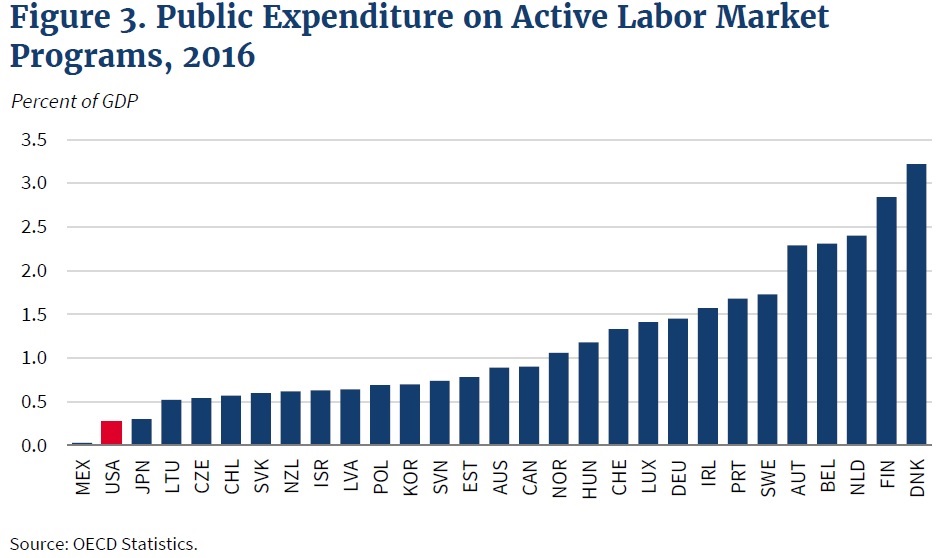
The CEA notes a point I’ve tried to make on this blog a few times over the years. Labor market policies can be “passive,” like paying benefits to the unemployed, or “active,” like assisting with job search and retraining. The US has traditionally spent far less on active labor market policies than other high-income countries (for more discussion, see here and here):

In a US economy where jobs and the skills needed to fill them are continually evolving, and where some of the necessary shifts can be wrenching and large, there is a case for thinking more systematically about job training throughout life. Individuals who need retraining face some practical problems: an information problem of what kind of training employers really want; an availability problem of how and where to get that training, and a financial problem of how to pay for it. Many employers do not necessarily view themselves as primarily in the training business. They want employees who are plug-and-play, ready to contribute on the first day. And employers worry that in an economy where employees shift between jobs, any efforts they make to train workers will only end up benefiting workers at their next employer. But programs for lifelong learning need input and support from employers, because ultimately employers are the ones who know what skills they want.

Moreover, the issue here is not just about helping those who are unemployed or between jobs. It’s also about those who would prefer to add skills now, in the hope of gaining job security or getting a promotion from a current employer. Lifelong learning doesn’t just happen during spells of unemployment.

I do not have a well-defined proposal to offer here. In political terms, it’s interesting to see the White House economists raising these issues. But the Trump administration does not seem to be one where the economists have an especially loud voice in making policy.

Economics of Climate Change: Three Recent Takes

Most economists took their last course in physical science many years ago, back in college days, and lack any particular in-depth knowledge of how to model weather or climate.  But economists can contribute usefully to the climate change debate in other ways. At least some economists do have expertise in patterns of energy use, potential for substitution, and technology, and thus have something to say about likely future paths for the emissions of carbon (and other greenhouse gases), and what it might take to change these paths. And at least some economists have expertise in thinking about how changes to climate would affect economic and human outcomes, ranging from crop yields to human mortality. Here are a few recent examples.

Richard Schmalensee takes a usefully unsentimental look at the prospects for a genuinely dramatic reduction in carbon emissions in “Handicapping the High-Stakes Race to Net-Zero,” appearing in the Milken Institute Review (Third Quarter 2018). He emphasizes three main challenges:

1) Carbon emissions from emerging economies are rising rapidly, often based on building new plants that generate electricity from coal. Even if emissions in advanced economies were slashed dramatically, there won’t be much progress on reducing global carbon emissions without tackling the issue in emerging economies. Schmalensee offers a scenario to illustrate this challenge:

“[S]uppose that, in the next decade or two, advanced economy emissions are cut in half, there is no population growth in emerging economies and emerging-economy emissions per dollar of GDP are cut by 31 percent (to the advanced economy average). Suppose, too, that GDP per capita in emerging economies rises to only 45 percent of the advanced economy average (roughly double what it is today). In this optimistic case, global emissions would still rise by about 1 percent.”

Schmalensee also believes that the most popular form of solar energy–that is, photovoltaic technology based on crystalline silicon–is unlikely ever to become cost-competitive with fossil fuels. So the dual challenge here is to find alternatives for low-carbon or carbon-free production of electricity, and then find ways for emerging market and low-income economies to afford the switch to these new technologies.

2) Most scenarios for decarbonization of energy put a high emphasis on use of solar and wind, which raise the challenge of how to build an electricity grid that relies on a intermittent source of energy. Schmalensee writes: 

“The most mature, widely deployed carbon-free generation technologies are wind, solar, hydroelectric and nuclear. Political resistance in many nations to building more dams is substantial, as is resistance to nuclear plants using current-generation designs � though generation from both sources will no doubt expand in emerging economies. Other technologies that are potentially valuable in a carbon-constrained world � among them carbon capture and storage, biofuels, geothermal energy, nuclear fusion, waste-to-energy and wave power � are either untried, immature or only suitable for special locations.

“Accordingly, in most deep decarbonization scenarios, wind and solar play leading roles in mid-century electricity supply. … But getting to net-zero seems likely to require going significantly beyond 50 percent wind and solar. The main problem is that wind and solar generation are intermittent, with output that is variable on time scales ranging from minutes to seasons, and imperfectly predictable. We know how to operate electric power systems with substantial intermittent generation at reasonable cost, as Germany and California have demonstrated. It is, however, almost universally agreed that we do not know how to operate systems dominated by intermittent generation at reasonable cost.”

The solutions here could involve either developing cost-effective and carbon-free sources of electricity that are not intermittent (small nuclear reactors? carbon capture and storage?) or cost-effective methods for mass storage of energy (batteries?). All of these approaches need considerably more  research and development.

3) The main focus of decarbonization has been on production of electricity, but that’s only one way in which humans produce and use energy. Schmalensee writes:

“While decarbonizing electricity generation is a necessary step toward net-zero, electricity generation accounts for only about one-third of human-caused CO2 emissions. Transportation accounts for another fifth � and while road transport (about 15 percent of total emissions) could be electrified at some cost, electrification of air transport seems highly unlikely. More importantly, little attention has been paid to reducing the substantial emissions from industry and construction (about 20 percent), land use (about 13 percent) and various other sources, including cement production and building heating (about 13 percent).”

Thinking about emissions in all of these contexts, and how they occur everywhere in the world, is the actual challenge.

Schmalensee is willing to contemplate large resource expenditures to address these issues. He writes
“In 1965 and 1966, NASA accounted for more than 4 percent of federal spending, which would translate to about $160 billion today. In contrast, the U.S. Department of Energy�s budget request for clean technology development in FY2017 was a paltry $9 billion.” His deeper message is that if people are actually serious about the goal of substantial decarbonization of the global economy, announcing lofty goals won’t suffice, and modest subsidies for existing technologies won’t be nearly enough. A genuinely enormous commitment to change is needed.

Two recent studies by economists take a look at consequences of climate change. One group project from the Climate Impact Lab consortium, “Valuing the Global Mortality Consequences of Climate Change Accounting for Adaptation Costs and Benefits” was written by Tamma Carleton, Michael Delgado, Michael Greenstone, Trevor Houser, Solomon Hsiang, Andrew Hultgren, Amir Jina, Robert Kopp, Kelly McCusker, Ishan Nath, James Rising, Ashwin Rode, Samuel Seo, Justin Simcock, Arvid Viaene, Jiacan Yuan, and Alice Zhang (Becker Friedman Institute for Economists at the University of Chicago, Working Paper 2018-51, August 2018). They write:

“[W]e estimate the mortality-temperature relationship around the world, both today and into the future. This is accomplished by using the most exhaustive dataset ever collected on annual, subnational mortality statistics. These data cover the universe of deaths from 41 countries totaling 56% of the global population at a resolution similar to that of US counties (2nd-administrative level) for each year across multiple age categories (i.e. 64). These data allow us to estimate the mortality-temperature relationship with substantially greater resolution and coverage of the human population than previous studies; the most comprehensive econometric analyses to date have been for a single country or individual cities from several countries. We find that in our sample an additional 35?C day (-5?C day), relative to a day at 20?C, increases the annual all-age mortality rate by 0.4 (0.3) 2 deaths per 100,000.”

This data allows them to look at mortality risks accounting for different age groups, different locations within countries, and different per capita income across countries. This framework also allows them to infer what kinds of adaptations that people can make to higher temperatures. They write:

The examples of Seattle, WA and Houston, TX, which have similar income levels, institutions, and other factors, but have very different climates, provide some high-level intuition for our approach. On average Seattle has just 0.001 days per year where the average temperature exceeds �32?C, while Houston experiences 0.31 of these days annually. Houston has adapted to this hotter climate, evidenced by the fact that a day above 32?C produces 1/40th of the excess mortality in Houston than it does in Seattle (Barreca et al., 2016). … Indeed, the difference in air conditioning penetration rates, which were 27% in Washington state and 100% in Texas as of 2000-4, provide evidence that the observed differences in temperature sensitivities between these cities reflect cost-benefit decisions. 

This working paper will be hard going for those not initiated into economic research, and the results aren’t simple to summarize. But the authors put it this way (citations omitted):

“Together, these two features of the analysis allow us to develop measures of the full mortality-related costs of climate change for the entire world, reflecting both the direct mortality costs (accounting for adaptation) and all adaptation costs. We find that the median estimate of the total mortality burden of climate change across 33 different climate models is projected to be worth 36 death equivalents per 100,000 at the end of the century or roughly 3.7% of global GDP when using standard assumptions about the value of a statistical life. Approximately 2/3 of the death equivalent costs are due to the costs of adaptation. Further, failing to account for income and climate adaptation as has been the norm in the literature would overstate the mortality costs of climate change by a factor of about 3.5. Finally, we note that there is evidence of substantial heterogeneity in impacts around the globe; at the end of the century we project an increase of about 3,800 death equivalents annually in Mogadishu and a decrease of about 1,100 annually in Oslo, Norway.”

In another recent study,  Riccardo Colacito, Bridget Hoffmann, Toan Phan, and Tim Sablik look at “The Impact of Higher Temperatures on Economic Growth” (Federal Reserve Bank of Richmond, Economic Brief EB18-08, August 2018). A general finding in the climate change literature is that warmer temperatures would have less effect on the US economy, in part because agriculture and other obviously weather-dependent industries are a relatively small share of the US economy, and in part because the US economy has considerable resources for adaptation.

However, this paper points out that in hot summers, lots of US industries see a decline. For example, the real estate industry does less well in exceptionally hot summers–maybe because people are less enthusiastic about shopping for homes or moving when it’s very hot. The insurance industry does less well in hot summers, in part because extreme heat pushes up medical costs and reduces profits for insurance firms. Other studies have found that very high summer temperatures are associated with lower production at automobile plants. In addition, these effects of  hotter summers on reduced output seem to be getting larger, rather than smaller over the last four decades.

This study is based on variation across seasons and years, and it doesn’t take into account the kinds of adaptations that might occur in the longer run, so using it to project decades into the future seems like a stretch to me. But adaptations to higher temperatures often have substantial costs, too. Overall, this study, together with the previous estimates about costs of mortaility and adaptation, serve as a useful warning that higher temperatures and climate change aren’t just about farming.

Should Professors Share Returns from Innovation with their Employers?

When a professor working at a university or college develops has an innovation that may lead to a new product or a new company, who should own the intellectual property? The professor? The university? Some mixture of the two? 

On one side, one can argue that giving the professor most or all of the ownership of intellectual property–sometimes known as the “professor’s privilege”–will encourage that person to develop marketable ideas. On the other side, one can argue that if a university has a financial interest in professors that develop new ideas, the university is more likely to structure itself–including the expectations about allocation of time for faculty and graduate students and its investments in equipment and buildings–in a way that leads to more overall innovation. The common over time, since about 1980, has been a reduced emphasis on incentives for professors to innovation and an increase emphasis on incentives for universities to support innovation. The United States switched to this model back around 1980, and many western European countries have followed suit since then.

Hans K. Hvide and Benjamin F. Jones present evidence from Norway suggesting that this shift may have been a mistake, in their paper “University Innovation and the Professor�s Privilege” (American Economic Review, July 2018, 108(7): 1860�1898, seems freely available at present, or you can do an internet search to find pre-publication versions on the web).  They write (citations omitted):

“The setting is Norway, which in 2003 ended the �professor�s privilege,� by which university researchers had previously enjoyed full rights to new business ventures and intellectual property they created. The new policy transferred two-thirds of these rights to the universities themselves, creating a policy regime like that which typically prevails in the United States and many other countries today. In addition to the policy experiment, Norway also provides unusual data opportunities. Registry data allow us to identify all start-ups in the economy, including those founded by university researchers. We can also link university researchers to their patents. We are thus able to study the reform�s effects on both new venture and patenting channels. 

“Inspired partly by a belief that US universities are more successful at commercial innovation, many European countries have enacted laws in the last 15 years that substantially altered the rights to university-based innovations. In Germany, Austria, Denmark, Finland, and Norway, new laws ended the so-called �professor�s privilege.� Recognizing potential complementarities between institution-level and researcher-level investments, the new laws sought to enhance university incentives to support commercialization activity, including through the establishment of technology transfer offices (TTOs). However, while these reforms may have encouraged university-level investment, they also sharply increased the effective tax rate on university-based innovators, leaving the effect of such reforms theoretically ambiguous. Broadly, these national systems moved from an environment where university researchers had full property rights to a system that looks much like the US system today (since the 1980 US Bayh-Dole Act), where the innovator typically holds a minority of the rights, often one-third, and the university holds the remainder. …

“Our primary empirical finding is that the shift in rights from researcher to university led to an approximate 50 percent drop in the rate of start-ups by university researchers. This drop appears (i) in a simple pre-post analysis of university start-up rates, (ii) when compared to background rates of start-ups in Norway, and (iii) when analyzed at the level of the individual Norwegian citizen, controlling for fixed and time-varying individual-level characteristics. We further find that university researchers substantially curtailed their patenting after the reform, with patent rates falling by broadly similar magnitudes as seen with start-ups. In addition to these effects on the quantity of innovative output, we find evidence for decreased quality of both start-ups and patents, where, for example, university start-ups exhibit less growth and university patents receive fewer citations after the reform, compared to controls. Overall, the reform appeared to have the opposite effect as intended.” 

Of course, universities are a powerful institutional lobby in favor of the idea that they should receive a share of rewards from innovations generated by their faculty.  From a university’s point of view, it is preferable to receive two-thirds of the returns from a level of innovation that is 50% lower, while from society’s view it is preferable that innovation be twice as high–no matter who gets the returns.

Of course, the Norwegian evidence from Hvide and Jones cannot be applied directly to the experience of the US or to other countries in western Europe. But at least in the short evidence review from Hvide and Jones, the evidence that ending the “professor’s privilege” would increase innovation seems weak. Yes, the passage of the Bayh-Dole act back in 1980 was followed by more patents going to universities, but it’s not at all clear that it led to more university-based innovation for the US economy as a whole.  For evidence from other countries, the authors write: “In contemporaneous studies of the professor�s privilege, Czarnitzki et al. (2015) find a decline in university patenting in Germany after the reform there, while Astebro et al. (2015) find lower rates of PhDs leaving universities to start companies in the United States than in Sweden, which has maintained its professor�s privilege.”

I’m sure some American universities do a better job of supporting innovative professors than others. But I’ve also heard a fair number of horror stories from professors where their institution was so insistent about following its own procedures for how an innovation would process and so concerned about the university getting a cut that it became a genuine intrusion and hindrance to the process of innovation. Perhaps it’s time for some rethinking the extent to which universities, or the professors at universities, should be viewed as the engines of innovation.

Design a site like this with WordPress.com
Get started