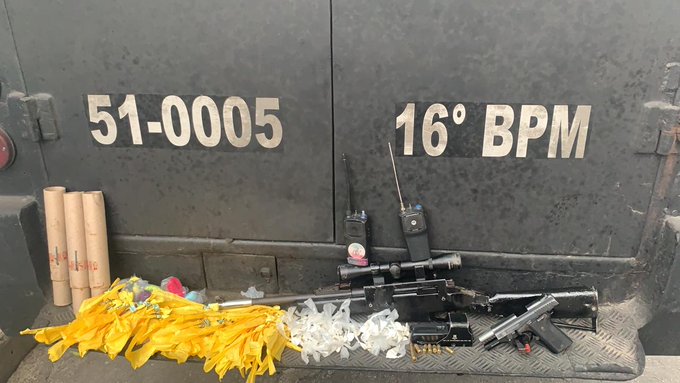
PM apreende um 762 na Cidade Alta em Cordovil

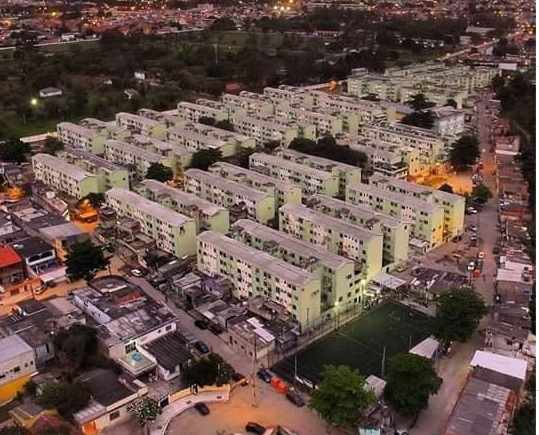
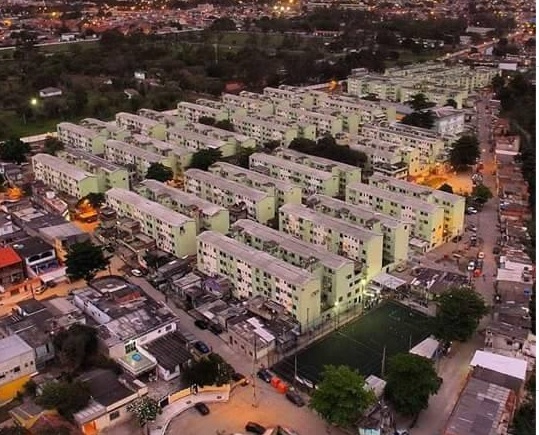
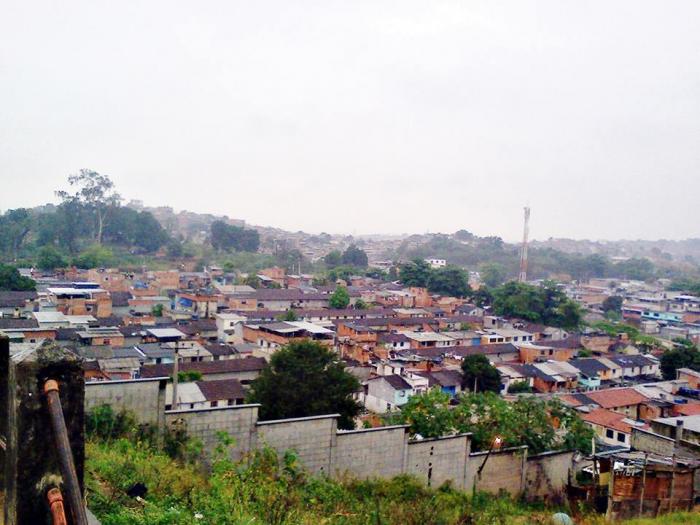
Nesta quarta-feira os policiais do 16� BPM (Cordovil) realizaram uma opera��o dentro da comunidade da Cidade Alta (TCP), em Cordovil, na zona norte do Rio de Janeiro.

Conseguiram prender dois envolvido com a boca de fumo na Cidade Alta, e apreendera uma pistola, muni��es, drogas e 1 fuzil 762.

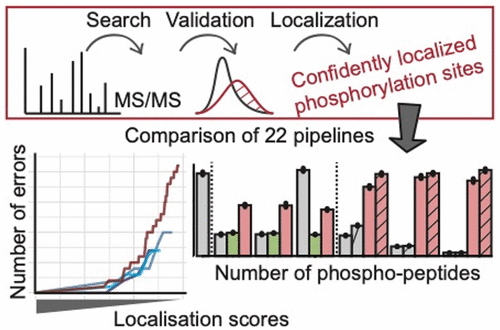
22 Phosphoproteomics Data Analysis solutions go head to head!

Sometimes I take a dataset and compare 2 different data processing pipelines. One time, maybe I compared 3? 

22? What? Wow! Why do we even have 22 pipelines?  The abstract suggest that there are very good reasons, actually — the results aren’t the same….and they propose a solution for this. Only a paywall and a biological requirement for sleep stand in my way of reading this right now!

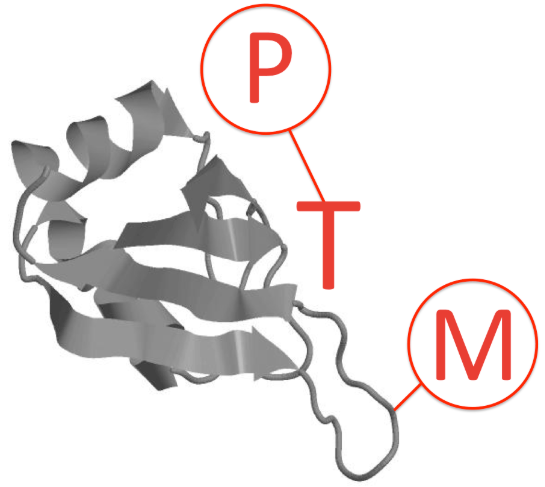
As a reminder — there is a super epic community proteomics PTM challenge coming up in less than 2 weeks and I think maybe 10 labs have signed up for it so far.

I think that this is probably a great resource to help set the stage.

CV expulsa o TCP do Conjunto Fumac� em Realengo

Mais um epis�dio de insatisfeitos que pulam e mudam a bandeira do tr�fico dentro de uma comunidade no Rio de Janeiro.

Dessa vez aconteceu no Conjunto Fumac� em Realengo, na zona oeste do Rio de Janeiro.

Segundo informa��es, dois traficantes foram expulsos do Fumac� por algum desentendimento com o TCP que dominava a comunidade.

Conhecidos como Shurek e Nego Nei, pularam para o Complexo do Chapad�o (CV) na zona norte do Rio de Janeiro e receberam apoio para voltar pro Fumac�.

Nesta madrugada de ter�a-feira, os dois organizaram a invas�o e expulsaram o TCP que n�o fecharam com eles.

Mas segundo os moradores, provavelmente vai ficar com o Comando Vermelho o Fumac�, porque nenhuma ala do TCP se envolveu nessa invas�o, muito menos a ala em Senador Camar� e Muqui�o que, geralmente auxiliavam a comunidade.

Vamos aguardar se o CV vai ficar l� dentro do Fumac�.

TCP retoma controle da Eternit em Barros Filho

Parece que foi s� uma estrat�gia r�pida do Comando Vermelho, implantar uma boca na marra dentro da comunidade da Eternit em Barros Filho.

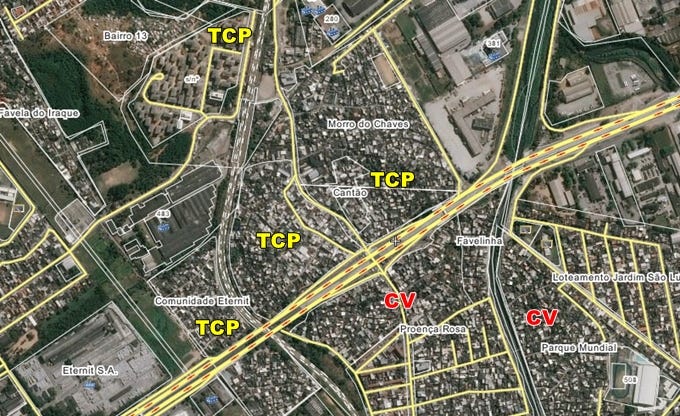
A Eternit estava sendo liderada pelo Terceiro Comando Puro do Bairro 13, e quando perderam o controle do Morro do Chaves para o Comando Vermelho, as comunidades da Joana D’arc e Eternit viraram uma zona de guerra.

Diariamente os dois bondes ficavam trocando tiros entre o Bairro 13 e Morro do Chaves, e quem sofria eram os moradores da Joana D’arc e Eternit.

Para afrontar mais o TCP, os traficantes do Chaves avan�aram pra Eternit e colocaram uma boca de fumo na marra. Obviamente os soldados do Bairro 13 foram pra l�, e a troca de tiros aconteceu.

Agora recentemente, o CV saiu da Eternit, abrindo espa�o para o Terceiro Comando Puro novamente.

Os soldados do Bairro 13 reorganizaram a boca de fumo dentro da Eternit, e deixaram a Joana D’arc apenas para fazer carga e descarga de produtos roubados na regi�o.

Vamos aguardar at� quando ser� assim.

Covalent Protein Painting to measure in vivo protein misfolding!

If there is an easier looking experimental method to measure protein misfolding in vivo, I’ve never seen it.

If you are interested in structural proteomics stuff at all, I highly recommend this preprint.

Formaldehyde is pretty efficient at binding to proteins! Turns out that:

1) you can get heavy stable isotopically labeled formaldehyde
2) in your cells the formaldehyde can only get access to the outside of your protein 3D structures, effectively “painting” the surface of them.
3) You can compare different biological conditions by using “heavy” and “light” formaldehyde.

Digest your proteins with chymotrypsin and ‘voila — you can quantitatively compare the outside of your proteins and protein-protein complexes!

The downside here is that you have to think hard about the peptide identifications as — CDH2 : 13CH3 , 13CH3 : CDH2 , 13CHD2 : CD3 , CD3 : 13CHD2 — could correspond to Disaster Level: “deuterated deamidation” study.

To fully eliminate this an issue, these authors acquired MS/MS at 120,000 resolution! Which…in my opinion is overkill, but on the instrument they used, theyv’e got 60,000 or 120,000 to choose from and 60,000 is going to get a little sketchy on the larger fragment ions. (Loosely related…I commonly run at 90,000 resolution on another instrument…)

Despite the decreased number of scans possible on an LC time scale, they come back with a tremendous amount of data.

In case any of the author see this — Unless I’m completely misunderstanding what I’m seeing — Extended Data Figure #4 is possibly my favorite visualization I’ve seen of anything so far this year. (Maybe I should put this commend on the bioRXIV thing like I’m supposed to….)

Oh yeah! I almost forgot! On top of how cool the technique is, the authors make some interesting findings regarding protein folding and alzheimers!

Traficantes do CV aparecem camuflados no Morro do 18

Ainda na incerteza do resultado final pelo controle do Morro do 18 em �gua Santa, na zona norte do Rio de Janeiro.

Nesse ritmo de chuvas no Rio de Janeiro, apareceram fotos de traficantes fortemente armados no alto do Morro do 18.

Geralmente quando acontece uma tentativa de invas�o no Morro do 18, a primeira localidade � na Fazendinha, em seguida avan�am para o morro.

Como a base usada � no Complexo do Lins (CV), a tropa do Marreta e do Urso, usam a �rea de mata para trocar plant�es no alto do Morro do 18.

Lembrando que a ala do TCP que abastecia o Morro do 18, era a ala que domina o Complexo do S�o Carlos, na parceria com a Mil�cia do Fub� e Campinho, que no rolo em �gua Santa, ficaram com as comunidades da Sa�u e Lemos de Brito.

Vamos aguardar se vai ter alguma resist�ncia ou se o CV vai ficar de vez no Morro do 18.

Vamos aguardar.

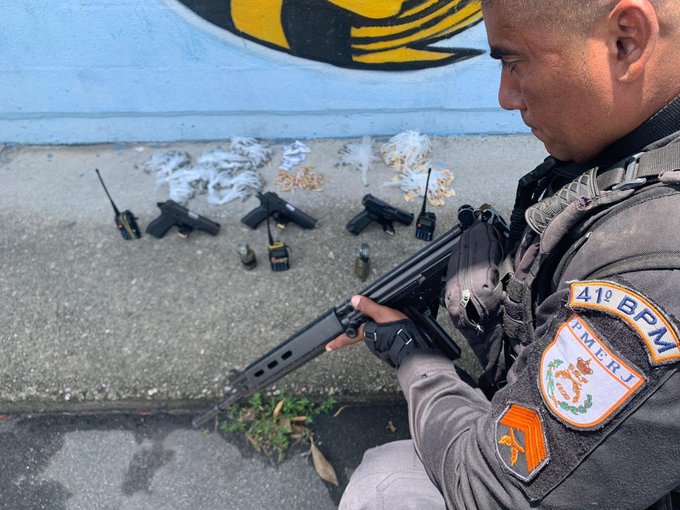
Pm apreende 3 pistolas no Conjunto Amarelinho

Os policiais do 41� BPM (Iraj�) realizaram uma opera��o na comunidade do Conjunto Amarelinho (TCP) em Iraj�, na zona norte do Rio de Janeiro.

Durante a opera��o a guarni��o foi atacada pelos traficantes do Terceiro Comando Puro, e houve uma troca de tiros entre ambos.

Quatro envolvidos ficaram feridos no confronto, e conseguiram apreender 3 pistolas, granadas e r�dios.

Foto: https://twitter.com/PMERJ

Remember that Prosit thing everyone was talking about? It is super easy to use!

It’s about time that we talked about how to add….

…well…deep learning…(but…come on, I HAD to use that when I found it, right?!?) to your proteomics workflow!

Don’t want to read my rambling about why Prosit is awesome and just want to do it? Skip to Part 2 below!

I almost guarantee that there is someone at your facility who drops all sorts of words like this around — and maybe that same person has given you reason to question their intelligence in other matters, but as long as they keep saying things about “neural networks” and “semi-supervised” whatevers it seems like everyone wants to talk to them, and maybe give them lots of money. Follow this easy walkthough and THAT COULD BE YOU. 

I jest, because Prosit is the real deal and has real world advantages, including more and higher confidence identifications right now.

For a biomolecule, the peptide bond is a joy to work with — energetically — crudely optimize the collision energy and you’ll break most of them. Our friends in the small molecule world, where I continue to dabble don’t have it anywhere near as good. There seems to be no rhyme or reason to what energy will break which bonds. When I do QE metabolomics, I step my CE, typically with 10, 30, 100. Just to come close. The ID-X even has something called “assisted” where it tries to help. Most of the time when you’ve got a molecule you really want to study, it makes sense to run it 10 times with different energies….

However — just because peptides are better than most molecules at fragmenting, that doesn’t make them consistent. Look at them. Why on earth would you miss the y7 in this peptide or the y4 in that one? It’s just not there. And — at some level it must make sense –energetically.

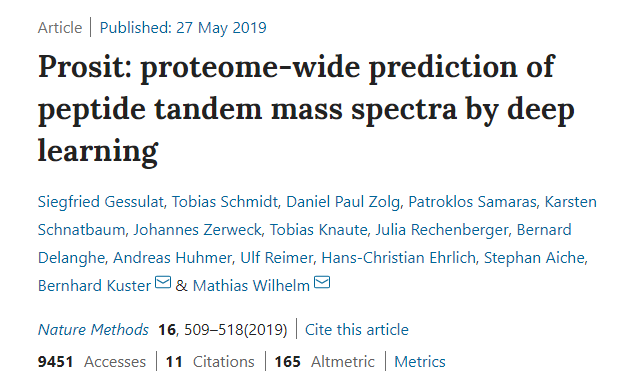
Prosit was described here last year:

In as few words as I appear capable of writing — Prosit looks at the ProteomeTools database (you know that thing where they are synthesizing EVERY human peptide and then fragmenting them and making libraries?) and it models the peptides YOU give it against that library with this deep learning thingy.

PART 2: How to use Prosit! 

You will need:
1) A protein .FASTA database.
2) The EncyclopeDIA (you can get it here)
3) That’s it. I just felt dumb making a list with 2 entries in it.

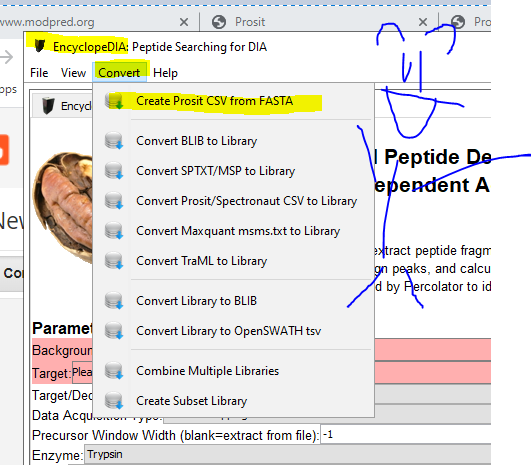
EncyclopeDIA can do all sorts of smart stuff (some of which I wrote not smart stuff about here) — and it also has awesome utilities. Such as “Create Prosit CSV from FASTA”

As an aside, I heard from the Prosit team — they’ll have this integrated soon, but if you wanted to put the words “deep learning” on your ASMS abstract that is due tomorrow you have to do what I am doing.

This is ridiculously easy. Add your FASTA. It will make you a Prosit .CSV file. I believe very strongly in you and your abilities. You’ll definitely be able to do it!

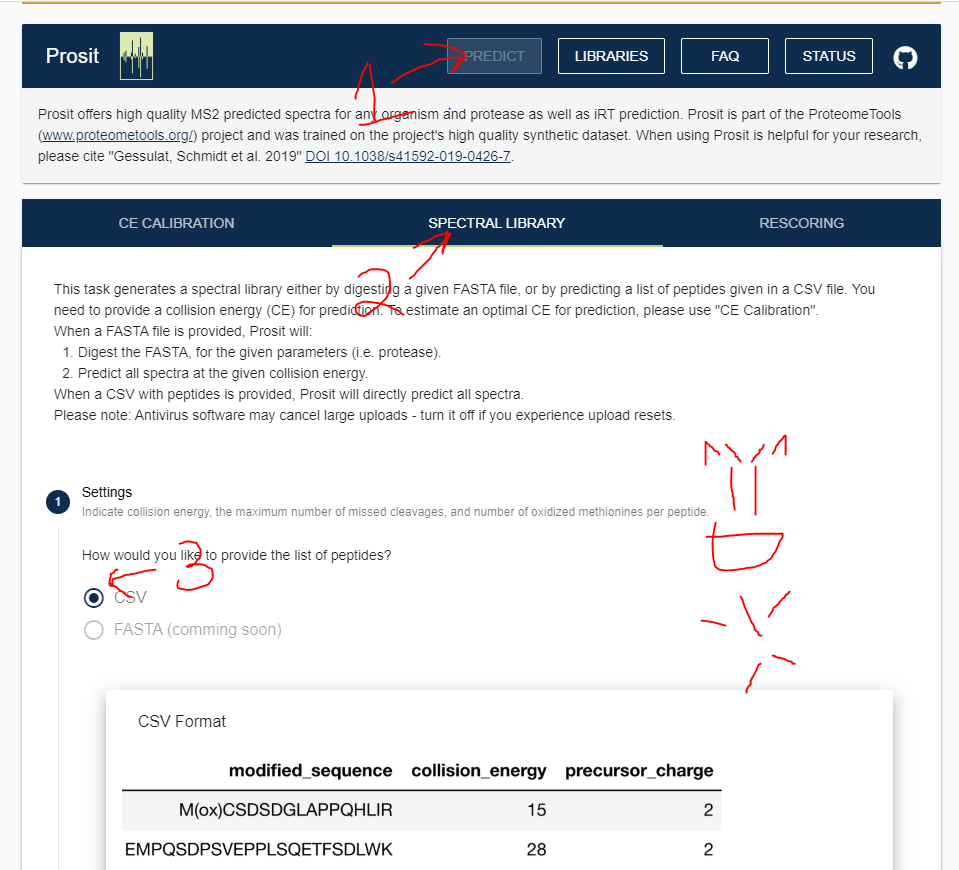
Now — go to proteomicsdb.org/prosit and load that CSV you just made.

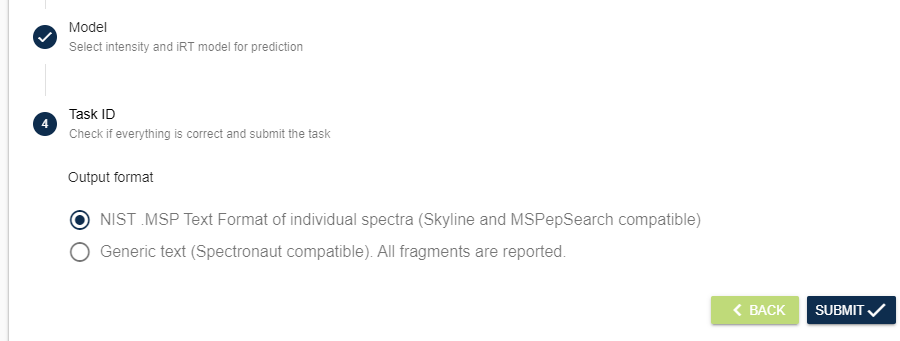
Hit next and then tell Prosit the format of your output library:

I’m using MSP because I can’t afford Spectronaut yet. Then submit your job!

Now — this is important. When you submit the job you’ll go into the queue. You’ll want to copy the link URL it gives you and/or the Task ID number. You will not want to close your browser without remembering to do this, because you won’t get your library. When it’s ready you’ll get a download link!

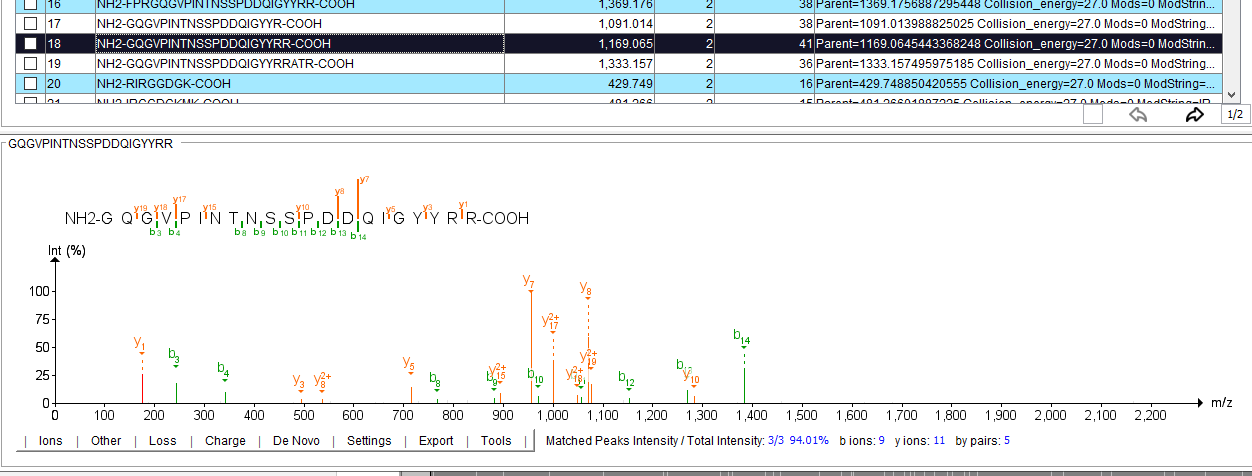
If you want to check the quality of your MSP library — the PDV is a nice, lightweight, java program that will allow you to flip through all of them. If you’ve already got the NIST MS Interpreter installed it will also load them. PDV will look something like this!

For this peptide, Prosit predicts that for a CE of 27 I’m not going to see every b/y ion. There are some bonds that it thinks, from the hundreds of thousands of real peptides it has studied, just won’t fragment well.

And if, for example, you are looking at that real peptide. And it’s right? Then you aren’t penalized for missing that fragment when using this library!
Mais um frente do Quitanda rodou em Costa Barros

Segundo informa��es, mais um respons�vel pelo tr�fico e o roubos, “rodou” na comunidade do Quitanda (TCP) em Costa Barros.

Primeiro foi o bandido de vulgo “Goiabinha”, que saiu pra desenrolar em Belford Roxo, e apareceu ferido no hospital e foi preso.

Agora foi a vez do criminoso conhecido como Canel�o que, tamb�m ocupava um cargo de lideran�a dentro da comunidade.

H� muito tempo a criminalidade que atua na comunidade da Quitanda fica fora da m�dia, s� observando os comparsas de Barros Filho passando sufoco contra o Comando Vermelho do Gog�, Chapad�o, Chaves, Proen�a Rosa, Mundial e Palmeirinha.

Vamos aguardar.

Predicting PTMs in 2019-nCoV Wuhan Coronavirus

Yeah….maybe I need a hobby….but I think this stuff is cool AND I’ve learned how to use some new tools thanks to my curiosity about this new virus and thinking about how I would analyze proteomics data from the virus if I could get my hands on it….

Here is the question: PTMs don’t typically just happen indiscriminately. There are particular motifs that are the targets of the enzymes that add the PTMs. So…can we start with just some unknown linear proteins and predict what PTMs that we would find?

And…are those predictions any good? I can’t yet answer that part directly, but I’m trying.

There are a LOT of tools that predict PTM sites. After two late nights of trying a few of them and doing a lot of failing — this older one is my current leading favorite — and you can read about it here.

If you’ve got better things to do on a Saturday than read, I got you, yo! 

You can also just go and dump stuff into their server at ModPred.org. The interface is super straight-forward. Put in your protein FASTA entry (one at a time), pick your mods and hit the button. (You can also install it locally, but I’d rather use their electricity.)

You are capped at 5,000 amino acids per model with the web interface of their server.  And you are definitely penalized for longer sequences. At 1,000 amino acids, I recommend walking your dog.

Okay — so only one protien from the 2019-nCoV translated FASTA is over the cap, so I broke it into 5 separate translated regions in order to have a large overalap in peptide sequences (in case the domains it is modeling against for PTM prediction are large ones). And — it took basically all morning.

You get a pretty output that you can keep or have it kick you out a Tab(?) delimited text file. I spent a lot of time swearing while combining everything into a single Excel file (I need to grow up and stop using Excel. It always seems like it will be easier — even though it increasingly is not the easiest solution.

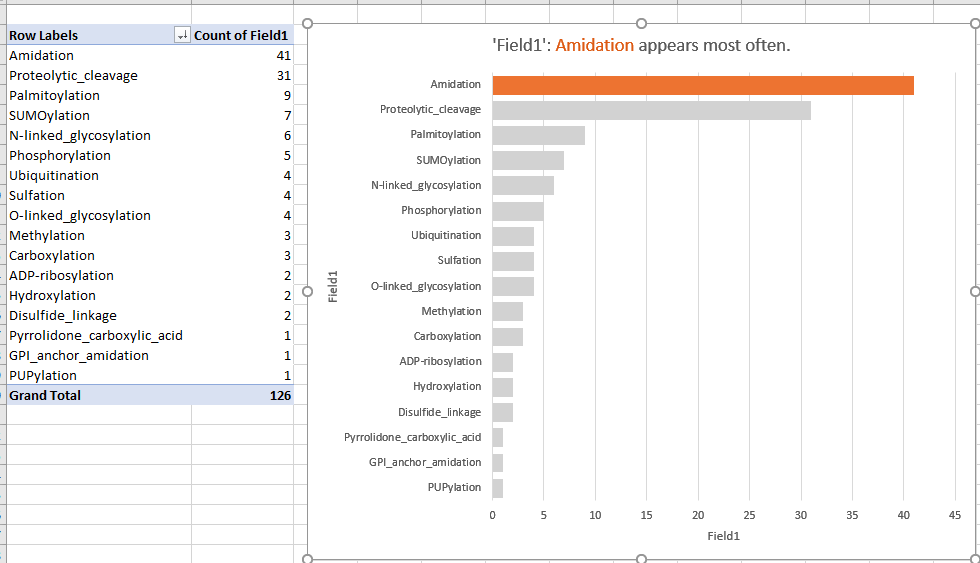
Okay — and here I’m talking smack about Excel — and the Ideas button just did something smart!! Normally, it’s just funny to hit the button, but — darn — it made a decent Pivot Table!

If you’re interested in the actual motifs predicted to be modified, you can download them from my Google drive here.

Okay — so — that’s all nice and all. Predicted PTMs are a pretty big step away from actual PTMs.

..and rightly so…

Can we test this?

I mentioned a couple of days ago that there was some cool unpublished MERS-CoV proteomics data on MASSIVE.

Now — this is CID ion trap MS/MS data — not my favorite source of data for identifying PTMs. It also kind of rules out some of my favorite tools, because they were designed with HRAM MS/MS data in mind. So…back in the time machine to the 1990s to fire up SeQuest and take a minute to polish up my sense of skepticism….

Okay — this will take more than a minute or two….I forgot how long CID MS/MS takes to search with a couple of PTMs.

I broke it up into queues and only one has finished — aaaaaaannnnnddddd….nothing!

Okay…so I do actually need another hobby….maybe something I can do inside, in case I screw up my knee and have to do a lot of sitting around for a while.

However — there is A LOT wrong with this system. One — we’re looking at single shot analysis from 2009s best mass spectrometer — in a human cell background. We’re not exactly digging to the full depth of the proteome — and PTMs rarely want to announce themselves. Two — I’m using a prediction model of one virus that is similar to another, but we are definitely reaching when trying to make predictions off the little data across the board. Three through 41 –? I didn’t even look to see if that region of the similar protein is even digested by trypsin. Maybe that is for next Saturday.

Design a site like this with WordPress.com
Get started